

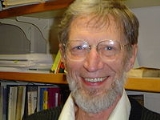
Alvin Plantinga

Encyclopedia
Alvin Carl Plantinga is an American
analytic
philosopher and the emeritus John A. O'Brien Professor of Philosophy at the University of Notre Dame
. He is known for his work in philosophy of religion
, epistemology, metaphysics
, and Christian apologetics
. Plantinga is a Christian
and known for applying the methods of analytic philosophy
to defend orthodox Christian
beliefs.
Plantinga is the author of a number of books, including God and Other Minds
(1967), The Nature of Necessity (1974), and the "warrant" series culminating in Warranted Christian Belief (2000). He has delivered the Gifford Lectures
three times, and was described by Time
magazine in 1980 as "America's leading orthodox Protestant philosopher of God."
to Cornelius A. Plantinga (1908–1994) and Lettie G. Bossenbroek (1908–2007). Plantinga's father was a first generation immigrant, born in the Netherlands
. His family is from the Dutch province of Friesland
. Plantinga’s father earned a Ph.D. in philosophy from Duke University
and a Master's Degree in psychology, and taught several academic subjects at different colleges over the years. One of Plantinga's brothers, Cornelius "Neal" Plantinga, Jr.
, is a theologian and the current president of Calvin Theological Seminary
. Another of his brothers, Leon
, is an emeritus professor of music
ology at Yale University
. His brother Terrell worked for CBS News.
In 1955, Plantinga married Kathleen De Boer. Plantinga and his wife have four children: Carl, Jane, Harry, and Ann. Both of his sons are professors at Calvin College
, Carl in Film Studies
and Harry in computer science
. Harry is also the director of the college's Christian Classics Ethereal Library
. Plantinga's older daughter, Jane Plantinga Pauw, is a pastor at Rainier Beach Presbyterian Church (PCUSA) in Seattle, Washington, and his younger daughter, Ann Kapteyn, is a missionary
in Cameroon
working for Wycliffe Bible Translators
.
, in Jamestown
, North Dakota
. During that same year, his father accepted a teaching job at Calvin College, in Grand Rapids, Michigan. In January 1950, Plantinga moved to Grand Rapids with his family and enrolled in Calvin College. During his first semester at Calvin, Plantinga was awarded a scholarship to attend Harvard University
. Beginning in the fall of 1950, Plantinga spent two semesters at Harvard. In 1951, during Harvard's spring recess, Plantinga attended a few philosophy classes at Calvin College, and was so impressed with Calvin philosophy professor William Harry Jellema
that he returned 1951 to study philosophy under him. In 1954, Plantinga began his graduate studies at the University of Michigan
where he studied under William Alston
, William Frankena
, and Richard Cartwright, among others. A year later, in 1955, he transferred to Yale University
where he received his Ph.D. in 1958.
 Plantinga began his career as an instructor in the philosophy department at Yale in 1957, and then in 1958 he became a professor of philosophy at Wayne State University
. In 1963, he accepted a teaching job at Calvin College, where he replaced the retiring Jellema. He then spent the next 19 years at Calvin before moving to the University of Notre Dame
in 1982.
, Western Division, 1981-1982. and as President of the Society of Christian Philosophers
1983-1986.
He has honorary degrees from Glasgow University (1982), Calvin College
(1986), North Park College (1994), the Free University of Amsterdam (1995), Brigham Young University
(1996), and Valparaiso University
(1999).
He was a Guggenheim Fellow, 1971–1972, and elected a Fellow in the American Academy of Arts and Sciences
in 1975.
In 2006, the University of Notre Dame
's Center for Philosophy of Religion renamed its Distinguished Scholar Fellowship as the Alvin Plantinga Fellowship. The fellowship includes an annual lecture by the current Plantinga Fellow.
exists as a basic belief
, requiring no argument, similar to how people usually claim to know that other minds
exist. He has also argued that there is no logical inconsistency between the existence of evil and the existence of an all-powerful, all-knowing, wholly good God.
to the logical problem of evil
. Plantinga's aim is to show that the existence of an omniscient, omnipotent, wholly good God is not inconsistent with the existence of evil, as many philosophers have argued.
In a truncated form, Plantinga's argument is as follows: He argues that it is greater for a being to possess free will
, as opposed to being non-free. And because a God cannot guarantee the benevolence of a truly free being without intervention or influence, thus removing free will, it follows that for a being to have true free will that they must be capable of moral evil
else such a being would be only capable of moral good, which in itself is as Plantinga stated: "Entirely paradoxical". Plantinga goes on to argue that a world with free will is more valuable than a world without such, therefore God has reason
to create a world which has the capability of evil. Thus because of this the existence of evil counts "neither against God's omnipotence
nor against His goodness
", rather it is an error by the creature in their exercise of such freedom.
According to Chad Meister, professor of philosophy at Bethel College
, most contemporary philosophers accept Plantinga's argument. The problem of evil is now commonly framed in evidential form which does not involve the claim that God and evil are logically contradictory or inconsistent. However, some philosophers continue to defend the cogency of the logical problem of evil.
". According to Reformed epistemology, belief in God can be rational and justified even without arguments or evidence for the existence of God. More specifically, Plantinga argues that belief in God is properly basic, and due to a religious externalist
epistemology, he claims belief in God could be justified independently of evidence. His externalist epistemology, called "Proper functionalism," is a form of epistemological reliabilism
.
Plantinga discusses his view of Reformed epistemology and Proper functionalism in a three volume series. In the first book of the trilogy, Warrant: The Current Debate, Plantinga introduces, analyzes, and criticizes 20th century developments in analytic epistemology, particularly the works of Chisholm
, BonJour
, Alston
, Goldman
, and others.
In the second book, Warrant and Proper Function, he introduces the notion of warrant as an alternative to justification and discusses topics like self-knowledge, memories, perception, and probability. Plantinga's proper function account argues that as a necessary condition of having warrant is that one's "belief-forming and belief-maintaining apparatus of powers" are functioning properly—"working the way it ought to work". Plantinga explains his argument for proper function with reference to a "design plan", as well as an environment in which one's cognitive equipment is optimal for use. Plantinga asserts that the design plan does not require a designer: "it is perhaps possible that evolution (undirected by God or anyone else) has somehow furnished us with our design plans", but the paradigm case of a design plan is like a technological product designed by a human being (like a radio or a wheel).
Plantinga seeks to defend this view of proper function against alternative views of proper function proposed by other philosophers which he groups together as 'naturalistic' including the 'functional generalization' view of John Pollock
, the evolutionary/etiological account provided by Ruth Millikan
, and a dispositional view held by John Bigelow
and Robert Pargetter. Plantinga's evolutionary argument against naturalism is also discussed in the later chapters of Warrant and Proper Function.
In 2000, the third volume, Warranted Christian Belief, was published. Plantinga reintroduces his theory of warrant to ask whether Christian theistic belief can enjoy warrant. He argues that this is plausible. Notably, the book does not address whether or not Christian theism is true.
to develop, in a more rigorous and formal way, Norman Malcolm
's and Charles Hartshorne
's modal ontological arguments.
, he argues that the truth of evolution is an epistemic defeater
for naturalism (i.e. if evolution is true, it undermines naturalism
). His basic argument is that if evolution and naturalism are both true, human cognitive faculties evolved to produce beliefs that have survival value (maximizing one's success at the four F's: "feeding, fleeing, fighting, and reproducing"), not necessarily to produce beliefs that are true. Thus, since human cognitive faculties are tuned to survival rather than truth in the naturalism-evolution model, there is reason to doubt the veracity of the products of those same faculties, including naturalism and evolution themselves. On the other hand, if God created man "in his image" by way of an evolutionary process (or any other means), then Plantinga argues our faculties would probably be reliable.
The argument does not assume any necessary correlation (or uncorrelation) between true beliefs and survival. Making the contrary assumption—that there is in fact a relatively strong correlation between truth and survival—if human belief-forming apparatus evolved giving a survival advantage, then it ought to yield truth since true beliefs confer a survival advantage. Plantinga counters that, while there may be overlap between true beliefs and beliefs that contribute to survival, the two kinds of beliefs are not the same, and he gives the following example with a man named Paul:
. He was a member of the 'Ad Hoc Origins Committee' that supported Philip E. Johnson's book Darwin on Trial
against palaeontologist Stephen Jay Gould
's high profile scathing review in Scientific American
in 1992. Plantinga also provided a back-cover endorsement of Johnson's book. He was a Fellow of the (now moribund) pro-intelligent design International Society for Complexity, Information, and Design, and has presented at a number of intelligent design conferences.
In a March 2010 article in the Chronicle of Higher Education, philosopher of science Michael Ruse
claims that Plantinga is an "open enthusiast of intelligent design." In a letter to the editor, Plantinga has the following response:
United States
The United States of America is a federal constitutional republic comprising fifty states and a federal district...
analytic
Analytic philosophy
Analytic philosophy is a generic term for a style of philosophy that came to dominate English-speaking countries in the 20th century...
philosopher and the emeritus John A. O'Brien Professor of Philosophy at the University of Notre Dame
University of Notre Dame
The University of Notre Dame du Lac is a Catholic research university located in Notre Dame, an unincorporated community north of the city of South Bend, in St. Joseph County, Indiana, United States...
. He is known for his work in philosophy of religion
Philosophy of religion
Philosophy of religion is a branch of philosophy concerned with questions regarding religion, including the nature and existence of God, the examination of religious experience, analysis of religious language and texts, and the relationship of religion and science...
, epistemology, metaphysics
Metaphysics
Metaphysics is a branch of philosophy concerned with explaining the fundamental nature of being and the world, although the term is not easily defined. Traditionally, metaphysics attempts to answer two basic questions in the broadest possible terms:...
, and Christian apologetics
Christian apologetics
Christian apologetics is a field of Christian theology that aims to present a rational basis for the Christian faith, defend the faith against objections, and expose the perceived flaws of other world views...
. Plantinga is a Christian
Christian
A Christian is a person who adheres to Christianity, an Abrahamic, monotheistic religion based on the life and teachings of Jesus of Nazareth as recorded in the Canonical gospels and the letters of the New Testament...
and known for applying the methods of analytic philosophy
Analytic philosophy
Analytic philosophy is a generic term for a style of philosophy that came to dominate English-speaking countries in the 20th century...
to defend orthodox Christian
Christian
A Christian is a person who adheres to Christianity, an Abrahamic, monotheistic religion based on the life and teachings of Jesus of Nazareth as recorded in the Canonical gospels and the letters of the New Testament...
beliefs.
Plantinga is the author of a number of books, including God and Other Minds
God and Other Minds
God and Other Minds is the name of a 1967 book by Alvin Plantinga which re-kindled serious philosophical debate on the Existence of God in Anglophone philosophical circles by arguing that belief in God was like belief in other minds: although neither could be demonstrated conclusively against a...
(1967), The Nature of Necessity (1974), and the "warrant" series culminating in Warranted Christian Belief (2000). He has delivered the Gifford Lectures
Gifford Lectures
The Gifford Lectures were established by the will of Adam Lord Gifford . They were established to "promote and diffuse the study of Natural Theology in the widest sense of the term — in other words, the knowledge of God." The term natural theology as used by Gifford means theology supported...
three times, and was described by Time
Time (magazine)
Time is an American news magazine. A European edition is published from London. Time Europe covers the Middle East, Africa and, since 2003, Latin America. An Asian edition is based in Hong Kong...
magazine in 1980 as "America's leading orthodox Protestant philosopher of God."
Family
Plantinga was born on November 15, 1932 in Ann Arbor, MichiganMichigan
Michigan is a U.S. state located in the Great Lakes Region of the United States of America. The name Michigan is the French form of the Ojibwa word mishigamaa, meaning "large water" or "large lake"....
to Cornelius A. Plantinga (1908–1994) and Lettie G. Bossenbroek (1908–2007). Plantinga's father was a first generation immigrant, born in the Netherlands
Netherlands
The Netherlands is a constituent country of the Kingdom of the Netherlands, located mainly in North-West Europe and with several islands in the Caribbean. Mainland Netherlands borders the North Sea to the north and west, Belgium to the south, and Germany to the east, and shares maritime borders...
. His family is from the Dutch province of Friesland
Friesland
Friesland is a province in the north of the Netherlands and part of the ancient region of Frisia.Until the end of 1996, the province bore Friesland as its official name. In 1997 this Dutch name lost its official status to the Frisian Fryslân...
. Plantinga’s father earned a Ph.D. in philosophy from Duke University
Duke University
Duke University is a private research university located in Durham, North Carolina, United States. Founded by Methodists and Quakers in the present day town of Trinity in 1838, the school moved to Durham in 1892. In 1924, tobacco industrialist James B...
and a Master's Degree in psychology, and taught several academic subjects at different colleges over the years. One of Plantinga's brothers, Cornelius "Neal" Plantinga, Jr.
Cornelius Plantinga
Cornelius "Neal" Plantinga, Jr. was president of Calvin Theological Seminary in Grand Rapids, Michigan from 2002 through 2011....
, is a theologian and the current president of Calvin Theological Seminary
Calvin Theological Seminary
Calvin Theological Seminary is a seminary affiliated with the Christian Reformed Church in North America, located in Grand Rapids, Michigan, and closely tied to Calvin College, though each institution has its own board. Rev...
. Another of his brothers, Leon
Leon Plantinga
Leon B. Plantinga is an American musicologist specializing in music of the later eighteenth and nineteenth centuries. His writings have influenced scholarship on Clementi, Beethoven, and Schumann, and his textbook Romantic Music continues to serve as a standard textbook on nineteenth-century music...
, is an emeritus professor of music
Music
Music is an art form whose medium is sound and silence. Its common elements are pitch , rhythm , dynamics, and the sonic qualities of timbre and texture...
ology at Yale University
Yale University
Yale University is a private, Ivy League university located in New Haven, Connecticut, United States. Founded in 1701 in the Colony of Connecticut, the university is the third-oldest institution of higher education in the United States...
. His brother Terrell worked for CBS News.
In 1955, Plantinga married Kathleen De Boer. Plantinga and his wife have four children: Carl, Jane, Harry, and Ann. Both of his sons are professors at Calvin College
Calvin College
Calvin College is a comprehensive liberal arts college located in Grand Rapids, Michigan. Founded in 1876, Calvin College is an educational institution of the Christian Reformed Church and stands in the Reformed tradition of Protestantism...
, Carl in Film Studies
Film studies
Film studies is an academic discipline that deals with various theoretical, historical, and critical approaches to films. It is sometimes subsumed within media studies and is often compared to television studies...
and Harry in computer science
Computer science
Computer science or computing science is the study of the theoretical foundations of information and computation and of practical techniques for their implementation and application in computer systems...
. Harry is also the director of the college's Christian Classics Ethereal Library
Christian Classics Ethereal Library
The Christian Classics Ethereal Library is a digital library that provides free electronic copies of Christian scripture and literature texts....
. Plantinga's older daughter, Jane Plantinga Pauw, is a pastor at Rainier Beach Presbyterian Church (PCUSA) in Seattle, Washington, and his younger daughter, Ann Kapteyn, is a missionary
Missionary
A missionary is a member of a religious group sent into an area to do evangelism or ministries of service, such as education, literacy, social justice, health care and economic development. The word "mission" originates from 1598 when the Jesuits sent members abroad, derived from the Latin...
in Cameroon
Cameroon
Cameroon, officially the Republic of Cameroon , is a country in west Central Africa. It is bordered by Nigeria to the west; Chad to the northeast; the Central African Republic to the east; and Equatorial Guinea, Gabon, and the Republic of the Congo to the south. Cameroon's coastline lies on the...
working for Wycliffe Bible Translators
Wycliffe Bible Translators
Wycliffe Bible Translators is an interdenominational organization mandated to making a translation of the Bible in every living language in the world, especially for cultures with little existing Christian influence. Wycliffe was founded in 1942 by William Cameron Townsend and is associated with...
.
Education
At the end of 11th grade, Plantinga's father urged Plantinga to skip his last year of high school and immediately enroll in college. Plantinga reluctantly followed his father's advice and in 1949, a few months before his 17th birthday, he enrolled in Jamestown CollegeJamestown College
Jamestown College is a private liberal arts college founded by the Presbyterian Church located in Jamestown, North Dakota. It has about 1,000 students enrolled today and has been co-educational from its founding....
, in Jamestown
Jamestown, North Dakota
As of the census of 2000, there were 15,527 people, 6,505 households, and 3,798 families residing in the city. The population density was 1,246.7 per square mile . There were 6,970 housing units at an average density of 559.6 per square mile...
, North Dakota
North Dakota
North Dakota is a state located in the Midwestern region of the United States of America, along the Canadian border. The state is bordered by Canada to the north, Minnesota to the east, South Dakota to the south and Montana to the west. North Dakota is the 19th-largest state by area in the U.S....
. During that same year, his father accepted a teaching job at Calvin College, in Grand Rapids, Michigan. In January 1950, Plantinga moved to Grand Rapids with his family and enrolled in Calvin College. During his first semester at Calvin, Plantinga was awarded a scholarship to attend Harvard University
Harvard University
Harvard University is a private Ivy League university located in Cambridge, Massachusetts, United States, established in 1636 by the Massachusetts legislature. Harvard is the oldest institution of higher learning in the United States and the first corporation chartered in the country...
. Beginning in the fall of 1950, Plantinga spent two semesters at Harvard. In 1951, during Harvard's spring recess, Plantinga attended a few philosophy classes at Calvin College, and was so impressed with Calvin philosophy professor William Harry Jellema
William Harry Jellema
William Harry Jellema was the founder of Calvin College's Philosophy Department.He taught at Calvin College from 1920 to 1936, transferred to Indiana University and then returned to Calvin from 1948 to 1963. Three of his students were elected President of the American Philosophical Association,...
that he returned 1951 to study philosophy under him. In 1954, Plantinga began his graduate studies at the University of Michigan
University of Michigan
The University of Michigan is a public research university located in Ann Arbor, Michigan in the United States. It is the state's oldest university and the flagship campus of the University of Michigan...
where he studied under William Alston
William Alston
William Payne Alston was an American philosopher. He made influential contributions to the philosophy of language, epistemology and Christian philosophy. He earned his Ph.D...
, William Frankena
William Frankena
William K. Frankena was an American moral philosopher. Frankena was a member of the University of Michigan's Department of Philosophy for 41 years and chair of the Department for 14 years...
, and Richard Cartwright, among others. A year later, in 1955, he transferred to Yale University
Yale University
Yale University is a private, Ivy League university located in New Haven, Connecticut, United States. Founded in 1701 in the Colony of Connecticut, the university is the third-oldest institution of higher education in the United States...
where he received his Ph.D. in 1958.
Teaching career
Wayne State University
Wayne State University is a public research university located in Detroit, Michigan, United States, in the city's Midtown Cultural Center Historic District. Founded in 1868, WSU consists of 13 schools and colleges offering more than 400 major subject areas to over 32,000 graduate and...
. In 1963, he accepted a teaching job at Calvin College, where he replaced the retiring Jellema. He then spent the next 19 years at Calvin before moving to the University of Notre Dame
University of Notre Dame
The University of Notre Dame du Lac is a Catholic research university located in Notre Dame, an unincorporated community north of the city of South Bend, in St. Joseph County, Indiana, United States...
in 1982.
Awards and honors
Plantinga served as president of the American Philosophical AssociationAmerican Philosophical Association
The American Philosophical Association is the main professional organization for philosophers in the United States. Founded in 1900, its mission is to promote the exchange of ideas among philosophers, to encourage creative and scholarly activity in philosophy, to facilitate the professional work...
, Western Division, 1981-1982. and as President of the Society of Christian Philosophers
Society of Christian Philosophers
The Society of Christian Philosophers is a society associated with the American Philosophical Association. The society was founded in 1978. Past Presidents include William Alston, Robert Merrihew Adams, Alvin Plantinga, Marilyn McCord Adams, George I. Mavrodes, Nicholas Wolterstorff, Eleonore...
1983-1986.
He has honorary degrees from Glasgow University (1982), Calvin College
Calvin College
Calvin College is a comprehensive liberal arts college located in Grand Rapids, Michigan. Founded in 1876, Calvin College is an educational institution of the Christian Reformed Church and stands in the Reformed tradition of Protestantism...
(1986), North Park College (1994), the Free University of Amsterdam (1995), Brigham Young University
Brigham Young University
Brigham Young University is a private university located in Provo, Utah. It is owned and operated by The Church of Jesus Christ of Latter-day Saints , and is the United States' largest religious university and third-largest private university.Approximately 98% of the university's 34,000 students...
(1996), and Valparaiso University
Valparaiso University
Valparaiso University, known colloquially as Valpo, is a regionally accredited private university located in the city of Valparaiso in the U.S. state of Indiana. Founded in 1859, it consists of five undergraduate colleges, a graduate school, a nursing school and a law school...
(1999).
He was a Guggenheim Fellow, 1971–1972, and elected a Fellow in the American Academy of Arts and Sciences
American Academy of Arts and Sciences
The American Academy of Arts and Sciences is an independent policy research center that conducts multidisciplinary studies of complex and emerging problems. The Academy’s elected members are leaders in the academic disciplines, the arts, business, and public affairs.James Bowdoin, John Adams, and...
in 1975.
In 2006, the University of Notre Dame
University of Notre Dame
The University of Notre Dame du Lac is a Catholic research university located in Notre Dame, an unincorporated community north of the city of South Bend, in St. Joseph County, Indiana, United States...
's Center for Philosophy of Religion renamed its Distinguished Scholar Fellowship as the Alvin Plantinga Fellowship. The fellowship includes an annual lecture by the current Plantinga Fellow.
Philosophical views
Notably, Plantiga has argued that some people can know that GodGod
God is the English name given to a singular being in theistic and deistic religions who is either the sole deity in monotheism, or a single deity in polytheism....
exists as a basic belief
Basic belief
Under the epistemological view called foundationalism, basic beliefs are the axioms of a belief system.Foundationalism holds that all beliefs must be justified in order to be believed...
, requiring no argument, similar to how people usually claim to know that other minds
Problem of other minds
The problem of other minds has traditionally been regarded as an epistemological challenge raised by the skeptic. The challenge may be expressed as follows: given that I can only observe the behavior of others, how can I know that others have minds? The thought behind the question is that no matter...
exist. He has also argued that there is no logical inconsistency between the existence of evil and the existence of an all-powerful, all-knowing, wholly good God.
Problem of evil
In The Nature of Necessity, Plantinga presents his free will defensePlantinga's free will defense
Alvin Plantinga's version of the free will defense is an attempt to refute the logical problem of evil, the argument that to posit the existence of an omnipotent, omniscient, wholly good god in an evil world constitutes a logical contradiction...
to the logical problem of evil
Problem of evil
In the philosophy of religion, the problem of evil is the question of how to explain evil if there exists a deity that is omnibenevolent, omnipotent, and omniscient . Some philosophers have claimed that the existences of such a god and of evil are logically incompatible or unlikely...
. Plantinga's aim is to show that the existence of an omniscient, omnipotent, wholly good God is not inconsistent with the existence of evil, as many philosophers have argued.
In a truncated form, Plantinga's argument is as follows: He argues that it is greater for a being to possess free will
Free will
"To make my own decisions whether I am successful or not due to uncontrollable forces" -Troy MorrisonA pragmatic definition of free willFree will is the ability of agents to make choices free from certain kinds of constraints. The existence of free will and its exact nature and definition have long...
, as opposed to being non-free. And because a God cannot guarantee the benevolence of a truly free being without intervention or influence, thus removing free will, it follows that for a being to have true free will that they must be capable of moral evil
Moral evil
Moral evil is the result of any morally negative event caused by the intentional action or inaction of an agent, such as a person. An example of a moral evil might be murder, or any other evil event for which someone can be held responsible or culpable....
else such a being would be only capable of moral good, which in itself is as Plantinga stated: "Entirely paradoxical". Plantinga goes on to argue that a world with free will is more valuable than a world without such, therefore God has reason
Reason
Reason is a term that refers to the capacity human beings have to make sense of things, to establish and verify facts, and to change or justify practices, institutions, and beliefs. It is closely associated with such characteristically human activities as philosophy, science, language, ...
to create a world which has the capability of evil. Thus because of this the existence of evil counts "neither against God's omnipotence
Omnipotence
Omnipotence is unlimited power. Monotheistic religions generally attribute omnipotence to only the deity of whichever faith is being addressed...
nor against His goodness
Omnibenevolence
Omnibenevolence is defined by the Oxford English Dictionary as "unlimited or infinite benevolence". It is often held to be impossible, or at least improbable, for a deity to exhibit such property along side omniscience and omnipotence as a result of the problem of evil...
", rather it is an error by the creature in their exercise of such freedom.
According to Chad Meister, professor of philosophy at Bethel College
Bethel College (Indiana)
Bethel College is a Christian liberal arts institution located in Mishawaka , Indiana, United States. It was established in 1947 by a Mennonite group which was one of the founding members of the Missionary Church...
, most contemporary philosophers accept Plantinga's argument. The problem of evil is now commonly framed in evidential form which does not involve the claim that God and evil are logically contradictory or inconsistent. However, some philosophers continue to defend the cogency of the logical problem of evil.
Reformed epistemology
Plantinga's contributions to epistemology include an argument which he dubs "Reformed epistemologyReformed epistemology
In the philosophy of religion, reformed epistemology is a school of thought regarding the epistemology of belief in God put forward by a group of Protestant Christian philosophers, most notably, Alvin Plantinga, William Alston, Nicholas Wolterstorff and Michael C. Rea...
". According to Reformed epistemology, belief in God can be rational and justified even without arguments or evidence for the existence of God. More specifically, Plantinga argues that belief in God is properly basic, and due to a religious externalist
Internalism and externalism
Internalism and externalism are two opposing ways of explaining various subjects in several areas of philosophy. These include human motivation, knowledge, justification, meaning and truth. The distinction arises in many areas of debate with similar but distinct meanings...
epistemology, he claims belief in God could be justified independently of evidence. His externalist epistemology, called "Proper functionalism," is a form of epistemological reliabilism
Reliabilism
Reliabilism, a category of theories in the philosophical discipline of epistemology, has been advanced both as a theory of knowledge and of justified belief...
.
Plantinga discusses his view of Reformed epistemology and Proper functionalism in a three volume series. In the first book of the trilogy, Warrant: The Current Debate, Plantinga introduces, analyzes, and criticizes 20th century developments in analytic epistemology, particularly the works of Chisholm
Roderick Chisholm
Roderick M. Chisholm was an American philosopher known for his work on epistemology, metaphysics, free will, and the philosophy of perception. He received his Ph.D. at Harvard University under Clarence Irving Lewis and Donald C. Williams, and taught at Brown University...
, BonJour
Laurence BonJour
Laurence BonJour is an American philosopher and Professor of Philosophy at the University of Washington.-Life:He received his bachelor's degrees in Philosophy and Political Science from Macalester College and his doctorate in 1969 from Princeton University with a dissertation directed by Richard...
, Alston
William Alston
William Payne Alston was an American philosopher. He made influential contributions to the philosophy of language, epistemology and Christian philosophy. He earned his Ph.D...
, Goldman
Alvin Goldman
Alvin Ira Goldman is an American professor of Philosophy at Rutgers University in New Jersey. He previously taught at the University of Michigan and at the University of Arizona. He earned his PhD from Princeton University and is married to Holly Smith, a well known ethicist, former...
, and others.
In the second book, Warrant and Proper Function, he introduces the notion of warrant as an alternative to justification and discusses topics like self-knowledge, memories, perception, and probability. Plantinga's proper function account argues that as a necessary condition of having warrant is that one's "belief-forming and belief-maintaining apparatus of powers" are functioning properly—"working the way it ought to work". Plantinga explains his argument for proper function with reference to a "design plan", as well as an environment in which one's cognitive equipment is optimal for use. Plantinga asserts that the design plan does not require a designer: "it is perhaps possible that evolution (undirected by God or anyone else) has somehow furnished us with our design plans", but the paradigm case of a design plan is like a technological product designed by a human being (like a radio or a wheel).
Plantinga seeks to defend this view of proper function against alternative views of proper function proposed by other philosophers which he groups together as 'naturalistic' including the 'functional generalization' view of John Pollock
John L. Pollock
John L. Pollock was an American philosopher known for influential work in epistemology, philosophical logic, cognitive science, and artificial intelligence....
, the evolutionary/etiological account provided by Ruth Millikan
Ruth Millikan
Ruth Garrett Millikan is a well-known American philosopher of biology, psychology, and language. She was awarded the Jean Nicod Prize and gave the Jean Nicod Lectures in Paris in 2002....
, and a dispositional view held by John Bigelow
John Bigelow
John Bigelow was an American lawyer and statesman.-Life:Born in Malden-on-Hudson, New York, John Bigelow, Sr.graduated from Union College in 1835 where he was a member of the Sigma Phi Society and the Philomathean Society, and was admitted to the bar in 1838...
and Robert Pargetter. Plantinga's evolutionary argument against naturalism is also discussed in the later chapters of Warrant and Proper Function.
In 2000, the third volume, Warranted Christian Belief, was published. Plantinga reintroduces his theory of warrant to ask whether Christian theistic belief can enjoy warrant. He argues that this is plausible. Notably, the book does not address whether or not Christian theism is true.
Modal ontological argument
Plantinga has expressed a modal logic version of the ontological argument in which he uses modal logicModal logic
Modal logic is a type of formal logic that extends classical propositional and predicate logic to include operators expressing modality. Modals — words that express modalities — qualify a statement. For example, the statement "John is happy" might be qualified by saying that John is...
to develop, in a more rigorous and formal way, Norman Malcolm
Norman Malcolm
Norman Malcolm was an American philosopher, born in Selden, Kansas. He studied philosophy with O.K. Bouwsma at the University of Nebraska, then enrolled as a graduate student at Harvard University in 1933....
's and Charles Hartshorne
Charles Hartshorne
Charles Hartshorne was a prominent American philosopher who concentrated primarily on the philosophy of religion and metaphysics. He developed the neoclassical idea of God and produced a modal proof of the existence of God that was a development of St. Anselm's Ontological Argument...
's modal ontological arguments.
Evolutionary argument against naturalism
In Plantinga's evolutionary argument against naturalismEvolutionary argument against naturalism
The evolutionary argument against naturalism is a philosophical argument regarding a perceived tension between biological evolutionary theory and philosophical naturalism — the belief that there are no supernatural entities or processes...
, he argues that the truth of evolution is an epistemic defeater
Defeater
In epistemology, a defeater is a belief B1 that is held to be incompatible with another belief B2, hence arguments or evidence supporting B1 can be used to refute B2....
for naturalism (i.e. if evolution is true, it undermines naturalism
Metaphysical naturalism
Metaphysical naturalism, also called ontological naturalism and philosophical naturalism, or just naturalism, is a philosophical worldview and belief system that holds that there is nothing but natural elements, principles, and relations of the kind studied by the natural sciences, i.e., those...
). His basic argument is that if evolution and naturalism are both true, human cognitive faculties evolved to produce beliefs that have survival value (maximizing one's success at the four F's: "feeding, fleeing, fighting, and reproducing"), not necessarily to produce beliefs that are true. Thus, since human cognitive faculties are tuned to survival rather than truth in the naturalism-evolution model, there is reason to doubt the veracity of the products of those same faculties, including naturalism and evolution themselves. On the other hand, if God created man "in his image" by way of an evolutionary process (or any other means), then Plantinga argues our faculties would probably be reliable.
The argument does not assume any necessary correlation (or uncorrelation) between true beliefs and survival. Making the contrary assumption—that there is in fact a relatively strong correlation between truth and survival—if human belief-forming apparatus evolved giving a survival advantage, then it ought to yield truth since true beliefs confer a survival advantage. Plantinga counters that, while there may be overlap between true beliefs and beliefs that contribute to survival, the two kinds of beliefs are not the same, and he gives the following example with a man named Paul:
Evolution and Christianity
In the past, Plantinga has lent support to the intelligent design movementIntelligent design movement
The intelligent design movement is a neo-creationist religious campaign for broad social, academic and political change to promote and support the idea of "intelligent design," which asserts that "certain features of the universe and of living things are...
. He was a member of the 'Ad Hoc Origins Committee' that supported Philip E. Johnson's book Darwin on Trial
Darwin on Trial
Darwin on Trial is a 1991 book about the theory of evolution and the creation-evolution debate. It was written by Harvard graduate and University of California, Berkeley law professor emeritus Phillip E. Johnson...
against palaeontologist Stephen Jay Gould
Stephen Jay Gould
Stephen Jay Gould was an American paleontologist, evolutionary biologist, and historian of science. He was also one of the most influential and widely read writers of popular science of his generation....
's high profile scathing review in Scientific American
Scientific American
Scientific American is a popular science magazine. It is notable for its long history of presenting science monthly to an educated but not necessarily scientific public, through its careful attention to the clarity of its text as well as the quality of its specially commissioned color graphics...
in 1992. Plantinga also provided a back-cover endorsement of Johnson's book. He was a Fellow of the (now moribund) pro-intelligent design International Society for Complexity, Information, and Design, and has presented at a number of intelligent design conferences.
In a March 2010 article in the Chronicle of Higher Education, philosopher of science Michael Ruse
Michael Ruse
Michael Ruse is a philosopher of biology at Florida State University, and is well known for his work on the creationism/evolution controversy and the demarcation problem in science...
claims that Plantinga is an "open enthusiast of intelligent design." In a letter to the editor, Plantinga has the following response:
Like any Christian (and indeed any theist), I believe that the world has been created by God, and hence "intelligently designed." The hallmark of intelligent design, however, is the claim that this can be shown scientifically; I'm dubious about that.
...As far as I can see, God certainly could have used Darwinian processes to create the living world and direct it as he wanted to go; hence evolution as such does not imply that there is no direction in the history of life. What does have that implication is not evolutionary theory itself, but unguided evolution, the idea that neither God nor any other person has taken a hand in guiding, directing or orchestrating the course of evolution. But the scientific theory of evolution, sensibly enough, says nothing one way or the other about divine guidance. It doesn't say that evolution is divinely guided; it also doesn't say that it isn't. Like almost any theist, I reject unguided evolution; but the contemporary scientific theory of evolution just as such—apart from philosophical or theological add-ons—doesn't say that evolution is unguided. Like science in general, it makes no pronouncements on the existence or activity of God.
Selected works by Plantinga
- God and Other Minds. Ithaca: Cornell University PressCornell University PressThe Cornell University Press, established in 1869 but inactive from 1884 to 1930, was the first university publishing enterprise in the United States.A division of Cornell University, it is housed in Sage House, the former residence of Henry William Sage....
. 1967. rev. ed., 1990. ISBN 0-8014-9735-3 - The Nature of Necessity. Oxford: Clarendon Press. 1974. ISBN 0-19-824404-5
- God, Freedom, and Evil. Grand Rapids: Eerdmans. 1974. ISBN 0-04-100040-4
- Does God Have A Nature? Wisconsin: Marquette University PressMarquette University PressMarquette University Press is a university press for Marquette University. The Press is a founding member of the Association of Jesuit University Presses ....
. 1980. ISBN 0-87462-145-3 - Faith and Rationality: Reason and Belief in God (ed. with Nicholas WolterstorffNicholas WolterstorffNicholas Wolterstorff is an American philosopher and currently the Noah Porter Emeritus Professor of Philosophical Theology at Yale University...
). Notre Dame: University of Notre Dame PressUniversity of Notre Dame PressThe University of Notre Dame Press is a university press that is part of the University of Notre Dame in Notre Dame, Indiana, United States.-External links:*...
. 1983. ISBN 0-268-00964-3 - Warrant: the Current Debate. New York: Oxford University PressOxford University PressOxford University Press is the largest university press in the world. It is a department of the University of Oxford and is governed by a group of 15 academics appointed by the Vice-Chancellor known as the Delegates of the Press. They are headed by the Secretary to the Delegates, who serves as...
. 1993. ISBN 0-19-507861-6 (1987-1988 Gifford LecturesGifford LecturesThe Gifford Lectures were established by the will of Adam Lord Gifford . They were established to "promote and diffuse the study of Natural Theology in the widest sense of the term — in other words, the knowledge of God." The term natural theology as used by Gifford means theology supported...
), online - Warrant and Proper Function. Oxford: Oxford University Press. 1993. ISBN 0-19-507863-2 (1987-1988 Gifford Lectures), online
- Warranted Christian Belief. New York: Oxford University Press. 2000. ISBN 0-19-513192-4 online
- Essays in the Metaphysics of Modality (ed.) Matthew Davidson. New York: Oxford University Press. 2003. ISBN 0-19-510376-9
- Knowledge of God (with Michael Tooley). Oxford: BlackwellBlackwell- Places :Canada*Blackwell, OntarioUnited Kingdom* Blackwell, County Durham, England* Blackwell, Cumbria, England* Blackwell, Bolsover, Alfreton, Derbyshire, England* Blackwell, Worcestershire, England* Blackwell in the Peak, Derbyshire, England...
. 2008. ISBN 0-631-19364-2 - Science and Religion (with Daniel DennettDaniel DennettDaniel Clement Dennett is an American philosopher, writer and cognitive scientist whose research centers on the philosophy of mind, philosophy of science and philosophy of biology, particularly as those fields relate to evolutionary biology and cognitive science. He is currently the Co-director of...
). Oxford: Oxford University Press. 2010 ISBN 0-19-973842-4 - Where the Conflict Really Lies: Science, Religion, and Naturalism. Oxford: Oxford University Press. 2011. ISBN 0-19-981209-8
Books about Plantinga
- Baker, Deane-Peter (ed), Alvin Plantinga (Contemporary Philosophy in Focus Series). New York: Cambridge University Press. 2007.
- Mascrod, Keith, Alvin Plantinga and Christian Apologetics. Wipf & Stock. 2007.
- Crisp, Thomas, Matthew Davidson, David Vander Laan (eds), Knowledge and Reality: Essays in Honor of Alvin Plantinga. Dordrecht: Springer. 2006.
- Beilby, James, Epistemology as Theology: An Evaluation of Alvin Plantinga's Religious Epistemology. Aldershot: Ashgate. 2005
- Beilby, James (ed), Naturalism Defeated? Essays on Plantinga's Evolutionary Argument Against Naturalism. Ithaca: Cornell University Press. 2002.
- Sennet, James (ed), The Analytic Theist: An Alvin Plantinga Reader. Grand Rapids: Eeardman. 1998. ISBN 0-8028-4229-1
- Kvanvig, Jonathan (ed), Warrant in Contemporary Epistemology: Essays in Honor of Plantinga's Theory of Knowledge. Savage, Maryland: Rowman & Littlefield. 1996.
- McLeod, Mark S. Rationality and Theistic Belief: An Essay on Reformed Epistemology (Cornell Studies in the Philosophy of Religion). Ithaca: Cornell University Press. 1993.
- Zagzebski, Linda (ed), Rational Faith. Notre Dame: University of Notre Dame Press. 1993.
- Sennett, James, Modality, Probability, and Rationality: A Critical Examination of Alvin Plantinga's Philosophy. New York: P. Lang. 1992.
- Hoitenga, Dewey, From Plato to Plantinga: An Introduction to Reformed Epistemology. Albany: State University of New York Press. 1991.
- Parsons, Keith, God and the Burden of Proof: Plantinga, Swinburne, and the Analytic Defense of Theism. Buffalo, New York: Prometheus Books. 1989.
- Tomberlin, James and Peter van Inwagen (eds), Alvin Plantinga (Profiles V.5). Dordrecht: D. Reidel. 1985.
External links
- Alvin Plantinga's faculty page at the University of Notre Dame
- Plantinga's Curriculum Vitae
- Virtual Library of Christian Philosophy a collection of some of Plantinga's papers
- Interviews from the PBS program Closer to TruthCloser to TruthCloser To Truth is a continuing television series on American public television / PBS, created, produced, and hosted by Dr. Robert Lawrence Kuhn.-Summary:...
- "The Dawkins Confusion", Plantinga's review of Richard DawkinsRichard DawkinsClinton Richard Dawkins, FRS, FRSL , known as Richard Dawkins, is a British ethologist, evolutionary biologist and author...
's The God DelusionThe God DelusionThe God Delusion is a 2006 bestselling non-fiction book by British biologist Richard Dawkins, professorial fellow of New College, Oxford, and inaugural holder of the Charles Simonyi Chair for the Public Understanding of Science at the University of Oxford.In The God Delusion, Dawkins contends that...
from Books and Culture magazine - Alvin Plantinga: The Analytic Theist more papers by Plantinga
- Alvin Plantinga's spiritual autobiography
- Warrant: The Current Debate Plantinga's Gifford Lecture, and volume 1 of his trilogy on warrant.
- Warrant and Proper Function Plantinga's Gifford Lecture, and volume 2 of the warrant trilogy.
- Warranted Christian Belief, volume 3 of the warrant trilogy.
- Daniel C. Dennett and Alvin Plantinga, Science and Religion: Are They Compatible? (Oxford University Press, 2011)