

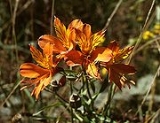
Alstroemeriaceae

Encyclopedia
The Alstroemeriaceae is a family of flowering plants, with 200 species
in three or four genera
, native to the Americas
, from Central America
to southern South America
.
The genus Alstroemeria, commonly called the Peruvian lilies, are popular florist's and garden flowers. The genus Bomarea
is a vine
that produces clusters of variously-colored, bell-shaped flowers.
, of 2003 (unchanged from the APG system
, of 1998), treats the family in the order Liliales
, in the clade monocots. The APG III system
, of 2009, merged the obscure family Luzuriagaceae into the Alstroemeriaceae, since the former group included only two genera, was the sister group of the Alstroemeriaceae, and possessed the same distinctive twisted petiole
s.
Tribe Alstroemerieae
Tribe Luzuriageae
Species
In biology, a species is one of the basic units of biological classification and a taxonomic rank. A species is often defined as a group of organisms capable of interbreeding and producing fertile offspring. While in many cases this definition is adequate, more precise or differing measures are...
in three or four genera
Genus
In biology, a genus is a low-level taxonomic rank used in the biological classification of living and fossil organisms, which is an example of definition by genus and differentia...
, native to the Americas
Americas
The Americas, or America , are lands in the Western hemisphere, also known as the New World. In English, the plural form the Americas is often used to refer to the landmasses of North America and South America with their associated islands and regions, while the singular form America is primarily...
, from Central America
Central America
Central America is the central geographic region of the Americas. It is the southernmost, isthmian portion of the North American continent, which connects with South America on the southeast. When considered part of the unified continental model, it is considered a subcontinent...
to southern South America
South America
South America is a continent situated in the Western Hemisphere, mostly in the Southern Hemisphere, with a relatively small portion in the Northern Hemisphere. The continent is also considered a subcontinent of the Americas. It is bordered on the west by the Pacific Ocean and on the north and east...
.
The genus Alstroemeria, commonly called the Peruvian lilies, are popular florist's and garden flowers. The genus Bomarea
Bomarea
Bomarea is one of the two major genera in the plant family Alstroemeriaceae. Most occur in the Andes. Several species are occasionally found as garden plants....
is a vine
Vine
A vine in the narrowest sense is the grapevine , but more generally it can refer to any plant with a growth habit of trailing or scandent, that is to say climbing, stems or runners...
that produces clusters of variously-colored, bell-shaped flowers.
Classification
The APG II systemAPG II system
The APG II system of plant classification is the second, now obsolete, version of a modern, mostly molecular-based, system of plant taxonomy that was published in April 2003 by the Angiosperm Phylogeny Group. It was a revision of the first APG system, published in 1998, and was superseded in 2009...
, of 2003 (unchanged from the APG system
APG system
The APG system of plant classification is the first, now obsolete, version of a modern, mostly molecular-based, system of plant taxonomy that was published in 1998 by the Angiosperm Phylogeny Group. It was superseded in 2003 by a revision, the APG II system, and then in 2009 by a further...
, of 1998), treats the family in the order Liliales
Liliales
Liliales is an order of monocotyledonous flowering plants. This order of necessity includes the family Liliaceae, but both the family and the order have had a widely disputed history, with the circumscription varying greatly from one taxonomist to another...
, in the clade monocots. The APG III system
APG III system
The APG III system of flowering plant classification is the third version of a modern, mostly molecular-based, system of plant taxonomy...
, of 2009, merged the obscure family Luzuriagaceae into the Alstroemeriaceae, since the former group included only two genera, was the sister group of the Alstroemeriaceae, and possessed the same distinctive twisted petiole
Petiole
Petiole may refer to:*Petiole , the stalk of a leaf, attaching the blade to the stem*Petiole , the stem formed by a restricted abdominal segment that connects the thorax with the gaster in the suborder Apocrita...
s.
Tribe Alstroemerieae
- AlstroemeriaAlstroemeriaAlstroemeria , commonly called the Peruvian Lily or Lily of the Incas, is a South American genus of about 120 species of flowering plants. Almost all of the species are restricted to one of two distinct centers of diversity, one in central Chile, the other in eastern Brazil...
- BomareaBomareaBomarea is one of the two major genera in the plant family Alstroemeriaceae. Most occur in the Andes. Several species are occasionally found as garden plants....
- Schickendantziella
Tribe Luzuriageae
- DrymophilaDrymophila (plant)Drymophila is a genus of flowering plants in the family Alstroemeriaceae. It has also been placed in Luzuriagaceae, Convallariaceae and Liliaceae.There are two species, both native to Australia:...
- Luzuriaga