

.gif)
Alpine (car)

Encyclopedia
Alpine was a French manufacturer of racing and sports car
s that used rear-mounted Renault
engines.
Jean Rédélé
(1922 - 2007), the founder of Alpine, was originally a Dieppe
garage proprietor, who began to achieve considerable competition success in one of the few French cars produced just after World War 2.
4CVs, Rédélé gained class wins in a number of major events, including the Mille Miglia
and Coupe des Alpes. As his experience with the little 4CV built up, he incorporated many modifications, including for example, special 5-speed gear boxes replacing the original 3-speed unit. To provide a lighter car he built a number of special versions with lightweight aluminium bodies: he drove in these at Le Mans
and Sebring
with some success in the early 1950s.
Encouraged by the development of these cars and consequent customer demand, he founded the Société Anonyme des Automobiles Alpine in 1954. The firm was named Alpine after his Coupe des Alpes successes. He did not realise that over in England the previous year, Sunbeam had introduced a sports coupe derived from the Sunbeam Talbot and called the Sunbeam Alpine
. This naming problem was to cause problems for Alpine throughout its history.
In 1955, he worked with the Chappe brothers to be amongst the pioneers of auto glass fibre construction and produced a small coupe, based on 4CV mechanicals and called the Alpine A106
. It used the platform chassis of the original Renault 4CV
. The A106 achieved a number of successes through the 1950s and was joined by a low and stylish cabriolet. Styling for this car was contracted to the Italian designer Michelotti. Under the glassfibre body was a very stiff chassis based on a central tubular backbone which was to be the hallmark of all Alpines built.
Alpine then took the Michelotti cabriolet design and developed a 2+2 closed coupe (or 'berlinette') body for it: this became the Alpine A108, now featuring the Dauphine Gordini
845 cc engine, which on later models was bored out to give a capacity of 904 cc or (subsequently) 998 cc. The A108 was built between 1958 and 1963.
This new car was the A110 Berlinette
Tour de France
, named after a successful run with the Alpine A108 in the 1962 event. Starting with a 956 cc engine of 51 bhp, the same chassis and body developed with relatively minor changes over the years to the stage where, by 1974, the little car was handling 1800 cc engines developing 180 bhp+. With a competition weight for the car of around 620 kg (1,367 lb), the performance was excellent.
Alpine achieved increasing success in rallying, and by 1968 had been allocated the whole Renault competition budget. The close collaboration allowed Alpines to be sold and maintained in France by normal Renault dealerships. Real top level success started in 1968 with outright wins in the Coupe des Alpes and other international events. By this time the competition cars were fitted with 1440 cc engines derived from the Renault R8 Gordini
. Competition successes became numerous, helped since Alpine were the first company fully to exploit the competition parts homologation rules.
, using cars with engines derived from the Renault 16
. In 1973, they repeated the 1-2-3 Monte Carlo result and went on to win the World Rally Championship
outright, beating Porsche
, Lancia
and Ford
. During all of this time, production of the Alpine A110
increased and manufacturing deals were struck for A110s and A108s with factories in a number of other countries including Spain, Mexico, Brazil and Bulgaria.
1973 brought the international petrol crisis, which had profound effects on many specialist car manufacturers worldwide. From a total Alpine production of 1421 in 1972, the numbers of cars sold dropped to 957 in 1974 and the company was bailed out via a takeover by Renault. Alpine's problems had been compounded by the need for them to develop a replacement for the A110
and launch the car just when European petrol prices leapt through the roof.
Through the 1970s, Alpine continued to campaign the A110, and later the Alpine A310
replacement car. However, to compete with Alpine's success, other manufacturers developed increasingly special cars, notably the Lancia Stratos
which was based closely on the A110's size and rear-engined concept, though incorporating a Ferrari engine. Alpine's own cars, still based on the 1962 design and using a surprising number of production parts, became increasingly uncompetitive. In 1974 Alpine built a series of factory racing Renault 17 Gordinis (one driven by Jean-Luc Thérier
) that won the Press on Regardless World Rally Championship round in Michigan
, USA.
In fact, having achieved the rally championship, and with Renault money now fully behind them, Alpine had set their sights on a new target. The next aim was to win at Le Mans. Renault had also taken over the Gordini tuning firm and merged the two to form Renault Sport
. A number of increasingly successful sports racing cars appeared, culminating in the 1978 Le Mans win with the Renault Alpine A442
B. This was fitted with a turbo-charged engine; Alpine had been the first company to run in and win an international rally with a turbo car as far back as 1972 when Jean-Luc Thérier
took a specially modified A110 to victory on the Critérium des Cévennes.
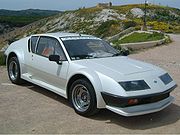 After the A310 Alpine transformed into the new Alpine GTA range produced from plastic and polyester components, commencing with normally aspirated PRV
V6 engines. In 1985 the V6 Turbo was introduced to complete the range. This car was faster and more powerful than the normally aspirated version. In 1986 polyester parts were cut for the first time by robot using a high pressure (3500 bar) water jet, 0.15 mm (0.00590551181102362 in) in diameter at three times the speed of sound. In the same year the American specification V6 Turbo was developed.
In 1987 fitment of anti-pollution systems allowed the V6 Turbo to be distributed to Switzerland, Germany, Austria and the Netherlands. 1989 saw the launch of the limited edition GTA Mille Miles to celebrate Alpine's 35th anniversary. Production was limited to 100 cars, all fitted with ABS braking, polished wheels, special leather interior and paintwork. This version was not available in RHD.
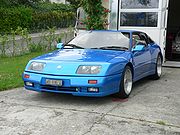 The Alpine A610
was launched in 1991. It was re-styled inside and out but was still recognisable as a GTA derivative. The chassis structure was extensively reworked but the central box principal remained the same. The front was completely re-designed the interior was also greatly improved. Air-conditioning and power steering were fitted as standard. The total production run for A610s derivatives was 818 vehicles 67 RHD and 751 LHD. After production of the A610 ended, the Alpine factory in Dieppe produced the Renault Sport Spider and a new era was to begin.
The last Alpine, an A610, rolled off the Dieppe line late in 1994, Renault abandoning the Alpine name. This was always a problem in the UK market. Alpines could not be sold in the UK under their own name because Sunbeam owned the trade mark (because of the mid-50s Sunbeam Alpine Mk I). In the 1970s, for example Dieppe were building modified Renault R5s for the world wide market. The rest of the world knew them as R5 Alpines but in the UK they had to be renamed to R5 Gordini. Strangely enough with the numerous company takeovers that have occurred, it is another French company, PSA (Peugot/Talbot/Citroën) who now own the British Alpine trademark.
The Alpine factory in Dieppe continues to expand; in the 1980s they built the special R5 Turbo cars, following the rear engined formula they have always used. They built all Clio Williams and RenaultSport Spiders. The factory proudly put its Alpine badges on the built early batches of the mid engined Clio series one Clio V6. The Clio Series 2 was also assembled there with more recent RenaultSport Clio 172 and RenaultSport Clio 182s.
Between 1989 and 1995, a new Alpine named the A710 "Berlinette 2", was designed and 2 prototypes were built. Due to the cost of the project (600 millions Francs), and as adding modern equipment and interior would compromise the price and performances, the project was canceled.
, Clio Renault Sport
and the new Mégane Renault Sport dCi is to be built on Renault’s Dieppe assembly line. All the RenaultSport track-, tarmac- and gravel-racing Meganes and Clios are also made in the Dieppe factory.
In October 2007, it has been reported that Renault’s marketing boss Patrick Blain has revealed that there are plans for several sports cars in Renault’s future lineup, but stressed that the first model won’t arrive until after 2010. Blain confirmed that Renault is unlikely to pick a new name for its future sports car and will probably go with Alpine to brand it. Blain described it as being a “radical sports car” and not just a sports version of a regular model.
The new Alpine sports car will likely have a version of the Nissan GT-R
's Premium Midship platform.
The presence of sportier models in the Renault line-up would give the French automaker a better opportunity to capitalize on its Formula One prowess, having won two back-to-back world championships with Fernando Alonso, translating these efforts to its production cars is a moot point because Renault’s lineup is lacking in the sports car department. Management is hoping to change all that and is keen to start building sports cars again, as it has in the past, with the revival of the legendary Alpine label.
In France there is a large network of Alpine enthusiasts clubs. Clubs exist in many countries including the UK, USA, Australia, Japan.
In February 2009, Renault confirmed that plans to revive the Alpine brand have been frozen as a direct result of the 2008-2009 global financial crisis and recession.
RS Models
RS official websites
An example of an Alpine weekend was held in Victoria
with attendees from South Australia
, Victoria
, New South Wales
and Queensland
. There were 17 Alpines and 2 Renault 5 Turbos. The Alpine model breakdown was:
A110: 5 | A310 (4 cyl): 3 | A310 (6 cyl): 4 | GTA Turbo: 2| GTA atmo: 3
from 1956 to 1963, under license by Willys-Overland do Brasil, branded "Willys Interlagos". It was the first Brazilian sports car
.
produced its own version of the Renault Alpine, known as Bulgaralpine from 1967 to 1969. About 100 vehicles were produced.
Sports car
A sports car is a small, usually two seat, two door automobile designed for high speed driving and maneuverability....
s that used rear-mounted Renault
Renault
Renault S.A. is a French automaker producing cars, vans, and in the past, autorail vehicles, trucks, tractors, vans and also buses/coaches. Its alliance with Nissan makes it the world's third largest automaker...
engines.
Jean Rédélé
Jean Rédélé
Jean Rédélé , was an automotive pioneer, pilot and founder of the French automotive brand Alpine....
(1922 - 2007), the founder of Alpine, was originally a Dieppe
Dieppe, Seine-Maritime
Dieppe is a commune in the Seine-Maritime department in France. In 1999, the population of the whole Dieppe urban area was 81,419.A port on the English Channel, famous for its scallops, and with a regular ferry service from the Gare Maritime to Newhaven in England, Dieppe also has a popular pebbled...
garage proprietor, who began to achieve considerable competition success in one of the few French cars produced just after World War 2.
Early days
Using RenaultRenault
Renault S.A. is a French automaker producing cars, vans, and in the past, autorail vehicles, trucks, tractors, vans and also buses/coaches. Its alliance with Nissan makes it the world's third largest automaker...
4CVs, Rédélé gained class wins in a number of major events, including the Mille Miglia
Mille Miglia
The Mille Miglia was an open-road endurance race which took place in Italy twenty-four times from 1927 to 1957 ....
and Coupe des Alpes. As his experience with the little 4CV built up, he incorporated many modifications, including for example, special 5-speed gear boxes replacing the original 3-speed unit. To provide a lighter car he built a number of special versions with lightweight aluminium bodies: he drove in these at Le Mans
24 Hours of Le Mans
The 24 Hours of Le Mans is the world's oldest sports car race in endurance racing, held annually since near the town of Le Mans, France. Commonly known as the Grand Prix of Endurance and Efficiency, race teams have to balance speed against the cars' ability to run for 24 hours without sustaining...
and Sebring
12 Hours of Sebring
The 12 Hours of Sebring is an annual motorsport endurance race for sports cars held at Sebring International Raceway, a former Army Air Force base in Sebring, Florida...
with some success in the early 1950s.
Encouraged by the development of these cars and consequent customer demand, he founded the Société Anonyme des Automobiles Alpine in 1954. The firm was named Alpine after his Coupe des Alpes successes. He did not realise that over in England the previous year, Sunbeam had introduced a sports coupe derived from the Sunbeam Talbot and called the Sunbeam Alpine
Sunbeam Alpine
The Sunbeam Alpine is a sporty two-seat open car from Rootes Group's Sunbeam car marque. The original was launched in 1953 as the first vehicle from Sunbeam-Talbot to bear the Sunbeam name alone since the 1935 takeover of Sunbeam and Talbot by the Rootes Group....
. This naming problem was to cause problems for Alpine throughout its history.
In 1955, he worked with the Chappe brothers to be amongst the pioneers of auto glass fibre construction and produced a small coupe, based on 4CV mechanicals and called the Alpine A106
Alpine A106
The Alpine A106 was the first of a line of light-weight glass-fibre bodied, rear-engined two-door coupés produced for a young competition-oriented Dieppe based Renault dealer called Jean Rédélé...
. It used the platform chassis of the original Renault 4CV
Renault 4CV
The Renault 4CV was an economy car produced by the French manufacturer Renault from August 1947-July 1961. The first French car to sell over a million units, the 4CV was ultimately superseded by the Renault Dauphine....
. The A106 achieved a number of successes through the 1950s and was joined by a low and stylish cabriolet. Styling for this car was contracted to the Italian designer Michelotti. Under the glassfibre body was a very stiff chassis based on a central tubular backbone which was to be the hallmark of all Alpines built.
Alpine then took the Michelotti cabriolet design and developed a 2+2 closed coupe (or 'berlinette') body for it: this became the Alpine A108, now featuring the Dauphine Gordini
Renault Dauphine
Renault Dauphine is a rear-engined economy car manufactured by Renault in one body style — a three-box, four-door sedan — as the successor to the Renault 4CV, with over two million examples marketed worldwide during its production from 1956-1967....
845 cc engine, which on later models was bored out to give a capacity of 904 cc or (subsequently) 998 cc. The A108 was built between 1958 and 1963.
1960s
By now the car's mechanicals were beginning to show their age. Alpine were already working closely with Renault and when the Renault R8 saloon was introduced in 1962. Alpine redeveloped their chassis and made a number of minor body changes to allow the use of R8 mechanicals.This new car was the A110 Berlinette
Alpine A110
The Alpine A110, also known as the "Berlinette", was a sports car produced by the French manufacturer Alpine from 1961 to 1977. The A110 was powered by various Renault engines....
Tour de France
Tour de France automobile
Tour de France Automobile was a sports car race held on roads around France, first held in 1899 at speeds of 30 mph . The first event was won by René de Knyff driving a Panhard et Levassor...
, named after a successful run with the Alpine A108 in the 1962 event. Starting with a 956 cc engine of 51 bhp, the same chassis and body developed with relatively minor changes over the years to the stage where, by 1974, the little car was handling 1800 cc engines developing 180 bhp+. With a competition weight for the car of around 620 kg (1,367 lb), the performance was excellent.
Alpine achieved increasing success in rallying, and by 1968 had been allocated the whole Renault competition budget. The close collaboration allowed Alpines to be sold and maintained in France by normal Renault dealerships. Real top level success started in 1968 with outright wins in the Coupe des Alpes and other international events. By this time the competition cars were fitted with 1440 cc engines derived from the Renault R8 Gordini
Gordini
Gordini is a French sports car manufacturer. The firm was founded by Amédée Gordini nicknamed "Le Sorcier" .Gordini competed in Formula One from 1950 to 1956....
. Competition successes became numerous, helped since Alpine were the first company fully to exploit the competition parts homologation rules.
1970s
In 1971, Alpine achieved a 1-2-3 finish in the Monte Carlo rallyMonte Carlo Rally
The Monte Carlo Rally or Rally Monte Carlo is a rallying event organised each year by the Automobile Club de Monaco which also organises the Formula One Monaco Grand Prix and the Rallye Monte-Carlo Historique. The rally takes place along the French Riviera in the Principality of Monaco and...
, using cars with engines derived from the Renault 16
Renault 16
The Renault 16 is a hatchback produced by French automaker Renault between 1965 and 1980 in Le Havre, France. The reviewer in the May 1965 edition of the English "Motoring Illustrated" said: "The Renault Sixteen can thus be described as a large family car but one that is neither a four door saloon...
. In 1973, they repeated the 1-2-3 Monte Carlo result and went on to win the World Rally Championship
World Rally Championship
The World Rally Championship is a rallying series organised by the FIA, culminating with a champion driver and manufacturer. The driver's world championship and manufacturer's world championship are separate championships, but based on the same point system. The series currently consists of 13...
outright, beating Porsche
Porsche
Porsche Automobil Holding SE, usually shortened to Porsche SE a Societas Europaea or European Public Company, is a German based holding company with investments in the automotive industry....
, Lancia
Lancia
Lancia Automobiles S.p.A. is an Italian automobile manufacturer founded in 1906 by Vincenzo Lancia and which became part of the Fiat Group in 1969. The company has a long history of producing distinctive cars and also has a strong rally heritage. Some modern Lancias are seen as presenting a more...
and Ford
Ford Motor Company
Ford Motor Company is an American multinational automaker based in Dearborn, Michigan, a suburb of Detroit. The automaker was founded by Henry Ford and incorporated on June 16, 1903. In addition to the Ford and Lincoln brands, Ford also owns a small stake in Mazda in Japan and Aston Martin in the UK...
. During all of this time, production of the Alpine A110
Alpine A110
The Alpine A110, also known as the "Berlinette", was a sports car produced by the French manufacturer Alpine from 1961 to 1977. The A110 was powered by various Renault engines....
increased and manufacturing deals were struck for A110s and A108s with factories in a number of other countries including Spain, Mexico, Brazil and Bulgaria.
1973 brought the international petrol crisis, which had profound effects on many specialist car manufacturers worldwide. From a total Alpine production of 1421 in 1972, the numbers of cars sold dropped to 957 in 1974 and the company was bailed out via a takeover by Renault. Alpine's problems had been compounded by the need for them to develop a replacement for the A110
Alpine A110
The Alpine A110, also known as the "Berlinette", was a sports car produced by the French manufacturer Alpine from 1961 to 1977. The A110 was powered by various Renault engines....
and launch the car just when European petrol prices leapt through the roof.
Through the 1970s, Alpine continued to campaign the A110, and later the Alpine A310
Alpine A310
The Alpine A310 was a sports car built by French manufacturer Alpine, from 1971 to 1984.Dieppe-based Alpine, once an independent company specialising in faster Renaults, later a Renault subsidiary, established a fine competition history with the Alpine A110 winning the 1973 Monte Carlo Rally and...
replacement car. However, to compete with Alpine's success, other manufacturers developed increasingly special cars, notably the Lancia Stratos
Lancia Stratos
The Lancia Stratos HF, widely and more simply known as Lancia Stratos, is a car made by Italian car manufacturer Lancia. The HF stands for High Fidelity...
which was based closely on the A110's size and rear-engined concept, though incorporating a Ferrari engine. Alpine's own cars, still based on the 1962 design and using a surprising number of production parts, became increasingly uncompetitive. In 1974 Alpine built a series of factory racing Renault 17 Gordinis (one driven by Jean-Luc Thérier
Jean-Luc Thérier
Jean-Luc Thérier is a French former rally driver. He was the highest scoring driver in the inaugural World Rally Championship in 1973 and the only one to win three events...
) that won the Press on Regardless World Rally Championship round in Michigan
Michigan
Michigan is a U.S. state located in the Great Lakes Region of the United States of America. The name Michigan is the French form of the Ojibwa word mishigamaa, meaning "large water" or "large lake"....
, USA.
In fact, having achieved the rally championship, and with Renault money now fully behind them, Alpine had set their sights on a new target. The next aim was to win at Le Mans. Renault had also taken over the Gordini tuning firm and merged the two to form Renault Sport
Renault Sport
Renault Sport Technologies is the France motorsport division of Renault. Renault Sport was responsible for Renault's sports car racing entries during the 1970s, including their win at the 1978 24 Hours of Le Mans race with the Renault Alpine A442.Actual Renault's Formula One team, Renault F1 in...
. A number of increasingly successful sports racing cars appeared, culminating in the 1978 Le Mans win with the Renault Alpine A442
Renault Alpine A442
The Renault Alpine A442 is a sports prototype racing car, designed and built by Alpine, but funded and powered by Alpine's owners Renault, specifically to contest the 24 Hours of Le Mans race. Variants were entered for the event in 1976, 1977 and 1978. An A442B finally won the race on the third...
B. This was fitted with a turbo-charged engine; Alpine had been the first company to run in and win an international rally with a turbo car as far back as 1972 when Jean-Luc Thérier
Jean-Luc Thérier
Jean-Luc Thérier is a French former rally driver. He was the highest scoring driver in the inaugural World Rally Championship in 1973 and the only one to win three events...
took a specially modified A110 to victory on the Critérium des Cévennes.
1980s
Alpine Renault continued to develop their range of models all through the 1980s. The A310 was the next modern interpretation of the A110. The Alpine A310 was a sports car with a rear-mounted engine and was initially powered by a four-cylinder 1.6 L sourced Renault 17 TS/Gordini engine. In 1976 the A310 was restyled by Robert Opron and fitted with the more powerful and newly developed V6 PRV engine. The 2.6 L motor was modified by Alpine with a four-speed manual gearbox. Later they would use a Five-speed manual gearbox and with the group 4 model get a higher tune with more cubic capacity and 3 twin barrel Weber carburetors.PRV
PRV may refer to:* Polycythaemia rubra vera, a blood disorder* Pressure reducing valve* Pressure relief valve* Peak Reverse Voltage, a characteristic of diodes* PRV engine, an automobile V6 engine developed by Peugeot Renault and Volvo...
V6 engines. In 1985 the V6 Turbo was introduced to complete the range. This car was faster and more powerful than the normally aspirated version. In 1986 polyester parts were cut for the first time by robot using a high pressure (3500 bar) water jet, 0.15 mm (0.00590551181102362 in) in diameter at three times the speed of sound. In the same year the American specification V6 Turbo was developed.
In 1987 fitment of anti-pollution systems allowed the V6 Turbo to be distributed to Switzerland, Germany, Austria and the Netherlands. 1989 saw the launch of the limited edition GTA Mille Miles to celebrate Alpine's 35th anniversary. Production was limited to 100 cars, all fitted with ABS braking, polished wheels, special leather interior and paintwork. This version was not available in RHD.
1990s
1990 saw the launch of the special edition wide bodied GTA Le Mans. The car wore polyester wheel arch extensions with a one piece front. Wheels were 3 piece BBS style produced by ACT, 8x16" front & 10x17" rear. Otherwise identical mechanically to the V6 Turbo, the engine was fitted with a catalytic converter and power was reduced to 185 bhp. This model was available in the UK and RHD versions carried a numbered plaque on the dashboard. The Le Mans is the most collectable and valuable GTA derivative, since only 325 were made (299 LHD and 26 RHD). These were available from Renault dealers in the UK and the country's motoring press are belatedly recognising the GTA series as the 'great unsung supercar of the 1980s'Renault Alpine GTA/A610
The Alpine A610 was a coupe automobile produced by the Renault-owned French manufacturer Alpine. It was launched in 1991. Due to a limited budget at the beginning of the project, its appearance does not differ much from the GTA, and it looks quite similar to the USA GTA with its pop-up headlights...
was launched in 1991. It was re-styled inside and out but was still recognisable as a GTA derivative. The chassis structure was extensively reworked but the central box principal remained the same. The front was completely re-designed the interior was also greatly improved. Air-conditioning and power steering were fitted as standard. The total production run for A610s derivatives was 818 vehicles 67 RHD and 751 LHD. After production of the A610 ended, the Alpine factory in Dieppe produced the Renault Sport Spider and a new era was to begin.
The last Alpine, an A610, rolled off the Dieppe line late in 1994, Renault abandoning the Alpine name. This was always a problem in the UK market. Alpines could not be sold in the UK under their own name because Sunbeam owned the trade mark (because of the mid-50s Sunbeam Alpine Mk I). In the 1970s, for example Dieppe were building modified Renault R5s for the world wide market. The rest of the world knew them as R5 Alpines but in the UK they had to be renamed to R5 Gordini. Strangely enough with the numerous company takeovers that have occurred, it is another French company, PSA (Peugot/Talbot/Citroën) who now own the British Alpine trademark.
The Alpine factory in Dieppe continues to expand; in the 1980s they built the special R5 Turbo cars, following the rear engined formula they have always used. They built all Clio Williams and RenaultSport Spiders. The factory proudly put its Alpine badges on the built early batches of the mid engined Clio series one Clio V6. The Clio Series 2 was also assembled there with more recent RenaultSport Clio 172 and RenaultSport Clio 182s.
Between 1989 and 1995, a new Alpine named the A710 "Berlinette 2", was designed and 2 prototypes were built. Due to the cost of the project (600 millions Francs), and as adding modern equipment and interior would compromise the price and performances, the project was canceled.
Present
The Dieppe factory is known as the producer of RenaultSport models that are sold worldwide. This was originally the "Alpine" factory that Renault gained when they acquired the brand in 1973. Some of the Renault Sport models produced in Dieppe are currently the Mégane Renault SportMégane Renault Sport
The Mégane Renaultsport or Mégane RS is a series of hot hatch models based on Renault Mégane, designed and built by French automaker Renault since 2004.-Mégane II Renaultsport:The RS is based on the Renault Mégane II small family car....
, Clio Renault Sport
Clio Renault Sport
The Renault Clio Renault Sport or Clio RS is a hot hatch produced since 1999 by Renault Sport, the high-performance division of French automaker Renault...
and the new Mégane Renault Sport dCi is to be built on Renault’s Dieppe assembly line. All the RenaultSport track-, tarmac- and gravel-racing Meganes and Clios are also made in the Dieppe factory.
In October 2007, it has been reported that Renault’s marketing boss Patrick Blain has revealed that there are plans for several sports cars in Renault’s future lineup, but stressed that the first model won’t arrive until after 2010. Blain confirmed that Renault is unlikely to pick a new name for its future sports car and will probably go with Alpine to brand it. Blain described it as being a “radical sports car” and not just a sports version of a regular model.
The new Alpine sports car will likely have a version of the Nissan GT-R
Nissan GT-R
The Nissan GT-R is a sports car produced by Nissan released in Japan on December 6, 2007, the United States on July 4, 2008, and the rest of the world in March 2009.-History:...
's Premium Midship platform.
The presence of sportier models in the Renault line-up would give the French automaker a better opportunity to capitalize on its Formula One prowess, having won two back-to-back world championships with Fernando Alonso, translating these efforts to its production cars is a moot point because Renault’s lineup is lacking in the sports car department. Management is hoping to change all that and is keen to start building sports cars again, as it has in the past, with the revival of the legendary Alpine label.
In France there is a large network of Alpine enthusiasts clubs. Clubs exist in many countries including the UK, USA, Australia, Japan.
In February 2009, Renault confirmed that plans to revive the Alpine brand have been frozen as a direct result of the 2008-2009 global financial crisis and recession.
Timeline
- 1922 - Jean Rédélé was born on May 17, 1922 in Dieppe in French Normandy. His father Émile works for Renault as testing engineer thus Rédélé is raised within an environment which fascinates him from the beginning of his life.
- 1946 - Jean Rédélé finishes a trading school (HEC, one of the best at this time) and founded in Dieppe a company that he called "Société des Grands garages de Normandie" on December, 17th in premises that he hired to his father, in order to sell Renault cars. In parallel he prepares his Renault 4CV for local racing events (his first rallye was Dieppe Rallye in 1950) and later on he is successful at Rallye Monte Carlo.
- 1953 - Renault asks him to start preparation of five racing cars for the Mille Miglia. The cooperation is very successful: the cars achieve the first places in their category. Even the 1952 Alemano bodied Renault 4CV wins diverse rallies.
- 1954 - Jean Rédélé and his friend Louis Pons achieve a victory at the Coupe des Alpes with a tuned 4CV. As a dedication to this event he chooses the name "Société des Automobiles Alpine" for the new founded company to develop cars on his own. He starts with the Alpine A106 Mille Milles, which was the sensational new car at the Paris Salon in 1954. The designation A106 is derived from Renault's internal designation system.
- 1960 - The model A108 is presented under the name of Berlinette Tour de France at the Paris Auto salon. The A110 will be derived from this model.
- 1962 - Again in Paris the public sees for the first time the new model A110. In the same year Renault presented the R8. The most essential parts like suspension and brakes are to be found in the Alpine, too.
- 1965 - The A110 is equipped with the 1300 cc engine which is based on the Gordini engine.
- 1966 - The A108 production is stopped.
- 1969 - Alpine uses the engine of the Renault R16 to introduce a 1600 cc version of the A110.
- 1970 - Renault gets the majority of the Alpine company.
- 1971 - Alpine wins the International Rally Championship with A110. The A310 model is introduced at the Geneva car show.
- 1973 - Alpine and its A110 are World Rally Champion.
- 1974 - For the new models 1600 SX, SI and SC Alpine develops a new suspension concept which is introduced with the A310 model, the successor of the A110. Alpine built factory racing Renault 17 Gordinis, they win the Press on Regardless Rally - World Rally Championship Round in Michigan USA. The fact that the French government forbids all motorsport events has severe impact on Alpine's economical situation.
- 1975 - For the last time a works A110 rally car enters a competition event.
- 1977 - In July Alpine stops fabricating the A110. The last Berlinette is a green 1600 SX. Even the Spanish production site has to deliver parts to complete this car. All in all 7176 Berlinettes left the site at Dieppe. But there have been licence agreements with Bulgarian, Spanish and Mexican companies. The following years saw several successors of the Berlinette. But none of them reached neither its popularity nor its image. Guy Fréquelin in the Alpine A310-V6 "Calberson" wins the 1977 French rally championship.
- 1996 - Today - Renault decides the model A610 to be last Alpine ever built. The company's management is not convinced of being able to develop a model for such a small market segment in an economical way. The Alpine factory in Dieppe is used for assembling Renault Sport cars which keep the sporting heritage alive.
- 2007 - August 10 - Jean Rédélé dies at age 85.
- 2007 - October - Renault revives the classic Alpine brand, new models due after 2010 (since cancelled).
Street models
- A106Alpine A106The Alpine A106 was the first of a line of light-weight glass-fibre bodied, rear-engined two-door coupés produced for a young competition-oriented Dieppe based Renault dealer called Jean Rédélé...
- A108
- A110Alpine A110The Alpine A110, also known as the "Berlinette", was a sports car produced by the French manufacturer Alpine from 1961 to 1977. The A110 was powered by various Renault engines....
- A310Alpine A310The Alpine A310 was a sports car built by French manufacturer Alpine, from 1971 to 1984.Dieppe-based Alpine, once an independent company specialising in faster Renaults, later a Renault subsidiary, established a fine competition history with the Alpine A110 winning the 1973 Monte Carlo Rally and...
- GTA/A610Renault Alpine GTA/A610The Alpine A610 was a coupe automobile produced by the Renault-owned French manufacturer Alpine. It was launched in 1991. Due to a limited budget at the beginning of the project, its appearance does not differ much from the GTA, and it looks quite similar to the USA GTA with its pop-up headlights...
Racing models
- Alpine M63
- Alpine M64
- Alpine M65
- Alpine A210
- Alpine A220
- Alpine A364
- Alpine A440
- Alpine A441
- Alpine A442
- Alpine A443
Renaultsport models at Dieppe
Alpine is now the Renaultsport Technologies factory in Dieppe.RS Models
- Renault ClioRenault ClioThe Renault Clio is a supermini car produced by the French automobile manufacturer Renault. Originally launched in 1990, it is currently in its third generation...
- Renault Clio V6 Renault Sport
- Renault Clio Renault Sport
- Renault Mégane Renault Sport
- Renault SpiderRenault SpiderThe Renault Sport Spider is a roadster produced by the French automaker Renault Sport between 1995 and 1997.-Project:...
RS official websites
- Renault Sport France (English site)
- Renault Sport United Kingdom
- Renault Sport - World Series
- Renault Sport - History
Australia
Renault Alpines were never imported into Australia, but as enthusiasts wanted more than just the normal local Renault offerings, Renault Alpine enthusiasts have privately imported the following models into Australia. Currently there are A110, A310, GTA-atmo-turbo-lemans, A610, Renault 5 Turbo and Renault Sport Spiders registered.An example of an Alpine weekend was held in Victoria
Victoria (Australia)
Victoria is the second most populous state in Australia. Geographically the smallest mainland state, Victoria is bordered by New South Wales, South Australia, and Tasmania on Boundary Islet to the north, west and south respectively....
with attendees from South Australia
South Australia
South Australia is a state of Australia in the southern central part of the country. It covers some of the most arid parts of the continent; with a total land area of , it is the fourth largest of Australia's six states and two territories.South Australia shares borders with all of the mainland...
, Victoria
Victoria (Australia)
Victoria is the second most populous state in Australia. Geographically the smallest mainland state, Victoria is bordered by New South Wales, South Australia, and Tasmania on Boundary Islet to the north, west and south respectively....
, New South Wales
New South Wales
New South Wales is a state of :Australia, located in the east of the country. It is bordered by Queensland, Victoria and South Australia to the north, south and west respectively. To the east, the state is bordered by the Tasman Sea, which forms part of the Pacific Ocean. New South Wales...
and Queensland
Queensland
Queensland is a state of Australia, occupying the north-eastern section of the mainland continent. It is bordered by the Northern Territory, South Australia and New South Wales to the west, south-west and south respectively. To the east, Queensland is bordered by the Coral Sea and Pacific Ocean...
. There were 17 Alpines and 2 Renault 5 Turbos. The Alpine model breakdown was:
A110: 5 | A310 (4 cyl): 3 | A310 (6 cyl): 4 | GTA Turbo: 2| GTA atmo: 3
Brazil
The Renault Alpine 108 was produced in BrazilBrazil
Brazil , officially the Federative Republic of Brazil , is the largest country in South America. It is the world's fifth largest country, both by geographical area and by population with over 192 million people...
from 1956 to 1963, under license by Willys-Overland do Brasil, branded "Willys Interlagos". It was the first Brazilian sports car
Sports car
A sports car is a small, usually two seat, two door automobile designed for high speed driving and maneuverability....
.
Bulgaria
BulgariaBulgaria
Bulgaria , officially the Republic of Bulgaria , is a parliamentary democracy within a unitary constitutional republic in Southeast Europe. The country borders Romania to the north, Serbia and Macedonia to the west, Greece and Turkey to the south, as well as the Black Sea to the east...
produced its own version of the Renault Alpine, known as Bulgaralpine from 1967 to 1969. About 100 vehicles were produced.
External links
- AR Alpine Renault web site
- FAR Forum Alpine Renault
- Alpine Renault Tuning and Restoration parts
- Renault Alpine Owners Club
- Club Alpine Renault
- Mille Miles - Alpine Magazine with worldwide readership
- Alpine A110 Berlinette
- Berlinette Alpine Club Des 2 Savoie
- The Alpine A310 Fan Page - USA
- Alpine A310 a personal view
- Renault Alpine Club - German Club
- Alpine road and race cars