

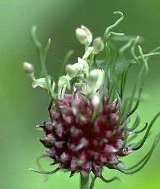
Allium vineale

Encyclopedia
Allium vineale is a perennial
bulb
flower in the genus Allium
, native to Europe
, north Africa
and western Asia
. The species was introduced in Australia
and North America
, where it has become an invasive species
.
All parts of the plant have a strong garlic
odour. The underground bulb
is 1-2 cm diameter, with a fibrous outer layer. The main stem
grows to 30-120 cm tall, bearing 2-4 leaves
and an apical inflorescence
2-5 cm diameter comprising a number of small bulbils and none to a few flower
s, subtended by a basal bract
. The leaves are slender hollow tubes
, 15-60 cm long and 2-4 mm thick, waxy textured, with a groove along the side of the leaf facing the stem. The flowers are 2-5 mm long, with six petals varying in colour from pink to red or greenish-white. It flowers in the summer, June to August in northern Europe. Plants with no flowers, only bulbils, are sometimes distinguished as the variety
Allium vineale var. compactum, but this character is probably not taxonomically
significant.
by livestock
. It is considered a pestilential invasive weed
, as grain
products may become tainted with a garlic odour or flavour in the presence of aerial bulblets at the time of harvest
. Wild garlic is resistant to herbicides due to the structure of its leaves, being vertical, smooth and waxy. Herbicides do not cling well to it and are therefore not as effective.
Perennial plant
A perennial plant or simply perennial is a plant that lives for more than two years. The term is often used to differentiate a plant from shorter lived annuals and biennials. The term is sometimes misused by commercial gardeners or horticulturalists to describe only herbaceous perennials...
bulb
Bulb
A bulb is a short stem with fleshy leaves or leaf bases. The leaves often function as food storage organs during dormancy.A bulb's leaf bases, known as scales, generally do not support leaves, but contain food reserves to enable the plant to survive adverse conditions. At the center of the bulb is...
flower in the genus Allium
Allium
Allium is a monocot genus of flowering plants, informally referred to as the onion genus. The generic name Allium is the Latin word for garlic....
, native to Europe
Europe
Europe is, by convention, one of the world's seven continents. Comprising the westernmost peninsula of Eurasia, Europe is generally 'divided' from Asia to its east by the watershed divides of the Ural and Caucasus Mountains, the Ural River, the Caspian and Black Seas, and the waterways connecting...
, north Africa
Africa
Africa is the world's second largest and second most populous continent, after Asia. At about 30.2 million km² including adjacent islands, it covers 6% of the Earth's total surface area and 20.4% of the total land area...
and western Asia
Asia
Asia is the world's largest and most populous continent, located primarily in the eastern and northern hemispheres. It covers 8.7% of the Earth's total surface area and with approximately 3.879 billion people, it hosts 60% of the world's current human population...
. The species was introduced in Australia
Australia
Australia , officially the Commonwealth of Australia, is a country in the Southern Hemisphere comprising the mainland of the Australian continent, the island of Tasmania, and numerous smaller islands in the Indian and Pacific Oceans. It is the world's sixth-largest country by total area...
and North America
North America
North America is a continent wholly within the Northern Hemisphere and almost wholly within the Western Hemisphere. It is also considered a northern subcontinent of the Americas...
, where it has become an invasive species
Invasive species
"Invasive species", or invasive exotics, is a nomenclature term and categorization phrase used for flora and fauna, and for specific restoration-preservation processes in native habitats, with several definitions....
.
All parts of the plant have a strong garlic
Garlic
Allium sativum, commonly known as garlic, is a species in the onion genus, Allium. Its close relatives include the onion, shallot, leek, chive, and rakkyo. Dating back over 6,000 years, garlic is native to central Asia, and has long been a staple in the Mediterranean region, as well as a frequent...
odour. The underground bulb
Bulb
A bulb is a short stem with fleshy leaves or leaf bases. The leaves often function as food storage organs during dormancy.A bulb's leaf bases, known as scales, generally do not support leaves, but contain food reserves to enable the plant to survive adverse conditions. At the center of the bulb is...
is 1-2 cm diameter, with a fibrous outer layer. The main stem
Plant stem
A stem is one of two main structural axes of a vascular plant. The stem is normally divided into nodes and internodes, the nodes hold buds which grow into one or more leaves, inflorescence , conifer cones, roots, other stems etc. The internodes distance one node from another...
grows to 30-120 cm tall, bearing 2-4 leaves
Leaf
A leaf is an organ of a vascular plant, as defined in botanical terms, and in particular in plant morphology. Foliage is a mass noun that refers to leaves as a feature of plants....
and an apical inflorescence
Inflorescence
An inflorescence is a group or cluster of flowers arranged on a stem that is composed of a main branch or a complicated arrangement of branches. Strictly, it is the part of the shoot of seed plants where flowers are formed and which is accordingly modified...
2-5 cm diameter comprising a number of small bulbils and none to a few flower
Flower
A flower, sometimes known as a bloom or blossom, is the reproductive structure found in flowering plants . The biological function of a flower is to effect reproduction, usually by providing a mechanism for the union of sperm with eggs...
s, subtended by a basal bract
Bract
In botany, a bract is a modified or specialized leaf, especially one associated with a reproductive structure such as a flower, inflorescence axis, or cone scale. Bracts are often different from foliage leaves. They may be smaller, larger, or of a different color, shape, or texture...
. The leaves are slender hollow tubes
Cylinder (geometry)
A cylinder is one of the most basic curvilinear geometric shapes, the surface formed by the points at a fixed distance from a given line segment, the axis of the cylinder. The solid enclosed by this surface and by two planes perpendicular to the axis is also called a cylinder...
, 15-60 cm long and 2-4 mm thick, waxy textured, with a groove along the side of the leaf facing the stem. The flowers are 2-5 mm long, with six petals varying in colour from pink to red or greenish-white. It flowers in the summer, June to August in northern Europe. Plants with no flowers, only bulbils, are sometimes distinguished as the variety
Variety (biology)
In botanical nomenclature, variety is a taxonomic rank below that of species: as such, it gets a three-part infraspecific name....
Allium vineale var. compactum, but this character is probably not taxonomically
Taxonomy
Taxonomy is the science of identifying and naming species, and arranging them into a classification. The field of taxonomy, sometimes referred to as "biological taxonomy", revolves around the description and use of taxonomic units, known as taxa...
significant.
Uses and problems
While Allium vineale has been suggested as a substitute for garlic, it has an unpleasant aftertaste compared to that of garlic itself. It imparts a garlic-like flavour and odour on dairy and beef products when grazedGrazing
Grazing generally describes a type of feeding, in which a herbivore feeds on plants , and also on other multicellular autotrophs...
by livestock
Livestock
Livestock refers to one or more domesticated animals raised in an agricultural setting to produce commodities such as food, fiber and labor. The term "livestock" as used in this article does not include poultry or farmed fish; however the inclusion of these, especially poultry, within the meaning...
. It is considered a pestilential invasive weed
Weed
A weed in a general sense is a plant that is considered by the user of the term to be a nuisance, and normally applied to unwanted plants in human-controlled settings, especially farm fields and gardens, but also lawns, parks, woods, and other areas. More specifically, the term is often used to...
, as grain
Caryopsis
In botany, a caryopsis is a type of simple dry fruit — one that is monocarpelate and indehiscent and resembles an achene, except that in a caryopsis the pericarp is fused with the thin seed coat....
products may become tainted with a garlic odour or flavour in the presence of aerial bulblets at the time of harvest
Harvest
Harvest is the process of gathering mature crops from the fields. Reaping is the cutting of grain or pulse for harvest, typically using a scythe, sickle, or reaper...
. Wild garlic is resistant to herbicides due to the structure of its leaves, being vertical, smooth and waxy. Herbicides do not cling well to it and are therefore not as effective.
See also
- AlliumAlliumAllium is a monocot genus of flowering plants, informally referred to as the onion genus. The generic name Allium is the Latin word for garlic....
- Allium oleraceum
- List of beneficial weeds