

All-terrain vehicle

Encyclopedia
American National Standards Institute
The American National Standards Institute is a private non-profit organization that oversees the development of voluntary consensus standards for products, services, processes, systems, and personnel in the United States. The organization also coordinates U.S. standards with international...
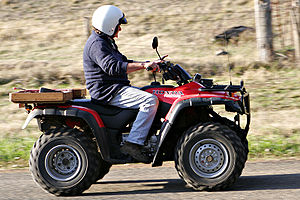
(ANSI) as a vehicle that travels on low pressure tires, with a seat that is straddled by the operator, along with handlebar
Handlebar
A handlebar is part of the steering mechanism, in lieu of a steering wheel, for vehicles that are ridden on, instead of in, such as bicycles, motorcycles, tricycles, ATVs, snowmobiles and personal watercraft. It may also be simply the handles on a device such as a zip line trolley or a floor buffer...
s for steering control. As the name implies, it is designed to handle a wider variety of terrain than most other vehicles. Although it is a street-legal vehicle in some countries, it is not street legal within most states and provinces of Australia, the United States, Canada, or the United Kingdom. In the UK, a recent variant class of ATV is now road-legal, but there are few models available in this class.
By the current ANSI definition, ATVs are intended for use by a single operator, although some companies have developed ATVs intended for use by the operator and one passenger. These ATVs are referred to in this article as tandem ATVs.
The rider sits on and operates these vehicles like a motorcycle
Motorcycle
A motorcycle is a single-track, two-wheeled motor vehicle. Motorcycles vary considerably depending on the task for which they are designed, such as long distance travel, navigating congested urban traffic, cruising, sport and racing, or off-road conditions.Motorcycles are one of the most...
, but the extra wheels give more stability at slower speeds. Although equipped with three (or typically, four) wheels, six-wheel models exist for specialized applications. Engine sizes
Engine displacement
Engine displacement is the volume swept by all the pistons inside the cylinders of an internal combustion engine in a single movement from top dead centre to bottom dead centre . It is commonly specified in cubic centimeters , litres , or cubic inches...
of ATVs currently for sale in the United States, (as of 2008 products), range from 49 cc.
Six-wheeled AATVs
The term "ATV" was originally coined to refer to non-straddle ridden six-wheeled amphibious ATVAmphibious ATV
An amphibious all-terrain vehicle is a small off-road, and typically six-wheel drive, amphibious vehicle. They were developed in the early 1960s and quickly became popular in both the US and Canada. These vehicles are now used by enthusiasts and professionals worldwide.These vehicles earned...
s such as the Jiger
Jiger (AATV)
The Jiger was the first All Terain Vehicle . It was a 6-wheeled amphibious ATV with differential steering via separate throttle control of its dual engines. The first Jigers were built-to-order beginning in 1961 by JGR Gunsport in Toronto and were mass produced by Jiger Corporation beginning in...
produced by the Jiger Corporation, the Amphicat
Amphicat
The Amphicat was a six-wheel-drive, skid steer amphibious all-terrain vehicle manufactured in the late 1960s through the early 1970s by Mobility Unlimited Inc. of Auburn Hills, Michigan...
produced by Mobility Unlimited Inc, and the Terra Tiger produced by the Allis-Chalmers Manufacturing Company in the late 1960s and early 1970s. With the introduction of straddle ridden ATVs, the term AATV was introduced to define the original amphibious ATV
Amphibious ATV
An amphibious all-terrain vehicle is a small off-road, and typically six-wheel drive, amphibious vehicle. They were developed in the early 1960s and quickly became popular in both the US and Canada. These vehicles are now used by enthusiasts and professionals worldwide.These vehicles earned...
category.
Three-wheelers
HondaHonda
is a Japanese public multinational corporation primarily known as a manufacturer of automobiles and motorcycles.Honda has been the world's largest motorcycle manufacturer since 1959, as well as the world's largest manufacturer of internal combustion engines measured by volume, producing more than...
made the first three-wheeled ATVs in 1970, which were famously portrayed in the James Bond
James Bond (film series)
The James Bond film series is a British series of motion pictures based on the fictional character of MI6 agent James Bond , who originally appeared in a series of books by Ian Fleming. Earlier films were based on Fleming's novels and short stories, followed later by films with original storylines...
movie, Diamonds Are Forever
Diamonds Are Forever (film)
Diamonds Are Forever is the seventh spy film in the Eon Productions James Bond series, and the sixth and final Eon Productions film to star Sean Connery as the fictional MI6 agent James Bond. The film is based on Ian Fleming's 1956 novel of the same name, and is the second of four James Bond films...
and other TV shows such as Magnum, P.I.
Magnum, P.I.
Magnum, P.I. is an American television series starring Tom Selleck as Thomas Magnum, a private investigator living on Oahu, Hawaii. The series ran from 1980 to 1988 in first-run broadcast on the American CBS television network....
and Hart to Hart
Hart to Hart
Hart to Hart is an American television series, starring Robert Wagner and Stefanie Powers as Jonathan and Jennifer Hart, a wealthy couple who also moonlighted as amateur detectives. The series was created by writer Sidney Sheldon and produced by Aaron Spelling and Leonard Goldberg...
. Dubbed the US90 and later—when Honda acquired the trademark on the term—the ATC90 (All Terrain Cycle), it was designed purely for recreational use. Clearly influenced by earlier ATVs, it featured large balloon tires instead of a mechanical suspension
Suspension (motorcycle)
A motorcycle's suspension serves a dual purpose: contributing to the vehicle's handling and braking, and providing safety and comfort by keeping the vehicle's passengers comfortably isolated from road noise, bumps and vibrations....
.
By the early 1980s, suspension and lower-profile tires were introduced. The 1982 Honda ATC200E Big Red was a landmark model. It featured both suspension and racks, making it the first utility three-wheeled ATV. The ability to go anywhere on terrain that most other vehicles could not cross soon made them popular with US and Canadian hunters, and those just looking for a good trail ride. Soon other manufacturers introduced their own models.
Sport models were also developed by Honda, which had a virtual monopoly in the market due to effective patents on design and engine placement. The 1981 ATC250R was the first high-performance three-wheeler, featuring full suspension, a 248 cc two-stroke engine, a five-speed transmission with manual clutch, and a front disc brake. For the sporting trail rider, the 1983 ATC200X was another landmark machine. It used an easy-to-handle 192 cc four-stroke that was ideal for new participants in the sport.
Over the next few years, all manufacturers except Suzuki
Suzuki
is a Japanese multinational corporation headquartered in Hamamatsu, Japan that specializes in manufacturing compact automobiles and 4x4 vehicles, a full range of motorcycles, all-terrain vehicles , outboard marine engines, wheelchairs and a variety of other small internal combustion engines...
, developed high performance two-stroke machines, but did not sell as many due to the reputation already secured by Honda. These models were the Yamaha Tri-Z YTZ250 with a 246 cc two-stroke engine and a manual
Manual transmission
A manual transmission, also known as a manual gearbox or standard transmission is a type of transmission used in motor vehicle applications...
five- or six-speed gearbox and the Kawasaki Tecate KXT250 with a 249 cc two-stroke with a five-speed gearbox. Other smaller or lesser known companies, such as Tiger ATV, Franks, and Cagiva
Cagiva
Cagiva is an Italian motorcycle manufacturer. It was founded in 1950 by Giovanni Castiglioni in Varese, originally producing small metal components. It went into the motorcycle industry in 1978. The name is a portmanteau derived from the founder and the founding location, i.e. CAstiglioni GIovanni...
, produced racing three wheelers, but in much smaller numbers. Few of these machines are known to exist today and are highly sought by collectors. There is a fan base for three wheelers.
Production of three wheelers ceased in 1987 due to safety concerns: three wheelers were more unstable than four wheelers (although accidents are equally severe in both classes). A ban on sales of new or used three wheelers and a recall of all remaining three wheelers has been proposed by the American Academy of Pediatrics
American Academy of Pediatrics
The American Academy of Pediatrics is the major professional association of pediatricians in the United States. The AAP was founded in 1930 by 35 pediatricians to address pediatric healthcare standards. It currently has 60,000 members in primary care and sub-specialist areas...
.
Four-wheelers
SuzukiSuzuki
is a Japanese multinational corporation headquartered in Hamamatsu, Japan that specializes in manufacturing compact automobiles and 4x4 vehicles, a full range of motorcycles, all-terrain vehicles , outboard marine engines, wheelchairs and a variety of other small internal combustion engines...
was a leader in the development of four-wheeled ATVs. It sold the first model, the 1982 QuadRunner LT125, which was a recreational machine for beginners.
Suzuki sold the first four-wheeled mini ATV, the LT50, from 1984 to 1987. After the LT50, Suzuki sold the first ATV with a CVT
Continuously variable transmission
A continuously variable transmission is a transmission that can change steplessly through an infinite number of effective gear ratios between maximum and minimum values. This contrasts with other mechanical transmissions that offer a fixed number of gear ratios...
transmission, the LT80, from 1987 to 2006.
In 1985 Suzuki introduced to the industry the first high-performance four-wheel ATV, the Suzuki LT250R QuadRacer. This machine was in production for the 1985-1992 model years. During its production run it underwent three major engineering makeovers. However, the core features were retained. These were: a sophisticated long-travel suspension, a liquid-cooled two-stroke motor and a fully manual five-speed transmission for 1985–1986 models and a six-speed transmission for the 87–92 models. It was a machine exclusively designed for racing by highly skilled riders.
Honda responded a year later with the FourTrax TRX250R—a machine that has not been replicated until recently. It currently remains a trophy winner and competitor to big-bore ATVs. Kawasaki Heavy Industries
Kawasaki Heavy Industries
is an international corporation based in Japan. It has headquarters in both Chūō-ku, Kobe and Minato, Tokyo.The company is named after its founder Shōzō Kawasaki and has no connection with the city of Kawasaki, Kanagawa....
responded with its Tecate-4 250.
In 1987, Yamaha Motor Company
Yamaha Motor Company
, is a Japanese motorized vehicle-producing company. Yamaha Motor is part of Yamaha Corporation and its headquarter is located in Iwata, Shizuoka. Along with expanding Yamaha Corporation into the world's biggest piano maker, then Yamaha CEO Genichi Kawakami took Yamaha into the field of motorized...
introduced a different type of high-performance machine, the Banshee 350
Yamaha Banshee 350
The Banshee 350, manufacturer designation YFZ350, is a two-stroke All-Terrain Vehicle produced by Yamaha. It was manufactured in Japan and sold in the United States from 1987 to 2006, and holds the distinction of having the longest production run of any ATV. The Yamaha Banshee, however, has...
, which featured a twin-cylinder liquid-cooled two-stroke motor from the RD350LC street motorcycle. Heavier and more difficult to ride in the dirt than the 250s, the Banshee became a popular machine with sand dune riders thanks to its unique power delivery. The Banshee remains popular, but 2006 is the last year it was available in the U.S. (due to EPA emissions regulations); it is still available in Canada, however.
Shortly after the introduction of the Banshee in 1987, Suzuki released the LT500R QuadRacer. This unique quad was powered by a 500 cc liquid cooled two stroke engine with a five-speed transmission. This ATV earned the nickname "Quadzilla" with its remarkable amount of speed and size. While there are claims of 100+ mph stock Quadzillas, it was officially recorded by 3&4 Wheel Action magazine as reaching a top speed of over 79 mi/h in a high speed shootout in its 1988 June issue, making it the fastest production ATV ever produced. Suzuki discontinued the production of the LT500R in 1990 after just four years.
At the same time, development of utility ATVs was rapidly escalating. The 1986 Honda FourTrax TRX350 4x4 ushered in the era of four-wheel drive
Four-wheel drive
Four-wheel drive, 4WD, or 4×4 is a four-wheeled vehicle with a drivetrain that allows all four wheels to receive torque from the engine simultaneously...
ATVs. Other manufacturers quickly followed suit, and 4x4s have remained the most popular type of ATV ever since. These machines are popular with hunters, farmers, ranchers and workers at construction sites.
Safety issues with three-wheel ATVs caused all ATV manufacturers to upgrade to four-wheel models in the late 1980s, and three-wheel models ended production in 1987, due to consent decrees between the major manufacturers and the Consumer Product Safety Commission
Consumer Product Safety Commission
The United States Consumer Product Safety Commission is an independent agency of the United States government created in 1972 through the Consumer Product Safety Act to protect "against unreasonable risks of injuries associated with consumer products." The CPSC is an independent agency that does...
—the result of legal battles over safety issues among consumer groups, the manufacturers and CPSC. The lighter weight of the three-wheel models made them popular with some expert riders. Cornering is more challenging than with a four-wheeled machine because leaning into the turn is even more important. Operators may roll over if caution isn't used. The front end of three-wheelers obviously has a single wheel, making it lighter, and flipping backwards is a potential hazard, especially when climbing hills. Rollovers may also occur when traveling down a steep incline. The consent decrees expired in 1997, allowing manufacturers to, once again, make and market three-wheel models, though there are none marketed today. Recently the CPSC has succeeded in finally banning three wheeled ATV's with attachments to bill HR4040. Many believe this is in response to Chinese manufacturers trying to import three wheeled ATV's. The Japanese manufacturers were also behind this legislation as they have been held responsible for years to provide ATV Safety training and to apply special labels and safety equipment to their ATVs while Chinese manufacturers did not.
Models continue, today, to be divided into the sport and utility markets. Sport models are generally small, light, two-wheel drive
Two-wheel drive
Two wheel drive or 2WD describes vehicles with a drivetrain that allows two wheels to receive power from the engine simultaneously.-Four wheeled vehicles:...
vehicles that accelerate quickly, have a manual transmission and run at speeds up to approximately 80 mph (35.8 m/s). Utility models are generally bigger four-wheel drive
Four-wheel drive
Four-wheel drive, 4WD, or 4×4 is a four-wheeled vehicle with a drivetrain that allows all four wheels to receive torque from the engine simultaneously...
vehicles with a maximum speed of up to approximately 70 mph (31.3 m/s). They have the ability to haul small loads on attached racks or small dump beds. They may also tow small trailers. Due to the different weights, each has advantages on different types of terrain.
Six-wheel models often have a small dump bed, with an extra set of wheels at the back to increase the payload capacity. They can be either four-wheel drive (back wheels driving only), or six-wheel drive.
Racing models
Sport models are built with performance, rather than utility, in mind. To be successful at fast trail riding, an ATV must have light weight, high power, good suspension and a low center of gravity. These machines can be modified for such racing disciplines as motocrossMotocross
Motocross is a form of motorcycle sport or all-terrain vehicle racing held on enclosed off road circuits. It evolved from trials, and was called scrambles, and later motocross, combining the French moto with cross-country...
, woods racing (also known as cross country), desert racing
Off-road racing
Off-road racing is a format of racing where various classes of specially modified vehicles compete in races through off-road environments.-North America:...
(also known as Hare Scrambles), hill climbing
Hill climbing
In computer science, hill climbing is a mathematical optimization technique which belongs to the family of local search. It is an iterative algorithm that starts with an arbitrary solution to a problem, then attempts to find a better solution by incrementally changing a single element of the solution...
, ice racing
Ice racing
Ice racing is a form of racing that uses cars, motorcycles, snowmobiles, All-terrain vehicles, or other motorized vehicles. Ice racing takes place on frozen lakes or rivers, or on carefully groomed frozen lots...
, speedway, Tourist Trophy (TT), flat track
Short track motor racing
In North American auto racing, particularly with regard to NASCAR, a short track is a racetrack of less than one mile in length. Short track racing, often associated with fairgrounds and similar venues, is where stock car racing first got off the back roads and into organized and regulated...
, drag racing
Drag racing
Drag racing is a competition in which specially prepared automobiles or motorcycles compete two at a time to be the first to cross a set finish line, from a standing start, in a straight line, over a measured distance, most commonly a ¼-mile straight track....
and others.
Safety
The modern breed of ATVs were introduced in the early 1970s and almost immediately realized alarming injury rates for children and adolescents. Based on analysis of the National Trauma Data BankNational Trauma Data Bank
The National Trauma Data Bank® , also called the American College of Surgeons National Trauma Data Bank, is a compilation of information about traumatic injuries and outcomes in the United States...
ATVs are more dangerous than dirt bikes, possibly due to crush injuries and failure to wear safety gear such as helmets. They are equally as dangerous as motorcycles, based on mortality and injury scores. More children and women are injured on ATVs, who also present a lower rate of helmet usage.
In the United States, statistics released by CPSC (Consumer Product Safety Commission
Consumer Product Safety Commission
The United States Consumer Product Safety Commission is an independent agency of the United States government created in 1972 through the Consumer Product Safety Act to protect "against unreasonable risks of injuries associated with consumer products." The CPSC is an independent agency that does...
) show that in 2005, there were an estimated 136,700 injuries associated with ATVs treated in US hospital emergency rooms. In 2004, the latest year for which estimates are available, 767 people died in ATV-associated incidents. According to statistics released by CPSC, the risk of injury in 2005 was 171.5 injuries per 10,000 four-wheel ATVs in use. The risk of death in 2004 was 1.1 deaths per 10,000 four-wheelers in use. Focus has shifted to machine size balanced with the usage of ATVs categorized by age ranges and engine displacements—in line with the consent decrees. ATVs are mandated to bear a label from the manufacturer stating that the use of machines greater than 90 cc by riders under the age of 12 is prohibited. This is a 'manufacturer/CPSC recommendation' and not necessarily state law.
The American Academy of Pediatrics
American Academy of Pediatrics
The American Academy of Pediatrics is the major professional association of pediatricians in the United States. The AAP was founded in 1930 by 35 pediatricians to address pediatric healthcare standards. It currently has 60,000 members in primary care and sub-specialist areas...
and the CPSC recommended that no children under the age of 16 should ride ATVs. A Canadian study stated that "associated injury patterns, severity, and costs to the healthcare system" of pediatric injuries associated to ATVs resemble those caused by Motor Vehicles, and that public policies should reflect this fact
In 1988, the All-terrain Vehicle Safety Institute (ASI) was formed to provide training and education for ATV riders. The cost of attending the training is minimal and is free for purchasers of new machines that fall within the correct age/size guidelines. Successful completion of a safety training class is, in many states, a minimum requirement for minor-age children to be granted permission to ride on state land. Some states have had to implement their own safety training programs, as the ASI program cannot include those riders with ATVs outside of the age/size guidelines, which may still fall within the states laws.
According to The New York Times
The New York Times
The New York Times is an American daily newspaper founded and continuously published in New York City since 1851. The New York Times has won 106 Pulitzer Prizes, the most of any news organization...
on September 2, 2007, the Consumer Product Safety Commission met in March 2005 to discuss the dangers of ATVs. Data from 2004 showed 44,000 children under 16 injured while riding ATVs, 150 of them fatally. Says the Times, "National associations of pediatricians, consumer advocates and emergency room doctors were urging the commission to ban sales of adult-size ATVs for use by children under 16 because the machines were too big and fast for young drivers to control. But when it came time to consider such a step, a staff member whose name did not appear on the meeting agenda unexpectedly weighed in." That staff member was John Gibson Mullan, "the agency’s director of compliance and a former lawyer for the A.T.V. industry" - the Times bases the claim on a recording of the meeting. Mullan reportedly said that the existing system of warnings and voluntary compliance was working. The agency's hazard statistician, Robin Ingle, was not allowed to present a rebuttal. She told the Times in an interview, "He had hijacked the presentation. He was distorting the numbers in order to benefit industry and defeat the petition. It was almost like he still worked for them, not us." CPSC reports of ATV deaths and injuries show an increase in the raw numbers of deaths and injuries that is statistically significant. The rate of deaths and injuries, which takes into account the fact that the number of ATVs in use has risen over the last ten years, has been shown to have experienced no statistically significant change.
The United States government maintains a website about the safety of ATVs where safety tips are provided, such as not driving ATVs with a passenger (passengers make it difficult or impossible for the driver to shift their weight, as required to drive an ATV) or not driving ATVs on paved roads (ATVs usually have a solid rear axle with no differential). There also exists a website created by parents whose children died in ATVs accidents.
Many common injuries can be prevented with the use of proper protective equipment. Most ATV manufacturers recommend at least a suitable DOT-approved helmet, protective eyewear, gloves and suitable riding boots for all riding conditions. Sport or aggressive riders, or riders on challenging terrain (such as those rock crawling
Rock crawling
Rock crawling is an extreme form of off road driving using vehicles anywhere from stock to highly modified to overcome obstacles. In rock crawling, drivers drive highly modified four-wheel-drive vehicles such as trucks, Jeeps, and "buggies" over very harsh terrain...
or hillclimbing
Hillclimbing
Hillclimbing is a branch of motorsport in which drivers compete against the clock to complete an uphill course....
) may opt for a motocross
Motocross
Motocross is a form of motorcycle sport or all-terrain vehicle racing held on enclosed off road circuits. It evolved from trials, and was called scrambles, and later motocross, combining the French moto with cross-country...
-style chest protector and knee/shin guards for further protection. Proper tires (suited to a particular terrain) can also play a vital role in preventing injuries.
Australia's safety debate
After consultation with stakeholders including farmers and quad bike manufacturers, Australia's Heads of Workplace Safety Authorities (HWSA) in 2011 released a strategy intended to reduce the high number of deaths and serious injuries associated with quad-bike use.The development of the report was closely followed by The Weekly Times newspaper and ABC television which reviewed the issue through its 7.30 program.
Apart from encouraging of standard safety measures such as helmet-wearing, the strategy also recommend development of a national training curriculum, point of sale material for purchasers and, controversially, a recommendation that owners consider fitting of an after-market anti-crush device which may offer added protection in the event of a roll-over.
When the report was released the only model of anti-crush protection on the market was the Australian-made "Quad bar" which was vigorously opposed by the industry through media activity and a http://www.google.com.au/imgres?q=quad+bike+safety+fiona+myers&um=1&hl=en&client=firefox-a&hs=GVM&sa=N&rls=org.mozilla:en-GB:official&biw=1280&bih=595&tbm=isch&tbnid=TBn1Buh6lOfEgM:&imgrefurl=http://www.weeklytimesnow.com.au/article/2011/06/16/344411_national-news.html&docid=aIP3l6bpdNxMIM&w=316&h=361&ei=S9qQTqzwH6LvmAXftZkS&zoom=1&iact=rc&dur=329&page=1&tbnh=129&tbnw=114&start=0&ndsp=21&ved=1t:429,r:7,s:0&tx=57&ty=56poster campaign] at regional events for farmers which are often used to showcase new products.
The industry argued that the device had not been properly tested and that past studies of tractor-style ROPS such as a full-frame 'cage' around the operator were not only ineffective, but could add to the risk to injury or death.
While quad bike safety has mainly focussed on users operating the machines correctly, the fundamental design has not been a public focus of the industry despite the high potential for rollovers and deaths which are frequently reported in media around the world.
Emissions
ATVs accounted for 58% of the SI (spark ignited) recreational vehicles in the US in the year 2000. That year, recreational SI vehicles produced 0.16% of NOx, 8% of HC, 5% of CO and .8% of PM emissions for all vehicles, both highway and nonroad. As a point of comparison, the nonroad SI < 19 kW (~25 hp) category (small spark ignition engines such as lawnmowers) comprised 20% of HC and 23% of CO total emissions. While recreational SI vehicles produce an aggregate of <4% of all HC emissions in the US, based on the relatively small population of ATVs (<1.2M) and small annual usage (<350 hrs), EPA emission regulations now include such engines, starting with the model year 2006. Engines meeting these standards now produce only 3% of the HC emissions that previously unregulated engines did.Land usage

Ownership
Ownership is the state or fact of exclusive rights and control over property, which may be an object, land/real estate or intellectual property. Ownership involves multiple rights, collectively referred to as title, which may be separated and held by different parties. The concept of ownership has...
in rural
Rural
Rural areas or the country or countryside are areas that are not urbanized, though when large areas are described, country towns and smaller cities will be included. They have a low population density, and typically much of the land is devoted to agriculture...
areas and travel over public/private properties, where their use is explicitly limited to trails. Subsequently, environmentalists
Environmentalism
Environmentalism is a broad philosophy, ideology and social movement regarding concerns for environmental conservation and improvement of the health of the environment, particularly as the measure for this health seeks to incorporate the concerns of non-human elements...
criticize ATV riding as a sport for excessive use in areas biologists consider to be sensitive, especially wetland
Wetland
A wetland is an area of land whose soil is saturated with water either permanently or seasonally. Wetlands are categorised by their characteristic vegetation, which is adapted to these unique soil conditions....
s and sand dunes
Dune
In physical geography, a dune is a hill of sand built by wind. Dunes occur in different forms and sizes, formed by interaction with the wind. Most kinds of dunes are longer on the windward side where the sand is pushed up the dune and have a shorter "slip face" in the lee of the wind...
and in much of inland Australia.
While the deep treads on some ATV tires are effective for navigating rocky, muddy and root covered terrain, these treads are also capable of digging channels that may drain bog
Bog
A bog, quagmire or mire is a wetland that accumulates acidic peat, a deposit of dead plant material—often mosses or, in Arctic climates, lichens....
s, increase sedimentation
Sedimentation
Sedimentation is the tendency for particles in suspension to settle out of the fluid in which they are entrained, and come to rest against a barrier. This is due to their motion through the fluid in response to the forces acting on them: these forces can be due to gravity, centrifugal acceleration...
in streams at crossings and damage groomed snowmobile
Snowmobile
A snowmobile, also known in some places as a snowmachine, or sled,is a land vehicle for winter travel on snow. Designed to be operated on snow and ice, they require no road or trail. Design variations enable some machines to operate in deep snow or forests; most are used on open terrain, including...
trails. Proper trail construction techniques can mitigate these effects. Studies have also shown that ATVs may help in the spread of invasive species. Because both scientific studies and U.S. National Forest Service personnel have identified unregulated Off-Road Vehicles (ORVs) as the source of major detrimental impacts on national forests, the U.S. Forest Service is currently engaged in the Travel Management Process, wherein individual forests are restricting all off-road motorized travel to approved trails and roads. This is in contrast to its previously allowed, unregulated cross-country travel across all national forest lands, except for specifically designated wilderness areas. Although ORVs had been identified 30 years ago as a threat to wild ecosystems by the Forest Service, only after pressure by an unlikely alliance of environmentalists, private landowners, hunters, ranchers, fishermen, quiet recreationists and forest rangers themselves (who identified ORVs as a "significant law enforcement problem" in national forests). has action been taken. The Travel Management Rule was initiated in 2004; completion is expected in 2010.
ATVs using tracks instead of wheels are used at France's Cap Prudhomme in Antarctica.
Sport competition
Throughout the United States and the United Kingdom there are many quad racing clubs with enduroEnduro
Enduro is a form of motorcycle sport run on courses that are predominantly off-road. Enduro consists of many different obstacles and challenges...
and quadcross sections. GNCC Racing
Grand National Cross Country
The Can-Am Grand National Cross Country Series is America's premieroff-road racing series. Founded in 1979, the 13-round championship isproduced exclusively by Racer Productions. Cross country racing is oneof the most physically demanding sports in the world...
began around 1980 and includes hare scramble and enduro type races. To date, events are mainly held in the eastern part of the United States. GNCC racing features many types of obstacles such as, hill climbing, creek and log crossings, dirt roads and wooded trails.
ATV National Motocross Championship was formed around 1985. ATVMX events are hosted at premiere motocross racetracks throughout the United States. ATVMX consists of several groups, including the Pro (AMA Pro) and Amateur (ATVA) series. Friday involves amateur practicing and racing on Saturday and Sunday. Saturday also involves racing for the Pro Am Women and Pro Am Unlimited classes. Sunday involves racing for the Pro and Pro Am production ATVs, but are scored separately. On average weekend over 500 racers will compete.
Championship Mud Racing/CMR saw its infancy in 2006 as leaders of the ATV industry recognized a need for uniformity of classes and rules of various local mud bog events. Providing standardized rules created the need for a governing body that both racers and event promoters could turn to and CMR was born. Once unified, a true points series was established and lead to a national championship for what was once nothing more than a hobby for most. In 2007 the finalized board of directors was established and the first races were held in 2008. Currently, the CMR schedule includes eight competition dates spanning from March to November. Points are awarded throughout the season in several different competition classes of ATV and SxS Mud Racing. The 2008 year included Mud Bog and Mudda-Cross competitions, but the 2009 and future seasons will only have Mudda-Cross competitions. Classes range from 0–499 cc to a Super-Modified class which will allow any size ATV in competition. The ultimate goal of The CMR is “to see the growth of ATV Mud Racing as a competitive sport and give competitors a pedestal upon which they can receive the recognition from national media and industry sponsors that they have long deserved.”
There is an ATV class in the Dakar Rally
Dakar Rally
The Dakar Rally is an annual rally raid type of off-road automobile race, organised by the Amaury Sport Organisation...
. Karim Dilou of Tunisia won the FIM Cross Country Rallies World Cup - Quad in 2008, riding for Yamaha.
Major ATV manufacturers
- Arctic CatArctic CatArctic Cat is a North American manufacturer of snowmobiles and all-terrain vehicles. The company was formed in 1960 and is based in Thief River Falls, MN. Many of Arctic Cat's vehicles are used today and can be accessorized to perform almost any job an outdoors-man might need...
- BombardierBombardier Recreational ProductsBombardier Recreational Products or BRP is a Canadian company that traces its roots back to the year 1942 when Joseph-Armand Bombardier founded L'Auto-Neige Bombardier Limitée in Valcourt in the Eastern Townships, Quebec.In 2003, Bombardier Inc...
(Can-AmCan-Am motorcyclesCan-Am is a motorcycle producing subsidiary of the Bombardier Recreational Products, a Canadian corporation.In 1973, under the direction and leadership of an American Engineer named Gary Robinson and former motocross World Champion, Jeff Smith working with a team of California desert racers,...
) - HondaHondais a Japanese public multinational corporation primarily known as a manufacturer of automobiles and motorcycles.Honda has been the world's largest motorcycle manufacturer since 1959, as well as the world's largest manufacturer of internal combustion engines measured by volume, producing more than...
- KawasakiKawasaki Heavy Industriesis an international corporation based in Japan. It has headquarters in both Chūō-ku, Kobe and Minato, Tokyo.The company is named after its founder Shōzō Kawasaki and has no connection with the city of Kawasaki, Kanagawa....
- KTMKTMKTM Sportmotorcycle AG is an Austrian motorcycle, bicycle and moped manufacturer.The company was founded in 1934 by engineer Hans Trunkenpolz in Mattighofen. It started out as a metal working shop and was named Kraftfahrzeuge Trunkenpolz Mattighofen...
- KymcoKymcoKYMCO KYMCO KYMCO (trade name for the Kwang Yang Motor Co, Ltd is a Taiwanese company that manufactures motor scooters, motorcycles, and ATVs for worldwide distribution. Founded in 1963, the company originally made parts for Honda. The company built its first complete scooter in 1970 and began...
- PolarisPolaris IndustriesPolaris Industries is a manufacturer of snowmobiles, ATV, and neighborhood electric vehicles. Polaris is based in Medina, Minnesota, USA. The company also manufactures motorcycles through its Victory Motorcycles subsidiary and through the Indian Motorcycle subsidiary which it purchased in April...
- SuzukiSuzukiis a Japanese multinational corporation headquartered in Hamamatsu, Japan that specializes in manufacturing compact automobiles and 4x4 vehicles, a full range of motorcycles, all-terrain vehicles , outboard marine engines, wheelchairs and a variety of other small internal combustion engines...
- YamahaYamaha Motor Company, is a Japanese motorized vehicle-producing company. Yamaha Motor is part of Yamaha Corporation and its headquarter is located in Iwata, Shizuoka. Along with expanding Yamaha Corporation into the world's biggest piano maker, then Yamaha CEO Genichi Kawakami took Yamaha into the field of motorized...
See also
- Amphibious ATVAmphibious ATVAn amphibious all-terrain vehicle is a small off-road, and typically six-wheel drive, amphibious vehicle. They were developed in the early 1960s and quickly became popular in both the US and Canada. These vehicles are now used by enthusiasts and professionals worldwide.These vehicles earned...
- Dune buggyDune buggyA dune buggy is a recreational vehicle with large wheels, and wide tires, designed for use on sand dunes or beaches. The design is usually a modified vehicle and engine mounted on an open chassis. The modifications usually attempt to increase the power-to-weight ratio by either lightening the...
- MotorcycleMotorcycleA motorcycle is a single-track, two-wheeled motor vehicle. Motorcycles vary considerably depending on the task for which they are designed, such as long distance travel, navigating congested urban traffic, cruising, sport and racing, or off-road conditions.Motorcycles are one of the most...
- Off highway vehicle
- QuadricycleQuadricycleQuadricycle, quadracycle, quadcycle, quadrocycle refers to any vehicle with four wheels.More specifically the term may refer to:...
- TomcarTomcarThe Tomcar is a type of commercial off-road utility vehicle.The Tomcar is made in two and four seat models, and is powered by either unleaded petrol or diesel engines...