
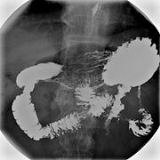
A
barium meal, also known as an
upper gastrointestinal series is a procedure in which
radiographsX-radiation is a form of electromagnetic radiation. X-rays have a wavelength in the range of 0.01 to 10 nanometers, corresponding to frequencies in the range 30 petahertz to 30 exahertz and energies in the range 120 eV to 120 keV. They are shorter in wavelength than UV rays and longer than gamma...
of the
esophagusThe esophagus is an organ in vertebrates which consists of a muscular tube through which food passes from the pharynx to the stomach. During swallowing, food passes from the mouth through the pharynx into the esophagus and travels via peristalsis to the stomach...
,
stomachThe stomach is a muscular, hollow, dilated part of the alimentary canal which functions as an important organ of the digestive tract in some animals, including vertebrates, echinoderms, insects , and molluscs. It is involved in the second phase of digestion, following mastication .The stomach is...
and
duodenumThe duodenum is the first section of the small intestine in most higher vertebrates, including mammals, reptiles, and birds. In fish, the divisions of the small intestine are not as clear and the terms anterior intestine or proximal intestine may be used instead of duodenum...
are taken after
barium sulfateBarium sulfate is the inorganic compound with the chemical formula BaSO4. It is a white crystalline solid that is odorless and insoluble in water. It occurs as the mineral barite, which is the main commercial source of barium and materials prepared from it...
is ingested by a patient. Barium meals are useful in the diagnosis of structural and
motilityMotility is a biological term which refers to the ability to move spontaneously and actively, consuming energy in the process. Most animals are motile but the term applies to single-celled and simple multicellular organisms, as well as to some mechanisms of fluid flow in multicellular organs, in...
abnormalities of the
foregutThe foregut is the anterior part of the alimentary canal, from the mouth to the duodenum at the entrance of the bile duct. At this point it is continuous with the midgut...
.
The gastrointestinal tract, like other soft-tissue structures, does not show clearly enough for diagnostic purposes on plain radiographs. Barium salts are radioopaque: they show clearly on a radiograph. If barium is swallowed before radiographs are taken, the barium within the esophagus, stomach or duodenum shows the shape of the lumina of these organs.
Liquid suspensions of barium sulfate are non-toxic, apart from a small risk of producing a disturbance in bowel function for 48 hours after ingestion. They usually have a chalky taste that can be disguised by adding flavours.
A barium meal usually takes less than an hour. The patient ingests gas pellets and citric acid to expand the stomach. Then about 3 cups (about 709mL) of Barium is ingested. The patient may move or roll over to coat the stomach and esophagus in barium. A needle may also be used to relax the muscle between the stomach and the duodenum. Following these preparations, an x-ray is taken.
There are two varieties of barium meal: single and double contrast meals. A single contrast meal uses only barium, a radioopaque (or positive) contrast medium, to image the upper gastrointestinal tract. A double contrast meal uses barium as well as a radiolucent (or negative) contrast medium such as air,
nitrogenNitrogen is a chemical element that has the symbol N, atomic number of 7 and atomic mass 14.00674 u. Elemental nitrogen is a colorless, odorless, tasteless, and mostly inert diatomic gas at standard conditions, constituting 78.08% by volume of Earth's atmosphere...
, or
carbon dioxideCarbon dioxide is a naturally occurring chemical compound composed of two oxygen atoms covalently bonded to a single carbon atom...
. The double contrast meal is more useful as a diagnostic test, demonstrating mucosal details and allowing the detection of small mucosal lesions such as
diverticulaA diverticulum is medical or biological term for an outpouching of a hollow structure in the body. Depending upon which layers of the structure are involved, they are described as being either true or false....
or
polypsA polyp is an abnormal growth of tissue projecting from a mucous membrane. If it is attached to the surface by a narrow elongated stalk, it is said to be pedunculated. If no stalk is present, it is said to be sessile. Polyps are commonly found in the colon, stomach, nose, sinus, urinary bladder...
.
The diagnostic usage of barium studies has declined in recent years with the increasing use of the practice of
esophagogastroduodenoscopyFor other expansions of the initialism "OGD", see the disambiguation page.In medicine , esophagogastroduodenoscopy is a diagnostic endoscopic procedure that visualizes the upper part of the gastrointestinal tract up to the duodenum...
, which allows direct visual inspection of suspicious areas within the oesophagus, stomach and duodenum.
See also
- Barium enema
- Barium swallow
A barium swallow is a medical imaging procedure used to examine the upper GI tract, which includes the esophagus and, to a lesser extent, the stomach.-Principle:...
- Barium follow-through
A barium follow-through procedure is a type of medical imaging technique. It is used to evaluate the presence of disease in a person's small intestine.-Examination:...