

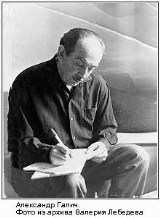
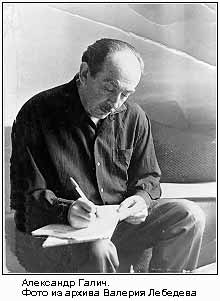
Alexander Galich

Encyclopedia
Russia
Russia or , officially known as both Russia and the Russian Federation , is a country in northern Eurasia. It is a federal semi-presidential republic, comprising 83 federal subjects...
n poet
Poet
A poet is a person who writes poetry. A poet's work can be literal, meaning that his work is derived from a specific event, or metaphorical, meaning that his work can take on many meanings and forms. Poets have existed since antiquity, in nearly all languages, and have produced works that vary...
, screenwriter, playwright, and singer-songwriter. Galich is a pen name, a sort of acronym of his last name, first name, and patronymic: Ginzburg Alexander Arkadievich. He adopted this name to conceal his Jewish ancestry in the face of antisemitism in the Soviet Union
Antisemitism in the Soviet Union
The Russian Revolution overthrew a centuries-old regime of official antisemitism. The Soviet Unions success, during its existence, in struggling with this legacy, and the degree to which its government fought against, or was itself guilty of antisemitism, is a topic of some debate...
. He also changed his patronymic from Aronovich to Arkadievich for this reason.
Biography
Alexander Ginzburg was born on 19 October 1918 in Ekaterinoslav (now DnipropetrovskDnipropetrovsk
Dnipropetrovsk or Dnepropetrovsk formerly Yekaterinoslav is Ukraine's third largest city with one million inhabitants. It is located southeast of Ukraine's capital Kiev on the Dnieper River, in the south-central region of the country...
), Ukraine
Ukrainian People's Republic
The Ukrainian People's Republic or Ukrainian National Republic was a republic that was declared in part of the territory of modern Ukraine after the Russian Revolution, eventually headed by Symon Petliura.-Revolutionary Wave:...
into a family of Jewish intellectuals
Intelligentsia
The intelligentsia is a social class of people engaged in complex, mental and creative labor directed to the development and dissemination of culture, encompassing intellectuals and social groups close to them...
. His father, Aron Samoilovich Ginzburg, was an economist, and his mother, Fanni Borisovna Veksler, worked in a music conservatory. For most of his childhood he lived in Sevastopol
Sevastopol
Sevastopol is a city on rights of administrative division of Ukraine, located on the Black Sea coast of the Crimea peninsula. It has a population of 342,451 . Sevastopol is the second largest port in Ukraine, after the Port of Odessa....
. Before World War II
World War II
World War II, or the Second World War , was a global conflict lasting from 1939 to 1945, involving most of the world's nations—including all of the great powers—eventually forming two opposing military alliances: the Allies and the Axis...
, he entered the Gorky Literary Institute, then moved to Stanislavsky's Operatic-Dramatic Studio, and then to the Studio-Theatre of A. Arbuzov and V. Pluchek (in 1939).
He wrote plays and screenplays, and in the late 1950s, he started to write songs and sing them accompanying himself on his guitar. Influenced by the Russian city romance tradition and the art of Alexander Vertinsky
Alexander Vertinsky
Alexander Nikolayevich Vertinsky was a Russian and Soviet artist, poet, singer, composer, cabaret artist and actor who exerted seminal influence on the Russian tradition of artistic singing.-Early years:...
, Galich developed his own voice within the genre. He practically single-handedly created the genre of "bard song
Bard (Soviet Union)
The term bard came to be used in the Soviet Union in the early 1960s, and continues to be used in Russia today, to refer to singer-songwriters who wrote songs outside the Soviet establishment, similarly to beatnik folk singers of the United States...
". Many of his songs spoke of the Second World War and the lives of concentration camp inmates—subjects which Vladimir Vysotsky
Vladimir Vysotsky
Vladimir Semyonovich Vysotsky was a Soviet singer, songwriter, poet, and actor whose career had an immense and enduring effect on Russian culture. He became widely known for his unique singing style and for his lyrics, which featured social and political commentary in often humorous street...
also began tackling at around the same time. They became popular with the public and were made available via magnitizdat
Magnitizdat
Magnitizdat is a term used to describe the process of re-copying and self distributing live audio tape recordings in the Soviet Union that were not available commercially...
.
His first songs, though rather innocent politically, nevertheless were distinctly out of tune with the official Soviet aesthetics. They marked a turning point in Galich's creative life, since before this, he was a quite successful Soviet man of letters. This turn was also brought about by the aborted premiere of his play Matrosskaya Tishina written for the newly opened Sovremennik Theatre
Sovremennik Theatre
Moscow Sovremennik Theatre is a theatre company in Moscow founded in 1956. "Sovremennik" means "Contemporary".-History:Sovremennik Theatre was founded by a group of young Soviet actors during Khrushchev Thaw...
. The play, already rehearsed, was banned by censors, who claimed that the author had a distorted view of the role of Jews in the Great Patriotic War. This incident was later described by Galich in the story Generalnaya Repetitsiya (Dress Rehearsal).
Galich's increasingly sharp criticism of the Soviet regime in his music caused him many problems. In 1971, he was expelled from the Soviet Writers' Union, which he had joined in 1955. In 1972, he was expelled from the Union of Cinematographers. That year he became baptized in the Orthodox Church.
Galich was forced to emigrate from the Soviet Union
Soviet Union
The Soviet Union , officially the Union of Soviet Socialist Republics , was a constitutionally socialist state that existed in Eurasia between 1922 and 1991....
in 1974. He initially lived in Norway
Norway
Norway , officially the Kingdom of Norway, is a Nordic unitary constitutional monarchy whose territory comprises the western portion of the Scandinavian Peninsula, Jan Mayen, and the Arctic archipelago of Svalbard and Bouvet Island. Norway has a total area of and a population of about 4.9 million...
for one year, where he made his first recordings outside of the USSR. These were broadcasted on Radio Liberty, a United States Congress
United States Congress
The United States Congress is the bicameral legislature of the federal government of the United States, consisting of the Senate and the House of Representatives. The Congress meets in the United States Capitol in Washington, D.C....
-funded radio station outlawed in USSR. His songs became immensely popular in the underground scene for being openly critical towards the Soviet government. He later moved to Munich
Munich
Munich The city's motto is "" . Before 2006, it was "Weltstadt mit Herz" . Its native name, , is derived from the Old High German Munichen, meaning "by the monks' place". The city's name derives from the monks of the Benedictine order who founded the city; hence the monk depicted on the city's coat...
, where he joined the Russian anti-communist organization NTS
National Alliance of Russian Solidarists
The National Alliance of Russian Solidarists ), known by its Russian abbreviation "NTS" is a Russian far-right anticommunist organization founded in 1930 by a group of young Russian anticommunist White emigres in Belgrade, Serbia .The organization was formed in response to the older generation of...
. He finally moved to Paris
Paris
Paris is the capital and largest city in France, situated on the river Seine, in northern France, at the heart of the Île-de-France region...
where, on the evening of 15 December 1977, he was found dead by his wife, clutching a Grundig
Grundig
Grundig AG is a German manufacturer of consumer electronics for home entertainment which transferred to Turkish control in 2004-2007. Established in 1945 in Nuremberg by Max Grundig, the company changed hands several times before becoming part of the Turkish Koç Holding group...
stereo recording antenna plugged into a power socket. While his death appears to have been an accident, the consensus opinion was that it was either an assassination or a suicide. As his wife was absent the whole day, no one witnessed the exact circumstances of his death.
In 1988, he was posthumously re-instated into the Writers' and Cinematographers' Unions. In 2003, the first memorial plaque for Galich was put up on a building in Akademgorodok
Akademgorodok
Akademgorodok , is a part of the Russian city Novosibirsk, located 20 km south of the city center. It is the educational and scientific centre of Siberia...
(Novosibirsk
Novosibirsk
Novosibirsk is the third-largest city in Russia, after Moscow and Saint Petersburg, and the largest city of Siberia, with a population of 1,473,737 . It is the administrative center of Novosibirsk Oblast as well as of the Siberian Federal District...
) where he performed in 1968. That same year, the Alexander Galich Memorial Society was founded.
Music
Alexander Galich, like most bards, had a fairly minimal musical background. He played his songs on a seven string Russian guitarRussian guitar
The Russian guitar is a seven-string acoustic guitar that arrived in Russia toward the end of the 18th century and the beginning of the 19th century, most probably as an evolution of the cittern, kobza, and torban...
, which was fairly standard at the time. He often wrote in the key of D minor, relying on very simple chord progressions and fingerpicking techniques. He had basic piano playing skills as well.
Galich had a signature cadence
Cadence (music)
In Western musical theory, a cadence is, "a melodic or harmonic configuration that creates a sense of repose or resolution [finality or pause]." A harmonic cadence is a progression of two chords that concludes a phrase, section, or piece of music...
that he would usually play at the conclusion of a song (and sometimes at the beginning). He would play the D minor chord toward the top of the fretboard (fret position 0XX0233, thickest to thinnest string, open G tuning), then slide down the fretboard to a higher voiced D minor (0 X X 0 10 10 12).