


Aleijadinho

Encyclopedia

Colonial Brazil
In the history of Brazil, Colonial Brazil, officially the Viceroyalty of Brazil comprises the period from 1500, with the arrival of the Portuguese, until 1815, when Brazil was elevated to kingdom alongside Portugal as the United Kingdom of Portugal, Brazil and the Algarves.During the over 300 years...
-born sculptor
Sculpture
Sculpture is three-dimensional artwork created by shaping or combining hard materials—typically stone such as marble—or metal, glass, or wood. Softer materials can also be used, such as clay, textiles, plastics, polymers and softer metals...
and architect
Architect
An architect is a person trained in the planning, design and oversight of the construction of buildings. To practice architecture means to offer or render services in connection with the design and construction of a building, or group of buildings and the space within the site surrounding the...
, noted for his works on and in various churches of Brazil.
Born in Vila Rica (Rich Town), whose name was later changed to Ouro Preto
Ouro Preto
-History:Founded at the end of the 17th century, Ouro Preto was originally called Vila Rica, or "rich village," the focal point of the gold rush and Brazil's golden age in the 18th century under Portuguese rule....
(Black Gold), Brazil, in 1738 (sometimes said to be in 1730) he was the son of Manuel Francisco de Costa Lisboa, a Portuguese
Portuguese people
The Portuguese are a nation and ethnic group native to the country of Portugal, in the west of the Iberian peninsula of south-west Europe. Their language is Portuguese, and Roman Catholicism is the predominant religion....
man and his African slave, Isabel. His father, a carpenter
Carpenter
A carpenter is a skilled craftsperson who works with timber to construct, install and maintain buildings, furniture, and other objects. The work, known as carpentry, may involve manual labor and work outdoors....
, had immigrated to Brazil where his skills were so in demand that he appears to have been elevated to the position of architect. When Antonio was young his father married and he was raised in his father's home along with his half siblings. It was there he is presumed to have learned the fundamentals of sculpture
Sculpture
Sculpture is three-dimensional artwork created by shaping or combining hard materials—typically stone such as marble—or metal, glass, or wood. Softer materials can also be used, such as clay, textiles, plastics, polymers and softer metals...
, architecture
Architecture
Architecture is both the process and product of planning, designing and construction. Architectural works, in the material form of buildings, are often perceived as cultural and political symbols and as works of art...
and the combination of the two. Antonio first appears as a day laborer working on the Church of Our Lady of Carmel in the town of Ouro Preto, a church designed by his father.

Francis of Assisi
Saint Francis of Assisi was an Italian Catholic friar and preacher. He founded the men's Franciscan Order, the women’s Order of St. Clare, and the lay Third Order of Saint Francis. St...
receiving the stigmata
Stigmata
Stigmata are bodily marks, sores, or sensations of pain in locations corresponding to the crucifixion wounds of Jesus, such as the hands and feet...
.
It was shortly thereafter that the signs of a debilitating disease, probably leprosy
Leprosy
Leprosy or Hansen's disease is a chronic disease caused by the bacteria Mycobacterium leprae and Mycobacterium lepromatosis. Named after physician Gerhard Armauer Hansen, leprosy is primarily a granulomatous disease of the peripheral nerves and mucosa of the upper respiratory tract; skin lesions...
, began to show and not long after that Antonio received the name by which he has come down through history, "o Aleijadinho", "The Little Cripple." Aleijadinho was disfigured and crippled by leprosy, and created his masterpiece with his chisel and hammer, tied to his fingerless hands.
After that he became more and more of a recluse, working mostly at night. When he did go out in public, he would be carried through the streets in a covered palanquin by his slave/assistants.
The Twelve Prophets at Congonhas
His crowning achievement was the Twelve Prophets at the Sanctuary of Bom Jesus of Matosinhos at CongonhasCongonhas
Congonhas is a historical Brazilian city located in the state of Minas Gerais. It is situated south from Belo Horizonte, the capital of state of Minas Gerais, by the highway BR-040...
. A wealthy businessman, Feliciano Mendes, had built the church to fulfill a vow made while he was desperately ill. Between 1800 and 1805 Aleijadinho sculpted the twelve soapstone
Soapstone
Soapstone is a metamorphic rock, a talc-schist. It is largely composed of the mineral talc and is thus rich in magnesium. It is produced by dynamothermal metamorphism and metasomatism, which occurs in the areas where tectonic plates are subducted, changing rocks by heat and pressure, with influx...
figures by having his assistants strap his hammer and chisels to what remained of his hands, which did not at this point include fingers. Since he no longer had feet to stand on he had pads strapped to his knees up which he'd climb the ladders needed to get him off the ground. The Twelve Prophets are arranged around the courtyard
Courtyard
A court or courtyard is an enclosed area, often a space enclosed by a building that is open to the sky. These areas in inns and public buildings were often the primary meeting places for some purposes, leading to the other meanings of court....
and stairway in front of the church.
The Passion Figures at Congonhas
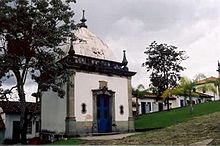
Passion (Christianity)
The Passion is the Christian theological term used for the events and suffering – physical, spiritual, and mental – of Jesus in the hours before and including his trial and execution by crucifixion...
. There are sixty-six life-sized figures carved in wood from 1780 to 1790, beginning with the Last Supper and ending with the Crucifixion. The main figures, Christ
Christ
Christ is the English term for the Greek meaning "the anointed one". It is a translation of the Hebrew , usually transliterated into English as Messiah or Mashiach...
, Peter
Saint Peter
Saint Peter or Simon Peter was an early Christian leader, who is featured prominently in the New Testament Gospels and the Acts of the Apostles. The son of John or of Jonah and from the village of Bethsaida in the province of Galilee, his brother Andrew was also an apostle...
, James
Saint James the Great
James, son of Zebedee was one of the Twelve Apostles of Jesus. He was a son of Zebedee and Salome, and brother of John the Apostle...
, John
John the Apostle
John the Apostle, John the Apostle, John the Apostle, (Aramaic Yoħanna, (c. 6 - c. 100) was one of the Twelve Apostles of Jesus. He was the son of Zebedee and Salome, and brother of James, another of the Twelve Apostles...
, the Good and Bad thieves, Mary Magdalene
Mary Magdalene
Mary Magdalene was one of Jesus' most celebrated disciples, and the most important woman disciple in the movement of Jesus. Jesus cleansed her of "seven demons", conventionally interpreted as referring to complex illnesses...
, and Mary, mother of Jesus are carved by Aleijadinho while the other figures, Roman
Roman Empire
The Roman Empire was the post-Republican period of the ancient Roman civilization, characterised by an autocratic form of government and large territorial holdings in Europe and around the Mediterranean....
soldiers, on-lookers and lesser figures were carved by his assistants. The figures were later painted by Manoel da Costa Ataíde
Manoel da Costa Ataíde
Manoel da Costa Ataíde, better known as Mestre Ataíde , was a Brazilian painter, sculptor, gilder and teacher.He was an important artist of the baroque school in Minas Gerais and had a major influence on painting in the region, with many students and followers...
, who also painted (1828) the ceiling of Lisboa's Church of Saint Francis of Assisi
Church of Saint Francis of Assisi (Ouro Preto)
The Church of Saint Francis of Assisi is a Rococo Catholic church in Ouro Preto, Brazil.Its erection began in 1766 after a design by the great Brazilian architect and sculptor Antônio Francisco Lisboa, the so-called Aleijadinho, who also designed the carved decorations inside, which were only...
in Ouro Preto. One of the figures watching the crucifixion
Crucifixion
Crucifixion is an ancient method of painful execution in which the condemned person is tied or nailed to a large wooden cross and left to hang until dead...
is believed to be a portrait (or self-portrait
Self-portrait
A self-portrait is a representation of an artist, drawn, painted, photographed, or sculpted by the artist. Although self-portraits have been made by artists since the earliest times, it is not until the Early Renaissance in the mid 15th century that artists can be frequently identified depicting...
) of Aleijadinho.
Melo (see sources) writes that the prevailing religious ideals at that time were, "associated with the ideas of pain, acceptance of suffering and reflection on the passion of Christ through visual reminders of His wounds."
He died on November 18, 1814 and was buried in the Church of Our Lady of Conception of Antonio Dias under a wooden floor section with his name carved on it.
Controversy
There is some debate as to whether Aleijadinho actually existed. The theory that Aleijadinho was actually a myth was proposed by Augusto de Lima, Jr., who suggested that Aleijadinho was invented by Rodrigo Bretas in his book "Traços Biográficos de Antônio Francisco Lisboa" (Biographical Traces of Antônio Francisco Lisboa). This theory relies on the notion that there were no references to Aleijadinho until this book was written.Recently published research further challenges the traditional biography of the artist. Faced with the lack of documentary evidence, the author identifies Antônio Francisco Lisboa as a poor sculptor in 18th century Vila Rica
Ouro Preto
-History:Founded at the end of the 17th century, Ouro Preto was originally called Vila Rica, or "rich village," the focal point of the gold rush and Brazil's golden age in the 18th century under Portuguese rule....
(Ouro Preto original designation), but not a victim of the deformities that would have earned him the nickname. His work, of much smaller scope than usually attributed, had to be confined to Ouro Preto and surrounding areas where he lived all of his life. There is no evidence for his work as an architect and even his parentage is in doubt. Instead, Guiomar de Grammont proposes the figure of a talented maker of religious imagery, a trade possibly shared with other artisans in the same workshop. In her interpretation, the Aleijadinho myth was created by the Rodrigo Bretas biography and reinforced over time by modernist intellectuals who saw in this character a symbolic founder of an indigenous Brazilian culture.
Sources
- Abrantes, José Israel and C Bandeira de Melo, Visitando Ouro Preto, Mariana E Congonhas, Ouro Preto Turismo Receptivo Ltda.
- Bazin, Germain, O Aleijadinho e a escultura barroca no Brasil, Rio, Editora Record, 1971
- Bretas, Rodrigo José Ferreira, Antônio Francisco Lisboa, Editora Itatiaia, Belo Horizonte, Brazil 2002
- Bury, John, Arquitetura e Arte no Brasil Colonial, São Paulo, Editora Nobel, 1991
- Drummond, Aristóteles, Minas : História, Estórias, Evocações, Cultura, Personalidades, Economia, Belo Horizonte, MG : Armazém de Idéias, 2002
- Ferreira, Delson Gonçalves, O Aleijadinho, Belo Horizonte, Editora Comunicação, Prefeitura de Belo Horizonte, 1981
- Jardim, Márcio, O Aleijadinho; uma síntese histórica, Editora Stellarum, Belo Horizonte, Brazil 1995
- Kelemen, Pál, Baroque and Rococo in Latin America, Volumes 1 and 2, Dover Publications, Inc. NY 1967
- Kvaran, Einar Einarsson, To Brazil ! – The Search for Aleijadinho, unpublished manuscript
- Mann, Graciela and Hans Mann, The Twelve Prophets of Aleijadinho, University of Texas Press, Austin, Texas 1967
- Oliveira, Myriam Andrade Ribeiro de & Santos Filho, Olinto Rodrigues dos & Santos, Antônio Fernando Batista dos, O Aleijadinho e sua oficina; catálogo das imagens devocionais, São Paulo, Editora Capivara, 2002
- Rodrigues, José Wasth, Documentário Arquitetônico, Editora Da Universidade De São Paulo, Belo Horizonte, Brazil 1990
- Vasconcellos, Sylvio de, Vida e obra de Antônio Francisco Lisboa, o Aleijadinho, São Paulo, Companhia Editora Nacional, 1979