


Yoshon

Encyclopedia
Judaism
Judaism ) is the "religion, philosophy, and way of life" of the Jewish people...
, Chodosh (or Chadash) is a concept within Kashrut
Kashrut
Kashrut is the set of Jewish dietary laws. Food in accord with halakha is termed kosher in English, from the Ashkenazi pronunciation of the Hebrew term kashér , meaning "fit" Kashrut (also kashruth or kashrus) is the set of Jewish dietary laws. Food in accord with halakha (Jewish law) is termed...
(the Jewish dietary regulations), based on the Biblical requirement not to eat any grain
GRAIN
GRAIN is a small international non-profit organisation that works to support small farmers and social movements in their struggles for community-controlled and biodiversity-based food systems. Our support takes the form of independent research and analysis, networking at local, regional and...
of the new year (or products made from it) prior to the annual Omer offering
Korban
The term offering as found in the Hebrew Bible in relation to the worship of Ancient Israel is mainly represented by the Hebrew noun korban whether for an animal or other offering...
on the 16th day of Nisan
Nisan
Nisan is the first month of the ecclesiastical year and the seventh month of the civil year, on the Hebrew calendar. The name of the month is Babylonian; in the Torah it is called the month of the Aviv, referring to the month in which barley was ripe. It is a spring month of 30 days...
.
Grain products which are no longer affected by this law are referred to as Yoshon (= old).
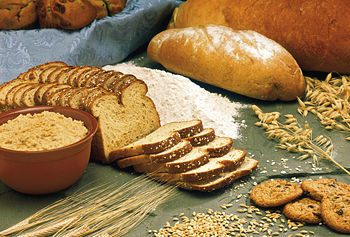
The five types of grain
In Rabbinic Judaism, this requirement is restricted to the five classical grains of Judaism - WheatWheat
Wheat is a cereal grain, originally from the Levant region of the Near East, but now cultivated worldwide. In 2007 world production of wheat was 607 million tons, making it the third most-produced cereal after maize and rice...
, Barley
Barley
Barley is a major cereal grain, a member of the grass family. It serves as a major animal fodder, as a base malt for beer and certain distilled beverages, and as a component of various health foods...
, Oat
Oat
The common oat is a species of cereal grain grown for its seed, which is known by the same name . While oats are suitable for human consumption as oatmeal and rolled oats, one of the most common uses is as livestock feed...
, Spelt
Spelt
Spelt is a hexaploid species of wheat. Spelt was an important staple in parts of Europe from the Bronze Age to medieval times; it now survives as a relict crop in Central Europe and northern Spain and has found a new market as a health food. Spelt is sometimes considered a subspecies of the...
, and Rye
Rye
Rye is a grass grown extensively as a grain and as a forage crop. It is a member of the wheat tribe and is closely related to barley and wheat. Rye grain is used for flour, rye bread, rye beer, some whiskeys, some vodkas, and animal fodder...
; any of these grains (or products made from them) that are too "young" to pass the requirement are referred to in Judaism as Chadash ("new [grain]"). Additionally, the Rabbinic interpretation requires grain to have taken root prior to the Omer offering for it to become permitted; therefore, grains planted after Passover could only be consumed -at earliest- twelve months later.
Following the destruction of the Temple in Jerusalem
Temple in Jerusalem
The Temple in Jerusalem or Holy Temple , refers to one of a series of structures which were historically located on the Temple Mount in the Old City of Jerusalem, the current site of the Dome of the Rock. Historically, these successive temples stood at this location and functioned as the centre of...
, the Omer offering is no longer offered. Hence, Chazal
Chazal
Chazal or Ḥazal is an acronym for the Hebrew "Ḥakhameinu Zikhronam Liv'rakha",...
enacted that the new grain becomes permissible following the date on which the offering was brought in ancient times.
Outside of the Land of Israel
The applicability of the Chadash rules to grain grown outside the Land of IsraelLand of Israel
The Land of Israel is the Biblical name for the territory roughly corresponding to the area encompassed by the Southern Levant, also known as Canaan and Palestine, Promised Land and Holy Land. The belief that the area is a God-given homeland of the Jewish people is based on the narrative of the...
is a subject of debate among halakhic
Halakha
Halakha — also transliterated Halocho , or Halacha — is the collective body of Jewish law, including biblical law and later talmudic and rabbinic law, as well as customs and traditions.Judaism classically draws no distinction in its laws between religious and ostensibly non-religious life; Jewish...
authorities. The majority of medieval Jewish scholars (e.g. Moses Maimonides, the Rif, and the Rosh) forbade its consumption. The later codifiers of Jewish law for Ashkenazic and Sephardic Jewry followed suit, both Rabbi Moses Isserles
Moses Isserles
Moses Isserles, also spelled Moshe Isserlis, , was an eminent Ashkenazic rabbi, talmudist, and posek, renowned for his fundamental work of Halakha , entitled ha-Mapah , an inline commentary on the Shulkhan Aruch...
and Rabbi Joseph Caro declaring the stringent position. A radically novel lenient approach was presented by Rabbi Yoel Sirkis
Yoel Sirkis
Joel ben Samuel Sirkis also known as the Bach - an abbreviation of his magnum opus, Bayit Chadash - was a prominent Jewish posek and halakhist. He lived in central Europe and held rabbinical positions in Belz, Brest-Litovsk and Kraków from 1561-1640.-Biography:Sirkis was born in Lublin in 1561...
who felt it is permissible if the grain originally belonged to a non-Jew. Additionally, the manner in which various foods have historically been available has meant that Jewish populations would need to risk starvation to pursue stringent compliance with this aspect of kashrut. These two factors led to a situation in which observation of the Yashan regulation was relatively limited until very recently (at least in the Ashkenazic community).
In Chabad literature
Rabbi Schneur Zalman of Liadi -the author of TanyaTanya
The Tanya is an early work of Hasidic philosophy, by Rabbi Shneur Zalman of Liadi, the founder of Chabad Hasidism, first published in 1797. Its formal title is Likkutei Amarim , but is more commonly known by its opening word, Tanya, which means "it was taught in a beraita"...
and Shulchan Aruch HaRav
Shulchan Aruch HaRav
The Shulchan Aruch HaRav is a codification of halakha by Rabbi Shneur Zalman of Liadi, known during his lifetime as HaRav...
- quotes the basic opinion of Chadash being forbidden Midioraita
D'Oraita and D'Rabbanan
The Aramaic terms de-'oraita and de-rabbanan are used extensively in discussion and text relating to Jewish law. The former refers to halachic requirements that are biblically mandated, while the latter refers to halachic requirements that are rabbinically mandated...
and after considering the leniency of Rabbi Yoel Sirkis writes that -even for wheat harvested from a non-Jewish field- a "Baal Nefesh" (lit. an "owner of soul") should be scrupulous and not rely on lenient Rabbinic opinions. Similarly, In a responsa
Responsa
Responsa comprise a body of written decisions and rulings given by legal scholars in response to questions addressed to them.-In the Roman Empire:Roman law recognised responsa prudentium, i.e...
of Rabbi Schneur Zalman, he notes that in generations prior to his the custom was to take the lenient approach (i.e. rely on Rabbi Sirkes's leniency) but in his generation many have assumed the stringency of not consuming Chadash.
Rabbi Schneur Zalman's son, the Mitteler Rebbe explains in a Maamor
Maamor
Maamor or ma'amar , literally meaning an "expression/statement", in a broader sense "teaching/lesson", is derived from the Hebrew word to "speak/pronounce/express". It is sometimes used in traditional Judaism for a printed study of Torah teachings...
the important aspect of the Kohen
Kohen
A Kohen is the Hebrew word for priest. Jewish Kohens are traditionally believed and halachically required to be of direct patrilineal descent from the Biblical Aaron....
bringing the Omer offering on the Mizbeach (from Barley
Barley
Barley is a major cereal grain, a member of the grass family. It serves as a major animal fodder, as a base malt for beer and certain distilled beverages, and as a component of various health foods...
-usually used as Feed
Compound feed
Compound feeds are feedstuffs that are blended from various raw materials and additives. These blends are formulated according to the specific requirements of the target animal...
) and only then is the consumption of Wheat (usually reserved for Human consumption) permitted.
From the writing of his followers, it has recently been published that Rabbi Sholom Dovber Schneersohn
Sholom Dovber Schneersohn
Sholom Dovber Schneersohn was an Orthodox rabbi and the fifth Rebbe of the Chabad Lubavitch chasidic movement. He is also known as "the Rebbe nishmosei eiden" and as "the Rebbe Rashab" .His teachings represent the emergence of an emphasis on outreach that later Chabad Rebbes would develop...
-the Fifth Chabad Rebbe- was scrupulous in refraining from Chadash products when he attended a Siyyum of Yeshivah Students.
Chodosh today
In modern times, particularly in Developed Nations, food is much more readily available than it historically had been, and grain is in sufficient abundance that many Orthodox JewsOrthodox Judaism
Orthodox Judaism , is the approach to Judaism which adheres to the traditional interpretation and application of the laws and ethics of the Torah as legislated in the Talmudic texts by the Sanhedrin and subsequently developed and applied by the later authorities known as the Gaonim, Rishonim, and...
have become more interested in observing chodosh restrictions. Modern packaging practices, which in some nations involve the stamping of production dates on every package, often allow individuals to determine whether food is definitely yashan (not "chodosh"); packaging organisations sometimes add Kashrut information to the packaging
Hechsher
A hechsher is the special certification marking found on the packages of products that have been certified as kosher . In Halakha , the dietary laws of kashrut specify food items that may be eaten and others that are prohibited as set out in the commandments of the Torah...
, and sometimes include in this information whether the product is known to be yashan.