

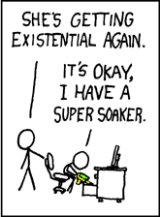
Xkcd

Encyclopedia
xkcd is a webcomic
created by Randall Munroe
. The comic's tagline describes it as "a webcomic of romance, sarcasm, math, and language." It has been recognized in such mainstream media as The Guardian
and The New York Times
.
The subject matter of the comic varies, including statements on life and love (some love strips are simply art with poetry), and mathematical
or scientific
in-joke
s. Some strips feature simple humor or pop-culture references. Although it has a cast of stick figures, the comic occasionally features landscapes, intricate mathematical patterns such as fractal
s (for example, strip #17 "What If shows an Apollonian gasket
), or imitations of the style of other cartoonists (as during "Parody Week").
The comic is available under the Creative Commons
Attribution-NonCommercial 2.5 License. New comics are added three times a week, on Mondays, Wednesdays, and Fridays; although, on six occasions so far, they have been updated every weekday: Parody Week, the "Choices" series, the "1337
" series, the "Secretary" series, the "The Race" series, the set of three "Five Minute Comics", and Guest Comic Week.
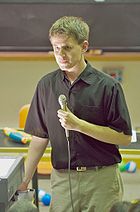 The comic began in September 2005 when Munroe decided to scan doodles
from his school notebooks and put them on his webpage. Eventually the comic was changed into a stand-alone website, where Munroe started selling T-shirts based on the comic. He currently "works on the comic full time," making Munroe one of the few professional webcomic artists. According to Munroe, the comic's name has no particular significance and is simply a four-letter word without a phonetic pronunciation, something he describes as "a treasured and carefully guarded point in the space of four-character strings
." The name of the comic is spelled in all lowercase letters, or all capitals.
In May 2007, the comic garnered widespread attention by depicting online communities in geographic form. Various websites were drawn as continents, each sized according to their relative popularity and located according to their general subject matter. This put xkcd at number two on the Syracuse Post-Standards "The new hotness" list.
On September 23, 2007, hundreds of people gathered at Reverend Thomas J. Williams park 42.39561°N 71.13051°W, in North Cambridge, Massachusetts whose coordinates were mentioned in a strip, #240. Munroe appeared, commenting, "Maybe wanting something does make it real," reversing the conclusion he drew in the last frame of the same strip.
In October 2008, The New Yorker
magazine online published an interview and "Cartoon Off" between Randall Munroe
and Farley Katz. For the "Cartoon-Off," Katz and Munroe each drew: "the Internet, as envisioned by the elderly", "String Theory", "1999", and "your favorite animal eating your favorite food".
In March, 2010, a puzzle hidden inside of the collection xkcd: Volume 0 was cracked by many members of the xkcd forums. The solution was "<3<3<3 2010-06-26 14:28:57 37.769573°N 122.483123°W." The first six characters were hearts, followed by a date, time, and coordinates. (June 26, 2010, 2:28:57 PM at Golden Gate Park
, specifically at the coordinates specified by Google Earth if you search for Golden Gate Park.) At the appropriate time and date, Randall again met with fans and handed out 255 limited edition prints of xkcd: Volume 0, titled xkcd: Volume 0 Service Pack 1.
's I Love the World
commercial.
 A large number of the strips contain mathematics or computer science
jokes. These jokes often feature university-level subjects, although many are written in such a way that a clear understanding of the subject is not required to get the punch line
. Romance is another subject often visited in the comic, with many strips not intended to be humorous; Munroe is a self-declared fan of Kurt Halsey's bleak romances.
There are also many strips opening with "My Hobby:" and usually depicting the nondescript narrator character describing some type of humorous or quirky behavior often involving language games.
References to Wikipedia
articles or to Wikipedia
as a whole have occurred in xkcd. For example, a facsimile of a made-up Wikipedia entry for "Malamanteau" (a stunt word
created by Munroe to poke fun at Wikipedia's writing style) appeared, provoking a controversy within Wikipedia that was picked up by various media. xkcd also frequently makes reference to Munroe's "obsession" with potential raptor
attacks, and has used many "your mom
" jokes. Multiple earlier strips featured "Red Spiders", and others refer to Joss Whedon's
science fiction series Firefly
.
Each comic also has a tooltip
, specified using the title attribute in HTML
. The text usually contains an afterthought or annotation related to that day's comic.
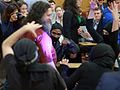
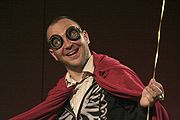 On several occasions, fans have been motivated by Munroe's comics to carry out, in real life, the subject of a particular drawing or sketch. Some examples include:
. In the 2008 Awards
, it was nominated for "Outstanding Use of the Medium," "Outstanding Short Form Comic," and "Outstanding Comedic Comic," and won "Outstanding Single Panel Comic." xkcd was also voted Best Comic Strip by readers in the 2007 Weblog Awards and 2008 Weblog Awards. It was also nominated for a 2009 NewNowNext Award
in the category 'OMFG Internet Award'. Randall Munroe has been nominated for the 2011 Hugo Award
for Best Fan Artist.
and nearly half of the comics have been translated into Russian
. One reader has translated many of the comics into Spanish
; translations exist for comics that, according to the translator, can be translated without losing their humor. Various xkcd comics have also been translated into German, Finnish, Czech, and Portuguese.
, under a Creative Commons
license, with all of the publisher's profits donated to Room to Read
to promote literacy and education in the developing world. Six months after release, the book has sold over 25,000 copies. The book tour in New York City
and Silicon Valley
was a fundraiser for Room to Read that raised $32,000 to build a school in Laos
.
Webcomic
Webcomics, online comics, or Internet comics are comics published on a website. While many are published exclusively on the web, others are also published in magazines, newspapers or often in self-published books....
created by Randall Munroe
Randall Munroe
Randall Patrick Munroe is an American webcomic author and former NASA roboticist as well as a programmer, best known as the creator of the webcomic xkcd...
. The comic's tagline describes it as "a webcomic of romance, sarcasm, math, and language." It has been recognized in such mainstream media as The Guardian
The Guardian
The Guardian, formerly known as The Manchester Guardian , is a British national daily newspaper in the Berliner format...
and The New York Times
The New York Times
The New York Times is an American daily newspaper founded and continuously published in New York City since 1851. The New York Times has won 106 Pulitzer Prizes, the most of any news organization...
.
The subject matter of the comic varies, including statements on life and love (some love strips are simply art with poetry), and mathematical
Mathematical joke
A mathematical joke is a form of humor which relies on aspects of mathematics or a stereotype of mathematicians to derive humor. The humor may come from a pun, or from a double meaning of a mathematical term. It may also come from a lay person's misunderstanding of a mathematical concept...
or scientific
Science
Science is a systematic enterprise that builds and organizes knowledge in the form of testable explanations and predictions about the universe...
in-joke
In-joke
An in-joke, also known as an inside joke or in joke, is a joke whose humour is clear only to people who are in a particular social group, occupation, or other community of common understanding...
s. Some strips feature simple humor or pop-culture references. Although it has a cast of stick figures, the comic occasionally features landscapes, intricate mathematical patterns such as fractal
Fractal
A fractal has been defined as "a rough or fragmented geometric shape that can be split into parts, each of which is a reduced-size copy of the whole," a property called self-similarity...
s (for example, strip #17 "What If shows an Apollonian gasket
Apollonian gasket
In mathematics, an Apollonian gasket or Apollonian net is a fractal generated from triples of circles, where each circle is tangent to the other two. It is named after Greek mathematician Apollonius of Perga.-Construction:...
), or imitations of the style of other cartoonists (as during "Parody Week").
The comic is available under the Creative Commons
Creative Commons
Creative Commons is a non-profit organization headquartered in Mountain View, California, United States devoted to expanding the range of creative works available for others to build upon legally and to share. The organization has released several copyright-licenses known as Creative Commons...
Attribution-NonCommercial 2.5 License. New comics are added three times a week, on Mondays, Wednesdays, and Fridays; although, on six occasions so far, they have been updated every weekday: Parody Week, the "Choices" series, the "1337
Leet
Leet , also known as eleet or leetspeak, is an alternative alphabet for the English language that is used primarily on the Internet. It uses various combinations of ASCII characters to replace Latinate letters...
" series, the "Secretary" series, the "The Race" series, the set of three "Five Minute Comics", and Guest Comic Week.
History
Doodle
A doodle is an unfocused drawing made while a person's attention is otherwise occupied. Doodles are simple drawings that can have concrete representational meaning or may just be abstract shapes....
from his school notebooks and put them on his webpage. Eventually the comic was changed into a stand-alone website, where Munroe started selling T-shirts based on the comic. He currently "works on the comic full time," making Munroe one of the few professional webcomic artists. According to Munroe, the comic's name has no particular significance and is simply a four-letter word without a phonetic pronunciation, something he describes as "a treasured and carefully guarded point in the space of four-character strings
String (computer science)
In formal languages, which are used in mathematical logic and theoretical computer science, a string is a finite sequence of symbols that are chosen from a set or alphabet....
." The name of the comic is spelled in all lowercase letters, or all capitals.
In May 2007, the comic garnered widespread attention by depicting online communities in geographic form. Various websites were drawn as continents, each sized according to their relative popularity and located according to their general subject matter. This put xkcd at number two on the Syracuse Post-Standards "The new hotness" list.
On September 23, 2007, hundreds of people gathered at Reverend Thomas J. Williams park 42.39561°N 71.13051°W, in North Cambridge, Massachusetts whose coordinates were mentioned in a strip, #240. Munroe appeared, commenting, "Maybe wanting something does make it real," reversing the conclusion he drew in the last frame of the same strip.
In October 2008, The New Yorker
The New Yorker
The New Yorker is an American magazine of reportage, commentary, criticism, essays, fiction, satire, cartoons and poetry published by Condé Nast...
magazine online published an interview and "Cartoon Off" between Randall Munroe
Randall Munroe
Randall Patrick Munroe is an American webcomic author and former NASA roboticist as well as a programmer, best known as the creator of the webcomic xkcd...
and Farley Katz. For the "Cartoon-Off," Katz and Munroe each drew: "the Internet, as envisioned by the elderly", "String Theory", "1999", and "your favorite animal eating your favorite food".
In March, 2010, a puzzle hidden inside of the collection xkcd: Volume 0 was cracked by many members of the xkcd forums. The solution was "<3<3<3 2010-06-26 14:28:57 37.769573°N 122.483123°W." The first six characters were hearts, followed by a date, time, and coordinates. (June 26, 2010, 2:28:57 PM at Golden Gate Park
Golden Gate Park
Golden Gate Park, located in San Francisco, California, is a large urban park consisting of of public grounds. Configured as a rectangle, it is similar in shape but 20% larger than Central Park in New York, to which it is often compared. It is over three miles long east to west, and about half a...
, specifically at the coordinates specified by Google Earth if you search for Golden Gate Park.) At the appropriate time and date, Randall again met with fans and handed out 255 limited edition prints of xkcd: Volume 0, titled xkcd: Volume 0 Service Pack 1.
Recurring items
While there is no specific storyline to the comic, there are some recurring themes and characters, many of which are touched on in an xkcd parody of the Discovery ChannelDiscovery Channel
Discovery Channel is an American satellite and cable specialty channel , founded by John Hendricks and distributed by Discovery Communications. It is a publicly traded company run by CEO David Zaslav...
's I Love the World
I Love the World
I Love the World, also known as I Love the Whole World, is an advertising campaign launched by Discovery Channel in 2008 in promotion of their new tagline: "The World is Just... Awesome"...
commercial.
Themes
Computer science
Computer science or computing science is the study of the theoretical foundations of information and computation and of practical techniques for their implementation and application in computer systems...
jokes. These jokes often feature university-level subjects, although many are written in such a way that a clear understanding of the subject is not required to get the punch line
Punch line
A punch line is the final part of a joke, comedy sketch, or profound statement, usually the word, sentence or exchange of sentences which is intended to be funny or to provoke laughter or thought from listeners...
. Romance is another subject often visited in the comic, with many strips not intended to be humorous; Munroe is a self-declared fan of Kurt Halsey's bleak romances.
There are also many strips opening with "My Hobby:" and usually depicting the nondescript narrator character describing some type of humorous or quirky behavior often involving language games.
References to Wikipedia
Wikipedia in culture
References to Wikipedia in culture have increased as more people learn about and use the online encyclopedia project. Many parody Wikipedia's openness, with characters vandalising or modifying articles. Still others feature characters using the references as a source, or positively comparing a...
articles or to Wikipedia
Wikipedia
Wikipedia is a free, web-based, collaborative, multilingual encyclopedia project supported by the non-profit Wikimedia Foundation. Its 20 million articles have been written collaboratively by volunteers around the world. Almost all of its articles can be edited by anyone with access to the site,...
as a whole have occurred in xkcd. For example, a facsimile of a made-up Wikipedia entry for "Malamanteau" (a stunt word
Stunt word
A stunt word is a neologism created to produce a special effect, or to attract attention. Examples are gloatation, titterosity, santorum, scrumtrulescent, and truthiness. Some stunt words are portmanteau words....
created by Munroe to poke fun at Wikipedia's writing style) appeared, provoking a controversy within Wikipedia that was picked up by various media. xkcd also frequently makes reference to Munroe's "obsession" with potential raptor
Velociraptor
Velociraptor is a genus of dromaeosaurid theropod dinosaur that existed approximately 75 to 71 million years ago during the later part of the Cretaceous Period. Two species are currently recognized, although others have been assigned in the past. The type species is V. mongoliensis; fossils...
attacks, and has used many "your mom
Your Mom
A maternal insult is a reference to a person's mother through the use of phrases such as "your mother" or other regional variants, frequently used to insult the target by way of their mother. Used as an insult, "your mother..." preys on widespread sentiments of filial piety, making the insult...
" jokes. Multiple earlier strips featured "Red Spiders", and others refer to Joss Whedon's
Joss Whedon
Joseph Hill "Joss" Whedon is an American screenwriter, executive producer, director, comic book writer, occasional composer and actor, founder of Mutant Enemy Productions and co-creator of Bellwether Pictures...
science fiction series Firefly
Firefly (TV series)
Firefly is an American space western television series created by writer and director Joss Whedon, under his Mutant Enemy Productions label. Whedon served as executive producer, along with Tim Minear....
.
Each comic also has a tooltip
Tooltip
The tooltip or infotip is a common graphical user interface element. It is used in conjunction with a cursor, usually a mouse pointer. The user hovers the cursor over an item, without clicking it, and a tooltip may appear—a small "hover box" with information about the item being hovered...
, specified using the title attribute in HTML
HTML
HyperText Markup Language is the predominant markup language for web pages. HTML elements are the basic building-blocks of webpages....
. The text usually contains an afterthought or annotation related to that day's comic.
Characters
Although Munroe does not maintain a list of characters on his web site, some recurring characters can be identified by their visual features (for example, hats) and mannerisms.- A man who looks like a normal stick-figure xkcd character, but for the addition of a black hat. The man's hat is a reference to Aram from the now-defunct webcomic Men in Hats, not to black hat hackersBlack hatA black hat is the villain or bad guy, especially in a western movie in which such a character would stereotypically wear a black hat in contrast to the hero's white hat, especially in black and white movies....
as is often supposed. This character first appeared in the comic "Poisson" (the twelfth comic published on the website). The character refers to himself as a "Classhole" (a portmanteau of "classy" and "asshole"). He does not shy from pointing out the failures of others and has at times used extreme violence in order to emphasize a point. In the January 30, 2008 comic, his hat was taken by a woman, though he later retrieved his hat by stealing a submarine and using it to crash through the ice where she was skating. The latest appearance of the two together was comic #984. The character is one of the most frequently occurring in the comic, though he remains unnamed (he was referred to in multiple comics as "hat guy"). In the "Secretary" story arc, he is nominated for the post of Secretary of the Internet when the Internet has started to collapse, but after a variety of hijinks involving Ron PaulRon PaulRonald Ernest "Ron" Paul is an American physician, author and United States Congressman who is seeking to be the Republican Party candidate in the 2012 presidential election. Paul represents Texas's 14th congressional district, which covers an area south and southwest of Houston that includes...
, Cory DoctorowCory DoctorowCory Efram Doctorow is a Canadian-British blogger, journalist, and science fiction author who serves as co-editor of the blog Boing Boing. He is an activist in favour of liberalising copyright laws and a proponent of the Creative Commons organization, using some of their licences for his books...
, and the Auto-Troll Shuffle (described as him taking a whole car apart, swapping the parts with the same parts of random cars in the same parking lot, and then building a new car out of those), is sentenced to death, escaping by filling the Capitol rotunda with plastic ball pitBall pitA ball pit is a pit, usually rectangular and padded, filled with small colorful hollow plastic balls...
-style balls, which distracts the pursuers, while he flees on Doctorow's hot-air balloon. - The most common recurring female "character" is known as Megan in several strips; she was first referred to by name in comic #159 – "Boombox", and again several times afterward. She is recognized by her short, dark hair.
- A boy in a barrel appeared in five early strips. Unlike most other characters, he is not a stick figure. He was repeatedly seen inside a barrel, floating in a large body of water. The boy in the barrel was one of many doodles in the older comics, but has not been seen since comic #31, in which he flew away with a ferret wearing a toy airplane.
- Another set of recurring characters is the nihilistNihilismNihilism is the philosophical doctrine suggesting the negation of one or more putatively meaningful aspects of life. Most commonly, nihilism is presented in the form of existential nihilism which argues that life is without objective meaning, purpose, or intrinsic value...
and the beretBeretA beret is a soft, round, flat-crowned hat, designated a "cap", usually of woven, hand-knitted wool, crocheted cotton, or wool felt, or acrylic fiber....
-wearing existentialist. Until comic #291, they had only been seen together, never separately. They are first seen in the "Nihilism" comic, and again in "Kayak," "Hypotheticals", and "Dark Flow." - Fictionalised versions of well known real-life figures in the computing and scientific community sometimes appear, such as free softwareFree softwareFree software, software libre or libre software is software that can be used, studied, and modified without restriction, and which can be copied and redistributed in modified or unmodified form either without restriction, or with restrictions that only ensure that further recipients can also do...
advocates Richard StallmanRichard StallmanRichard Matthew Stallman , often shortened to rms,"'Richard Stallman' is just my mundane name; you can call me 'rms'"|last= Stallman|first= Richard|date= N.D.|work=Richard Stallman's homepage...
and Cory DoctorowCory DoctorowCory Efram Doctorow is a Canadian-British blogger, journalist, and science fiction author who serves as co-editor of the blog Boing Boing. He is an activist in favour of liberalising copyright laws and a proponent of the Creative Commons organization, using some of their licences for his books...
, and physicist Richard FeynmanRichard FeynmanRichard Phillips Feynman was an American physicist known for his work in the path integral formulation of quantum mechanics, the theory of quantum electrodynamics and the physics of the superfluidity of supercooled liquid helium, as well as in particle physics...
. Other celebrities such as actress Summer GlauSummer GlauSummer Lyn Glau is an American actress, known for playing River Tam in the science fiction series Firefly and follow-up film Serenity, and for playing Cameron in the series Terminator: The Sarah Connor Chronicles.-Early life:...
also appear in xkcd. - Gary GygaxGary GygaxErnest Gary Gygax was an American writer and game designer best known for co-creating the pioneering role-playing game Dungeons & Dragons with Dave Arneson. Gygax is generally acknowledged as the father of role-playing games....
makes an appearance in the comic "Ultimate Game" - Mrs. Roberts was a main character in the "1337" series, and has appeared in other comics along with her children, Robert'); DROP TABLE Students;-- aka "Little Bobby Tables" (a reference to SQL injectionSQL injectionA SQL injection is often used to attack the security of a website by inputting SQL statements in a web form to get a badly designed website in order to dump the database content to the attacker. SQL injection is a code injection technique that exploits a security vulnerability in a website's software...
), and Elaine Roberts (although her first name is really "Help I'm trapped in a drivers license factory"), the protagonist of the "1337" series. - FireflyFirefly (TV series)Firefly is an American space western television series created by writer and director Joss Whedon, under his Mutant Enemy Productions label. Whedon served as executive producer, along with Tim Minear....
character River Tam—and actress Summer GlauSummer GlauSummer Lyn Glau is an American actress, known for playing River Tam in the science fiction series Firefly and follow-up film Serenity, and for playing Cameron in the series Terminator: The Sarah Connor Chronicles.-Early life:...
, who played her—has appeared in a few comics, usually in a dream sequence where a character in the strip makes reference to her. Other Firefly cast members, such as Nathan FillionNathan FillionNathan Fillion is a Canadian actor, currently starring as Richard Castle on the ABC series Castle. He is also known for his portrayal of the lead role of Captain Malcolm Reynolds in the television series Firefly and its feature film continuation, Serenity.He has acted in traditionally distributed...
, have appeared in the series and many turn out to have similar personalities to their Firefly characters.
Inspired activities
- Richard StallmanRichard StallmanRichard Matthew Stallman , often shortened to rms,"'Richard Stallman' is just my mundane name; you can call me 'rms'"|last= Stallman|first= Richard|date= N.D.|work=Richard Stallman's homepage...
was sent a katanaKatanaA Japanese sword, or , is one of the traditional bladed weapons of Japan. There are several types of Japanese swords, according to size, field of application and method of manufacture.-Description:...
and was confronted by students dressed as ninjas before speaking at the Yale Political UnionYale Political UnionThe Yale Political Union , a debate society now the largest student organization at Yale University, was founded in 1934 by Professor Alfred Whitney Griswold , to enliven the university's political culture of the time. It was modelled on the Cambridge Union Society and Oxford Union...
—inspired by "Open Source". - When Cory DoctorowCory DoctorowCory Efram Doctorow is a Canadian-British blogger, journalist, and science fiction author who serves as co-editor of the blog Boing Boing. He is an activist in favour of liberalising copyright laws and a proponent of the Creative Commons organization, using some of their licences for his books...
won the 2007 EFF Pioneer AwardEFF Pioneer AwardThe EFF Pioneer Award is an annual prize for people who have made significant contributions to the empowerment of individuals in using computers. Until 1998 it was presented at a ceremony in Washington, D.C., USA. Thereafter it was presented at the Computers, Freedom, and Privacy conference...
, the presenters gave him a red cape, goggles and a balloon – inspired by "Blagofaire". - xkcd readers sneaking chessChessChess is a two-player board game played on a chessboard, a square-checkered board with 64 squares arranged in an eight-by-eight grid. It is one of the world's most popular games, played by millions of people worldwide at home, in clubs, online, by correspondence, and in tournaments.Each player...
boards onto roller coasters – inspired by "Chess Photo". - A subgroup of "geohashing" xkcd readers has emerged, members of which travel to random nearby latitude/longitude locations calculated by the geohashing algorithm described in "Geohashing".
- In October 2007, a group of researchers at University of Southern CaliforniaUniversity of Southern CaliforniaThe University of Southern California is a private, not-for-profit, nonsectarian, research university located in Los Angeles, California, United States. USC was founded in 1880, making it California's oldest private research university...
Information Sciences InstituteInformation Sciences InstituteThe Information Sciences Institute is a research and development unit of the University of Southern California's Viterbi School of Engineering which focuses on computer and communications technology and information processing...
conducted a census of the Internet and presented their data using a Hilbert curveHilbert curveA Hilbert curve is a continuous fractal space-filling curve first described by the German mathematician David Hilbert in 1891, as a variant of the space-filling curves discovered by Giuseppe Peano in 1890....
, which they claimed was inspired by an xkcd comic that used a similar technique. - YouTubeYouTubeYouTube is a video-sharing website, created by three former PayPal employees in February 2005, on which users can upload, view and share videos....
has placed a feature on comments that plays back the comment aloud on "Audio Preview", possibly based on the strip "Listen to Yourself". - Running the following code is an easter eggEaster egg (media)Image:Carl Oswald Rostosky - Zwei Kaninchen und ein Igel 1861.jpg|250px|thumb|right|Example of Easter egg hidden within imagerect 467 383 539 434 desc none...
in Python 3.0: import antigravity, inspired by the strip "Python". The module also contains a geohashing function. - In the xkcd cartoon "Troll Slayer" (591) 4chan's4chan4chan is an English-language imageboard website. Launched on October 1, 2003, its boards were originally used for the posting of pictures and discussion of manga and anime...
/b/ boards are taken over by Twilight lovers. In response to this, /b/ was temporarily renamed "Twilight Appreciation Station", and included the text "We have met the enemy and he is us", which appears in the cartoon as a note added by Randall Munroe. In order to prevent /b/ from trolling the xkcd forums, registration was blocked for several days after the comic appeared. - GNU Emacs 23.1 introduced M-x butterfly easter egg, in response to "Real Programmers.
- RepRap/Makerbot operator Allan Ecker was inspired by xkcd "Infrastructures" to actually design a tiny open sourceOpen sourceThe term open source describes practices in production and development that promote access to the end product's source materials. Some consider open source a philosophy, others consider it a pragmatic methodology...
violin, available on Thingiverse. - Based on Packages, programmers set up programs to automatically find an item for sale on the Internet for $1.00 every day.
- AAISP has implemented the code word "shibboleet" in their call centres in reference to the comic #806.
- Comic #305, Rule 34, has the characters commenting on the lack of pornographyPornographyPornography or porn is the explicit portrayal of sexual subject matter for the purposes of sexual arousal and erotic satisfaction.Pornography may use any of a variety of media, ranging from books, magazines, postcards, photos, sculpture, drawing, painting, animation, sound recording, film, video,...
featuring women in the shower playing electric guitarElectric guitarAn electric guitar is a guitar that uses the principle of direct electromagnetic induction to convert vibrations of its metal strings into electric audio signals. The signal generated by an electric guitar is too weak to drive a loudspeaker, so it is amplified before sending it to a loudspeaker...
. Randall Munroe subsequently created the website WetRiffs.com, which hosts submitted pictures of men and women in showers playing guitars.
Awards and recognition
xkcd has been recognized at the Web Cartoonists' Choice AwardsWeb Cartoonists' Choice Awards
The Web Cartoonists' Choice Awards are annual awards in which online cartoonists nominate and select outstanding webcomics. The awards have been held since 2001, were featured in a The New York Times column on webcomics in 2005, and have been mentioned as a tool for librarians.The WCCA represent a...
. In the 2008 Awards
2008 Web Cartoonists' Choice Awards
The Web Cartoonists' Choice Awards is an annual award voted on by web cartoonists themselves. The nominations ballots for the 8th annual award cover webcomics active in 2007 and were emailed to pre-registered voters by 7 January 2008 and closed those submissions on 23 January 2008...
, it was nominated for "Outstanding Use of the Medium," "Outstanding Short Form Comic," and "Outstanding Comedic Comic," and won "Outstanding Single Panel Comic." xkcd was also voted Best Comic Strip by readers in the 2007 Weblog Awards and 2008 Weblog Awards. It was also nominated for a 2009 NewNowNext Award
NewNowNext Awards
The first NewNowNext-Awards were held in 2008 by the gay and lesbian-themed network Logo.- 2008 :The nominees were announced by Cazwell and Amanda Lepore. Hosts were Candis Cayne and Colman Domingo...
in the category 'OMFG Internet Award'. Randall Munroe has been nominated for the 2011 Hugo Award
Hugo Award
The Hugo Awards are given annually for the best science fiction or fantasy works and achievements of the previous year. The award is named after Hugo Gernsback, the founder of the pioneering science fiction magazine Amazing Stories, and was officially named the Science Fiction Achievement Awards...
for Best Fan Artist.
Translations
xkcd comics have been translated into a number of languages. A community of readers has translated every comic into FrenchFrench language
French is a Romance language spoken as a first language in France, the Romandy region in Switzerland, Wallonia and Brussels in Belgium, Monaco, the regions of Quebec and Acadia in Canada, and by various communities elsewhere. Second-language speakers of French are distributed throughout many parts...
and nearly half of the comics have been translated into Russian
Russian language
Russian is a Slavic language used primarily in Russia, Belarus, Uzbekistan, Kazakhstan, Tajikistan and Kyrgyzstan. It is an unofficial but widely spoken language in Ukraine, Moldova, Latvia, Turkmenistan and Estonia and, to a lesser extent, the other countries that were once constituent republics...
. One reader has translated many of the comics into Spanish
Spanish language
Spanish , also known as Castilian , is a Romance language in the Ibero-Romance group that evolved from several languages and dialects in central-northern Iberia around the 9th century and gradually spread with the expansion of the Kingdom of Castile into central and southern Iberia during the...
; translations exist for comics that, according to the translator, can be translated without losing their humor. Various xkcd comics have also been translated into German, Finnish, Czech, and Portuguese.
Book
In September 2009, Munroe released a book, entitled xkcd: volume 0, containing selected xkcd comics. The book was published by breadpigBreadpig
Breadpig produces a variety of items that appeal to geeks, most notably publishing the xkcd book.-Uncorporation:Breadpig calls itself an "uncorporation," which means in practice they give a lot of their profits away to charity...
, under a Creative Commons
Creative Commons
Creative Commons is a non-profit organization headquartered in Mountain View, California, United States devoted to expanding the range of creative works available for others to build upon legally and to share. The organization has released several copyright-licenses known as Creative Commons...
license, with all of the publisher's profits donated to Room to Read
Room to Read
Room to Read is an international non-profit organization with its global headquarters in San Francisco, California. Founded on the belief that World Change Starts With Educated Children, the organization focuses on literacy and gender equality in education...
to promote literacy and education in the developing world. Six months after release, the book has sold over 25,000 copies. The book tour in New York City
New York City
New York is the most populous city in the United States and the center of the New York Metropolitan Area, one of the most populous metropolitan areas in the world. New York exerts a significant impact upon global commerce, finance, media, art, fashion, research, technology, education, and...
and Silicon Valley
Silicon Valley
Silicon Valley is a term which refers to the southern part of the San Francisco Bay Area in Northern California in the United States. The region is home to many of the world's largest technology corporations...
was a fundraiser for Room to Read that raised $32,000 to build a school in Laos
Laos
Laos Lao: ສາທາລະນະລັດ ປະຊາທິປະໄຕ ປະຊາຊົນລາວ Sathalanalat Paxathipatai Paxaxon Lao, officially the Lao People's Democratic Republic, is a landlocked country in Southeast Asia, bordered by Burma and China to the northwest, Vietnam to the east, Cambodia to the south and Thailand to the west...
.
External links
- "What I learned from the xkcd effect" An article on the impact of xkcd topics on Google searches.
- What xkcd means comic