


X-linked recessive

Encyclopedia
Mendelian inheritance
Mendelian inheritance is a scientific description of how hereditary characteristics are passed from parent organisms to their offspring; it underlies much of genetics...
in which a mutation in a gene
Gene
A gene is a molecular unit of heredity of a living organism. It is a name given to some stretches of DNA and RNA that code for a type of protein or for an RNA chain that has a function in the organism. Living beings depend on genes, as they specify all proteins and functional RNA chains...
on the X chromosome
X chromosome
The X chromosome is one of the two sex-determining chromosomes in many animal species, including mammals and is common in both males and females. It is a part of the XY sex-determination system and X0 sex-determination system...
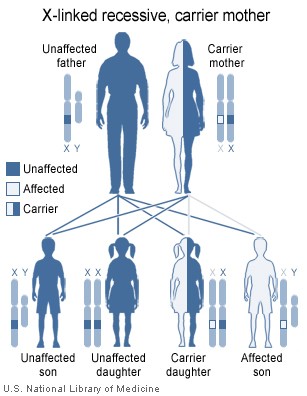
causes the phenotype to be expressed (1) in males (who are necessarily hemizygous for the gene mutation because they have only one X chromosome) and (2) in females who are homozygous for the gene mutation (i.e., they have a copy of the gene mutation on each of their two X chromosomes).
X-linked inheritance means that the gene causing the trait or the disorder is located on the X chromosome. Females have two X chromosomes, while males have one X and one Y chromosome
Y chromosome
The Y chromosome is one of the two sex-determining chromosomes in most mammals, including humans. In mammals, it contains the gene SRY, which triggers testis development if present. The human Y chromosome is composed of about 60 million base pairs...
. Carrier females who have only one copy of the mutation
Mutation
In molecular biology and genetics, mutations are changes in a genomic sequence: the DNA sequence of a cell's genome or the DNA or RNA sequence of a virus. They can be defined as sudden and spontaneous changes in the cell. Mutations are caused by radiation, viruses, transposons and mutagenic...
do not usually express the phenotype
Phenotype
A phenotype is an organism's observable characteristics or traits: such as its morphology, development, biochemical or physiological properties, behavior, and products of behavior...
, although differences in X chromosome inactivation can lead to varying degrees of clinical expression in carrier females since some cells will express one X allele
Allele
An allele is one of two or more forms of a gene or a genetic locus . "Allel" is an abbreviation of allelomorph. Sometimes, different alleles can result in different observable phenotypic traits, such as different pigmentation...
and some will express the other. The current estimate of sequenced X-linked genes is 499 and the total including vaguely defined traits is 983
Sex Differences In Phenotype/Genotypes and Frequency
In humans, generally "men are affected and women are carriers" for two reasons. The first is the simple statistical fact that if the X-chromosomes is a population that carry a particular X-linked mutation at a frequency of 'f' (for example, 1%) then that will be the frequency that men are likely to express the mutation (since they have only one X), while women will express it at a frequency of f2 (for example 1% * 1% = 0.01%) since they have two X's and hence two chances to get the normal allele. Thus, X-linked mutations tend to be rare in women.Most common
The most common X-linked recessive disorders are:- Color blindnessColor blindnessColor blindness or color vision deficiency is the inability or decreased ability to see color, or perceive color differences, under lighting conditions when color vision is not normally impaired...
; a classic example of an X-linked trait because it is easy to explain the phenotype and it's relatively common 7% to 10% of men are red-green colorblind, making the above calculations predict 0.49% to 1% of women are carriers. Its commonness may be attributable to its not being a serious disability in most cases and an actual advantage in some situations (for example, not being distracted by some of the color in color based camouflage).It is also known as daltonism. - Hemophilia A; another famous example because it was found in European royal families who intermarried and were famous enough that their pedigrees could be established and offered in textbooks as a "famous example" of an X-linked trait that had been documented in history books before mendelian genetics was understood.
- Duchenne muscular dystrophyDuchenne muscular dystrophyDuchenne muscular dystrophy is a recessive X-linked form of muscular dystrophy, which results in muscle degeneration, difficulty walking, breathing, and death. The incidence is 1 in 3,000 boys. Females and males are affected, though females are rarely affected and are more often carriers...
; muscular dystrophyMuscular dystrophyMuscular dystrophy is a group of muscle diseases that weaken the musculoskeletal system and hamper locomotion. Muscular dystrophies are characterized by progressive skeletal muscle weakness, defects in muscle proteins, and the death of muscle cells and tissue.In the 1860s, descriptions of boys who...
associated with mutations in the dystrophinDystrophinDystrophin is a rod-shaped cytoplasmic protein, and a vital part of a protein complex that connects the cytoskeleton of a muscle fiber to the surrounding extracellular matrix through the cell membrane. This complex is variously known as the costamere or the dystrophin-associated protein complex...
gene, characterized by rapid progression of muscle degeneration, eventually leading to loss in ambulation, respiratory failure and death. - Becker's muscular dystrophyBecker's muscular dystrophyBecker muscular dystrophy is an X-linked recessive inherited disorder characterized by slowly progressive muscle weakness of the legs and pelvis....
; milder form of Duchenne, causes slowly progressive muscle weakness of the legs and pelvisPelvisIn human anatomy, the pelvis is the lower part of the trunk, between the abdomen and the lower limbs .The pelvis includes several structures:...
. - Hemophilia B; a blood clottingCoagulationCoagulation is a complex process by which blood forms clots. It is an important part of hemostasis, the cessation of blood loss from a damaged vessel, wherein a damaged blood vessel wall is covered by a platelet and fibrin-containing clot to stop bleeding and begin repair of the damaged vessel...
disorder caused by a mutationMutationIn molecular biology and genetics, mutations are changes in a genomic sequence: the DNA sequence of a cell's genome or the DNA or RNA sequence of a virus. They can be defined as sudden and spontaneous changes in the cell. Mutations are caused by radiation, viruses, transposons and mutagenic...
of the Factor IXFactor IXFactor IX is one of the serine proteases of the coagulation system; it belongs to peptidase family S1. Deficiency of this protein causes hemophilia B. It was discovered in 1952 after a young boy named Stephen Christmas was found to be lacking this exact factor, leading to...
geneGeneA gene is a molecular unit of heredity of a living organism. It is a name given to some stretches of DNA and RNA that code for a type of protein or for an RNA chain that has a function in the organism. Living beings depend on genes, as they specify all proteins and functional RNA chains...
, leading to a deficiency of Factor IX. It is rarer than haemophilia AHaemophilia AHaemophilia A is a deficiency in clotting factor VIII.Haemophilia A is inherited as an X-linked recessive trait, and thus occurs in males and in homozygous females. However, mild haemophilia A has been described in heterozygous females, presumably due to extremely unfavourable lyonization...
. It's also called Christmas disease - X-linked ichthyosisX-linked ichthyosisX-linked ichthyosis is a skin condition caused by the hereditary deficiency of the steroid sulfatase enzyme that affects 1 in 2000 to 1 in 6000 males. XLI manifests with dry, scaly skin and is due to deletions or mutations in the STS gene...
; a skinSkin-Dermis:The dermis is the layer of skin beneath the epidermis that consists of connective tissue and cushions the body from stress and strain. The dermis is tightly connected to the epidermis by a basement membrane. It also harbors many Mechanoreceptors that provide the sense of touch and heat...
condition (ichthyosisIchthyosisIchthyosis is a heterogeneous family of at least 28, generalized, mostly genetic skin disorders. All types of ichthyosis have dry, thickened, scaly or flaky skin...
) caused by the hereditary deficiencyGenetic disorderA genetic disorder is an illness caused by abnormalities in genes or chromosomes, especially a condition that is present from before birth. Most genetic disorders are quite rare and affect one person in every several thousands or millions....
of the steroid sulfataseSteroid sulfataseSteroid sulfatase , formerly known as arylsulfatase C, is a sulfatase enzyme involved in the metabolism of steroids. It is encoded by the STS gene.- Function :...
(STS) enzyme that affects 1 in 2000 to 1 in 6000 males. - X-linked agammaglobulinemiaX-linked agammaglobulinemiaX-linked agammaglobulinemia is a rare X-linked genetic disorder that was discovered in 1952 which affects the body's ability to fight infection. XLA is an X-linked disorder, and therefore is more common in males...
(XLA); affects the body's ability to fight infection (origin of the name: A=no, gammaglobulin=Antibody). XLA patients do not generate mature B cellB cellB cells are lymphocytes that play a large role in the humoral immune response . The principal functions of B cells are to make antibodies against antigens, perform the role of antigen-presenting cells and eventually develop into memory B cells after activation by antigen interaction...
s. B cells are part of the immune system and normally manufacture antibodies (also called immunoglobulins) which defends the body from infections (the humoral response). Patients with untreated XLA are prone to develop serious and even fatal infections. - Glucose-6-phosphate dehydrogenase deficiencyGlucose-6-phosphate dehydrogenase deficiencyGlucose-6-phosphate dehydrogenase deficiency is an X-linked recessive hereditary disease characterised by abnormally low levels of glucose-6-phosphate dehydrogenase , a metabolic enzyme involved in the pentose phosphate pathway, especially important in red blood cell metabolism. G6PD deficiency is...
; may exhibit nonimmune hemolytic anemia in response to a number of causes, most commonly infection or exposure to certain medications or chemicals.
Less common disorders
Theoretically, a mutation in any of the genes in the :Category:Genes on chromosome X may cause disease, but below are some notable ones, with short description of symptoms:- AdrenoleukodystrophyAdrenoleukodystrophyAdrenoleukodystrophy is a rare, inherited disorder that leads to progressive brain damage, failure of the adrenal glands and eventually death. ALD is a disease in a group of genetic disorders called leukodystrophies, whose chief feature is damage to myelin...
; leads to progressive brain damage, failure of the adrenal glands and eventually death. - Alport syndromeAlport syndromeAlport syndrome or hereditary nephritis is a genetic disorder characterized by glomerulonephritis, endstage kidney disease, and hearing loss. Alport syndrome can also affect the eyes . The presence of blood in the urine is almost always found in this condition.It was first identified in a British...
; glomerulonephritis, endstage kidney disease, and hearing loss. - Androgen insensitivity syndromeAndrogen insensitivity syndromeAndrogen insensitivity syndrome is a condition that results in the partial or complete inability of the cell to respond to androgens. The unresponsiveness of the cell to the presence of androgenic hormones can impair or prevent the masculinization of male genitalia in the developing fetus, as...
; variable degrees of undervirilization and/or infertility in XY persons of either gender - Barth syndromeBarth syndromeBarth syndrome , also known as 3-Methylglutaconic aciduria type II, is a X-linked genetic disorder.-Presentation:Though not always present, the cardinal characteristics of this multi-system disorder include: cardiomyopathy , neutropenia Barth syndrome (BTHS), also known as 3-Methylglutaconic...
; metabolism distortion, delayed motor skills, stamina deficiency, hypotonia, chronic fatigue, delayed growth, cardiomyopathy, and compromised immune system. - Centronuclear myopathy; where cell nuclei are abnormally located in skeletal muscle cells. In CNM the nuclei are located at a position in the center of the cell, instead of their normal location at the periphery.
- Charcot-Marie-Tooth disease (CMTX2-3)Charcot-Marie-Tooth diseaseCharcot–Marie–Tooth disease- , known also as Morbus Charcot-Marie-Tooth, Charcot-Marie-Tooth neuropathy, hereditary motor and sensory neuropathy , hereditary sensorimotor neuropathy , or peroneal muscular atrophy, is an inherited disorder of nerves that takes different forms...
; disorder of nerves (neuropathy) that is characterized by loss of muscle tissue and touch sensation, predominantly in the feet and legs but also in the hands and arms in the advanced stages of disease. - Coffin-Lowry syndromeCoffin-Lowry syndromeCoffin-Lowry syndrome is a genetic disorder that is X-linked dominant and which causes severe mental problems sometimes associated with abnormalities of growth, cardiac abnormalities, kyphoscoliosis, as well as auditory and visual abnormalities.-History:...
; severe mental retardation sometimes associated with abnormalities of growth, cardiac abnormalities, kyphoscoliosis as well as auditory and visual abnormalities. - Fabry disease; A lysosomal storage disease causing anhidrosis, fatigue, angiokeratomas, burning extremity pain and ocular involvement.
- Hunter's Syndrome; potentially causing hearing loss, thickening of the heart valves leading to a decline in cardiac function, obstructive airway disease, sleep apnea, and enlargement of the liver and spleen.
- Hypohidrotic ectodermal dysplasiaHypohidrotic ectodermal dysplasiaHypohidrotic ectodermal dysplasia is one of about 150 types of ectodermal dysplasia in humans...
, presenting with hypohidrosis, hypotrichosis, hypodontia - Kabuki syndromeKabuki syndromeKabuki syndrome, also previously known as Kabuki makeup syndrome, KMS or Niikawa–Kuroki Syndrome, is a pediatric congenital disorder of suspected genetic origin with multiple congenital anomalies and intellectual disabilities. It is very rare, affecting roughly one in every 32,000 individuals...
; multiple congenital anomalies and mental retardation. - Kennedy diseaseKennedy diseaseKennedy's disease or X-linked Spinal and Bulbar Muscular Atrophy or Spinobulbar Muscular Atrophy or X-Linked Bulbo-Spinal Atrophy is an X-linked recessive, slow progressing, neurodegenerative disease associated with mutation of the androgen receptor...
; muscle cramps and progressive weakness - Lesch-Nyhan syndromeLesch-Nyhan syndromeLesch–Nyhan syndrome , also known as Nyhan's syndrome, Kelley-Seegmiller syndrome and Juvenile gout, is a rare inherited disorder caused by a deficiency of the enzyme hypoxanthine-guanine phosphoribosyltransferase , produced by mutations in the HPRT gene located on X chromosome. LNS affects about...
; neurologic dysfunction, cognitive and behavioral disturbances including self-mutilation, and uric acid overproduction (hyperuricemia) - Lowe Syndrome; hydrophthalmia, cataracts, intellectual disabilities, aminoaciduria, reduced renal ammonia production and vitamin D-resistant rickets
- Menkes diseaseMenkes diseaseMenkes disease , also called Menkes syndrome, copper transport disease, steely hair disease, kinky hair disease, or Menkes kinky hair syndrome, is a disorder that affects copper levels in the body, leading to copper deficiency...
; sparse and coarse hair, growth failure, and deterioration of the nervous system - Nasodigitoacoustic syndromeNasodigitoacoustic syndromeNasodigitoacoustic syndrome, also called Keipert syndrome, is a rare congenital syndrome first described by J.A. Keipert and colleagues in 1973. The syndrome is characterized by a mishaped nose, broad thumbs and halluces , brachydactyly, sensorineural hearing loss, facial features such as...
; mishaped nose, brachydactylyBrachydactylyBrachydactyly , is a medical term which literally means "shortness of the fingers and toes" . The shortness is relative to the length of other long bones and other parts of the body. Brachydactyly is an inherited, usually dominant trait...
of the distal phalangesDistal phalangesThe distal or terminal phalanges are the terminal limb bones located at the tip of the digits...
, sensorineural deafness - Nonsyndromic deafnessNonsyndromic deafnessNonsyndromic deafness is hearing loss that is not associated with other signs and symptoms. In contrast, syndromic deafness involves hearing loss that occurs with abnormalities in other parts of the body....
and X-linked nonsyndromic deafness; hearing loss - Norrie diseaseNorrie diseaseNorrie Disease is a genetic disorder that primarily affects the eye and almost always leads to blindness. In addition to the congenital ocular symptoms, some patients suffer from a progressive hearing loss starting mostly in their 2nd decade of life, while another portion may be mentally...
; cataracts, leukocoria along with other developmental issues in the eye - Occipital horn syndromeOccipital horn syndromeOccipital horn syndrome , formerly considered a variant of Ehlers-Danlos syndrome, is an X-linked recessive connective tissue disorder. It is caused by a deficiency in the transport of the essential mineral copper, associated with mutations in the ATP7A gene...
; deformations in the skeleton - Ornithine transcarbamylase deficiencyOrnithine transcarbamylase deficiencyOrnithine transcarbamylase deficiency , the most common of the urea cycle disorders, is a rare metabolic disorder, occurring in one out of every 80,000 births...
; developmental delay and mental retardation. Progressive liver damage, skin lesions, and brittle hair may also be seen - Siderius X-linked mental retardation syndrome; cleft lip and palate with mental retardation and facial dysmorphism, caused by mutations in the histone demethylase PHF8PHF8PHD finger protein 8 is a protein that in humans is encoded by the PHF8 gene.- Function :PHF8 belongs to the family of ferrous iron and 2-oxoglutarate dependent oxygenases, and is active as a histone lysine demethylase with selectivity for the di-and monomethyl states.- Clinical significance...
- Simpson-Golabi-Behmel syndromeSimpson-Golabi-Behmel syndromeSimpson–Golabi–Behmel syndrome , also called Bulldog syndrome, Sara Agers syndrome, Golabi–Rosen syndrome, Simpson dysmorphia syndrome or X-linked dysplasia gigantism syndrome , is a rare inherited congenital disorder with widely variable expression, causing craniofacial and other abnormalities.It...
; coarse faces with protruding jaw and tongue, widened nasal bridge, and upturned nasal tip - Spinal muscular atrophySpinal muscular atrophySpinal Muscular Atrophy is a neuromuscular disease characterized by degeneration of motor neurons, resulting in progressive muscular atrophy and weakness. The clinical spectrum of SMA ranges from early infant death to normal adult life with only mild weakness...
caused by UBE1UBE1Ubiquitin-like modifier activating enzyme 1, also known as UBA1, is an enzyme which in humans is encoded by the UBA1 gene.- Function :...
gene mutation; weakness due to loss of the motor neurons of the spinal cord and brainstem - Wiskott-Aldrich syndromeWiskott-Aldrich syndromeWiskott–Aldrich syndrome is a rare X-linked recessive disease characterized by eczema, thrombocytopenia , immune deficiency, and bloody diarrhea . It is also sometimes called the eczema-thrombocytopenia-immunodeficiency syndrome in keeping with Aldrich's original description in 1954...
; eczema, thrombocytopenia, immune deficiency, and bloody diarrhea - X-linked Severe Combined ImmunodeficiencyX-SCIDX-linked severe combined immunodeficiency is an immunodeficiency disorder that affects lymphocytes. It is a recessive trait stemming from a defective version of the gene responsible for the functionality of the Interleukin 2 receptor ....
(SCID); infections, usually causing death in the first years of life - X-linked sideroblastic anemia; skin paleness, fatigue, dizziness and enlarged spleen and liver.
External links
- X-linked diseases from the Wellcome TrustWellcome TrustThe Wellcome Trust was established in 1936 as an independent charity funding research to improve human and animal health. With an endowment of around £13.9 billion, it is the United Kingdom's largest non-governmental source of funds for biomedical research...
- X linked recessive from the women's healthWomen's healthWomen's health refers to health issues specific to human female anatomy. These often relate to structures such as female genitalia and breasts or to conditions caused by hormones specific to, or most notable in, females. Women's health issues include menstruation, contraception, maternal health,...