

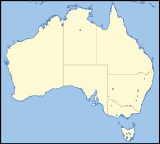
Wilsons Promontory National Park

Encyclopedia
Wilsons Promontory National Park, commonly known as Wilsons Prom or The Prom, is a national park in the Gippsland
region of Victoria
(Australia
), 157 km southeast of Melbourne.
It is mainland Australia
's southernmost national park
, known for its beautiful rainforests, unspoiled beaches, and abundant wildlife.
It covers the southern portion of Wilsons Promontory
, a peninsula
containing South Point
, the southernmost point on the Australian mainland. A lighthouse
on the south-east corner
of the peninsula is the southern-most lighthouse on mainland Australia and has operated continuously since 1859.
A large section of the park was burnt out in April 2005 by a bushfire caused by a controlled burn
that breached containment lines because of warmer and windier conditions than were forecast for that day, causing the evacuation of six-hundred people.
The park is highly popular with bushwalkers and campers, and has a number of lodges and serviced camping areas at a camping area near the mouth of Tidal River
.
occupied the area at least 6,500 years ago based on archaeological records.
The first Europeans to sight Wilsons Promontory are believed to be George Bass
and Matthew Flinders
in 1798.
Extensive sealing took place at Sealer's Cove during the 19th Century, such that seals are no longer found there.
Lobbying by the Field Naturalists Club of Victoria
and the Royal Society of Victoria
(including Arthur Henry Shakespeare Lucas
) led to the Government of Victoria
temporarily reserve the area as National Park in 1898, made permanent in 1908. The original settlement in the Park was on the Darby River site, where a chalet existed.
The Prom was used as commando training area during World War II
.
During the Black Saturday Fires (February 2009) throughout Victoria, Wilsons Prom had been struck by lightning, which then led to the loss of up to 50% of the park through extensive fire damage.
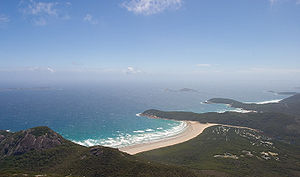 The main campsite is at Tidal River, and consists primarily of unpowered sites for tents or caravans. Some cabins, huts and limited higher end options are also available. Booking is essential during the summer and other holiday periods throughout the year, as it is a popular holiday location.
The campsite is very close to the river and to an excellent ocean beach. Facilities include toilet and shower blocks, water near each site, a general store, an outdoor cinema(summer months only) and a visitor centre. Park rangers patrol the prom, interpretive activities are provided over the summer holiday period and at certain times medical staff are available.
Camping is not permitted outside designated camping areas, and the campsites at Sealer's Cove and other locations require a permit. Numerous other regulations apply.
 As a National Park, Wilsons Promontory is home to a wide range of wildlife species, including kangaroo
s, wombat
s, echidna
s, emu
s, a wide range of small marsupial
s, and numerous species of birds, most prominent among which are the rosella
s.
Generally, the wildlife around Tidal River is accustomed to human presence, and many of the animals and birds near the campsites will approach humans, accept food from them, or even enter their tents uninvited. It is however illegal to feed wildlife and if you are found to be feeding them you will be issued with a fine by Parks Victoria Staff.
Outside the camping area, the wildlife is less accustomed to humans, and may be more difficult to spot. Possum
s can be quite easily found with a torch at night, and kangaroos and emus are often to seen in large numbers on either side of the road on the way in to the National Park.
Swamp wallabies are frequently spotted on many of the walks, as are a variety of bird species.
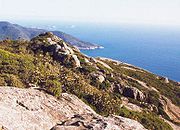 The Prom has many different areas in which one can hike. There are trails of differing levels of difficulty, predominantly day hikes ranging from short strolls using beach access ramps up to longer 2 or 3 hour walks. Staff in the visitors centre can give helpful information and advice on walks to suit your skill level and timeframe. There are also several overnight hiking options which can be combined into larger circuit hikes from 2 days upwards. There are also multi-day hikes in the northern section of the park which require walkers to have excellent navigational skills. A permit is required for all overnight hiking.
A portion of the peninsula is warm temperate rainforest. These areas are generally traversed on boardwalks and bridges and are full of wildlife, particularly bird species and swamp wallabies.
There is also some mountain
ous terrain. Mount Oberon affords beautiful views that are only mildly marred by a radio aerial close by. An alternative walk up Mount Bishop also provides panoramic and spectacular views of the Prom.
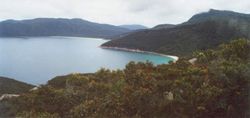
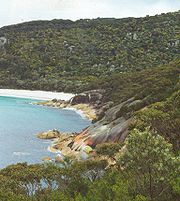
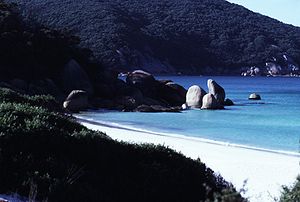 The coastline is ruggedly beautiful with indented coves and beaches interspersed amongst granite headlands, tors and cliffs. Beaches vary from broad sandy littoral plains to steep coves and rock pools. The northern part of the park comprises a great deal of the Yanakie isthmus with sandy healthlands.
Note that it can be windy, cool and clouded over at the summit, even during the summer months.
Gippsland
Gippsland is a large rural region in Victoria, Australia. It begins immediately east of the suburbs of Melbourne and stretches to the New South Wales border, lying between the Great Dividing Range to the north and Bass Strait to the south...
region of Victoria
Victoria (Australia)
Victoria is the second most populous state in Australia. Geographically the smallest mainland state, Victoria is bordered by New South Wales, South Australia, and Tasmania on Boundary Islet to the north, west and south respectively....
(Australia
Australia
Australia , officially the Commonwealth of Australia, is a country in the Southern Hemisphere comprising the mainland of the Australian continent, the island of Tasmania, and numerous smaller islands in the Indian and Pacific Oceans. It is the world's sixth-largest country by total area...
), 157 km southeast of Melbourne.
It is mainland Australia
Australia
Australia , officially the Commonwealth of Australia, is a country in the Southern Hemisphere comprising the mainland of the Australian continent, the island of Tasmania, and numerous smaller islands in the Indian and Pacific Oceans. It is the world's sixth-largest country by total area...
's southernmost national park
National park
A national park is a reserve of natural, semi-natural, or developed land that a sovereign state declares or owns. Although individual nations designate their own national parks differently A national park is a reserve of natural, semi-natural, or developed land that a sovereign state declares or...
, known for its beautiful rainforests, unspoiled beaches, and abundant wildlife.
It covers the southern portion of Wilsons Promontory
Wilsons Promontory
Wilsons Promontory is a peninsula that forms the southernmost part of the Australian mainland and is located at . South Point at is the southernmost tip of Wilsons Promontory and hence of mainland Australia...
, a peninsula
Peninsula
A peninsula is a piece of land that is bordered by water on three sides but connected to mainland. In many Germanic and Celtic languages and also in Baltic, Slavic and Hungarian, peninsulas are called "half-islands"....
containing South Point
South Point (Wilsons Promontory)
South Point is the southernmost point of the Australian mainland located on the northern side of Bass Strait. It is also the southernmost point of the mainland of the Wilsons Promontory-Peninsula. South Point is located at . South Point is also part of the Wilsons Promontory National Park in...
, the southernmost point on the Australian mainland. A lighthouse
Wilsons Promontory Lighthouse
Wilsons Promontory Lighthouse is situated on South East Point, Wilsons Promontory, Victoria, Australia. From its pont on the peninsula, it commands almost 360° views of Bass Strait. The Wilson's Promontory lighthouse is the southernmost lighthouse on mainland Australia. The walk from the nearest...
on the south-east corner
South East Point, Wilsons Promontory
South East Point lies on the southerly tip of Wilsons Promontory, Victoria, Australia. South East Point is located at . It commands sensational views of Bass Strait and is a major landmark for all ships travelling between the southern Australian ports and the Pacific Ocean. South East Point is the...
of the peninsula is the southern-most lighthouse on mainland Australia and has operated continuously since 1859.
A large section of the park was burnt out in April 2005 by a bushfire caused by a controlled burn
Controlled burn
Controlled or prescribed burning, also known as hazard reduction burning or Swailing is a technique sometimes used in forest management, farming, prairie restoration or greenhouse gas abatement. Fire is a natural part of both forest and grassland ecology and controlled fire can be a tool for...
that breached containment lines because of warmer and windier conditions than were forecast for that day, causing the evacuation of six-hundred people.
The park is highly popular with bushwalkers and campers, and has a number of lodges and serviced camping areas at a camping area near the mouth of Tidal River
Tidal River, Wilsons Promontory
Tidal River is a river in Wilsons Promontory National Park, Wilsons Promontory, Victoria, Australia. It is also a permanent camping ground that takes its name from the river, which flows past the camping ground to the north, and provides it with all its fresh water.-The campsite:Tidal River is the...
.
History
Indigenous AustraliansIndigenous Australians
Indigenous Australians are the original inhabitants of the Australian continent and nearby islands. The Aboriginal Indigenous Australians migrated from the Indian continent around 75,000 to 100,000 years ago....
occupied the area at least 6,500 years ago based on archaeological records.
The first Europeans to sight Wilsons Promontory are believed to be George Bass
George Bass
George Bass was a British naval surgeon and explorer of Australia.-Early years:He was born on 30 January 1771 at Aswarby, a hamlet near Sleaford, Lincolnshire, the son of a tenant farmer, George Bass, and a local beauty named Sarah Nee Newman. His father died in 1777 when Bass was 6...
and Matthew Flinders
Matthew Flinders
Captain Matthew Flinders RN was one of the most successful navigators and cartographers of his age. In a career that spanned just over twenty years, he sailed with Captain William Bligh, circumnavigated Australia and encouraged the use of that name for the continent, which had previously been...
in 1798.
Extensive sealing took place at Sealer's Cove during the 19th Century, such that seals are no longer found there.
Lobbying by the Field Naturalists Club of Victoria
Field Naturalists Club of Victoria
The Field Naturalists Club of Victoria is an Australian natural history and conservation organisation.It was founded in May 1880 by a group of nature enthusiasts that included Thomas Pennington Lucas. Charles French and Dudley Best. It is the oldest conservation group in Victoria...
and the Royal Society of Victoria
Royal Society of Victoria
The Royal Society of Victoria is the oldest learned society in the state of Victoria in Australia.The Royal Society of Victoria was formed in 1859 from a merger between The Philosophical Society of Victoria and The Victorian Institute for the Advancement of Science , both founded...
(including Arthur Henry Shakespeare Lucas
Arthur Henry Shakespeare Lucas
Arthur Henry Shakespeare Lucas was an English-born Australian schoolmaster and scientist.-Early life:Lucas born was born in Stratford-on-Avon, Warwickshire, the third son of the Rev. Samuel Lucas, a Wesleyan minister, and his wife Elizabeth, née Broadhead...
) led to the Government of Victoria
Government of Victoria
The Government of Victoria, under the Constitution of Australia, ceded certain legislative and judicial powers to the Commonwealth, but retained complete independence in all other areas...
temporarily reserve the area as National Park in 1898, made permanent in 1908. The original settlement in the Park was on the Darby River site, where a chalet existed.
The Prom was used as commando training area during World War II
World War II
World War II, or the Second World War , was a global conflict lasting from 1939 to 1945, involving most of the world's nations—including all of the great powers—eventually forming two opposing military alliances: the Allies and the Axis...
.
During the Black Saturday Fires (February 2009) throughout Victoria, Wilsons Prom had been struck by lightning, which then led to the loss of up to 50% of the park through extensive fire damage.
Camping
The campsite is very close to the river and to an excellent ocean beach. Facilities include toilet and shower blocks, water near each site, a general store, an outdoor cinema(summer months only) and a visitor centre. Park rangers patrol the prom, interpretive activities are provided over the summer holiday period and at certain times medical staff are available.
Camping is not permitted outside designated camping areas, and the campsites at Sealer's Cove and other locations require a permit. Numerous other regulations apply.
Wildlife
Kangaroo
A kangaroo is a marsupial from the family Macropodidae . In common use the term is used to describe the largest species from this family, especially those of the genus Macropus, Red Kangaroo, Antilopine Kangaroo, Eastern Grey Kangaroo and Western Grey Kangaroo. Kangaroos are endemic to the country...
s, wombat
Wombat
Wombats are Australian marsupials; they are short-legged, muscular quadrupeds, approximately in length with a short, stubby tail. They are adaptable in their habitat tolerances, and are found in forested, mountainous, and heathland areas of south-eastern Australia, including Tasmania, as well as...
s, echidna
Echidna
Echidnas , also known as spiny anteaters, belong to the family Tachyglossidae in the monotreme order of egg-laying mammals. There are four extant species, which, together with the platypus, are the only surviving members of that order and are the only extant mammals that lay eggs...
s, emu
Emu
The Emu Dromaius novaehollandiae) is the largest bird native to Australia and the only extant member of the genus Dromaius. It is the second-largest extant bird in the world by height, after its ratite relative, the ostrich. There are three subspecies of Emus in Australia...
s, a wide range of small marsupial
Marsupial
Marsupials are an infraclass of mammals, characterized by giving birth to relatively undeveloped young. Close to 70% of the 334 extant species occur in Australia, New Guinea, and nearby islands, with the remaining 100 found in the Americas, primarily in South America, but with thirteen in Central...
s, and numerous species of birds, most prominent among which are the rosella
Rosella
A rosella is one of five to eight species of colorful Australian parrots in the genus Platycercus. Platycercus means "broad-tailed" or "flat-tailed", reflecting a feature common to the rosellas and other members of the broad-tailed parrot tribe...
s.
Generally, the wildlife around Tidal River is accustomed to human presence, and many of the animals and birds near the campsites will approach humans, accept food from them, or even enter their tents uninvited. It is however illegal to feed wildlife and if you are found to be feeding them you will be issued with a fine by Parks Victoria Staff.
Outside the camping area, the wildlife is less accustomed to humans, and may be more difficult to spot. Possum
Possum
A possum is any of about 70 small to medium-sized arboreal marsupial species native to Australia, New Guinea, and Sulawesi .Possums are quadrupedal diprotodont marsupials with long tails...
s can be quite easily found with a torch at night, and kangaroos and emus are often to seen in large numbers on either side of the road on the way in to the National Park.
Swamp wallabies are frequently spotted on many of the walks, as are a variety of bird species.
Hiking
A portion of the peninsula is warm temperate rainforest. These areas are generally traversed on boardwalks and bridges and are full of wildlife, particularly bird species and swamp wallabies.
There is also some mountain
Mountain
Image:Himalaya_annotated.jpg|thumb|right|The Himalayan mountain range with Mount Everestrect 58 14 160 49 Chomo Lonzorect 200 28 335 52 Makalurect 378 24 566 45 Mount Everestrect 188 581 920 656 Tibetan Plateaurect 250 406 340 427 Rong River...
ous terrain. Mount Oberon affords beautiful views that are only mildly marred by a radio aerial close by. An alternative walk up Mount Bishop also provides panoramic and spectacular views of the Prom.
Civilisation
Wilsons Promontory is rather isolated, and the closest town is Yanakie located 36 km north of Tidal River. Yanakie is very small, and is primarily consists of a general store and the Promhill Cabins. The settlement at Tidal River, however, does have a general store, café, fish and chip shop, open-air cinema (summer months only), post boxes and public telephones.Mount Oberon
Mount Oberon is also located in Wilsons Promontory Park. People usually take a vehicle halfway up the mountain to Telegraph Saddle car park and then continue on foot. Walkers follow the gently uphill management vehicle track to Mount Oberon’s summit. A short series of steps below the summit’s rocky outcrops, leads to views over Tidal River, the coast and islands offshore.Note that it can be windy, cool and clouded over at the summit, even during the summer months.
External links
- Park page at Parks Victoria
- Wilsons Promontory National Park - The Science of Managing the Terrestrial Environment Contains detailed information on climate, geographical features, flora, fauna, history and land management techniques used at the park.
- Climate statistics for Australian locations - Wilsons Promontory Lighthouse Detailed observations from the weather station covering Wilsons Promontory.
- Friends of the Prom (FOTP) Volunteer group who assist park staff with preservation and upkeep.
- Wilsons Promontory National Park, Explore Australia - Campsites and Activities