

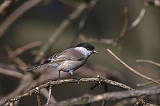
Willow Tit

Encyclopedia
The Willow Tit is a passerine
bird
in the tit family Paridae. It is a widespread and common resident breeder throughout temperate and subarctic Europe
and northern Asia
. It is more of a conifer specialist than the closely related Marsh Tit
, which explains it breeding much further north. It is resident, and most birds do not migrate
.
In the east of its range it is much paler than Marsh Tit, but as one goes west the various races become increasingly similar, so much so that it was not recognised as a breeding bird in Great Britain
until the end of the 19th century, despite being widespread.
The Willow Tit is distinguished from the Marsh Tit by a sooty brown instead of a glossy blue black cap; the general colour is otherwise similar, though the under parts are more buff and the flanks distinctly more rufous; the pale buff edgings to the secondaries form a light patch on the closed wing. The feathers of the crown and the black bib under the bill are longer, but this is not an easily noticed character. However, the more graduated tail (not square) shows distinctly when spread. Length is 11.5 cm, and wings range from 60–70 mm.
The commonest call is a nasal zee, zee, zee, but the notes of the bird evidently vary considerably. Occasionally a double note, ipsee, ipsee, is repeated four or five times.
The Willow Tit often excavates its own nesting hole, even piercing hard bark; this is usually in a rotten stump or in a tree, more or less decayed. Most nests examined are cups of felted material, such as fur, hair and wood chips, but feather
s are sometimes used. The number of eggs varies from six to nine, with reddish spots or blotches.
Birds feed on insect
s, caterpillar
s, and seeds, much like other tits. This species is parasitised by the moorhen flea
, Dasypsyllus gallinulae.
treats it as a distinct genus
. This is supported by mtDNA cytochrome b
sequence
analysis; within Poecile, the Willow Tit is part of a group of Eurasian "typical chickadees" that includes also the Marsh Tit, Père David's Tit, and the Songar Tit
(Gill et al. 2005, del Hoyo et al. 2007).
The genus name has often been treated as feminine (giving the species name ending montana); however, this was not specified by the original genus author Johann Jakob Kaup
, and under the International Code of Zoological Nomenclature
the genus name must therefore be treated by default as masculine, giving the name ending montanus (del Hoyo et al. 2007).
At one time the Willow Tit was considered conspecific with the Black-capped Chickadee of North America due to their very similar appearance. In fact the Willow Tit, Black-Capped Chickadee, Marsh Tit and Carolina Chickadee are all very similar to one another in appearance.
Passerine
A passerine is a bird of the order Passeriformes, which includes more than half of all bird species. Sometimes known as perching birds or, less accurately, as songbirds, the passerines form one of the most diverse terrestrial vertebrate orders: with over 5,000 identified species, it has roughly...
bird
Bird
Birds are feathered, winged, bipedal, endothermic , egg-laying, vertebrate animals. Around 10,000 living species and 188 families makes them the most speciose class of tetrapod vertebrates. They inhabit ecosystems across the globe, from the Arctic to the Antarctic. Extant birds range in size from...
in the tit family Paridae. It is a widespread and common resident breeder throughout temperate and subarctic Europe
Europe
Europe is, by convention, one of the world's seven continents. Comprising the westernmost peninsula of Eurasia, Europe is generally 'divided' from Asia to its east by the watershed divides of the Ural and Caucasus Mountains, the Ural River, the Caspian and Black Seas, and the waterways connecting...
and northern Asia
Asia
Asia is the world's largest and most populous continent, located primarily in the eastern and northern hemispheres. It covers 8.7% of the Earth's total surface area and with approximately 3.879 billion people, it hosts 60% of the world's current human population...
. It is more of a conifer specialist than the closely related Marsh Tit
Marsh Tit
The Marsh Tit Poecile palustris is a passerine bird in the tit family Paridae and genus Poecile, closely related to the Willow, Père David's and Songar Tits. It is small with a black crown and nape, pale cheeks, brown back and greyish-brown wings and tail. Between 8 and 11 subspecies are recognised...
, which explains it breeding much further north. It is resident, and most birds do not migrate
Bird migration
Bird migration is the regular seasonal journey undertaken by many species of birds. Bird movements include those made in response to changes in food availability, habitat or weather. Sometimes, journeys are not termed "true migration" because they are irregular or in only one direction...
.
In the east of its range it is much paler than Marsh Tit, but as one goes west the various races become increasingly similar, so much so that it was not recognised as a breeding bird in Great Britain
Great Britain
Great Britain or Britain is an island situated to the northwest of Continental Europe. It is the ninth largest island in the world, and the largest European island, as well as the largest of the British Isles...
until the end of the 19th century, despite being widespread.
The Willow Tit is distinguished from the Marsh Tit by a sooty brown instead of a glossy blue black cap; the general colour is otherwise similar, though the under parts are more buff and the flanks distinctly more rufous; the pale buff edgings to the secondaries form a light patch on the closed wing. The feathers of the crown and the black bib under the bill are longer, but this is not an easily noticed character. However, the more graduated tail (not square) shows distinctly when spread. Length is 11.5 cm, and wings range from 60–70 mm.
The commonest call is a nasal zee, zee, zee, but the notes of the bird evidently vary considerably. Occasionally a double note, ipsee, ipsee, is repeated four or five times.
The Willow Tit often excavates its own nesting hole, even piercing hard bark; this is usually in a rotten stump or in a tree, more or less decayed. Most nests examined are cups of felted material, such as fur, hair and wood chips, but feather
Feather
Feathers are one of the epidermal growths that form the distinctive outer covering, or plumage, on birds and some non-avian theropod dinosaurs. They are considered the most complex integumentary structures found in vertebrates, and indeed a premier example of a complex evolutionary novelty. They...
s are sometimes used. The number of eggs varies from six to nine, with reddish spots or blotches.
Birds feed on insect
Insect
Insects are a class of living creatures within the arthropods that have a chitinous exoskeleton, a three-part body , three pairs of jointed legs, compound eyes, and two antennae...
s, caterpillar
Caterpillar
Caterpillars are the larval form of members of the order Lepidoptera . They are mostly herbivorous in food habit, although some species are insectivorous. Caterpillars are voracious feeders and many of them are considered to be pests in agriculture...
s, and seeds, much like other tits. This species is parasitised by the moorhen flea
Moorhen flea
The moorhen flea, Dasypsyllus gallinulae, originally from South America, is now a globally widespread flea species. It is a large flea, easily identified because the male has two heavy horn-like spines on one of the genital flaps, and the female has a deep "bite" on the seventh sternite.It is found...
, Dasypsyllus gallinulae.
Systematics
Most authorities retain Poecile as a subgenus within the genus Parus, but the American Ornithologists' UnionAmerican Ornithologists' Union
The American Ornithologists' Union is an ornithological organization in the USA. Unlike the National Audubon Society, its members are primarily professional ornithologists rather than amateur birders...
treats it as a distinct genus
Genus
In biology, a genus is a low-level taxonomic rank used in the biological classification of living and fossil organisms, which is an example of definition by genus and differentia...
. This is supported by mtDNA cytochrome b
Cytochrome b
Cytochrome b/b6 is the main subunit of transmembrane cytochrome bc1 and b6f complexes. In addition, it commonly refers to a region of mtDNA used for population genetics and phylogenetics.- Function :...
sequence
DNA sequence
The sequence or primary structure of a nucleic acid is the composition of atoms that make up the nucleic acid and the chemical bonds that bond those atoms. Because nucleic acids, such as DNA and RNA, are unbranched polymers, this specification is equivalent to specifying the sequence of...
analysis; within Poecile, the Willow Tit is part of a group of Eurasian "typical chickadees" that includes also the Marsh Tit, Père David's Tit, and the Songar Tit
Songar Tit
The Songar Tit is a passerine bird in the tit family. It is the southern counterpart of the Willow Tit P...
(Gill et al. 2005, del Hoyo et al. 2007).
The genus name has often been treated as feminine (giving the species name ending montana); however, this was not specified by the original genus author Johann Jakob Kaup
Johann Jakob Kaup
Johann Jakob Kaup was a German naturalist.-Biography:He was born at Darmstadt. After studying at Göttingen and Heidelberg he spent two years at Leiden, where his attention was specially devoted to the amphibians and fishes. He then returned to Darmstadt as an assistant in the grand ducal museum,...
, and under the International Code of Zoological Nomenclature
International Code of Zoological Nomenclature
The International Code of Zoological Nomenclature is a widely accepted convention in zoology that rules the formal scientific naming of organisms treated as animals...
the genus name must therefore be treated by default as masculine, giving the name ending montanus (del Hoyo et al. 2007).
At one time the Willow Tit was considered conspecific with the Black-capped Chickadee of North America due to their very similar appearance. In fact the Willow Tit, Black-Capped Chickadee, Marsh Tit and Carolina Chickadee are all very similar to one another in appearance.