

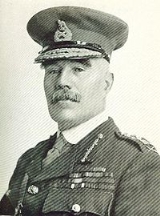
William Robertson

Encyclopedia
Field Marshal Sir William Robert Robertson, 1st Baronet, GCB, GCMG, GCVO, DSO
(29 January 1860 – 12 February 1933) was a British Army
officer who served as Chief of the Imperial General Staff (CIGS) from 1916 to 1918, during the First World War. He was the first British Army soldier to rise from private soldier
to field marshal.
, Lincolnshire
. Educated at the local church school, he began his military career in 1877 by enlisting as a private in the 16th (The Queen's) Lancers
(at that time not all cavalry regiments referred to their private soldiers as "trooper"). At that time, the army was seen by many people as a refuge of last resort for paupers and 'ne'r do wells'. His mother was horrified. "I will name it to no one," he records her saying in his autobiography, "I would rather bury you than see you in a red coat."
He rose to sergeant major
in 1885, his career being helped by a developing expertise in signalling and quartermaster
s' duties. Encouraged by his officers (and the clergyman of his old parish) he passed an examination for officer status and obtained a commission as a lieutenant in the 3rd Dragoon Guards
. This was very unusual at the time. Those who had exceptional skills in supporting services were sometimes promoted to officer rank in the engineers or similar corps, but Robertson was commissioned as a cavalry officer. It would have been impossible for this to happen in Britain, as officers were expected to have a private income that would enable them to 'keep up appearances' and pay extravagant mess bills. In India, it was different. Active service officers with experience were needed, there was less accent upon social status and appearance, and the cost of living cheaper. Robertson supplemented his income by qualifying as an interpreter in several languages, for which officers received extra pay.
He consequently served in India and completed a tour of duty with the Intelligence Corps. He was wounded and awarded the DSO
in the Chitral
relief expedition. Promoted to captain, he attended Staff College
at Camberley
in 1896–97. Attendance at the Staff College indicated that he had been selected as an intelligent and promising officer, and graduates of the College were earmarked for 'fast track' promotion, capable of commanding military formations. He was the first former ranker to attend Staff College.
, Robertson was appointed as Intelligence officer to Frederick Roberts, 1st Earl Roberts
, the British Commander-in-Chief
South Africa, subsequently returning to the War Office to head the foreign section of the intelligence department. He was later commandant of the British Army Staff College
.
, Robertson served as Quartermaster General and then as Chief of Staff of the British Expeditionary Force (under John French) before being promoted to Chief of the Imperial General Staff in December 1915. As CIGS, Robertson was a strong supporter of BEF commander Douglas Haig
. He was committed to a Western Front
strategy focusing on Germany and against what he saw as peripheral operations on other fronts. This stance was at odds with Lloyd George's view that Britain's war effort ought to be focused on the other theatres until the arrival of sufficient US troops on the Western Front.
Robertson was forced out in February 1918 over his refusal to agree that the British representative at the new Supreme War Council at Versailles (an inter-Allied body) should be Deputy CIGS and a member of the Army Council (giving him the right to issue orders to the BEF). Lloyd George offered Robertson a choice of remaining as CIGS in London with reduced powers, or else accepting demotion to the Versailles job - either way he would have been cut out of the decision-making loop, as Lloyd George would have been able to deal through the alternative channel. Robertson's position was that either the CIGS should himself be the Versailles delegate (in the Second World War the Combined Chiefs of Staff
, on which the CIGS Alan Brooke sat, would be the supreme Anglo-American military body) or else the Versailles representative should be clearly subordinate to the CIGS, so after a fortnight of argument his "resignation" was announced. Lord Derby, Secretary of State for War, threatened to resign in protest, but did not do so.
Robertson then became General Officer Commanding
-in-Chief of Eastern Command
. After the armistice
, he commanded the British Army of the Rhine
.
In 1919, Robertson was thanked by Parliament, granted £10,000 and created a Baronet
, of Beaconsfield in the County of Buckingham. When he was promoted to field marshal a year later, he became the first man to rise in the British army from the lowest rank (private) to the highest (field marshal).
Robertson died in February, 1933, aged 73. He was succeeded in the baronetcy by his son Brian Hubert. The latter rose to become a general in the Army and was raised to the peerage as Baron Robertson of Oakridge in 1961.
in the Canadian Rockies
is named for him, and Sir William Robertson High School in his birth village, Welbourn
, is named after him.
|-
|-
Distinguished Service Order
The Distinguished Service Order is a military decoration of the United Kingdom, and formerly of other parts of the British Commonwealth and Empire, awarded for meritorious or distinguished service by officers of the armed forces during wartime, typically in actual combat.Instituted on 6 September...
(29 January 1860 – 12 February 1933) was a British Army
British Army
The British Army is the land warfare branch of Her Majesty's Armed Forces in the United Kingdom. It came into being with the unification of the Kingdom of England and Scotland into the Kingdom of Great Britain in 1707. The new British Army incorporated Regiments that had already existed in England...
officer who served as Chief of the Imperial General Staff (CIGS) from 1916 to 1918, during the First World War. He was the first British Army soldier to rise from private soldier
Private (rank)
A Private is a soldier of the lowest military rank .In modern military parlance, 'Private' is shortened to 'Pte' in the United Kingdom and other Commonwealth countries and to 'Pvt.' in the United States.Notably both Sir Fitzroy MacLean and Enoch Powell are examples of, rare, rapid career...
to field marshal.
Early life
"Wully" Robertson was born at WelbournWelbourn
Welbourn is a village in North Kesteven, central Lincolnshire on the A607 between Leadenham and Wellingore.-Village:The village church is St Chad's, part of the Loveden Deanery of the Diocese of Lincoln: the incumbent is the Revd Dr Alan Megahey....
, Lincolnshire
Lincolnshire
Lincolnshire is a county in the east of England. It borders Norfolk to the south east, Cambridgeshire to the south, Rutland to the south west, Leicestershire and Nottinghamshire to the west, South Yorkshire to the north west, and the East Riding of Yorkshire to the north. It also borders...
. Educated at the local church school, he began his military career in 1877 by enlisting as a private in the 16th (The Queen's) Lancers
16th The Queen's Lancers
The 16th The Queen's Lancers was a cavalry regiment in the British Army, first raised in 1759. It saw service for two centuries, before being amalgamated into the 16th/5th Lancers in 1922.-History:...
(at that time not all cavalry regiments referred to their private soldiers as "trooper"). At that time, the army was seen by many people as a refuge of last resort for paupers and 'ne'r do wells'. His mother was horrified. "I will name it to no one," he records her saying in his autobiography, "I would rather bury you than see you in a red coat."
He rose to sergeant major
Sergeant Major
Sergeants major is a senior non-commissioned rank or appointment in many militaries around the world. In Commonwealth countries, Sergeants Major are usually appointments held by senior non-commissioned officers or warrant officers...
in 1885, his career being helped by a developing expertise in signalling and quartermaster
Quartermaster
Quartermaster refers to two different military occupations depending on if the assigned unit is land based or naval.In land armies, especially US units, it is a term referring to either an individual soldier or a unit who specializes in distributing supplies and provisions to troops. The senior...
s' duties. Encouraged by his officers (and the clergyman of his old parish) he passed an examination for officer status and obtained a commission as a lieutenant in the 3rd Dragoon Guards
3rd Dragoon Guards
The 3rd Dragoon Guards was a cavalry regiment in the British Army, first raised in 1685. It saw service for three centuries, before being amalgamated into the 3rd/6th Dragoon Guards in 1922....
. This was very unusual at the time. Those who had exceptional skills in supporting services were sometimes promoted to officer rank in the engineers or similar corps, but Robertson was commissioned as a cavalry officer. It would have been impossible for this to happen in Britain, as officers were expected to have a private income that would enable them to 'keep up appearances' and pay extravagant mess bills. In India, it was different. Active service officers with experience were needed, there was less accent upon social status and appearance, and the cost of living cheaper. Robertson supplemented his income by qualifying as an interpreter in several languages, for which officers received extra pay.
He consequently served in India and completed a tour of duty with the Intelligence Corps. He was wounded and awarded the DSO
Distinguished Service Order
The Distinguished Service Order is a military decoration of the United Kingdom, and formerly of other parts of the British Commonwealth and Empire, awarded for meritorious or distinguished service by officers of the armed forces during wartime, typically in actual combat.Instituted on 6 September...
in the Chitral
Chitral
Chitral or Chetrar , translated as field in the native language Khowar, is the capital of the Chitral District, situated on the western bank of the Kunar River , in Pakistan. The town is at the foot of Tirich Mir, the highest peak of the Hindu Kush, high...
relief expedition. Promoted to captain, he attended Staff College
Staff College, Camberley
Staff College, Camberley, Surrey, was a staff college for the British Army from 1802 to 1997, with periods of closure during major wars. In 1997 it was merged into the new Joint Services Command and Staff College.-Origins:...
at Camberley
Camberley
Camberley is a town in Surrey, England, situated 31 miles southwest of central London, in the corridor between the M3 and M4 motorways. The town lies close to the borders of both Hampshire and Berkshire; the boundaries intersect on the western edge of the town where all three counties...
in 1896–97. Attendance at the Staff College indicated that he had been selected as an intelligent and promising officer, and graduates of the College were earmarked for 'fast track' promotion, capable of commanding military formations. He was the first former ranker to attend Staff College.
Boer War and Staff College
With the start of the Second Boer WarSecond Boer War
The Second Boer War was fought from 11 October 1899 until 31 May 1902 between the British Empire and the Afrikaans-speaking Dutch settlers of two independent Boer republics, the South African Republic and the Orange Free State...
, Robertson was appointed as Intelligence officer to Frederick Roberts, 1st Earl Roberts
Frederick Roberts, 1st Earl Roberts
Field Marshal Frederick Sleigh Roberts, 1st Earl Roberts, Bt, VC, KG, KP, GCB, OM, GCSI, GCIE, KStJ, PC was a distinguished Indian born British soldier who regarded himself as Anglo-Irish and one of the most successful British commanders of the 19th century.-Early life:Born at Cawnpore, India, on...
, the British Commander-in-Chief
Commander-in-Chief
A commander-in-chief is the commander of a nation's military forces or significant element of those forces. In the latter case, the force element may be defined as those forces within a particular region or those forces which are associated by function. As a practical term it refers to the military...
South Africa, subsequently returning to the War Office to head the foreign section of the intelligence department. He was later commandant of the British Army Staff College
Staff College, Camberley
Staff College, Camberley, Surrey, was a staff college for the British Army from 1802 to 1997, with periods of closure during major wars. In 1997 it was merged into the new Joint Services Command and Staff College.-Origins:...
.
World War I
Following the outbreak of World War IWorld War I
World War I , which was predominantly called the World War or the Great War from its occurrence until 1939, and the First World War or World War I thereafter, was a major war centred in Europe that began on 28 July 1914 and lasted until 11 November 1918...
, Robertson served as Quartermaster General and then as Chief of Staff of the British Expeditionary Force (under John French) before being promoted to Chief of the Imperial General Staff in December 1915. As CIGS, Robertson was a strong supporter of BEF commander Douglas Haig
Douglas Haig
Douglas Haig, 1st Earl Haig was a British soldier and senior commander during World War I.Douglas Haig may also refer to:* Club Atlético Douglas Haig, a football club from Argentina* Douglas Haig , American actor...
. He was committed to a Western Front
Western Front (World War I)
Following the outbreak of World War I in 1914, the German Army opened the Western Front by first invading Luxembourg and Belgium, then gaining military control of important industrial regions in France. The tide of the advance was dramatically turned with the Battle of the Marne...
strategy focusing on Germany and against what he saw as peripheral operations on other fronts. This stance was at odds with Lloyd George's view that Britain's war effort ought to be focused on the other theatres until the arrival of sufficient US troops on the Western Front.
Robertson was forced out in February 1918 over his refusal to agree that the British representative at the new Supreme War Council at Versailles (an inter-Allied body) should be Deputy CIGS and a member of the Army Council (giving him the right to issue orders to the BEF). Lloyd George offered Robertson a choice of remaining as CIGS in London with reduced powers, or else accepting demotion to the Versailles job - either way he would have been cut out of the decision-making loop, as Lloyd George would have been able to deal through the alternative channel. Robertson's position was that either the CIGS should himself be the Versailles delegate (in the Second World War the Combined Chiefs of Staff
Combined Chiefs of Staff
The Combined Chiefs of Staff was the supreme military command for the western Allies during World War II. It was a body constituted from the British Chiefs of Staff Committee and the American Joint Chiefs of Staff....
, on which the CIGS Alan Brooke sat, would be the supreme Anglo-American military body) or else the Versailles representative should be clearly subordinate to the CIGS, so after a fortnight of argument his "resignation" was announced. Lord Derby, Secretary of State for War, threatened to resign in protest, but did not do so.
Robertson then became General Officer Commanding
General Officer Commanding
General Officer Commanding is the usual title given in the armies of Commonwealth nations to a general officer who holds a command appointment. Thus, a general might be the GOC II Corps or GOC 7th Armoured Division...
-in-Chief of Eastern Command
Eastern Command (United Kingdom)
-History:The Command was established in 1905 from the Fourth Army Corps and was based in London. Among the formations raised under its supervision in World War I was the 12th Division. Its headquarters was initially located at Horseguards in London. During World War II the Command relocated to...
. After the armistice
Armistice
An armistice is a situation in a war where the warring parties agree to stop fighting. It is not necessarily the end of a war, but may be just a cessation of hostilities while an attempt is made to negotiate a lasting peace...
, he commanded the British Army of the Rhine
British Army of the Rhine
There have been two formations named British Army of the Rhine . Both were originally occupation forces in Germany, one after the First World War, and the other after the Second World War.-1919–1929:...
.
In 1919, Robertson was thanked by Parliament, granted £10,000 and created a Baronet
Baronet
A baronet or the rare female equivalent, a baronetess , is the holder of a hereditary baronetcy awarded by the British Crown...
, of Beaconsfield in the County of Buckingham. When he was promoted to field marshal a year later, he became the first man to rise in the British army from the lowest rank (private) to the highest (field marshal).
Robertson died in February, 1933, aged 73. He was succeeded in the baronetcy by his son Brian Hubert. The latter rose to become a general in the Army and was raised to the peerage as Baron Robertson of Oakridge in 1961.
Legacy
Mount RobertsonMount Robertson
Mount Robertson is a mountain in the Canadian Rockies, standing astride the British Columbia-Alberta boundary between Palliser Pass and North Kananaskis Pass. The British Columbia side of the pass is in Mount Assiniboine Provincial Park...
in the Canadian Rockies
Canadian Rockies
The Canadian Rockies comprise the Canadian segment of the North American Rocky Mountains range. They are the eastern part of the Canadian Cordillera, extending from the Interior Plains of Alberta to the Rocky Mountain Trench of British Columbia. The southern end borders Idaho and Montana of the USA...
is named for him, and Sir William Robertson High School in his birth village, Welbourn
Welbourn
Welbourn is a village in North Kesteven, central Lincolnshire on the A607 between Leadenham and Wellingore.-Village:The village church is St Chad's, part of the Loveden Deanery of the Diocese of Lincoln: the incumbent is the Revd Dr Alan Megahey....
, is named after him.
Further reading
- The Military Correspondence of Field-Marshal Sir William Robertson, Chief Imperial General Staff December 1915–February 1918 Woodward, David R (ed.) Bodley Head for ARS, 1989
- The British Field Marshals 1736-1997, Tony Heathcote, Pen & Sword Books Ltd, 1999, ISBN 0-85052-696-5
- Robertson, Sir William Robert, From Private to Field Marshal, London: Constable, 1921
- David R Woodward, "Sir William Robertson and Sir Douglas Haig", Chapter 5 of "Haig, a re-appraisal 80 years on", edited by Brian Bond & Nigel Cave. Pen & Sword Military, Barnsley, 2009. ISBN 9781844158874
External links
- Sir William Robert Robertson, 1st Bt (1860-1933), Field Marshal (National Portrait Gallery)
- William Robertson at The Online Library of Liberty
- Outline of career
|-
|-