W.A.C. Bennett

Encyclopedia
William Andrew Cecil Bennett, PC
, OC
(September 6, 1900 February 23, 1979) was the 25th Premier
of the Canadian
province of British Columbia
. With just over 20 years in office, Bennett was and remains the longest-serving premier in British Columbia history. He was usually referred to as W.A.C. Bennett, although many referred to him either affectionately or mockingly as "Wacky" Bennett. To his close friends, he was known as "Cece".
, New Brunswick
, Canada
, one of five children born to Andrew Havelock Bennett and Mary Emma Burns. His father was a third cousin of Richard Bedford Bennett, eleventh Prime Minister of Canada.
He left formal school in grade nine, during the First World War, to take a job in a hardware store, but would pursue correspondence courses as an adult to improve his knowledge and job potential. He joined the Air Force but the war ended before he saw active duty. At the age of 18, he and his family moved to Edmonton, Alberta and then to Westlock, Alberta
, where Bennett's father operated a hardware store.
In 1927 Bennett married Annie Elizabeth May Richards, known as "May". In 1930 they moved to Victoria and then Kelowna with their two children, Anita and R.J. A third child, William ("Bill")
was born in 1932. In Kelowna he joined the local Gyro Club, Masonic Lodge
, the Kelowna Club, and was active in the United Church of Canada
.
where he opened his own hardware store, Bennett's Hardware. A successful merchant, he served as President of the Kelowna Board of Trade from 1937 to 1939.
In 1932 Bennett, Guiseppe Guezzi, and Pasquale "Cap" Capozzi established a wine-making company to produce wine from the vast surplus of Okanagan apples going to waste during the Depression. Three years later Bennett and Capozzi, both teetotalers
, concluded that there was no market for their apple wines and switched to making wines from California grapes. In 1936 they established Calona Wines
, the name a phonetic spelling of Kelowna. Bennett departed the company in 1940 to enter politics.
's South Okanagan
nomination for the 1937 provincial election, but was unsuccessful. For the 1941 election, he won the nomination and entered provincial politics as the Conservative member of the British Columbia Legislative Assembly for South Okanagan. Following the election, the Conservative and Liberal parties voted to henceforth govern in coalition
, an arrangement formally titled the British Columbia Coalition Organization.
As a coalitionist, Bennett was re-elected in 1945
, but vacated the seat in 1948 in order to run, unsuccessfully, as Progressive Conservative candidate in the Yale federal by-election
of that year. Regaining the Coalition nomination for the South Okanagan
seat, Bennett was returned to the British Columbia Legislative Assembly in the 1949 provincial election
.
After failing in his bid to become leader of the provincial Progressive Conservative Party in 1951, he left the party to sit as an independent member. In December of that year, he took out a membership in the Social Credit League
.
, the province used an alternative vote system that had been designed to enable the Conservative and Liberal
parties to keep the Co-operative Commonwealth Federation out of power. Unexpectedly, this enabled Social Credit to win the largest number of seats, arguably because of second-preference ballots from CCF voters. With only 19 seats out of a total of 48, Social Credit fell short of holding a majority. The Socreds succeeded in convincing an Independent Labour Member of the Legislative Assembly
(MLA) to support them and so were able to form a minority government
. The party had no leader, however, and only three members had experience as an MLA. In a vote of the newly elected caucus
, Bennett was voted into the position of party leader and premier-designate on July 15, 1952. Of the 19 votes cast, Bennett received 10, another received 2, and two more (including Philip Gaglardi
) one vote each.
 On August 1, he was sworn in as Premier of British Columbia, an office he went on to hold for 20 years, until 1972. Bennett engineered the defeat of his initial minority government with a school funding proposal, and forced an election in 1953
. Social Credit was re-elected with a clear majority. Preferential voting was not used in BC again as Bennett, who had profited from the system, abandoned it following his 1953 victory.
The Social Credit Party won seven consecutive elections during W.A.C. Bennett's involvement and leadership: 1952, 1953, 1956, 1960, 1963, 1966, and 1969. The only election Bennett lost as a member of Social Credit was in 1972, the last election in which he was a candidate.
theories of monetary reform
, these could not be implemented at the provincial level, as the Alberta Social Credit Party had learned in the 1930s. Bennett quickly converted the provincial party into one advocating a mix of populism and conservatism, and it became a vehicle for those who sought to keep the CCF out of power. However, he did actively campaign for the Social Credit Party of Canada
in federal election campaigns. During the 1957 election
, he spoke for the party at a rally in Regina, Saskatchewan
. In the 1965 election
, Bennett and his cabinet ministers toured BC to encourage voters to elect Social Credit Members of Parliament
to promote BC's interests. Bennett's political philosophy has been described as conservative and populist
.
The cabinets of the Bennett governments over 20 years had several memorable ministers, including the flamboyant "Flying Phil" Gaglardi
, who oversaw the rapid expansion of highways throughout the province and a similar expansion of BC Ferries.
 In 1960, the Bennett government introduced British Columbia's first provincial flag
, the first official provincial flag adopted west of Quebec.
His practice of "pay as you go" carefully tracked spending, transferred debts to other government agencies, which allowed Bennett in 1959 to claim that the province was debt free.
(1960) and BC Hydro
(1961). BC Rail, formerly the Pacific Great Eastern Railway, owned by the province since 1918, underwent a series of major expansions. His Minister of Highways, Phil Gaglardi, oversaw major highway expansions and improvements. Major hydro-electric dam-building projects were undertaken on the Columbia
and Peace River
s. Bennett was instrumental in establishing the Bank of British Columbia
with the government taking a 25% ownership.
Bennett advocated in 1955 for a universal medical, dental, hospital, and pharmaceutical insurance coverage.
Universal, publicly-funded medical and hospital insurance was introduced as part of the federal government's creation of what became known as Medicare
. The provincial government introduced a retail sales tax to fund the program.
Post-secondary education institutions were created and expanded in the 1960s, including with the addition of BC's second and third degree-granting universities: the University of Victoria
in 1963 and Simon Fraser University
in 1965. (The first was the University of British Columbia
.)
was signed by Canada and the United States. Although the signatories were the federal governments of Canada and the United States, Premier Bennett was reported to have played a major part in the negotiations. Under the provisions of the treaty, the U.S. paid British Columbia C$275 million (plus interest) for the downstream power generation rights over the following 30 years. BC used the money to fund construction of dams on the Columbia River for power generation and flood control.
BC hosted the 1971 constitutional conference in Victoria. From this emerged the Victoria Charter
, the most far-reaching federal-provincial agreement on constitutional amendment since Confederation
. Bennett advocated that BC should have a veto over constitutional amendments, along with Ontario and Quebec.
election by Dave Barrett
's revitalized New Democratic Party (the successor to the CCF), he served as Leader of the Opposition until resigning his seat as member for South Okanagan in June 1973.
His son, W.R. "Bill" Bennett, won the South Okanagan by-election in September. W.A.C. Bennett retired as leader of the Social Credit Party on November 15, and his son Bill Bennett was elected leader of the BC Social Credit Party on November 24, 1973. NDP Premier Dave Barrett dropped the writ and sought re-election in the fall of 1975, the Socreds were returned to power with 35 seats in the 55-seat Legislature, and W.A.C.'s son Bill became the new Premier of British Columbia, inheriting his father's mantle of power as well as many of his father's cabinet members.
In 1976, W.A.C. Bennett was made an Officer of the Order of Canada
. He died in 1979, and was interred in the Kelowna Municipal Cemetery, in Kelowna, British Columbia
.
In 1998, the Government of Canada honoured W.A.C. Bennett with his portrait on a postage stamp of Canada. The W.A.C. Bennett Dam near Hudson's Hope
, built under the Two River Policy, is named after him. The library at the Burnaby campus of Simon Fraser University
also bears his name. He was featured on the cover of Time Magazine on September 30, 1966.
Queen's Privy Council for Canada
The Queen's Privy Council for Canada ), sometimes called Her Majesty's Privy Council for Canada or simply the Privy Council, is the full group of personal consultants to the monarch of Canada on state and constitutional affairs, though responsible government requires the sovereign or her viceroy,...
, OC
Order of Canada
The Order of Canada is a Canadian national order, admission into which is, within the system of orders, decorations, and medals of Canada, the second highest honour for merit...
(September 6, 1900 February 23, 1979) was the 25th Premier
Premier of British Columbia
The Premier of British Columbia is the first minister, head of government, and de facto chief executive for the Canadian province of British Columbia. Until the early 1970s the title Prime Minister of British Columbia was often used...
of the Canadian
Canada
Canada is a North American country consisting of ten provinces and three territories. Located in the northern part of the continent, it extends from the Atlantic Ocean in the east to the Pacific Ocean in the west, and northward into the Arctic Ocean...
province of British Columbia
British Columbia
British Columbia is the westernmost of Canada's provinces and is known for its natural beauty, as reflected in its Latin motto, Splendor sine occasu . Its name was chosen by Queen Victoria in 1858...
. With just over 20 years in office, Bennett was and remains the longest-serving premier in British Columbia history. He was usually referred to as W.A.C. Bennett, although many referred to him either affectionately or mockingly as "Wacky" Bennett. To his close friends, he was known as "Cece".
Early and family life
Bennett was born in Hastings, Albert CountyAlbert County, New Brunswick
Albert County is located in southeastern New Brunswick, Canada on the Chignecto Bay of the Bay of Fundy. Prior to the abolition of county government in 1967, the county seat was Hopewell Cape...
, New Brunswick
New Brunswick
New Brunswick is one of Canada's three Maritime provinces and is the only province in the federation that is constitutionally bilingual . The provincial capital is Fredericton and Saint John is the most populous city. Greater Moncton is the largest Census Metropolitan Area...
, Canada
Canada
Canada is a North American country consisting of ten provinces and three territories. Located in the northern part of the continent, it extends from the Atlantic Ocean in the east to the Pacific Ocean in the west, and northward into the Arctic Ocean...
, one of five children born to Andrew Havelock Bennett and Mary Emma Burns. His father was a third cousin of Richard Bedford Bennett, eleventh Prime Minister of Canada.
He left formal school in grade nine, during the First World War, to take a job in a hardware store, but would pursue correspondence courses as an adult to improve his knowledge and job potential. He joined the Air Force but the war ended before he saw active duty. At the age of 18, he and his family moved to Edmonton, Alberta and then to Westlock, Alberta
Westlock, Alberta
Westlock is a town in central Alberta, Canada. Founded in 1913, the town is primarily an agricultural, business, and government administration centre serving communities and rural areas within surrounding Westlock County.- Geography :...
, where Bennett's father operated a hardware store.
In 1927 Bennett married Annie Elizabeth May Richards, known as "May". In 1930 they moved to Victoria and then Kelowna with their two children, Anita and R.J. A third child, William ("Bill")
Bill Bennett
William Richards Bennett, PC, OBC , commonly known as Bill Bennett, was the 27th Premier of the Canadian province of British Columbia 1975–1986. He is a son of the former Premier, W. A. C. Bennett. He was a 3rd cousin, twice removed, of R.B...
was born in 1932. In Kelowna he joined the local Gyro Club, Masonic Lodge
Masonic Lodge
This article is about the Masonic term for a membership group. For buildings named Masonic Lodge, see Masonic Lodge A Masonic Lodge, often termed a Private Lodge or Constituent Lodge, is the basic organisation of Freemasonry...
, the Kelowna Club, and was active in the United Church of Canada
United Church of Canada
The United Church of Canada is a Protestant Christian denomination in Canada. It is the largest Protestant church and, after the Roman Catholic Church, the second-largest Christian church in Canada...
.
Early business career
Bennett opened his own hardware store in 1927, in partnership with another man, and married soon afterwards. Bennett sold his interest just before the 1929 Stock Market crash, fled the tough Alberta economic conditions, and soon moved to Kelowna, British ColumbiaKelowna, British Columbia
Kelowna is a city on Okanagan Lake in the Okanagan Valley, in the southern interior of British Columbia, Canada. Its name derives from a Okanagan language term for "grizzly bear"...
where he opened his own hardware store, Bennett's Hardware. A successful merchant, he served as President of the Kelowna Board of Trade from 1937 to 1939.
In 1932 Bennett, Guiseppe Guezzi, and Pasquale "Cap" Capozzi established a wine-making company to produce wine from the vast surplus of Okanagan apples going to waste during the Depression. Three years later Bennett and Capozzi, both teetotalers
Teetotalism
Teetotalism refers to either the practice of or the promotion of complete abstinence from alcoholic beverages. A person who practices teetotalism is called a teetotaler or is simply said to be teetotal...
, concluded that there was no market for their apple wines and switched to making wines from California grapes. In 1936 they established Calona Wines
Okanagan Valley (wine region)
The Okanagan Valley is a Canadian wine region located in the British Columbia region of the Okanagan. Along with the nearby Similkameen Valley, the approximately 4000 hectares of vineyards planted in the Okanagan account for more than 90% of all wine produced in British Columbia and after the...
, the name a phonetic spelling of Kelowna. Bennett departed the company in 1940 to enter politics.
Enters politics
Bennett tried for the British Columbia Conservative PartyBritish Columbia Conservative Party
The British Columbia Conservative Party is a political party in British Columbia, Canada. First elected as the government in 1903, the party went into decline after 1933...
's South Okanagan
South Okanagan
South Okanagan was a provincial electoral district in the Canadian province of British Columbia beginning with the election of 1916. Following the 1975 election boundary revisions accompanied the riding's renaming to Okanagan South...
nomination for the 1937 provincial election, but was unsuccessful. For the 1941 election, he won the nomination and entered provincial politics as the Conservative member of the British Columbia Legislative Assembly for South Okanagan. Following the election, the Conservative and Liberal parties voted to henceforth govern in coalition
Coalition government
A coalition government is a cabinet of a parliamentary government in which several political parties cooperate. The usual reason given for this arrangement is that no party on its own can achieve a majority in the parliament...
, an arrangement formally titled the British Columbia Coalition Organization.
As a coalitionist, Bennett was re-elected in 1945
British Columbia general election, 1945
The British Columbia general election of 1945 was the twenty-first general election in the Province of British Columbia, Canada. It was held to elect members of the Legislative Assembly of British Columbia. The election was called on August 31, 1945, and held on October 25, 1945...
, but vacated the seat in 1948 in order to run, unsuccessfully, as Progressive Conservative candidate in the Yale federal by-election
Yale (electoral district)
Yale was a federal electoral district in British Columbia, Canada, that was represented in the Canadian House of Commons from 1872 to 1892 and from 1917 to 1953....
of that year. Regaining the Coalition nomination for the South Okanagan
South Okanagan
South Okanagan was a provincial electoral district in the Canadian province of British Columbia beginning with the election of 1916. Following the 1975 election boundary revisions accompanied the riding's renaming to Okanagan South...
seat, Bennett was returned to the British Columbia Legislative Assembly in the 1949 provincial election
British Columbia general election, 1949
The British Columbia general election of 1949 was the 22nd general election in the Province of British Columbia, Canada. It was held to elect members of the Legislative Assembly of British Columbia. The election was called on April 16, 1949, and held on June 15, 1949...
.
After failing in his bid to become leader of the provincial Progressive Conservative Party in 1951, he left the party to sit as an independent member. In December of that year, he took out a membership in the Social Credit League
British Columbia Social Credit Party
The British Columbia Social Credit Party, whose members are known as Socreds, was the governing political party of British Columbia, Canada, for more than 30 years between the 1952 provincial election and the 1991 election...
.
Social Credit leader and premier
Commencing with the 1952 provincial electionBritish Columbia general election, 1952
The British Columbia general election, 1952 was the 23rd general election in the Province of British Columbia, Canada. It was held to elect members of the Legislative Assembly of British Columbia. The election was called on April 10, 1952, and held on June 12, 1952. The new legislature met for the...
, the province used an alternative vote system that had been designed to enable the Conservative and Liberal
British Columbia Liberal Party
The British Columbia Liberal Party is the governing political party in British Columbia, Canada. First elected for government in 1916, the party went into decline after 1952, with its rump caucus merging with the Social Credit Party for the 1975 election...
parties to keep the Co-operative Commonwealth Federation out of power. Unexpectedly, this enabled Social Credit to win the largest number of seats, arguably because of second-preference ballots from CCF voters. With only 19 seats out of a total of 48, Social Credit fell short of holding a majority. The Socreds succeeded in convincing an Independent Labour Member of the Legislative Assembly
Member of the Legislative Assembly
A Member of the Legislative Assembly or a Member of the Legislature , is a representative elected by the voters of a constituency to the legislature or legislative assembly of a sub-national jurisdiction....
(MLA) to support them and so were able to form a minority government
Minority government
A minority government or a minority cabinet is a cabinet of a parliamentary system formed when a political party or coalition of parties does not have a majority of overall seats in the parliament but is sworn into government to break a Hung Parliament election result. It is also known as a...
. The party had no leader, however, and only three members had experience as an MLA. In a vote of the newly elected caucus
Caucus
A caucus is a meeting of supporters or members of a political party or movement, especially in the United States and Canada. As the use of the term has been expanded the exact definition has come to vary among political cultures.-Origin of the term:...
, Bennett was voted into the position of party leader and premier-designate on July 15, 1952. Of the 19 votes cast, Bennett received 10, another received 2, and two more (including Philip Gaglardi
Philip Gaglardi
Philip Arthur Gaglardi , sometimes known as Flying Phil or even Sorry Phil, was a politician in the Canadian province of British Columbia...
) one vote each.
British Columbia general election, 1953
The British Columbia general election of 1953 was the 24th general election in the Province of British Columbia, Canada. It was held to elect members of the Legislative Assembly of British Columbia. The election was called on April 10, 1953, and held on June 9, 1953...
. Social Credit was re-elected with a clear majority. Preferential voting was not used in BC again as Bennett, who had profited from the system, abandoned it following his 1953 victory.
The Social Credit Party won seven consecutive elections during W.A.C. Bennett's involvement and leadership: 1952, 1953, 1956, 1960, 1963, 1966, and 1969. The only election Bennett lost as a member of Social Credit was in 1972, the last election in which he was a candidate.
Political ideology
While the Social Credit party was founded to promote the social creditSocial Credit
Social Credit is an economic philosophy developed by C. H. Douglas , a British engineer, who wrote a book by that name in 1924. Social Credit is described by Douglas as "the policy of a philosophy"; he called his philosophy "practical Christianity"...
theories of monetary reform
Monetary reform
Monetary reform describes any movement or theory that proposes a different system of supplying money and financing the economy from the current system.Monetary reformers may advocate any of the following, among other proposals:...
, these could not be implemented at the provincial level, as the Alberta Social Credit Party had learned in the 1930s. Bennett quickly converted the provincial party into one advocating a mix of populism and conservatism, and it became a vehicle for those who sought to keep the CCF out of power. However, he did actively campaign for the Social Credit Party of Canada
Social Credit Party of Canada
The Social Credit Party of Canada was a conservative-populist political party in Canada that promoted social credit theories of monetary reform...
in federal election campaigns. During the 1957 election
Canadian federal election, 1957
The Canadian federal election of 1957 was held June 10, 1957, to select the 265 members of the House of Commons of Canada. In one of the great upsets in Canadian political history, the Progressive Conservative Party , led by John Diefenbaker, brought an end to 22 years of Liberal rule, as the...
, he spoke for the party at a rally in Regina, Saskatchewan
Regina, Saskatchewan
Regina is the capital city of the Canadian province of Saskatchewan. The city is the second-largest in the province and a cultural and commercial centre for southern Saskatchewan. It is governed by Regina City Council. Regina is the cathedral city of the Roman Catholic and Romanian Orthodox...
. In the 1965 election
Canadian federal election, 1965
The Canadian federal election of 1965 was held on November 8 to elect members of the Canadian House of Commons of the 27th Parliament of Canada. The Liberal Party of Prime Minister Lester B. Pearson was re-elected with a larger number of seats in the House...
, Bennett and his cabinet ministers toured BC to encourage voters to elect Social Credit Members of Parliament
Member of Parliament
A Member of Parliament is a representative of the voters to a :parliament. In many countries with bicameral parliaments, the term applies specifically to members of the lower house, as upper houses often have a different title, such as senate, and thus also have different titles for its members,...
to promote BC's interests. Bennett's political philosophy has been described as conservative and populist
Populism
Populism can be defined as an ideology, political philosophy, or type of discourse. Generally, a common theme compares "the people" against "the elite", and urges social and political system changes. It can also be defined as a rhetorical style employed by members of various political or social...
.
The cabinets of the Bennett governments over 20 years had several memorable ministers, including the flamboyant "Flying Phil" Gaglardi
Philip Gaglardi
Philip Arthur Gaglardi , sometimes known as Flying Phil or even Sorry Phil, was a politician in the Canadian province of British Columbia...
, who oversaw the rapid expansion of highways throughout the province and a similar expansion of BC Ferries.
Flag of British Columbia
The flag of British Columbia is based upon the shield of the provincial arms of British Columbia. At the top of the flag is a rendition of the Union Flag, defaced in the centre by a crown, representing the province's origins as a British colony, with a setting sun below.-History:The British...
, the first official provincial flag adopted west of Quebec.
Financial policy
A fiscal conservative, he served also as the Minister of Finance, keeping tight control over government spending, while leading his province into an era of modernization and prosperity.His practice of "pay as you go" carefully tracked spending, transferred debts to other government agencies, which allowed Bennett in 1959 to claim that the province was debt free.
Government expansion
Bennett's governments undertook a series of nationalizations to create provincial Crown corporations, including BC FerriesBC Ferries
British Columbia Ferry Services Inc. or BC Ferries is a de facto Crown Corporation that provides all major passenger and vehicle ferry services for coastal and island communities in the Canadian province of British Columbia...
(1960) and BC Hydro
BC Hydro
The BC Hydro and Power Authority is a Canadian electric utility in the province of British Columbia generally known simply as BC Hydro. It is the main electric distributor, serving 1.8 million customers in most areas, with the exception of the Kootenay region, where FortisBC, a subsidiary of Fortis...
(1961). BC Rail, formerly the Pacific Great Eastern Railway, owned by the province since 1918, underwent a series of major expansions. His Minister of Highways, Phil Gaglardi, oversaw major highway expansions and improvements. Major hydro-electric dam-building projects were undertaken on the Columbia
Columbia River
The Columbia River is the largest river in the Pacific Northwest region of North America. The river rises in the Rocky Mountains of British Columbia, Canada, flows northwest and then south into the U.S. state of Washington, then turns west to form most of the border between Washington and the state...
and Peace River
Peace River (Canada)
The Peace River is a river in Canada that originates in the Rocky Mountains of northern British Columbia and flows to the northeast through northern Alberta. The Peace River flows into the Slave River, a tributary of the Mackenzie River. The Mackenzie is the 12th longest river in the world,...
s. Bennett was instrumental in establishing the Bank of British Columbia
Bank of British Columbia
There have been two Canadian banks with the name Bank of British Columbia.-The first bank:The first was established by Royal Charter in 1862, with its head office in London. Between 1862 and 1871 it issued dollar banknotes. By 1885 it had branches in San Francisco, Portland, Oregon , Victoria,...
with the government taking a 25% ownership.
Bennett advocated in 1955 for a universal medical, dental, hospital, and pharmaceutical insurance coverage.
Universal, publicly-funded medical and hospital insurance was introduced as part of the federal government's creation of what became known as Medicare
Medicare (Canada)
Medicare is the unofficial name for Canada's publicly funded universal health insurance system. The formal terminology for the insurance system is provided by the Canada Health Act and the health insurance legislation of the individual provinces and territories.Under the terms of the Canada Health...
. The provincial government introduced a retail sales tax to fund the program.
Post-secondary education institutions were created and expanded in the 1960s, including with the addition of BC's second and third degree-granting universities: the University of Victoria
University of Victoria
The University of Victoria, often referred to as UVic, is the second oldest public research university in British Columbia, Canada. It is a research intensive university located in Saanich and Oak Bay, about northeast of downtown Victoria. The University's annual enrollment is about 20,000 students...
in 1963 and Simon Fraser University
Simon Fraser University
Simon Fraser University is a Canadian public research university in British Columbia with its main campus on Burnaby Mountain in Burnaby, and satellite campuses in Vancouver and Surrey. The main campus in Burnaby, located from downtown Vancouver, was established in 1965 and has more than 34,000...
in 1965. (The first was the University of British Columbia
University of British Columbia
The University of British Columbia is a public research university. UBC’s two main campuses are situated in Vancouver and in Kelowna in the Okanagan Valley...
.)
Columbia River Treaty
In 1961 the Columbia River TreatyColumbia River Treaty
The Columbia River Treaty is an agreement between Canada and the United States of America on the development and operation of dams in the upper Columbia River basin for power and flood control benefits in both countries. For more information about the Columbia River Treaty, visit Columbia Basin...
was signed by Canada and the United States. Although the signatories were the federal governments of Canada and the United States, Premier Bennett was reported to have played a major part in the negotiations. Under the provisions of the treaty, the U.S. paid British Columbia C$275 million (plus interest) for the downstream power generation rights over the following 30 years. BC used the money to fund construction of dams on the Columbia River for power generation and flood control.
BC-Canada relations
Bennett proposed that Canada be considered as a group of regions instead of provinces: Atlantic Canada, Quebec, Ontario, Western Canada, and BC. He also proposed that the four western provinces be expanded north, with BC absorbing the Yukon Territory. Although there were no concrete results, the concept of different regions, instead of provinces, has become part of how Canadians discuss the country.BC hosted the 1971 constitutional conference in Victoria. From this emerged the Victoria Charter
Victoria Charter
The Victoria Charter was a set of proposed amendments to the Constitution of Canada in 1971. This document represented a failed attempt on the part of Prime Minister Pierre Trudeau to patriate the Constitution, add rights and freedoms to it and entrench English and French as Canada's official...
, the most far-reaching federal-provincial agreement on constitutional amendment since Confederation
Confederation
A confederation in modern political terms is a permanent union of political units for common action in relation to other units. Usually created by treaty but often later adopting a common constitution, confederations tend to be established for dealing with critical issues such as defense, foreign...
. Bennett advocated that BC should have a veto over constitutional amendments, along with Ontario and Quebec.
Post-premiership
Following his party's defeat in the 1972British Columbia general election, 1972
The 30th general election for the Canadian province of British Columbia was held to elect members of the Legislative Assembly of British Columbia. The election was called on July 24, 1972, and held on August 30, 1972...
election by Dave Barrett
Dave Barrett
David Barrett, OC , commonly known as Dave Barrett, is a retired politician and social worker in British Columbia, Canada...
's revitalized New Democratic Party (the successor to the CCF), he served as Leader of the Opposition until resigning his seat as member for South Okanagan in June 1973.
His son, W.R. "Bill" Bennett, won the South Okanagan by-election in September. W.A.C. Bennett retired as leader of the Social Credit Party on November 15, and his son Bill Bennett was elected leader of the BC Social Credit Party on November 24, 1973. NDP Premier Dave Barrett dropped the writ and sought re-election in the fall of 1975, the Socreds were returned to power with 35 seats in the 55-seat Legislature, and W.A.C.'s son Bill became the new Premier of British Columbia, inheriting his father's mantle of power as well as many of his father's cabinet members.
In 1976, W.A.C. Bennett was made an Officer of the Order of Canada
Order of Canada
The Order of Canada is a Canadian national order, admission into which is, within the system of orders, decorations, and medals of Canada, the second highest honour for merit...
. He died in 1979, and was interred in the Kelowna Municipal Cemetery, in Kelowna, British Columbia
Kelowna, British Columbia
Kelowna is a city on Okanagan Lake in the Okanagan Valley, in the southern interior of British Columbia, Canada. Its name derives from a Okanagan language term for "grizzly bear"...
.
In 1998, the Government of Canada honoured W.A.C. Bennett with his portrait on a postage stamp of Canada. The W.A.C. Bennett Dam near Hudson's Hope
Hudson's Hope, British Columbia
Hudson's Hope is a district municipality in northeastern British Columbia, Canada, in the Peace River Regional District. It covers an area of with a population of 1,157 people. Having been first settled in 1805, it is the third oldest community in the province, although it was not incorporated...
, built under the Two River Policy, is named after him. The library at the Burnaby campus of Simon Fraser University
Simon Fraser University
Simon Fraser University is a Canadian public research university in British Columbia with its main campus on Burnaby Mountain in Burnaby, and satellite campuses in Vancouver and Surrey. The main campus in Burnaby, located from downtown Vancouver, was established in 1965 and has more than 34,000...
also bears his name. He was featured on the cover of Time Magazine on September 30, 1966.
Quotes
- "Just say that I smiled and I smiled and I smiled!" – signature riposte when asked to respond to criticism from opposition party or media
- "The finest sound in the land is the ringing of cash registers."
- "The Socialist Hordes are at the gates of British Columbia!"
- "I couldn't give it away, so we decided to build it and run it." – On the British Columbia Railway.
- "We are a young country; we must build on the solid rock of sound economic policies and balanced budgets. But, we must be prepared, as a nation, to step from the solid rock onto new ground. The path of ease, the path of tradition alone, is not the path of a greater Canada." – Addressing the Canadian Chamber of Commerce in 1962.
- "I'm plugged into God" – On the reason for his political successes
- "It's the smell of money." – To residents complaining of the smell of a local pulp mill
- "They couldn't run a peanut stand." – On the New Democratic Party
- "You may not be my friend, but I'll be your friend, even if I'm the last friend you ever have." – On his frequent application of "my friend" to everyone, including political opponents.
- "The answer is 'No'." – How Wacky Bennett would emphasize his stubborn opposition
Further reading
- W.A.C.: Bennett and the rise of British Columbia, David J. MitchellDavid J. MitchellDavid Joseph Mitchell is a Canadian writer, former politician, university administrator, businessman and political commentator. He is currently the President & CEO of the Public Policy Forum, an Ottawa-based NGO dedicated to improving the quality of government in Canada through enhanced dialogue...
(ISBN 0-88894-395-4) - the most authoritative biography - Bowering's B.C.: A Swashbuckling History, by George BoweringGeorge BoweringGeorge Harry Bowering, OC, OBC is a prolific Canadian novelist, poet, historian, and biographer. He has served as Canada's Parliamentary Poet Laureate....
, Toronto 1996, Penguin Canada, ISBN 0-14-024040-3. - Vintage Canada: the complete reference to Canadian wines, by Tony Asper, McGraw-Hill Ryerson, 1999.
External links
- Jack Wasserman interviewing W.A.C. Bennett about the 1952 election, CBC Archives TV clip
- NW Council - Columbia River Treaty
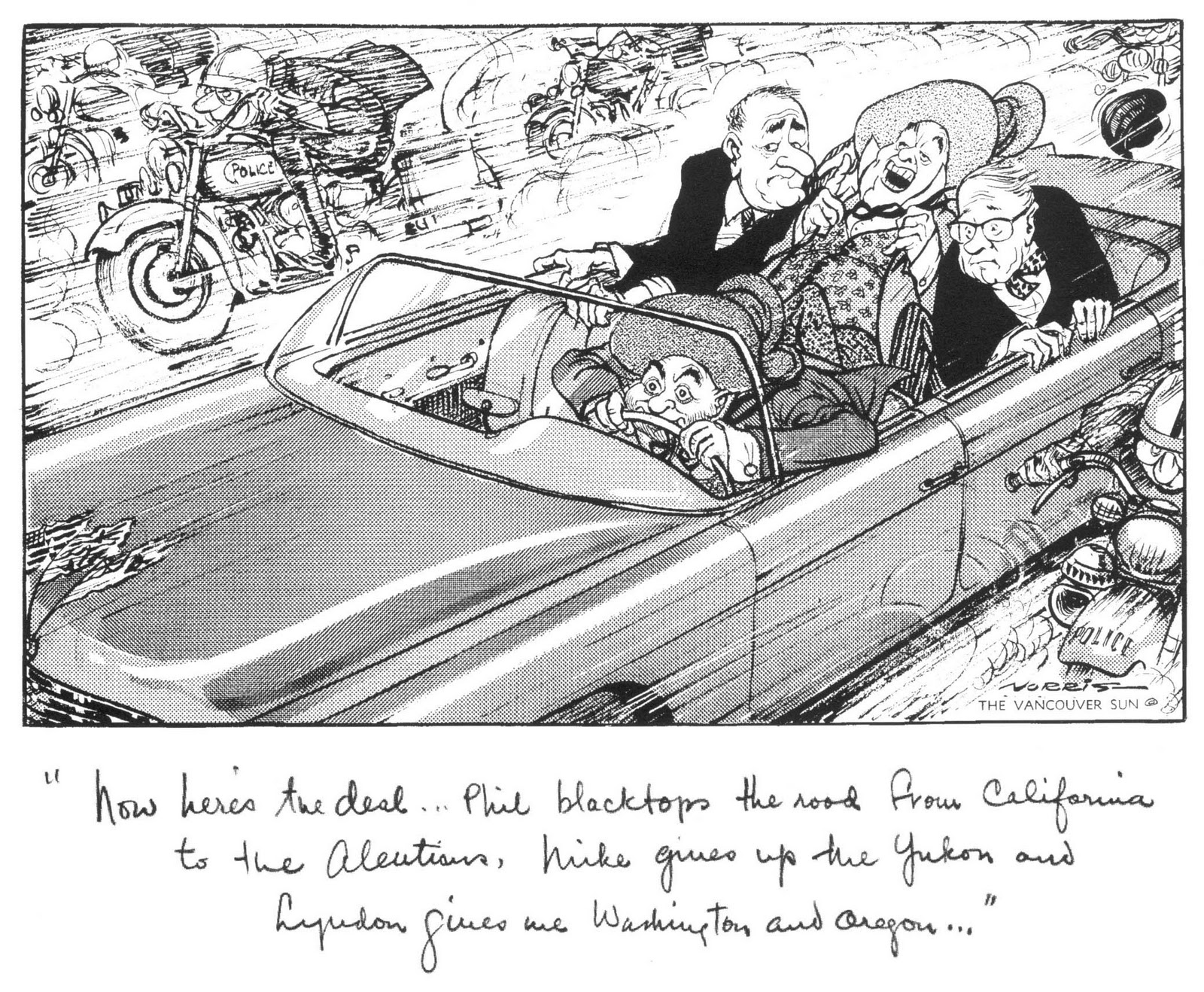
- Vancouver Sun cartoon of Bennett, Phil Gaglardi, President Lyndon Johnson, and Prime Minister Lester Pearson by Len NorrisLen NorrisLeonard Matheson Norris, better known as Len Norris , was a longtime editorial cartoonist for the Canadian newspaper Vancouver Sun from 1950 to 1988...