
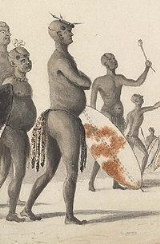
Mzilikazi (ca. 1790 - 9 September 1868), also sometimes called Mosilikatze, was a
Southern AfricaSouthern Africa is the southernmost region of the African continent, variably defined by geography or geopolitics. Within the region are numerous territories, including the Republic of South Africa ; nowadays, the simpler term South Africa is generally reserved for the country in English.-UN...
n king who founded the Matabele kingdom (Mthwakazi),
MatabelelandModern day Matabeleland is a region in Zimbabwe divided into three provinces: Matabeleland North, Bulawayo and Matabeleland South. These provinces are in the west and south-west of Zimbabwe, between the Limpopo and Zambezi rivers. The region is named after its inhabitants, the Ndebele people...
, in what became
RhodesiaRhodesia , officially the Republic of Rhodesia from 1970, was an unrecognised state located in southern Africa that existed between 1965 and 1979 following its Unilateral Declaration of Independence from the United Kingdom on 11 November 1965...
and is now
ZimbabweZimbabwe is a landlocked country located in the southern part of the African continent, between the Zambezi and Limpopo rivers. It is bordered by South Africa to the south, Botswana to the southwest, Zambia and a tip of Namibia to the northwest and Mozambique to the east. Zimbabwe has three...
. He was born the son of Matshobana near Mkuze,
ZululandThe Zulu Kingdom, sometimes referred to as the Zulu Empire or, rather imprecisely, Zululand, was a monarchy in Southern Africa that extended along the coast of the Indian Ocean from the Tugela River in the south to Pongola River in the north....
(now part of South Africa) and died at
IngamaIngama is a village about 20 km south west of the present day Bulawayo, the second largest city of Zimbabwe. Ingama is about 5km to the north of Old Bulawayo Mzilikazi's last royal residence. Old Bulawayo is now being rebuilt as the AmaNdebele are trying to resuscitate their kingdom along the lines...
, Matabeleland (near
BulawayoBulawayo is the second largest city in Zimbabwe after the capital Harare, with an estimated population in 2010 of 2,000,000. It is located in Matabeleland, 439 km southwest of Harare, and is now treated as a separate provincial area from Matabeleland...
, Zimbabwe). Many consider him to be the greatest Southern African military leader after the
ZuluThe Zulu Kingdom, sometimes referred to as the Zulu Empire or, rather imprecisely, Zululand, was a monarchy in Southern Africa that extended along the coast of the Indian Ocean from the Tugela River in the south to Pongola River in the north....
king
ShakaShaka kaSenzangakhona , also known as Shaka Zulu , was the most influential leader of the Zulu Kingdom....
. In his autobiography,
David Livingstone David Livingstone was a Scottish Congregationalist pioneer medical missionary with the London Missionary Society and an explorer in Africa. His meeting with H. M. Stanley gave rise to the popular quotation, "Dr...
referred to him as the second most impressive leader he encountered on the African Continent.
Leaving Zululand
He took his tribe, the
KhumaloThe Khumalo are an African clan that originated in northern KwaZulu, South Africa. The Khumalos are part of a group of Zulus and Ngunis known as the Mtungwa. Others include the Mabaso, located between the Ndwandwe and the Mthethwa....
, on an 800 km long journey from Zululand to what is now called Zimbabwe. Along the way he showed considerable
statesmanA statesman is usually a politician or other notable public figure who has had a long and respected career in politics or government at the national and international level. As a term of respect, it is usually left to supporters or commentators to use the term...
ship, as he was able to weld his own people and the many tribes he conquered into a large and ethnically diverse but centralised
kingdomA monarchy is a form of government in which the office of head of state is usually held until death or abdication and is often hereditary and includes a royal house. In some cases, the monarch is elected...
.
He was originally a lieutenant of Shaka, but in 1823 he had a quarrel with him and rebelled. Rather than face ritual execution, he fled northwards with his tribe. He first travelled to
MozambiqueMozambique, officially the Republic of Mozambique , is a country in southeastern Africa bordered by the Indian Ocean to the east, Tanzania to the north, Malawi and Zambia to the northwest, Zimbabwe to the west and Swaziland and South Africa to the southwest...
but in 1826 he moved west into the
TransvaalThe South African Republic , often informally known as the Transvaal Republic, was an independent Boer-ruled country in Southern Africa during the second half of the 19th century. Not to be confused with the present-day Republic of South Africa, it occupied the area later known as the South African...
due to continued attacks by his enemies. As he conquered the Transvaal he absorbed many members of other tribes and established a military despotism, such as Mzilikazi's attacks in the Nzunza kraal at Esikhunjini, where the Nzunza king Magodongo and others were kidnapped and subsequently killed at Mkobola river. For the next ten years, Mzilikazi dominated the Transvaal. This period, known locally as the
MfecaneMfecane , also known by the Sesotho name Difaqane or Lifaqane, was a period of widespread chaos and warfare among indigenous tribes in southern Africa during the period between 1815 to about 1840....
(crushing) was characterised by devastation and murder on a grand scale as Mzilikazi removed all opposition and remodelled the territory to suit the new Ndebele order. He used the method of
scorched earthA scorched earth policy is a military strategy or operational method which involves destroying anything that might be useful to the enemy while advancing through or withdrawing from an area...
to keep distance to all surrounding kingdoms. The death toll has never been satisfactorily determined but the region was so depopulated that the Trekboers were able to occupy and take ownership of all the best land in the 1830s due to the low population of the area.
Meeting the Boers
The Boers began to arrive in Transvaal in 1836, and after several confrontations over the next two years the Ndebele suffered heavy losses. By early 1838, Mzilikazi was forced north across the Limpopo and out of Transvaal altogether. Further attacks first caused him to move west again to present-day
BotswanaBotswana, officially the Republic of Botswana , is a landlocked country located in Southern Africa. The citizens are referred to as "Batswana" . Formerly the British protectorate of Bechuanaland, Botswana adopted its new name after becoming independent within the Commonwealth on 30 September 1966...
and then later northwards towards what is now
ZambiaZambia , officially the Republic of Zambia, is a landlocked country in Southern Africa. The neighbouring countries are the Democratic Republic of the Congo to the north, Tanzania to the north-east, Malawi to the east, Mozambique, Zimbabwe, Botswana and Namibia to the south, and Angola to the west....
. He was unable to conquer the land there due to the prevalence of
tsetse flyTsetse , sometimes spelled tzetze and also known as tik-tik flies, are large biting flies that inhabit much of mid-continental Africa between the Sahara and the Kalahari deserts. They live by feeding on the blood of vertebrate animals and are the primary biological vectors of trypanosomes, which...
-borne diseases of oxen. Mzilikazi travelled southeastwards to what became known as Matabeleland (situated in the southwest of present-day Zimbabwe) and settled there in 1840..
After his arrival, he organised his followers into a military system with
regimentA regiment is a major tactical military unit, composed of variable numbers of batteries, squadrons or battalions, commanded by a colonel or lieutenant colonel...
al
kraalKraal is an Afrikaans and Dutch word for an enclosure for cattle or other livestock, located within an African settlement or village surrounded by a palisade, mud wall, or other fencing, roughly circular in form.In the Dutch language a kraal is a term derived from the Portuguese word , cognate...
s, similar to those of Shaka, which became strong enough to repel the
BoerBoer is the Dutch and Afrikaans word for farmer, which came to denote the descendants of the Dutch-speaking settlers of the eastern Cape frontier in Southern Africa during the 18th century, as well as those who left the Cape Colony during the 19th century to settle in the Orange Free State,...
attacks of 1847 - 1851 and persuade the government of the
South African RepublicThe South African Republic , often informally known as the Transvaal Republic, was an independent Boer-ruled country in Southern Africa during the second half of the 19th century. Not to be confused with the present-day Republic of South Africa, it occupied the area later known as the South African...
to sign a peace treaty with him in 1852.
Matabele Kingdom
While Mzilikazi was generally friendly to
EuropeEurope is, by convention, one of the world's seven continents. Comprising the westernmost peninsula of Eurasia, Europe is generally 'divided' from Asia to its east by the watershed divides of the Ural and Caucasus Mountains, the Ural River, the Caspian and Black Seas, and the waterways connecting...
an travellers, he remained mindful of the danger they posed to his kingdom and in later years he refused some visitors any access to his realm. The many European travellers who met with Mzilikazi include
Robert MoffatRobert Moffat was a Scottish Congregationalist missionary to Africa, and father in law of David Livingstone....
the missionary,
David HumeDavid Hume was a Scottish-South African explorer and big-game hunter.David Hume was born in Berwick, Scotland and went to South Africa with Benjamin Moodie's Scottish settlers in 1817. He became a pioneer trader, explorer and renowned big-game hunter...
the explorer / trader,
Andrew SmithSir Andrew Smith KCB was a Scottish surgeon, explorer, ethnologist and zoologist. He is considered the father of Zoology in South Africa having described many species across a wide range of groups in his major work, Illustrations of the Zoology of South Africa.Smith was born in Hawick, Roxburghshire...
the medical doctor, ethnologist and zoologist,
William Cornwallis HarrisMajor Sir William Cornwallis Harris was an English military engineer, artist and hunter.-Life and career:...
the hunter and the missionary explorer
David Livingstone David Livingstone was a Scottish Congregationalist pioneer medical missionary with the London Missionary Society and an explorer in Africa. His meeting with H. M. Stanley gave rise to the popular quotation, "Dr...
.
During the tribe's wanderings north of the Limpopo Mzilikazi became separated from the bulk of the tribe who gave him up for dead and hailed his young heir Nkulumane as successor. However, on his reappearance after a traumatic journey through the Zambezi valley, Mzilikazi asserted control and had his son and all those chiefs who had chosen him put to death. They were all executed by being cast over a steep cliff of a hill now called Ntabazinduna (Hill of the Chiefs). He made his capital 5 km away and named it Gu-Bulawayo which means "place of slaughter". King Shaka's capital was also called
BulawayoBulawayo is the second largest city in Zimbabwe after the capital Harare, with an estimated population in 2010 of 2,000,000. It is located in Matabeleland, 439 km southwest of Harare, and is now treated as a separate provincial area from Matabeleland...
.
External links