

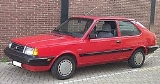
Volvo 300 series

Encyclopedia
The Volvo 300 series is a rear wheel drive automobile
sold as both a hatchback
and (later) a conventional saloon from 1976-1991. It was launched in the Netherlands
shortly after Volvo
acquired a major stake in the passenger car division of DAF
in 1973. The series consisted of the Volvo 340 (initially badged as the 343/345) and the later Volvo 360.
The 300 series was unusual in having the gearbox mounted over the rear axle (which was of the De Dion tube
type), with the 2 liter models having the driveshaft
enclosed in a "torque tube". The rear-mounted gearbox helped with weight distribution
but resulted in an unusually large transmission tunnel, especially by comparison with then-contemporary front wheel drive competitors such as the Mk. III Ford Escort
and the Opel Kadett
E/Mk. II Vauxhall Astra
.
Overall, the 300 series was considered heavy and unrewarding to drive but reliable and safe by the standards of its day. However, early 360GLT versions were well regarded by more enthusiastic drivers, with the unusual gearbox location ensuring good weight distribution and unusually good balance and traction.
, BMW
, and Volvo. Volvo was not originally interested due to the cost, but they were later persuaded by DAF's access to Renault
engines. This helped Volvo expand its model line-up without the large expenditures associated with developing a new model. Building cars in the Netherlands
also helped the Swedish
Volvo to access the markets of the EEC, of which Sweden was then not yet a member.
Volvo purchased a one-third share in DAF in 1973, increasing to a three-quarters stake in 1975; the DAF company's name was changed to Volvo Car BV that year. Free of its passenger car division, DAF's commercial vehicle division, DAF Trucks
, still operates today.
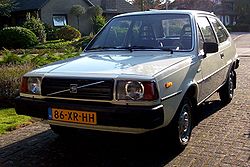 The Volvo 343 was introduced in 1976. DAF had already begun development of this car as a replacement for the Volvo (previously DAF) 66
. It was fitted with a 1.4 litre Renault engine in the front and DAF's radical Variomatic
continuously variable transmission
unusually mounted in the rear, helping weight distribution. To add to the appeal of the car, Volvo adapted the M45 manual transmission from the 200 series
to fit in place of the CVT, and was sold alongside the CVT models from 1979. A five-door model, the 345, was added in 1980. In around 1980 also larger wrap around bumpers were introduced. 1981 saw the addition of an additional engine option, the Volvo designed B19, only available with the manual transmission. A revised bonnet, grille and front lamp arrangement and slightly different wings signalled a facelift in 1981, which also gave the car a new dashboard and revised interior.
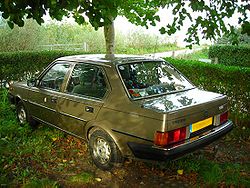 The third digit designating the number of doors was dropped from model designations in 1983. The 360 arrived that year with two 2.0 litre engine choices, the 92 bhp B19A and the 115 bhp B19E, also from Volvo. This 2-litre 360 model was available in five-door and three-door hatchback form, with four-door saloon models added in 1984.
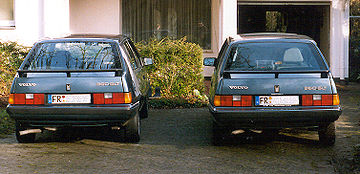
In around 1985 a further facelift was introduced. Amongst other small changes, (optionally body coloured) wrap-around bumpers with the indicator repeaters attached to them were fitted. Instrumentation changed from Smiths units to VDO. The older Volvo redblock engines in the 360 were upgraded to the low friction B200 unit. Capacities and outputs remained much the same. The carburettor version was designated B200K and the Bosch LE-Jet fuel injected version is known as the B200E.
From 1987 on, incremental improvements in features and emissions control were made. Production of the 300 series ended in 1991, despite the fact it was supposedly replaced by the Volvo 440
in 1987.
A famous advertisement for the 300 series in the late 1980s saw a crash test dummy
"come alive", and drive a 340 out of a second floor factory window, nose-diving into the concrete ground.
C-series OHV pushrod unit, and for the 360 there was the B200
2.0-litre engine taken from the Volvo 240 with outputs varying from 95 bhp to 112 bhp.
A new Renault F-series 80 bhp 1.7 litre petrol engine (designated the B172) was introduced in the 340 during the late 1984 range facelift, along with a 340 version of the saloon, which was only available with the new engine.
 A diesel engine for the 340 developing 55 bhp, was only available in certain markets and was added to the 340 models in 1986. This diesel was a Renault
F-series like the petrol 1.7, and was available with a 1.6 litre non-turbo engine only.
These diesel models were never offered in the UK
. However they were offered in right-hand drive form in Ireland
.
Volvo also experimented with LPG tanks, a feature of which was made available in 1979 with the Volvo 343 and 345 but they were limited in LPG availability.
While the car was fundamentally robust, the detail build quality was never up to the same standard of Volvo's larger, Swedish-built models, coupled to the fact that the early Variomatic cars proved to be particularly troublesome. The Volvo badge however ensured that the car had a strong middle-class following (often as a second car) particularly in the UK in the 1980s, regularly making that country's top annual 20 sales tables for that decade, and they are still fairly common in the UK 15 years after production ceased. They are robust and mechanically simple (and therefore easy to maintain). Even the unpopular Variomatic transmissions are reliable given proper care. The rust protection was poorer than other Volvos, but the engines (especially the 1.4 and 2.0s) were quite durable.
An unusual feature of the car's design is the geometry of the rear axle. Two degrees of negative camber on the rear de Dion
axle produces a similar stabilising effect as the expensive and complex Weissach axle
launched by Porsche
a year after the launch of the Volvo 343. The inherent stability of this design made the car popular with caravan owners, being voted Tow Car of the Year in 1985.
The Renault-sourced 1.7 litre engine suffers from a well-known problem where the carburetor mounting flange warps due to engine heat, causing a small air leak and subsequent running problems. This is easy to fix, requiring minor machining of the mating faces.
The Volvo 300 has experienced something of a renaissance in recent years with a number of very active websites across Europe. A strong, young following has developed attracted by a rear wheel drive car which is very cheap to buy, insure and relatively easy to work on. In the UK, despite being unsuitable for professional drifting
, many 300s (because of their low price) have found popularity amongst the amateur drifting community. Known as "trampdrifting," old bangers are modified to drift at a minimal cost and are discarded once they reach the end of their usefulness.
It featured among the top 10 most popular new cars in the UK in 1982, 1983 and 1984, and was one of the UK's most popular imported cars of the decade
.
It was not sold in North America. The Volvo 360GLT only was introduced in Australia and New Zealand during 1984, and lasted until 1987.
There was the Volvo 340 estate, and a convertible was also built as a design study, but both were never put into production. A van version was also considered. This was essentially a five-door 340, but with both windows on the rear doors replaced with metal in the same colour as the rest of the car. The rear seats were also removed.
Another model of note was the 363CS. Possibly named after 'Clubsport', to indicate a high-performance version, the 363 CS was based on the three-door bodyshell, and fitted with the 2.7 V6 PRV engine, as used in the Volvo 260 series. Again only a prototype, a small number were built and were painted in metallic silver with black and orange 'Starsky and Hutch' - style stripes down both sides. Flared wheelarches and orange-painted, multi-spoke alloy wheels were also included to create a sporty look.
co-host Jeremy Clarkson
has a long hatred for the 340. In a 1992 episode as a preamble to a road test of the then-new Volvo 850
, he has one destroyed in a scrap metal shredder. In another episode, he intentionally crashed one against a tree as he pointed out Volvo's reputation for safety.
For instance, a heavily tuned version (using alpine/gordini cross-flow engines bored to 1770 cc) was driven by Per-Inge Walfridsson to win the European Championship of Rallycross in 1980.
In the UK, several Volvo 360 GLT models can be seen in action on Road-Rally events.
The Volvo 360 GLT also participated in a 24 hour endurance record breaking run at the Surfers Paradise raceway
in Queensland, Australia to showcase the introduction of the model down-under in 1984. This exact same Volvo 360 GLT car was later converted to rallying specifications and participated in many Australia rally events and is still running in 2009 as a rally car.
In more recent years, the 360 series has been used in a dedicated racing class at the circuit of Zandvoort
(former F1 circuit), called the "Volvo 360 Cup" (www.volvo360cup.nl)
Another field of motorsport where the 300 series has become popular in recent years is amateur drifting due to their rear-wheel-drive suitability and fairly cheap cost.
Automobile
An automobile, autocar, motor car or car is a wheeled motor vehicle used for transporting passengers, which also carries its own engine or motor...
sold as both a hatchback
Hatchback
A Hatchback is a car body style incorporating a shared passenger and cargo volume, with rearmost accessibility via a rear third or fifth door, typically a top-hinged liftgate—and features such as fold-down rear seats to enable flexibility within the shared passenger/cargo volume. As a two-box...
and (later) a conventional saloon from 1976-1991. It was launched in the Netherlands
Netherlands
The Netherlands is a constituent country of the Kingdom of the Netherlands, located mainly in North-West Europe and with several islands in the Caribbean. Mainland Netherlands borders the North Sea to the north and west, Belgium to the south, and Germany to the east, and shares maritime borders...
shortly after Volvo
Volvo Cars
Volvo Car Corporation, or Volvo Personvagnar AB, is a Swedish automobile manufacturer founded in 1927, in Gothenburg, Sweden. It is owned by Zhejiang Geely Holding Group. Volvo was originally formed as a subsidiary company to the ball bearing maker SKF. When Volvo AB was introduced on the Swedish...
acquired a major stake in the passenger car division of DAF
DAF Trucks
DAF Trucks NV is a Dutch truck manufacturing company and a division of PACCAR. Its headquarters and main plant are in Eindhoven. Cabs and axle assemblies are produced at its Westerlo plant in Belgium...
in 1973. The series consisted of the Volvo 340 (initially badged as the 343/345) and the later Volvo 360.
The 300 series was unusual in having the gearbox mounted over the rear axle (which was of the De Dion tube
De Dion tube
A de Dion tube is an automobile suspension technology. It is a sophisticated form of non-independent suspension and is a considerable improvement over the alternative swing axle and Hotchkiss drive types. A de Dion suspension uses universal joints at both the wheel hubs and differential, and uses a...
type), with the 2 liter models having the driveshaft
Driveshaft
A drive shaft, driveshaft, driving shaft, propeller shaft, or Cardan shaft is a mechanical component for transmitting torque and rotation, usually used to connect other components of a drive train that cannot be connected directly because of distance or the need to allow for relative movement...
enclosed in a "torque tube". The rear-mounted gearbox helped with weight distribution
Weight distribution
Weight distribution is the apportioning of weight within a vehicle, especially cars, airplanes, and trains.In a vehicle which relies on gravity in some way, weight distribution directly affects a variety of vehicle characteristics, including handling, acceleration, traction, and component life...
but resulted in an unusually large transmission tunnel, especially by comparison with then-contemporary front wheel drive competitors such as the Mk. III Ford Escort
Ford Escort (European)
The Mark I Ford Escort was introduced in the United Kingdom at the end of 1967, making its show debut at Brussels Motor Show in January 1968. It replaced the successful long running Anglia. The car was presented in continental Europe as a product of Ford's European operation...
and the Opel Kadett
Opel Kadett
The Opel Kadett is a small family car produced by the German automobile manufacturer Opel between 1937 and 1940, and then again from 1962 until 1991 , when it was replaced by the Opel Astra.-Original model :...
E/Mk. II Vauxhall Astra
Vauxhall Astra
Astra is a model name which has been used by Vauxhall, the British subsidiary of General Motors , on their small family car ranges since 1979. Astras are technically essentially identical with similar vehicles offered by GM's German subsidiary Opel in most other European countries...
.
Overall, the 300 series was considered heavy and unrewarding to drive but reliable and safe by the standards of its day. However, early 360GLT versions were well regarded by more enthusiastic drivers, with the unusual gearbox location ensuring good weight distribution and unusually good balance and traction.
Origins
After building a series of compact cars, DAF sought a partner to bring its new larger model, codenamed P900 and intended to become the DAF 77, to market in 1970. Several manufacturers were approached, including AudiAudi
Audi AG is a German automobile manufacturer, from supermini to crossover SUVs in various body styles and price ranges that are marketed under the Audi brand , positioned as the premium brand within the Volkswagen Group....
, BMW
BMW
Bayerische Motoren Werke AG is a German automobile, motorcycle and engine manufacturing company founded in 1916. It also owns and produces the Mini marque, and is the parent company of Rolls-Royce Motor Cars. BMW produces motorcycles under BMW Motorrad and Husqvarna brands...
, and Volvo. Volvo was not originally interested due to the cost, but they were later persuaded by DAF's access to Renault
Renault
Renault S.A. is a French automaker producing cars, vans, and in the past, autorail vehicles, trucks, tractors, vans and also buses/coaches. Its alliance with Nissan makes it the world's third largest automaker...
engines. This helped Volvo expand its model line-up without the large expenditures associated with developing a new model. Building cars in the Netherlands
Netherlands
The Netherlands is a constituent country of the Kingdom of the Netherlands, located mainly in North-West Europe and with several islands in the Caribbean. Mainland Netherlands borders the North Sea to the north and west, Belgium to the south, and Germany to the east, and shares maritime borders...
also helped the Swedish
Sweden
Sweden , officially the Kingdom of Sweden , is a Nordic country on the Scandinavian Peninsula in Northern Europe. Sweden borders with Norway and Finland and is connected to Denmark by a bridge-tunnel across the Öresund....
Volvo to access the markets of the EEC, of which Sweden was then not yet a member.
Volvo purchased a one-third share in DAF in 1973, increasing to a three-quarters stake in 1975; the DAF company's name was changed to Volvo Car BV that year. Free of its passenger car division, DAF's commercial vehicle division, DAF Trucks
DAF Trucks
DAF Trucks NV is a Dutch truck manufacturing company and a division of PACCAR. Its headquarters and main plant are in Eindhoven. Cabs and axle assemblies are produced at its Westerlo plant in Belgium...
, still operates today.
Model chronology
Volvo 66
The Volvo 66 was a Swedish automobile. It sprang directly from the DAF 66, which was originally styled by Michelotti. The compact car was introduced in August 1975, almost exactly a year after Volvo Cars bought DAF, and before production of the Volvo 300 series began.The Volvo 66 was known for its...
. It was fitted with a 1.4 litre Renault engine in the front and DAF's radical Variomatic
Variomatic
Variomatic is the stepless, fully automatic transmission of the Dutch car manufacturer DAF, originally developed by Hub van Doorne: this consists of a "V" shaped drive belt and two pulleys, each of two cones, whose effective diameter can be changed so that the "V" belt runs nearer the spindle or...
continuously variable transmission
Continuously variable transmission
A continuously variable transmission is a transmission that can change steplessly through an infinite number of effective gear ratios between maximum and minimum values. This contrasts with other mechanical transmissions that offer a fixed number of gear ratios...
unusually mounted in the rear, helping weight distribution. To add to the appeal of the car, Volvo adapted the M45 manual transmission from the 200 series
Volvo 200 series
The Volvo 200 series is a range of large family cars , produced by Volvo from 1974 to 1993, with more than 2.8 million units sold worldwide. The 200 series was essentially an updated version of the 140; both were designed by Jan Wilsgaard. It shared the same body, but included a number of...
to fit in place of the CVT, and was sold alongside the CVT models from 1979. A five-door model, the 345, was added in 1980. In around 1980 also larger wrap around bumpers were introduced. 1981 saw the addition of an additional engine option, the Volvo designed B19, only available with the manual transmission. A revised bonnet, grille and front lamp arrangement and slightly different wings signalled a facelift in 1981, which also gave the car a new dashboard and revised interior.
In around 1985 a further facelift was introduced. Amongst other small changes, (optionally body coloured) wrap-around bumpers with the indicator repeaters attached to them were fitted. Instrumentation changed from Smiths units to VDO. The older Volvo redblock engines in the 360 were upgraded to the low friction B200 unit. Capacities and outputs remained much the same. The carburettor version was designated B200K and the Bosch LE-Jet fuel injected version is known as the B200E.
From 1987 on, incremental improvements in features and emissions control were made. Production of the 300 series ended in 1991, despite the fact it was supposedly replaced by the Volvo 440
Volvo 440
The Volvo 440 and 460 are versions of a family car produced by the Swedish carmaker Volvo Cars. They were built at the DAF factory in the Netherlands, and released in Europe in 1987 and 1989 respectively....
in 1987.
A famous advertisement for the 300 series in the late 1980s saw a crash test dummy
Crash test dummy
Crash test dummies are full-scale anthropomorphic test devices that simulate the dimensions, weight proportions and articulation of the human body, and are usually instrumented to record data about the dynamic behavior of the ATD in simulated vehicle impacts...
"come alive", and drive a 340 out of a second floor factory window, nose-diving into the concrete ground.
Engines
The 300 Series had a choice of three petrol engines; a 1.4, 1.7, and a 2.0-litre. The 1.4 litre B14 was a RenaultRenault
Renault S.A. is a French automaker producing cars, vans, and in the past, autorail vehicles, trucks, tractors, vans and also buses/coaches. Its alliance with Nissan makes it the world's third largest automaker...
C-series OHV pushrod unit, and for the 360 there was the B200
Volvo B21 engine
The Volvo B21 was a slant straight-4 engine first used in the Volvo 200 series, meant to replace the B20. The B21 and all derived engines are often referred to as red block engines for the red paint applied to the block...
2.0-litre engine taken from the Volvo 240 with outputs varying from 95 bhp to 112 bhp.
A new Renault F-series 80 bhp 1.7 litre petrol engine (designated the B172) was introduced in the 340 during the late 1984 range facelift, along with a 340 version of the saloon, which was only available with the new engine.
Renault
Renault S.A. is a French automaker producing cars, vans, and in the past, autorail vehicles, trucks, tractors, vans and also buses/coaches. Its alliance with Nissan makes it the world's third largest automaker...
F-series like the petrol 1.7, and was available with a 1.6 litre non-turbo engine only.
These diesel models were never offered in the UK
United Kingdom
The United Kingdom of Great Britain and Northern IrelandIn the United Kingdom and Dependencies, other languages have been officially recognised as legitimate autochthonous languages under the European Charter for Regional or Minority Languages...
. However they were offered in right-hand drive form in Ireland
Ireland
Ireland is an island to the northwest of continental Europe. It is the third-largest island in Europe and the twentieth-largest island on Earth...
.
Volvo also experimented with LPG tanks, a feature of which was made available in 1979 with the Volvo 343 and 345 but they were limited in LPG availability.
Reputation and popularity
Like other Volvos, the 340 embodied many ground-breaking safety features which have since become standard on most cars.While the car was fundamentally robust, the detail build quality was never up to the same standard of Volvo's larger, Swedish-built models, coupled to the fact that the early Variomatic cars proved to be particularly troublesome. The Volvo badge however ensured that the car had a strong middle-class following (often as a second car) particularly in the UK in the 1980s, regularly making that country's top annual 20 sales tables for that decade, and they are still fairly common in the UK 15 years after production ceased. They are robust and mechanically simple (and therefore easy to maintain). Even the unpopular Variomatic transmissions are reliable given proper care. The rust protection was poorer than other Volvos, but the engines (especially the 1.4 and 2.0s) were quite durable.
An unusual feature of the car's design is the geometry of the rear axle. Two degrees of negative camber on the rear de Dion
De Dion tube
A de Dion tube is an automobile suspension technology. It is a sophisticated form of non-independent suspension and is a considerable improvement over the alternative swing axle and Hotchkiss drive types. A de Dion suspension uses universal joints at both the wheel hubs and differential, and uses a...
axle produces a similar stabilising effect as the expensive and complex Weissach axle
Weissach axle
The Weissach axle is a special rear suspension arrangement devised for the Porsche 928. The goal of the Weissach axle was to eliminate lift-throttle oversteer by allowing the rear suspension to adjust itself during cornering maneuvers....
launched by Porsche
Porsche
Porsche Automobil Holding SE, usually shortened to Porsche SE a Societas Europaea or European Public Company, is a German based holding company with investments in the automotive industry....
a year after the launch of the Volvo 343. The inherent stability of this design made the car popular with caravan owners, being voted Tow Car of the Year in 1985.
The Renault-sourced 1.7 litre engine suffers from a well-known problem where the carburetor mounting flange warps due to engine heat, causing a small air leak and subsequent running problems. This is easy to fix, requiring minor machining of the mating faces.
The Volvo 300 has experienced something of a renaissance in recent years with a number of very active websites across Europe. A strong, young following has developed attracted by a rear wheel drive car which is very cheap to buy, insure and relatively easy to work on. In the UK, despite being unsuitable for professional drifting
Drifting (motorsport)
Drifting refers to a driving technique and to a motorsport where the driver intentionally over steers, causing loss of traction in the rear wheels through turns, while maintaining vehicle control and a high exit speed...
, many 300s (because of their low price) have found popularity amongst the amateur drifting community. Known as "trampdrifting," old bangers are modified to drift at a minimal cost and are discarded once they reach the end of their usefulness.
It featured among the top 10 most popular new cars in the UK in 1982, 1983 and 1984, and was one of the UK's most popular imported cars of the decade
1980s
File:1980s decade montage.png|thumb|400px|From left, clockwise: The first Space Shuttle, Columbia, lifted off in 1981; American President Ronald Reagan and Soviet leader Mikhail Gorbachev eased tensions between the two superpowers, leading to the end of the Cold War; The Fall of the Berlin Wall in...
.
It was not sold in North America. The Volvo 360GLT only was introduced in Australia and New Zealand during 1984, and lasted until 1987.
Prototypes
There are a few variations of the Volvo 300 series that never made production:There was the Volvo 340 estate, and a convertible was also built as a design study, but both were never put into production. A van version was also considered. This was essentially a five-door 340, but with both windows on the rear doors replaced with metal in the same colour as the rest of the car. The rear seats were also removed.
Another model of note was the 363CS. Possibly named after 'Clubsport', to indicate a high-performance version, the 363 CS was based on the three-door bodyshell, and fitted with the 2.7 V6 PRV engine, as used in the Volvo 260 series. Again only a prototype, a small number were built and were painted in metallic silver with black and orange 'Starsky and Hutch' - style stripes down both sides. Flared wheelarches and orange-painted, multi-spoke alloy wheels were also included to create a sporty look.
Top Gear
Top GearTop Gear (current format)
Top Gear is a British television series about motor vehicles, primarily cars. It began in 1977 as a conventional motoring magazine show. Over time, and especially since a relaunch in 2002, it has developed a quirky, humorous style...
co-host Jeremy Clarkson
Jeremy Clarkson
Jeremy Charles Robert Clarkson is an English broadcaster, journalist and writer who specialises in motoring. He is best known for his role on the BBC TV show Top Gear along with co-presenters Richard Hammond and James May...
has a long hatred for the 340. In a 1992 episode as a preamble to a road test of the then-new Volvo 850
Volvo 850
The Volvo 850 is a compact executive car produced by Volvo Cars from 1992 to 1997 and designed by Jan Wilsgaard. Available in sedan/saloon and station wagon/estate body styles, the Volvo 850 was notable as the first front-wheel drive vehicle from this Swedish manufacturer to be exported to North...
, he has one destroyed in a scrap metal shredder. In another episode, he intentionally crashed one against a tree as he pointed out Volvo's reputation for safety.
The Volvo 300 Series in motorsport
Despite the 'geriatric' image the 300-series has gained over the years, it has had quite some successful appearances in motorsport.For instance, a heavily tuned version (using alpine/gordini cross-flow engines bored to 1770 cc) was driven by Per-Inge Walfridsson to win the European Championship of Rallycross in 1980.
In the UK, several Volvo 360 GLT models can be seen in action on Road-Rally events.
The Volvo 360 GLT also participated in a 24 hour endurance record breaking run at the Surfers Paradise raceway
Surfers Paradise International Raceway
Surfers Paradise International Raceway was a motor racing complex at Gold Coast, Queensland, Australia. The circuit was designed and built by Keith Williams, a motor racing enthusiast. It was located opposite the Surfers Paradise Ski Gardens at Carrara...
in Queensland, Australia to showcase the introduction of the model down-under in 1984. This exact same Volvo 360 GLT car was later converted to rallying specifications and participated in many Australia rally events and is still running in 2009 as a rally car.
In more recent years, the 360 series has been used in a dedicated racing class at the circuit of Zandvoort
Zandvoort
Zandvoort is a municipality and a town in the Netherlands, in the province of North Holland.Zandvoort is one of the major beach resorts of the Netherlands; it has a long sandy beach, bordered by coastal dunes...
(former F1 circuit), called the "Volvo 360 Cup" (www.volvo360cup.nl)
Another field of motorsport where the 300 series has become popular in recent years is amateur drifting due to their rear-wheel-drive suitability and fairly cheap cost.
External links
- Volvo 360 Cup (Dutch)
- Volvo 300 at the BBCBBCThe British Broadcasting Corporation is a British public service broadcaster. Its headquarters is at Broadcasting House in the City of Westminster, London. It is the largest broadcaster in the world, with about 23,000 staff...
"Hitch-hiker's guide to the Galaxy" website] - Volvo 300 Club website (Dutch)
- Volvo 300 mania website