


Vincenzo Danti

Encyclopedia
Perugia
Perugia is the capital city of the region of Umbria in central Italy, near the River Tiber, and the capital of the province of Perugia. The city is located about north of Rome. It covers a high hilltop and part of the valleys around the area....
.
His father was an architect and goldsmith, and Vincenzo developed an interest in drawing and goldsmithing. In 1545 he went to Rome
Rome
Rome is the capital of Italy and the country's largest and most populated city and comune, with over 2.7 million residents in . The city is located in the central-western portion of the Italian Peninsula, on the Tiber River within the Lazio region of Italy.Rome's history spans two and a half...
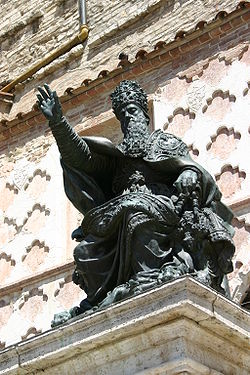
to study sculpture and in 1553 he managed to secure a commission for a bronze statue of Pope Julius III
Pope Julius III
Pope Julius III , born Giovanni Maria Ciocchi del Monte, was Pope from 7 February 1550 to 1555....
which was placed outside Perugia Cathedral
Perugia Cathedral
The Cathedral of San Lorenzo is the main religious edifice of Perugia, Umbria, central Italy.- History :From the establishment of the bishopric, a cathedral existed in Perugia in different locations, until, in 936-1060, a new edifice, corresponding to the transept of the present cathedral, was...
. Large bronze statues at this time were few and far between, and it is believed that Danti's bronze was based on a bronze of Julius III by Michelangelo
Michelangelo
Michelangelo di Lodovico Buonarroti Simoni , commonly known as Michelangelo, was an Italian Renaissance painter, sculptor, architect, poet, and engineer who exerted an unparalleled influence on the development of Western art...
(now lost). In 1557 he went to Florence. In 1559 he made a bronze relief depicting Moses and the Brazen Serpent. This was influenced by bronze reliefs by Donatello
Donatello
Donato di Niccolò di Betto Bardi , also known as Donatello, was an early Renaissance Italian artist and sculptor from Florence...
. It is cast in low relief and is not finished to a very high degree, but is not non finito
Non finito
Non finito is a sculpting technique literally meaning that the work is unfinished. Non finito sculptures appear unfinished because the artist only sculpts part of the block, leaving the figure appearing to be stuck within the block of material. It was pioneered by Donatello during the Renaissance...
either.
Although the competition in 1560 for the Neptune
Fountain of Neptune
The Fountain of Neptune is a fountain in Florence, Italy, situated on the Piazza della Signoria , in front of the Palazzo Vecchio....
fountain was mainly between the two more established sculptors, Bartolomeo Ammanati
Bartolomeo Ammanati
Bartolomeo Ammannati was an Italian architect and sculptor, born at Settignano, near Florence. He studied under Baccio Bandinelli and Jacopo Sansovino and closely imitated the style of Michelangelo.He was more distinguished in architecture than in sculpture...
and Cellini, Danti also tried to prove his worth by competing. In 1561 he carved Honour Triumphs over Falsehood, a statue 'in the round' - interesting to view from all angles. The marble for this statue was bought for him by his patron Danti Sforza Almeni for him to prove his skill. The statue was notable for the fact that it was carved from a single block of marble, something that took great skill to do.
In 1567 he started writing a book about rules of order and proportion in architecture. He did intend to write fifteen of these but only did one. In 1569–71 he produced what is probably his most famous work, The Beheading of St John the Baptist. This is positioned above the bronze doors of the south entrance of the Battistero di San Giovanni in Florence. This bronze group shows the Baptist kneeling in the middle waiting for the sword of the executioner on the right, with Salome on the left. This is in a mannerist style with the bodies and limbs elongated, and bizarre folds in the material. The poses of all are very elegant.
In 1568-72 he carried on Michelangelo's new tradition of depicting modern men in ancient armour (from the Medici Chapel), when he carved Cosimo I as Augustus. This was commissioned for the Uffizi in Florence where it remained until replaced by another statue of Cosimo (a member of the powerful Medici family) by Giambologna
Giambologna
Giambologna, born as Jean Boulogne, incorrectly known as Giovanni da Bologna and Giovanni Bologna , was a sculptor, known for his marble and bronze statuary in a late Renaissance or Mannerist style.- Biography :...
. In 1575 he returned to Perugia where he died in 1576.