
All Topics  
Vibrio parahaemolyticus

 
Vibrio Parahaemolyticus

   Email Print
   Bookmark   Link


Vibrio parahaemolyticus


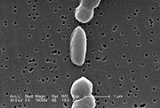
Vibrio parahaemolyticus is a curved, rod-shaped, Gram-negative
Gram-negative

Gram-negative bacteria are those bacteria that do not retain crystal violet dye in the Gram staining protocol. In a Gram stain test, a counterstain is added after the crystal violet, coloring all Gram-negative bacteria with a red or pink color....
 bacterium found in brackish saltwater
Seawater

Seawater is water from a sea or ocean. On average, seawater in the world's oceans has a salinity of about 3.5%, or 35 parts per thousand . This means that every 1 kg of seawater has approximately 35 grams of sea salt ....
, which, when ingested, causes gastrointestinal illness in humans. V. parahaemolyticus is oxidase
Oxidase

An oxidase is any enzyme that catalyst an redox reaction involving molecular oxygen as the electron acceptor. In these reactions, oxygen is reduced to water or hydrogen peroxide ....
 positive, facultatively aerobic
Aerobic organism

An aerobic organism or aerobe is an organism that can survive and grow in an oxygenated environment....
, and does not form spores
Endospore

An endospore is a dormancy, tough, and non-reproductive structure produced by bacteria from the Firmicute phylum. Examples include Bacillus and Clostridium....
. Like other members of the genus Vibrio
Vibrio

Vibrio is a genus of Gram-negative bacteria possessing a curved rod shape. Typically found in Seawater, Vibrio are Facultative anaerobic organism that test positive for oxidase and do not form spores....
, this species is motile, with a single, polar flagellum
Flagellum

A flagellum is a tail-like structure that projects from the cell body of certain prokaryotic and eukaryotic cells, and it functions in locomotion....
.

e infection can occur via the fecal-oral route
Fecal-oral route

The fecal-oral route is a Transmission of diseases, when they can be passed when Feces particles from one host are introduced into the mouth of another potential host....
, ingestion of bacteria in raw or undercooked seafood, usually oysters, is the predominant cause the acute gastroenteritis
Gastroenteritis

Gastroenteritis is inflammation of the gastrointestinal tract, involving both the stomach and the small intestine and resulting in acute diarrhea....
 caused by V. parahaemolyticus.


Discussion
Ask a question about 'Vibrio parahaemolyticus'
Start a new discussion about 'Vibrio parahaemolyticus'
Answer questions from other users
Full Discussion Forum


Encyclopedia


Vibrio parahaemolyticus is a curved, rod-shaped, Gram-negative
Gram-negative

Gram-negative bacteria are those bacteria that do not retain crystal violet dye in the Gram staining protocol. In a Gram stain test, a counterstain is added after the crystal violet, coloring all Gram-negative bacteria with a red or pink color....
 bacterium found in brackish saltwater
Seawater

Seawater is water from a sea or ocean. On average, seawater in the world's oceans has a salinity of about 3.5%, or 35 parts per thousand . This means that every 1 kg of seawater has approximately 35 grams of sea salt ....
, which, when ingested, causes gastrointestinal illness in humans. V. parahaemolyticus is oxidase
Oxidase

An oxidase is any enzyme that catalyst an redox reaction involving molecular oxygen as the electron acceptor. In these reactions, oxygen is reduced to water or hydrogen peroxide ....
 positive, facultatively aerobic
Aerobic organism

An aerobic organism or aerobe is an organism that can survive and grow in an oxygenated environment....
, and does not form spores
Endospore

An endospore is a dormancy, tough, and non-reproductive structure produced by bacteria from the Firmicute phylum. Examples include Bacillus and Clostridium....
. Like other members of the genus Vibrio
Vibrio

Vibrio is a genus of Gram-negative bacteria possessing a curved rod shape. Typically found in Seawater, Vibrio are Facultative anaerobic organism that test positive for oxidase and do not form spores....
, this species is motile, with a single, polar flagellum
Flagellum

A flagellum is a tail-like structure that projects from the cell body of certain prokaryotic and eukaryotic cells, and it functions in locomotion....
.

Pathogenesis

While infection can occur via the fecal-oral route
Fecal-oral route

The fecal-oral route is a Transmission of diseases, when they can be passed when Feces particles from one host are introduced into the mouth of another potential host....
, ingestion of bacteria in raw or undercooked seafood, usually oysters, is the predominant cause the acute gastroenteritis
Gastroenteritis

Gastroenteritis is inflammation of the gastrointestinal tract, involving both the stomach and the small intestine and resulting in acute diarrhea....
 caused by V. parahaemolyticus. Wound infections also occur, but are less common than seafood-borne disease. The disease mechanism of V. parahaemolyticus infections has not been fully elucidated. However, most clinical disease results from strains that carry either the thermostable direct hemolysin
Hemolysis

Hemolysis ?from the Greek Hemo-, Greek language meaning blood, -lysis, meaning to break open?is the breaking open of red blood cells and the release of hemoglobin into the surrounding fluid ....
 gene (tdh) or the tdh-related hemolysin gene (trh) or both genes.

Epidemiology

Outbreaks tend to be concentrated along coastal regions during the summer and early fall when higher water temperatures favor higher levels of bacteria. Seafood most often implicated includes squid, mackerel, tuna, sardines, crab, shrimp, and bivalves
Bivalvia

Bivalves are molluscs belonging to the class Bivalvia. They have two-part animal shells, and typically both valves are symmetry along the hinge line....
 like oysters and clams. The incubation period
Incubation period

Incubation period is the time elapsed between exposure to a pathogenic organism, a chemical or ionizing radiation, and when symptoms and signs are first apparent....
 of ~24 hours is followed by explosive, watery diarrhea
Diarrhea

In medicine, diarrhea, also spelled diarrhoea , is characterized by frequent loose or liquid bowel movements. The spelling of "diarrhea" is an appropriation of the Greek "diarrhoia" meaning "a flowing through." ....
 accompanied by nausea
Nausea

Nausea is the sensation of unease and discomfort in the stomach with an urge to vomit....
, vomiting
Vomiting

Vomiting is the forceful expulsion of the contents of one's stomach through the mouth and sometimes the nose. Undesired vomiting may result from many causes, ranging from gastritis or poisoning to brain tumors, or elevated intracranial pressure....
, abdominal cramp
Cramp

For the heraldic device, see cramp ; for the band, see The CrampsCramps, , are very unpleasant, often painful, sensations caused by contraction or over shortening of muscles....
s, and sometimes fever
Fever

Fever is a frequent medical sign that describes an increase in internal body temperature to levels above normal. Fever is most accurately characterized as a temporary elevation in the body's thermoregulatory set-point, usually by about 1?2 ?C ....
. Vibrio parahaemolyticus symptoms typically resolve with-in 72 hours, but can persist for up to 10 days in immunocompromised
Immunodeficiency

Immunodeficiency is a state in which the immune system's ability to fight infectious disease is compromised or entirely absent. Most cases of immunodeficiency are acquired but some people are born with defects in the immune system, or primary immunodeficiency....
 individuals. As the vast majority of cases of V. parahaemolyticus food infection are self-limiting, treatment is not typically necessary. In severe cases, fluid and electrolyte
Electrolyte

An electrolyte is any substance containing free ions that behaves as an electrical conductor medium. Because they generally consist of ions in solution, electrolytes are also known as ionic solutions, but molten electrolytes and solid electrolytes are also possible....
 replacement is indicated.

Additionally, swimming or working in affected areas can lead to infections of the eyes or ears and open cuts and wounds. Following Hurricane Katrina, there were 22 vibrio wound infections 3 of which were caused by V. parahaemolyticus and 2 of these led to death.

Hosts

Hosts of Vibrio parahaemolyticus include:
  • Clithon retropictus
    Clithon retropictus

    Clithon retropictus is a species of freshwater and brackish water snail with an Operculum , a nerite. It is an Aquatic animal gastropod mollusk in the family Neritidae, the nerites....
  • Nerita albicilla
  • humans


External links