

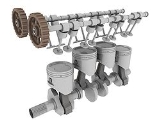
Valvetrain

Encyclopedia
Valve
A valve is a device that regulates, directs or controls the flow of a fluid by opening, closing, or partially obstructing various passageways. Valves are technically pipe fittings, but are usually discussed as a separate category...
s. A traditional reciprocating internal combustion engine
Internal combustion engine
The internal combustion engine is an engine in which the combustion of a fuel occurs with an oxidizer in a combustion chamber. In an internal combustion engine, the expansion of the high-temperature and high -pressure gases produced by combustion apply direct force to some component of the engine...
uses valves to control air and fuel flow into and out of the cylinders, facilitating combustion.
Layout
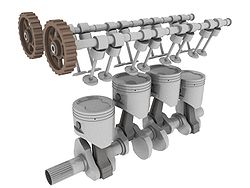
Valvetrain: The valvetrain consists of valves, rocker arms, pushrods, lifters, and camshaft(s). Valvetrain opening/closing and duration, as well as the geometry of the valvetrain, controls the amount of air and fuel entering the combustion chamber at any given point in time. Timing for open/close/duration is controlled by the camshaft that is synchronized to the crankshaft by a chain, belt or gear.Valvetrains are built in several configurations, each of which varies slightly in layout but still performs the task of opening and closing the valves at the time necessary for proper operation of the engine. These layouts are differentiated by the location of the camshaft within the engine:
Overhead camshaft
Overhead camshaft
Overhead cam valvetrain configurations place the engine camshaft within the cylinder heads, above the combustion chambers, and drive the valves or lifters in a more direct manner compared to overhead valves and pushrods...
- The camshaftCamshaftA camshaft is a shaft to which a cam is fastened or of which a cam forms an integral part.-History:An early cam was built into Hellenistic water-driven automata from the 3rd century BC. The camshaft was later described in Iraq by Al-Jazari in 1206. He employed it as part of his automata,...
(or camshafts, depending on the design employed) is located above the valves within the cylinder head, and operates either indirectly or directly on the valves.
Cam-in-block
Cam-in-block
The cam-in-block valvetrain layout of piston engines is one where the camshaft is placed within the cylinder block, usually beside and slightly above the crankshaft in a straight engine or directly above the crankshaft in the V of a V engine...
- The camshaft is located within the engine block, and operates directly on the valves, or indirectly via pushrods and rocker arms. Because they often require pushrods they are often called pushrod engines.
Camless
Camless
Most four-stroke piston engines today employ one or more camshafts to operate poppet valves. The lobes on the camshafts operate cam followers which in turn open the poppet valves. A camless uses electromagnetic, hydraulic, or pneumatic actuators to open the poppet valves instead...
- This layout uses no camshafts at all. Technologies such as Solenoids are used to individually actuate the valves.
Parts
As stated above, the valvetrain is the mechanical system responsible for operation of the valves. Valves are usually of the poppetPoppet valve
A poppet valve is a valve consisting of a hole, usually round or oval, and a tapered plug, usually a disk shape on the end of a shaft also called a valve stem. The shaft guides the plug portion by sliding through a valve guide...
type, although many others have been developed such as sleeve
Sleeve valve
The sleeve valve is a type of valve mechanism for piston engines, distinct from the usual poppet valve. Sleeve-valve engines saw use in a number of pre-World War II luxury cars and in USA in the Willys-Knight car and light truck...
, slide and rotary valves.
Poppet valves typically require small coil springs, appropriately named valve springs, to keep them closed when not actuated by the camshaft. They are attached to the valve stem ends, seating within spring retainers. Other mechanisms can be used in place of valve springs to keep the valves closed: Formula 1 engines employ pneumatic valve springs in which pneumatic pressure closes the valves, while motorcycle manufacturer Ducati uses desmodromic mechanisms to mechanically close the valves.
Depending on the design used, the valves are actuated directly by a rocker arm, finger or bucket tappet. Overhead camshaft engines use fingers or bucket tappets, upon which the cam lobes contact, while cam-in-block engines use rocker arms. Rocker arms are actuated by a pushrod, and pivot on a shaft or individual ball studs in order to actuate the valves.
Pushrods are long, slender metal rods seated within the engine block. At the bottom ends the pushrods are fitted with lifters
Tappet
A tappet is the noise made by a worn cam follower, however the term is widely used to represent the cam follower itself. In mechanical engineering it is a projection which imparts a linear motion to some other component within an assembly...
, either solid or hydraulic, upon which the camshaft, located within the cylinder block
Cylinder block
A cylinder block is an integrated structure comprising the cylinder of a reciprocating engine and often some or all of their associated surrounding structures...
, makes contact. The camshaft pushes on the lifter, which pushes on the pushrod, which pushes on the rocker arm, which rotates and pushes down on the valve.
Camshafts must actuate the valves at the appropriate time in the combustion cycle
Four-stroke cycle
A four-stroke engine, also known as four-cycle, is an internal combustion engine in which the piston completes four separate strokes—intake, compression, power, and exhaust—during two separate revolutions of the engine's crankshaft, and one single thermodynamic cycle.There are two...
. In order to accomplish this the camshaft is linked to and kept in synchronisation with the crankshaft
Crankshaft
The crankshaft, sometimes casually abbreviated to crank, is the part of an engine which translates reciprocating linear piston motion into rotation...
(the main shaft upon which the piston
Piston
A piston is a component of reciprocating engines, reciprocating pumps, gas compressors and pneumatic cylinders, among other similar mechanisms. It is the moving component that is contained by a cylinder and is made gas-tight by piston rings. In an engine, its purpose is to transfer force from...
s act) through the use of a metal chain, rubber belt or geartrain. Because these mechanisms are essential to the proper timing of valve actuation they are named timing chains, timing belts and timing gears, respectively.