

Universal Fighting System

Encyclopedia
Collectible card game
thumb|Players and their decksA collectible card game , also called a trading card game or customizable card game, is a game played using specially designed sets of playing cards...
originally designed by Sabertooth Games
Sabertooth Games
Sabertooth Games is a now defunct Memphis, Tennessee based game company, founded in 2001. The company primarily produced collectible card games as a subsidiary of Games Workshop, PLC...
. The themes of the cards are drawn from a multitude of licensed gaming universes, principally Fighting game
Fighting game
Fighting game is a video game genre where the player controls an on-screen character and engages in close combat with an opponent. These characters tend to be of equal power and fight matches consisting of several rounds, which take place in an arena. Players must master techniques such as...
licenses. While the official product launch was in April 2006, the first set released in February 2006 was a special "battle box
Battle box
In collectible card games, the term battle box is used by some companies to describe a set of cards available for purchase as a single unit. A battle box is generally ready to play as-is , containing complete decks for two players...
" based on the Penny Arcade
Penny Arcade (webcomic)
Penny Arcade is a webcomic focused on video games and video game culture, written by Jerry Holkins and illustrated by Mike Krahulik. The comic debuted in 1998 on the website loonygames.com. Since then, Holkins and Krahulik have established their own site, which is typically updated with a new comic...
online comic.
It was announced on February 22, 2008, that the publication rights of the Universal Fighting System had been transferred to Fantasy Flight Games
Fantasy Flight Games
Fantasy Flight Games is a Roseville, Minnesota-based game company that creates and publishes role-playing, board, and card games. Fantasy Flight Publishing was founded in 1995 by its CEO, Christian T. Petersen. Since the release of its first game product in 1997, the company has been doing...
. In May, 2010, the Universal Fighting System CCG was taken over by a new game company called Jasco Games (www.jascogames.com) and is the current home of UFS.
Fantasy Flight Games announced on June 3, 2010, that Jasco Games now "owns the rights to the core UFS mechanics and hold a license for the characters of ShadoWar. Additionally, Jasco has acquired FFG’s remaining stock of UFS cards."
Licenses
Two months after the release of the prototypical Penny Arcade Battle Box, the game officially launched with the simultaneous release of two separate sets of cards, one based on the Street Fighter series and the other based on Soulcalibur III. All primary game releases since then have followed a similar two-set structure. A license with SNK PlaymoreSNK Playmore
SNK Playmore Corporation is a Japanese video game hardware and software company. SNK is an acronym of , which was SNK's original name. The company's legal and trading name became SNK in 1986....
allowed for cards based on The King of Fighters 2006
KOF: Maximum Impact 2
KOF: Maximum Impact 2, released in North America as The King of Fighters 2006, is a 3D competitive fighting game produced by SNK Playmore and released for the PlayStation 2 in...
and Samurai Shodown V
Samurai Shodown V
Samurai Shodown V, known as in Japan, is the eighth game in SNK's Samurai Shodown/Samurai Spirits series of fighting games. It was one of the last ever games to be released on the Neo Geo. The original Japanese version of the game also has a great deal of dialogue in single-player mode, but all...
gaming universes in December 2006, and a second Capcom license, Darkstalkers, was added in November of the following year. Bandai Namco's Soulcalibur IV
Soulcalibur IV
is the fourth installment in Namco's Soul series of fighting games. The game was released for the PlayStation 3 and Xbox 360 on July 29, 2008, in North America, on July 31, 2008, in Japan, Europe, and Australia, and on August 1, 2008, in the United Kingdom and New Zealand.The game is notable for...
and Fantasy Flight Game's own original property ShadoWar were added in March 2009, and Tekken 6
Tekken 6
is a fighting game developed and published by Namco Bandai. It is the eighth game in the Tekken franchise. It was released in Japanese arcades on November 26, 2007 as the first game running on the PlayStation 3-based System 357 arcade board. The game received an update, subtitled Bloodline...
was added in August 2009. Jasco Games released Red Horizon on February 11th, 2011, the first set that was released after the company took ownership of UFS. Their next set to be release is Red Horizon: Tides of Vengeance. Like ShadoWar, Red Horizon is an original property.
Gameplay
A game in the Universal Fighting System represents a battle between two adversaries. Each player controls one of the two characters, with the objective being to defeat the opponent, typically through loss of vitality. The two characters need not be from the same universe; for example, Chun-LiChun-Li
is a video game character produced by Capcom. First introduced in Street Fighter II, she has since appeared as a player character in nearly all subsequent games....
from Street Fighter could battle Cassandra from Soulcalibur or Tycho from Penny Arcade.
Players take turns, with each turn consisting of multiple actions. With each additional action a player takes in a turn, the difficulty of successfully completing that action increases. Players can continue to take actions until they choose to stop or until they fail an attempt. The game structure typically involve players building up foundations over successive turns, which then allows a greater number of actions before failure. Management of these becomes crucial, as players must strike a balance between using their resources for offense and defense; going "all out" for a series of attacks can leave one vulnerable to retaliation during the opponent's turn. The system relies heavily on card combinations, where one card enhances the effect of another. The game is an advanced or expert level product (owing in large part to the fact that every card has at least one special ability), primarily aimed at older or more experienced gamers.
Card types
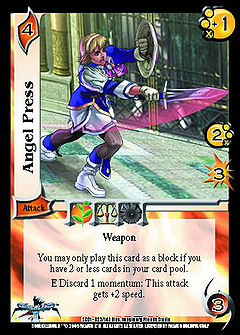
The Universal Fighting System has five different types of cards:- Characters – A card which represents the combatant whose role the player is currently assuming. Character cards contain information about the character's hand size, special abilities, symbols/alignment, and starting vitality.
- Attacks – Orange-bordered cards which represent attempts to directly inflict damage on an opponent. Successful attacks that deal damage are added to one's momentum, which helps towards enhancing certain attacks and other cards.
- Actions – Blue-bordered cards played from the hand which allow the character to perform some non-attack action or maneuver.
- Foundations – Grey-bordered cards which signify intensive training and reserves of inner strength upon which a character can draw to power attacks or abilities.
- Assets – Green-bordered cards which represent places or objects which are in play.
There are also split cards, which have two types and two possible effects. When the card is played, the player must decide which type the card will be.
Card symbols
Different character cards feature different selections of the thirteen attribute symbols, and a deck can only use cards that match one or more of that character's symbols. Hence, this prevents a character from using abilities which are not a match for their style or personality. The thirteenth symbol, Infinity, has no defined attributes and can count as any other symbol at any given time. The thirteen symbols and their associated traits are:| Element (description) | Attributes |
|---|---|
| [AIR] (A white whirlwind) | Intelligence, Deliberateness |
| [ALL] (A red circle) | Existence, Fullness |
| [CHAOS] (Three arrows pointing out) | Disorder, Instinct |
| [DEATH] (A white skull) | Destruction, Finality |
| [EARTH] (A green mountain) | Stalwart, Strength |
| [EVIL] (A red pitchfork) | Ruthlessness, Villainy |
| [FIRE] (An orange flame) | Passion, Speed |
| [GOOD] (A yellow halo) | Compassion, Heroism |
| [LIFE] (A growing plant) | Beginning, Creation |
| [ORDER] (A golden justice scale) | Law, Structure |
| [VOID] (A dark-grey vortex) | Emptiness, Space |
| [WATER] (A blue wave) | Adaptation, Fluidity |
| [INFINITY] (A Möbius strip) | Eternity, Timelessness |
Card rarity and distribution
Each card has rarity information printed along the bottom to indicate how common it is. The rarity was previously denoted by the number of small dots appearing at the bottom of the card, according to the following legend. More recently, the dots have been replaced by the relevant letter.| • or C | Common |
| •• or UC | Uncommon |
| ••• (non-foil) or SE | Starter deck exclusive |
| ••• (foil) or R | Rare |
| •••• or UR | Ultra Rare or Promotional (dots only) |
| P | Promotional |
| ~ | Reprint (Battle Packs only) |
Starter decks
Starter pack
A starter pack is a sealed package of cards or figurines, designed to serve as the beginning of a collection, in collectible card games and collectible miniature wargames....
are semi-random, with 29 fixed cards and 31 random cards. This includes some exclusive cards which are only available through that starter and not available in booster packs. In each 10-card booster pack
Booster pack
In collectible card games and collectible miniature wargames, a booster pack is a sealed package of cards or figurines, designed to add to a player's collection....
, there are 6 commons and 3 uncommons, with the remaining card being either rare or ultra-rare. There are also very rare boosters made up entirely of rare and super rare cards, colloquially known as "god packs". Lastly, each box of starter decks or booster packs contains a single "box topper", which is a special promotional card and not part of the standard card set.
Promotional character cards, foil variants of commons and uncommons, and specially-designed cards are also obtainable by participating in hobby league tournaments and/or special events.
The 120 cards provided in the Penny Arcade Battle Box follow a fixed distribution, without any element of randomness. The rarity system is adapted differently in these; one dot for a card that the box has four copies of, two for a card of three copies and three for a card of two copies (the "rarest"). Any Battle Pack card reprinted from a previous release will have a tilde symbol - ~ - in place of dots.
Until the release of Tekken 6, all regular rares, ultra-rares and promotional cards were foiled. Beginning with Tekken 6, foil cards were retired, and all rarities appear in non-foil form only.
Card sets and products
The first set released for each game universe is typically named after that game universe, while later sets have original names. Because it contains cards from two game universes, the inaugural SNK set is named after the game company instead. Most SNK sets feature cards drawn from both Samurai Shodown V and The King of Fighters 2006; the fourth is based solely on the latter game. The first Soulcalibur IV set is named Tower of Souls to more easily differentiate it from the inaugural Soulcalibur III set. Soulcalibur III and Soulcalibur IV are considered to be different licenses, despite technically being from the same series, and thus have their own set identifiers (SC and SCIV, respectively).| Game Universe & Set Name | Release Date | Set Size | Starter Deck Characters | Booster Characters |
|---|---|---|---|---|
| Street Fighter | April 2006 | 143 | Chun Li, Dhalsim Dhalsim , is a video game character from the Street Fighter series of fighting games.Dhalsim made his debut in the original Street Fighter II as one of the games original eight main characters. In his backstory, Dhalsim is characterized as a pacifist who goes against his beliefs by entering the World... , Ken, Ryu Ryu (Street Fighter) is a video game player character created by Capcom, the main protagonist of the Street Fighter series. Having premiered in the first Street Fighter in 1987, Ryu appears as the lead character from the game along with his best friend Ken Masters participating in the Street Fighter tournament... |
Chun Li, Dhalsim Dhalsim , is a video game character from the Street Fighter series of fighting games.Dhalsim made his debut in the original Street Fighter II as one of the games original eight main characters. In his backstory, Dhalsim is characterized as a pacifist who goes against his beliefs by entering the World... , Ken, Ryu Ryu (Street Fighter) is a video game player character created by Capcom, the main protagonist of the Street Fighter series. Having premiered in the first Street Fighter in 1987, Ryu appears as the lead character from the game along with his best friend Ken Masters participating in the Street Fighter tournament... , Sagat, Zangief Zangief is a fictional character in the Street Fighter series of video games. Created by Akira Yasuda for Capcom, Zangief first appeared in Street Fighter II, later appearing in other games, media, and promotions related to the Street Fighter franchise... |
| SF02: World Warriors | July 2006 | 126 | (none; boosters only) | Balrog Balrog Balrogs are fictional demonic beings who appear in J. R. R. Tolkien's Middle-earth legendarium. Such creatures first appeared in print in his novel The Lord of the Rings, though they figured in earlier writings that posthumously appeared in The Silmarillion and other books.Balrogs are described as... , Blanka Blanka is a video game character from the Street Fighter series of fighting games. Blanka is depicted as a feral savage, with green skin and long orange hair, resembling a monster more than a human... , E. Honda, Guile Guile (Street Fighter) is a fictional character in Capcom's Street Fighter series of fighting games.-Street Fighter series:Guile made his first appearance in Street Fighter II as one of the eight selectable characters featured in the first release of the game... , M. Bison M. Bison M. Bison, known in Japan as Vega, is a video game character created by Capcom. First introduced in Street Fighter II: The World Warrior, he is a recurring character in the Street Fighter series of fighting games, acting as the final boss and primary antagonist of the Street Fighter II and Street... , Vega Vega Vega is the brightest star in the constellation Lyra, the fifth brightest star in the night sky and the second brightest star in the northern celestial hemisphere, after Arcturus... |
| SF03: The Next Level | December 2006 | 90 | (none; boosters only) | Akuma Akuma (Street Fighter) Akuma known in Japan as , is a video game character from the Street Fighter series of fighting games. Akuma made his debut in Super Street Fighter II Turbo as a secret character and hidden boss. In the storyline of the Street Fighter video games, he is the younger brother of Gouken, Ryu and Ken's... , Cammy, Dudley, Fei Long |
| SF04: The Dark Path | February 2007 | 144 | Chun-Li Chun-Li is a video game character produced by Capcom. First introduced in Street Fighter II, she has since appeared as a player character in nearly all subsequent games.... , Ryu Ryu (Street Fighter) is a video game player character created by Capcom, the main protagonist of the Street Fighter series. Having premiered in the first Street Fighter in 1987, Ryu appears as the lead character from the game along with his best friend Ken Masters participating in the Street Fighter tournament... , T. Hawk, Twelve |
Adon, Charlie, Chun-Li Chun-Li is a video game character produced by Capcom. First introduced in Street Fighter II, she has since appeared as a player character in nearly all subsequent games.... , Rose, Ryu Ryu (Street Fighter) is a video game player character created by Capcom, the main protagonist of the Street Fighter series. Having premiered in the first Street Fighter in 1987, Ryu appears as the lead character from the game along with his best friend Ken Masters participating in the Street Fighter tournament... , Sakura, T. Hawk, Twelve |
| SF05: Extreme Rivals | May 2007 | 90 | (none; boosters only) | Cody, Dee Jay Dee Jay is a character from Capcom's Street Fighter series of fighting games. He is a Jamaican kickboxer who also works as a recording artist and breakdancer... , Ibuki Ibuki (Street Fighter) is a video game character from the Street Fighter fighting game series. She along with Elena were the lone female characters in the Street Fighter III series, until 3rd Strike, where they were joined by Makoto and Chun-Li... , Ken, R. Mika |
| SF06: Fight for the Future | November 2007 | 99 | (none; boosters only) | Alex, Cammy, Chun-Li Chun-Li is a video game character produced by Capcom. First introduced in Street Fighter II, she has since appeared as a player character in nearly all subsequent games.... , Dhalsim Dhalsim , is a video game character from the Street Fighter series of fighting games.Dhalsim made his debut in the original Street Fighter II as one of the games original eight main characters. In his backstory, Dhalsim is characterized as a pacifist who goes against his beliefs by entering the World... , Gen, Gill, Guile Guile (Street Fighter) is a fictional character in Capcom's Street Fighter series of fighting games.-Street Fighter series:Guile made his first appearance in Street Fighter II as one of the eight selectable characters featured in the first release of the game... |
| SF07: Domination | February 2008 | 144 | Akuma Akuma (Street Fighter) Akuma known in Japan as , is a video game character from the Street Fighter series of fighting games. Akuma made his debut in Super Street Fighter II Turbo as a secret character and hidden boss. In the storyline of the Street Fighter video games, he is the younger brother of Gouken, Ryu and Ken's... , Ken, Sagat, Sakura |
Blanka Blanka is a video game character from the Street Fighter series of fighting games. Blanka is depicted as a feral savage, with green skin and long orange hair, resembling a monster more than a human... , Dan Dan Hibiki is a video game character from Capcom's Street Fighter series of fighting games. Introduced in Street Fighter Alpha, Dan is consistently portrayed as an arrogant, overconfident, yet utterly feeble character.-Concept and creation:... , Guy Guy (Final Fight) is a video game character who first appears in the 1989 arcade beat-em-up Final Fight by Capcom. Guy would later reemerge, along with other Final Fight characters, as a fighting game character in Street Fighter Alpha: Warriors' Dreams and its sequels... , Karin, M. Bison M. Bison M. Bison, known in Japan as Vega, is a video game character created by Capcom. First introduced in Street Fighter II: The World Warrior, he is a recurring character in the Street Fighter series of fighting games, acting as the final boss and primary antagonist of the Street Fighter II and Street... , Ryu Ryu (Street Fighter) is a video game player character created by Capcom, the main protagonist of the Street Fighter series. Having premiered in the first Street Fighter in 1987, Ryu appears as the lead character from the game along with his best friend Ken Masters participating in the Street Fighter tournament... , Sean, Yang, Yun, Zangief Zangief is a fictional character in the Street Fighter series of video games. Created by Akira Yasuda for Capcom, Zangief first appeared in Street Fighter II, later appearing in other games, media, and promotions related to the Street Fighter franchise... |
| SF08: Deadly Ground | June 2008 | 99 | (none; boosters only) | Adon, Cammy, Charlie, E. Honda, Fei Long, Ibuki Ibuki (Street Fighter) is a video game character from the Street Fighter fighting game series. She along with Elena were the lone female characters in the Street Fighter III series, until 3rd Strike, where they were joined by Makoto and Chun-Li... , Juli, Juni, Makoto Makoto (Street Fighter) is a fictional character from the Street Fighter video game series. She is a Tosan fighter and a Rindōkan karate expert from Japan. She first appeared in Street Fighter III: 3rd Strike, and again in Super Street Fighter IV. She wears a white dougi and a yellow hachimaki around her neck, intended to... , Rose, Vega Vega Vega is the brightest star in the constellation Lyra, the fifth brightest star in the night sky and the second brightest star in the northern celestial hemisphere, after Arcturus... |
| SF09: Warrior's Dream | Dec 2008 | 99 | (none; boosters only) | Alex, Balrog Balrog Balrogs are fictional demonic beings who appear in J. R. R. Tolkien's Middle-earth legendarium. Such creatures first appeared in print in his novel The Lord of the Rings, though they figured in earlier writings that posthumously appeared in The Silmarillion and other books.Balrogs are described as... , Chun Li, Dhalsim Dhalsim , is a video game character from the Street Fighter series of fighting games.Dhalsim made his debut in the original Street Fighter II as one of the games original eight main characters. In his backstory, Dhalsim is characterized as a pacifist who goes against his beliefs by entering the World... , Elena Elena (Street Fighter) is a fictional character in the Street Fighter series. She first appeared in the arcade game Street Fighter III: New Generation, and appeared in several revisions of it, including Street Fighter III, Street Fighter III: 2nd Impact, and Street Fighter III: 3rd Strike... , Guile Guile (Street Fighter) is a fictional character in Capcom's Street Fighter series of fighting games.-Street Fighter series:Guile made his first appearance in Street Fighter II as one of the eight selectable characters featured in the first release of the game... , Hugo, M. Bison M. Bison M. Bison, known in Japan as Vega, is a video game character created by Capcom. First introduced in Street Fighter II: The World Warrior, he is a recurring character in the Street Fighter series of fighting games, acting as the final boss and primary antagonist of the Street Fighter II and Street... , R. Mika, Remy, T. Hawk |
| Darkstalkers | November 2007 | 126 | (none; boosters only) | B.B. Hood, Bishamon, Demitri, Donovan, Felicia Felicia (Darkstalkers) is a fictional character in the Darkstalkers series of fighting game by Capcom She first appeared in the 1994 game Darkstalkers: The Night Warriors and its subsequent sequels, later appearing in other Capcom games outside of the Darkstalkers series and related media and merchandise.-Conception and... , J. Talbain, Lilith, Lord Raptor, Morrigan, Pyron, Q-Bee, Rikuo, Sasquatch, Victor |
| DS02: Realm of Midnight | June 2008 | 99 | (none; boosters only) | Anakaris, Bishamon, Demitri, Donovan, Felicia Felicia (Darkstalkers) is a fictional character in the Darkstalkers series of fighting game by Capcom She first appeared in the 1994 game Darkstalkers: The Night Warriors and its subsequent sequels, later appearing in other Capcom games outside of the Darkstalkers series and related media and merchandise.-Conception and... , Hsien-Ko, Huitzil, J. Talbain, Jedah, Morrigan, Victor |
| Soulcalibur III | April 2006 | 143 | Astaroth Astaroth (Soul Calibur) is a fictional character in the Soul series of video games. Created by Namco's Project Soul division, he first appeared in the original Soulcalibur and its subsequent sequels, later appearing in various merchandise related to the series. He is voiced in Japanese by Banjō Ginga for Soulcalibur and... , Nightmare Nightmare (Soul Calibur) is a character in the Soul series of fighting games. The evil alter-ego of , he later becomes an entity separated from Siegfried in Soulcalibur III. Nightmare first appeared in one of the possible endings for the Siegfried character in the game Soul Edge. In the sequel Soulcalibur, he was given a... , Taki, Voldo Voldo is a fictional character in the Soul series of video games. Created by Namco's Project Soul division, he first appeared in Soul Edge, and later in all games of the Soulcalibur saga with the exception of Soulcalibur Legends. His likeness has been used for merchandise related to the series, ranging... |
Astaroth Astaroth (Soul Calibur) is a fictional character in the Soul series of video games. Created by Namco's Project Soul division, he first appeared in the original Soulcalibur and its subsequent sequels, later appearing in various merchandise related to the series. He is voiced in Japanese by Banjō Ginga for Soulcalibur and... , Cassandra, Mitsurugi, Nightmare Nightmare (Soul Calibur) is a character in the Soul series of fighting games. The evil alter-ego of , he later becomes an entity separated from Siegfried in Soulcalibur III. Nightmare first appeared in one of the possible endings for the Siegfried character in the game Soul Edge. In the sequel Soulcalibur, he was given a... , Taki, Voldo Voldo is a fictional character in the Soul series of video games. Created by Namco's Project Soul division, he first appeared in Soul Edge, and later in all games of the Soulcalibur saga with the exception of Soulcalibur Legends. His likeness has been used for merchandise related to the series, ranging... |
| SC02: A Tale of Swords & Souls | July 2006 | 126 | (none; boosters only) | Ivy, Kilik, Raphael, Setsuka, Tira, Zasalamel |
| SC03: Soul Arena | February 2007 | 144 | Abyss, Cervantes Cervantes de Leon is a fictional character in the Soul series of video games. Created by Namco's Project Soul division, he first appeared in Soul Edge and its subsequent sequels, later appearing in various merchandise related to the series... , Lizardman, Yoshimitsu |
Abyss, Cervantes Cervantes de Leon is a fictional character in the Soul series of video games. Created by Namco's Project Soul division, he first appeared in Soul Edge and its subsequent sequels, later appearing in various merchandise related to the series... , Lizardman, Mitsurugi, Taki, Talim, Rock, Yoshimitsu |
| SC04: Blades of Fury | May 2007 | 90 | (none; boosters only) | Maxi, Nightmare Nightmare (Soul Calibur) is a character in the Soul series of fighting games. The evil alter-ego of , he later becomes an entity separated from Siegfried in Soulcalibur III. Nightmare first appeared in one of the possible endings for the Siegfried character in the game Soul Edge. In the sequel Soulcalibur, he was given a... , Tira, Xianghua, Yun-seong |
| SC05: Higher Calibur | August 2007 | 99 | (none; boosters only) | Astaroth Astaroth (Soul Calibur) is a fictional character in the Soul series of video games. Created by Namco's Project Soul division, he first appeared in the original Soulcalibur and its subsequent sequels, later appearing in various merchandise related to the series. He is voiced in Japanese by Banjō Ginga for Soulcalibur and... , Cassandra, Cervantes Cervantes de Leon is a fictional character in the Soul series of video games. Created by Namco's Project Soul division, he first appeared in Soul Edge and its subsequent sequels, later appearing in various merchandise related to the series... , Ivy, Seong Mi-na, Voldo Voldo is a fictional character in the Soul series of video games. Created by Namco's Project Soul division, he first appeared in Soul Edge, and later in all games of the Soulcalibur saga with the exception of Soulcalibur Legends. His likeness has been used for merchandise related to the series, ranging... |
| SC06: Flash of the Blades | September 2008 | 99 | (none; boosters only) | Kilik, Lizardman, Mitsurugi, Raphael, Seong Mi-na, Setsuka, Siegfried, Sophitia, Taki, Talim, Zasalamel |
| Soulcalibur IV | April 2009 | 144 | Cervantes Cervantes de Leon is a fictional character in the Soul series of video games. Created by Namco's Project Soul division, he first appeared in Soul Edge and its subsequent sequels, later appearing in various merchandise related to the series... , Ivy, Nightmare Nightmare A nightmare is an unpleasant dream that can cause a strong negative emotional response from the mind, typically fear or horror, but also despair, anxiety and great sadness. The dream may contain situations of danger, discomfort, psychological or physical terror... , Siegfried |
Algol, Astaroth Astaroth (Soul Calibur) is a fictional character in the Soul series of video games. Created by Namco's Project Soul division, he first appeared in the original Soulcalibur and its subsequent sequels, later appearing in various merchandise related to the series. He is voiced in Japanese by Banjō Ginga for Soulcalibur and... , Hilde Hildegard von Krone , for short, is a fictional character in the Soul series of video games. Created by Namco's Project Soul division, she first appeared in Soulcalibur IV and its subsequent sequels, later appearing in various merchandise related to the series... , Tira |
| SCIV02: Quest of Souls | November 2009 | 99 | (none; boosters only) | Amy, Mistsurugi, Taki, Yoshimitsu, Xianghua |
| SNK Playmore | December 2006 | 144 | Haohmaru, Mai Mai Shiranui is a player character in both the Fatal Fury and The King of Fighters series of fighting games by SNK and in related media, also appearing in a large number of other games... , Terry Terry Bogard is a video game character created by SNK Playmore , and is the main character of the Fatal Fury series. In the series, he is an American fighter who enters the worldwide tournaments called The King of Fighters to kill Geese Howard, a criminal who killed Terry's father. Terry becomes a formidable... , Ukyo |
Alba, Athena Athena Asamiya is a character originally from the former SNK's video game Psycho Soldier and a descendant of Princess Athena in its Athena. She later appears in The King of Fighters series of fighting games as a female fighter character and has appeared in each of its thirteen editions... , Charlotte, Galford, Gaira, Hanzo, Iori Iori Yagami is a character from the SNK Playmore's The King of Fighters video game series that first appeared in The King of Fighters '95 as the leader of the Rivals Team. He is an iconic character of the series, and regularly appears on publicity material and merchandise. Iori is a central character to the... , Kyo Kyo Kusanagi is one of the main characters in SNK Playmore's The King of Fighters video game series; he was first introduced in The King of Fighters '94 as the leader of the Japan team. He is one of the iconic characters of the series and regularly appears on publicity material and merchandise. His name and... , Lien, Nagase Nagase -People with this surname:*Jinen Nagase , Japanese politician*Masatoshi Nagase , Japanese actor*Tomoya Nagase , Japanese actor and pop musician*Miyu Nagase , Japanese pop musician-Fictional characters with this name:... , Nakoruru, Yoshitora |
| SNK02: Fortune & Glory | August 2007 | 99 | (none; boosters only) | Billy Billy Kane is a video game character created by SNK Playmore . He makes first appearance in the fighting game Fatal Fury: King of Fighters as the sub-boss from the game. In the Fatal Fury series Billy is the right-hand man from Geese Howard, the crime lord from Southtown... , Genjuro, Jubei, K', Luise, Mai Mai Shiranui is a player character in both the Fatal Fury and The King of Fighters series of fighting games by SNK and in related media, also appearing in a large number of other games... , Nightmare Geese Geese Howard is a fictional video game character appearing in SNK Playmore's Fatal Fury fighting games series. Debuting in Fatal Fury: King of Fighters, Geese is the local crime boss of the fictional city of South Town. Geese hosts a fighting tournament named "The King of Fighters", in which he faces the... , Sankuro, Seth, Tam Tam, Ukyo |
| SNK03: The Cutting Edge | February 2008 | 144 | Haohmaru, Mai Mai Shiranui is a player character in both the Fatal Fury and The King of Fighters series of fighting games by SNK and in related media, also appearing in a large number of other games... , Rock Howard Rock Howard is a video game character appearing in various games from SNK Playmore . Rock makes his first appearance as a playable character in the fighting game Garou: Mark of the Wolves, the last chapter in the Fatal Fury series, as the new lead character from the series... , Yoshitora |
B. Jenet, Galford, Iori Iori Yagami is a character from the SNK Playmore's The King of Fighters video game series that first appeared in The King of Fighters '95 as the leader of the Rivals Team. He is an iconic character of the series, and regularly appears on publicity material and merchandise. Iori is a central character to the... , Kula, Kyo Kyo Kusanagi is one of the main characters in SNK Playmore's The King of Fighters video game series; he was first introduced in The King of Fighters '94 as the leader of the Japan team. He is one of the iconic characters of the series and regularly appears on publicity material and merchandise. His name and... , Kyoshiro, Nagase Nagase -People with this surname:*Jinen Nagase , Japanese politician*Masatoshi Nagase , Japanese actor*Tomoya Nagase , Japanese actor and pop musician*Miyu Nagase , Japanese pop musician-Fictional characters with this name:... , Ninon, Rera Rera RERA can refer to:* Respiratory Event Related Arousals, see Respiratory Disturbance Index* a fictional character, see List of Samurai Shodown characters#Nakoruru... , Yumeji, |
| SNK04: The King of Fighters 2006 | September 2008 | 99 | (none; boosters only) | Alba, Chae, Fio, Hanzo, Jivatma, Leona, Maxima, Mignon, Soiree, Terry Terry Bogard is a video game character created by SNK Playmore , and is the main character of the Fatal Fury series. In the series, he is an American fighter who enters the worldwide tournaments called The King of Fighters to kill Geese Howard, a criminal who killed Terry's father. Terry becomes a formidable... , Yuri Yuri Sakazaki is a video game character from SNK Playmore's Art of Fighting series. She first appears in the original Art of Fighting being kidnapped by Mr. Big, a criminal from the fictional city of Southtown. The players, Yuri's brother Ryo and his friend Robert Garcia spend the game searching for her... |
| SNK05: Flames of Fame | December 2008 | 99 | (none; boosters only) | Basara, Billy Billy Kane is a video game character created by SNK Playmore . He makes first appearance in the fighting game Fatal Fury: King of Fighters as the sub-boss from the game. In the Fatal Fury series Billy is the right-hand man from Geese Howard, the crime lord from Southtown... , Gaira, Kazuki, Kim Kim Kaphwan Kap-hwan Kim , usually written surname first as Kim Kap-hwan, is a character in both the Fatal Fury and The King of Fighters series created by SNK Playmore . He is credited as the first ever fictional Korean character to appear in a fighting game... , Nakoruru, Nightmare Geese Geese Howard is a fictional video game character appearing in SNK Playmore's Fatal Fury fighting games series. Debuting in Fatal Fury: King of Fighters, Geese is the local crime boss of the fictional city of South Town. Geese hosts a fighting tournament named "The King of Fighters", in which he faces the... , Ralf Ralf Jones is a video game character created by SNK Playmore . Ralf has made appearance in several games from the company, premiering in TNK III as a military tank driver. The Ikari Warriors series also emphasized Ralf's role as a soldier with him becoming the partner of Clark Still... , Rock Howard Rock Howard is a video game character appearing in various games from SNK Playmore . Rock makes his first appearance as a playable character in the fighting game Garou: Mark of the Wolves, the last chapter in the Fatal Fury series, as the new lead character from the series... , Sogetsu, Terry Terry Bogard is a video game character created by SNK Playmore , and is the main character of the Fatal Fury series. In the series, he is an American fighter who enters the worldwide tournaments called The King of Fighters to kill Geese Howard, a criminal who killed Terry's father. Terry becomes a formidable... |
| ShadoWar | April 2009 | 144 | Astrid, Ragnar, Yi Shan, Zi Mei | Lu Chen, Rashotep, Temujin, Zhao Daiyu |
| Tekken 6 | August 2009 | 99 | (none;boosters only) | Christie Montiero, Kazuya Mishima Kazuya Mishima is a fictional character in the Tekken fighting game series. Although originally appearing as the main protagonist in the original Tekken game, he becomes one of the series' leading villains from Tekken 2 onward, after being overtaken by the Devil Gene, where he is known as Devil Kazuya .-In the... , King, Nina Williams Nina Williams is a character from Namco's Tekken game series. She is known to be a cold-blooded assassin who had made her very first appearance in the original Tekken game and since has appeared in every Tekken game released... , Paul Phoenix |
| Red Horizon | December 2010 | (none;boosters only) |
| Name of product | Release date | Total cards | Unique cards | Characters |
|---|---|---|---|---|
| Penny Arcade Battle Box | February 2006 | 120 | 45 | Gabe, Tycho |
| Soulcalibur III Battle Pack | November 2006 | 120 | 44 | Sophitia, Siegfried |
| Street Fighter Battle Pack | July 2007 | 120 | 36 | Akuma Akuma (Street Fighter) Akuma known in Japan as , is a video game character from the Street Fighter series of fighting games. Akuma made his debut in Super Street Fighter II Turbo as a secret character and hidden boss. In the storyline of the Street Fighter video games, he is the younger brother of Gouken, Ryu and Ken's... , Ryu Ryu (Street Fighter) is a video game player character created by Capcom, the main protagonist of the Street Fighter series. Having premiered in the first Street Fighter in 1987, Ryu appears as the lead character from the game along with his best friend Ken Masters participating in the Street Fighter tournament... |
Some characters have only appeared as promotional cards, available through various outlets. The following is a list of all of the promotional characters that have not appeared in any of the expansions or battle sets through to the release of the twelfth pair of sets, Soulcalibur IV and Shadowar.
| Name of game universe | Characters |
|---|---|
| Street Fighter | Geki, Necro, Q, Rolento |
| Soulcalibur | Amy, Arthur, Chester, Demuth, Greed, Miser, Night Terror, Olcadan, Revenant, Strife |
| SNK Playmore | Duke, Lilly Kane, Mr. Karate |
| UFS | Nicholas the Saint Santa Claus Santa Claus is a folklore figure in various cultures who distributes gifts to children, normally on Christmas Eve. Each name is a variation of Saint Nicholas, but refers to Santa Claus... , The Universal Fighter |
| Coolest Prize | Andrew Olexa, Jacky Tang, James Hata, Matt Kohls, Omar Chavez, Scott Mence, Wess "Flawless" Victory, Jonathan Herr, Paul Bittner, Mike Lowe |
Set Rotation
As with most trading card games, an effort is made to keep the organized-play environment fresh and accessible to new players by periodically retiring older sets. However, unlike other games, the rotation policy in UFS does not follow the set-release structure, with some cards in any given set rotating before or after others. In general, the watermarkWatermark
A watermark is a recognizable image or pattern in paper that appears as various shades of lightness/darkness when viewed by transmitted light , caused by thickness or density variations in the paper...
within a card's text box (or below the vitality symbol on Character cards) dictates which "wave" a card belongs to, though older sets did not have this feature. A more detailed rotation structure can be found here.
The Coolest Prize in Gaming
A key draw to competitive UFS play is "The Coolest Prize in Gaming." Winners of specific Worlds Singles, Worlds Teams, Nationals Singles, and Nationals Teams events are allowed to design their own card, in conjunction with the publisher. The card's art features the winners themselves and they receive every copy printed.External links
- Jasco Games The new official homepage
- Fantasy Flight Games' Universal Fighting System homepage
- Team Canada Online: A UFS/CCG fan website
- CCGDb.com: A search engine for the UFS TCG, as well as several other TCG systems.