

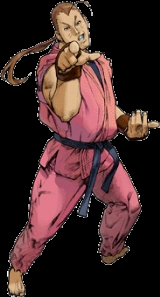
Dan Hibiki

Encyclopedia
is a video game character from Capcom
's Street Fighter
series of fighting game
s. Introduced in Street Fighter Alpha, Dan is consistently portrayed as an arrogant, overconfident, yet utterly feeble character.
, rival company SNK
released their own fighting game, Art of Fighting
. The principal character of this series, Ryo Sakazaki
, bore a resemblance in appearance and name to Ryu
, as well as other aesthetic similarities to Ken, wearing an orange gi and sporting blonde hair.
In humorous retaliation, Street Fighter II co-designer Akiman
drew an artwork of Sagat
holding a defeated opponent by the head during the release of Street Fighter II' - Champion Edition. The defeated opponent wore an attire similar to Ryo's: an orange karate gi with a torn black shirt underneath and geta
sandals; but had long dark hair tied to a ponytail like Robert Garcia, another character from the Art of Fighting series. This character design would become the basis of Dan, who was introduced as a secret character
in Street Fighter Alpha until finally becoming a selectable character by default in the game's sequel, Street Fighter Alpha 2
. His fireball is telling: instead of using both hands to unleash his Gadōken, as Ryu and Ken do for the Hadōken, he propels it with one hand, like Ryo, Robert and Yuri
do for the Kooh-ken (though Dan's Gadōken has pitifully short range and does mediocre damage. It only gains longer range when you use the super version of the move, the Shinkū Gadōken). Dan can also taunt infinitely like the Art of Fighting games, unlike his fellow Street Fighter Alpha characters who can only taunt once per round in the Alpha series.
When developing Street Fighter IV, executive producer Yoshinori Ono emphasized Dan as a character he strongly wanted to have appear in the game, stating that while the character's personality and actions earned him the label of a joke character, he felt Dan was a very technical fighting game character that could be used well and bring something unique to the game. In a later interview, he emphasized his desire to have Dan in the game again, citing the then-unveiled inclusion of Sakura Kasugano
in home versions as added incentive.
, reminiscent of Ryo's orange outfit in Art of Fighting.
Though his fighting stance is similar to Ken and Ryu's, it is more "loose" and animated. Many of his mannerisms directly mirror those of Yuri Sakazaki. In Street Fighter IV Dan's stance more closely resembles Ryo Sakazaki's fighting stance, rather than Ryu and Ken's.
In Street Fighter IV
, he can be seen with the kanji 最強流 (Saikyō-ryū) on his lapel. During some moves, the kanji 父 (father) or 弾 (bullet, pronounced 'Dan') appears on his back, similar to Akuma.
as a martial artist who developed his own fighting style called Saikyō-ryū, "The Strongest Style", despite the considerable lack of power in his techniques. During these two games, Dan seeks to defeat Sagat
to avenge his father's death. While Dan is an unlockable character in Street Fighter Alpha, in following games he is already available. By Street Fighter Alpha 3
, Dan has succeeded in his quest, and seeks to perfect and promote his fighting style. In this game, he also declares himself the mentor from the fighter Sakura Kasugano
and is revealed to be one of Blanka
's friends.
Dan also appears in the console versions from Street Fighter IV
, entering the tournament and in an effort to make his Saikyo-style more popular. He also appears as Sakura's mentor and fights her as a rival in the penultimate fight of his Arcade mode. In Super Street Fighter IV
, he continues fighting to promote and gain membership into his Saikyo Dojo which has no members at all. However, his plan fails due to lack of publicity used for his dojo. Dan is used as the dummy opponent for the Challenge Mode in the home versions.
His stance as a "weak" character is emphasized in the puzzle game Super Puzzle Fighter II Turbo
, in which Dan is a hidden character who drops only red counter gems, making him extremely easy to beat. In Super Gem Fighter Mini Mix
, Dan's story begins with himself looking to expand his Saikyo-ryu school, and subsequently chooses Sakura as his student. Upon meeting Sakura, he offers to teach her his style, and she accepts after Dan defeats her in a fight. Sakura masters the entire Saikyo-ryu style, and chooses to forget the entire style three days after mastering it, humiliating Dan.
Dan appears as a playable character in some Capcom crossover projects including two crossovers with Marvel: Marvel Super Heroes vs. Street Fighter
and Marvel vs. Capcom 2
as well as the crossovers with SNK
starting with Capcom vs. SNK Pro. During the debut trailer for the crossover fighting game Street Fighter X Tekken
, Dan is beaten through a door following an encounter with Tekken
fighter Kazuya Mishima
.
Additionally, Dan has had a small appearance in the original video animation
Street Fighter Alpha: The Animation. In the manga
Street Fighter: Sakura Ganbaru!
, Dan is featured as a supporting character.
ranked Dan at number twelve in their "Top 25 Street Fighter Characters" article, noting his role as a "fan favourite" despite his status as a joke character. GameDaily
listed Dan at number eighteen in their "Top 20 Street Fighter Characters of All Time" article and at number two in their "Top 25 Most Bizarre Fighting Characters" article, stating that despite the character's handicaps "...Dan is fun". In the January 30, 1997 issue of Gamest magazine in Japan, Dan ranked at the top from the poll Top 50 Characters of 1996. GamesRadar
listed Dan's uselessness as the number one in-game in-joke, stating that the character has become a fan favourite for overconfident players who want to show their skills. UGO Networks editor Paul Furfari chose Dan as one of the top 50 best Street Fighter characters, commenting that players could use him to "insult or embarrass a competing player." GameRadar's Mikel Reparaz also wrote an article titled "The pathetic history of Dan Hibiki" which focused on his appearances ever since Street Fighter Alpha and his history with the Art of Fighting characters. Reparaz labelled Dan as "a crappy version of Ryu or Ken", stating nevertheless to be one of the most enjoyable playable characters of the series. Ryan Clements from IGN shared similar comments, stating that if players are able to fully control Dan's moves, the character becomes very effective in fights from Street Fighter IV. Kotaku
's Brian Ashcraft also praised Dan's gameplay in Street Fighter IV, but criticized his English voice. UGO listed him thirteenth in their article of "The 25 Awesomest Hidden Characters" with comments on his introduction in Street Fighter Alpha as a comic-relief character. His "Shisso Buraiken" move from Street Fighter IV was listed as one of the most satisfying uppercuts in gaming's history by GamesRadar due to the effect done in the opponent's facial expression. Dan's absence from Street Fighter X Tekken
was joked by series producer Yoshinori Ono to be as a result of Tekken
character who "killed" him at the Comic-Con 2010 trailer from the game. As a result, Joystiq
wrote a comical article based on the character's "death."
Capcom
is a Japanese developer and publisher of video games, known for creating multi-million-selling franchises such as Devil May Cry, Chaos Legion, Street Fighter, Mega Man and Resident Evil. Capcom developed and published Bionic Commando, Lost Planet and Dark Void too, but they are less known. Its...
's Street Fighter
Street Fighter
, commonly abbreviated as SF, is a series of Fighting Games developed in Japan in which the players pit the video games' competitive fighters from around the world, each with his or her own unique fighting style, against one another...
series of fighting game
Fighting game
Fighting game is a video game genre where the player controls an on-screen character and engages in close combat with an opponent. These characters tend to be of equal power and fight matches consisting of several rounds, which take place in an arena. Players must master techniques such as...
s. Introduced in Street Fighter Alpha, Dan is consistently portrayed as an arrogant, overconfident, yet utterly feeble character.
Concept and creation
Shortly after the release of Street Fighter IIStreet Fighter II
is a competitive fighting game originally released for the arcades in . It is the arcade sequel to the original Street Fighter released in and was Capcom's fourteenth title that ran on the CP System arcade hardware...
, rival company SNK
SNK Playmore
SNK Playmore Corporation is a Japanese video game hardware and software company. SNK is an acronym of , which was SNK's original name. The company's legal and trading name became SNK in 1986....
released their own fighting game, Art of Fighting
Art of Fighting
is a trilogy of competitive fighting game titles that were released for the Neo Geo platform in the early 1990s. It was the second fighting game franchise created by SNK, following the Fatal Fury series and is set in the same fictional universe...
. The principal character of this series, Ryo Sakazaki
Ryo Sakazaki
is a video game character developed for the fighting game Art of Fighting from SNK Playmore . His name is most often written in kana, however, in some games kanji is used to write parts of his name. In the series, Ryo is a martial artist that practices his family's fighting style, the Kyokugenryu...
, bore a resemblance in appearance and name to Ryu
Ryu (Street Fighter)
is a video game player character created by Capcom, the main protagonist of the Street Fighter series. Having premiered in the first Street Fighter in 1987, Ryu appears as the lead character from the game along with his best friend Ken Masters participating in the Street Fighter tournament...
, as well as other aesthetic similarities to Ken, wearing an orange gi and sporting blonde hair.
In humorous retaliation, Street Fighter II co-designer Akiman
Akira Yasuda
is a Japanese animator, character designer, game designer and mecha designer, who works under the pen name "Akiman".-Career:...
drew an artwork of Sagat
Sagat (Street Fighter)
is a boss character from the early editions of Capcom's Street Fighter fighting game series. He was later turned into a regular, playable character. Sagat is depicted as a well-renowned Muay Thai expert fighter known for his incredible power. He is often called the "Emperor of Muay Thai" in his...
holding a defeated opponent by the head during the release of Street Fighter II' - Champion Edition. The defeated opponent wore an attire similar to Ryo's: an orange karate gi with a torn black shirt underneath and geta
Geta (footwear)
Geta are a form of traditional Japanese footwear that resemble both clogs and flip-flops. They are a kind of sandal with an elevated wooden base held onto the foot with a fabric thong to keep the foot well above the ground. They are worn with traditional Japanese clothing such as kimono or yukata,...
sandals; but had long dark hair tied to a ponytail like Robert Garcia, another character from the Art of Fighting series. This character design would become the basis of Dan, who was introduced as a secret character
Secret character
A secret character can be a player character or a non-player character in a video game that must be unlocked by completing a goal within the game...
in Street Fighter Alpha until finally becoming a selectable character by default in the game's sequel, Street Fighter Alpha 2
Street Fighter Alpha 2
Street Fighter Alpha 2, known as in Japan, Asia and South America, is a fighting game originally released for the CPS II arcade hardware by Capcom. The game is both a sequel and a remake to the previous years Street Fighter Alpha: Warriors' Dreams, which is itself a prequel to the Street Fighter...
. His fireball is telling: instead of using both hands to unleash his Gadōken, as Ryu and Ken do for the Hadōken, he propels it with one hand, like Ryo, Robert and Yuri
Yuri Sakazaki
is a video game character from SNK Playmore's Art of Fighting series. She first appears in the original Art of Fighting being kidnapped by Mr. Big, a criminal from the fictional city of Southtown. The players, Yuri's brother Ryo and his friend Robert Garcia spend the game searching for her...
do for the Kooh-ken (though Dan's Gadōken has pitifully short range and does mediocre damage. It only gains longer range when you use the super version of the move, the Shinkū Gadōken). Dan can also taunt infinitely like the Art of Fighting games, unlike his fellow Street Fighter Alpha characters who can only taunt once per round in the Alpha series.
When developing Street Fighter IV, executive producer Yoshinori Ono emphasized Dan as a character he strongly wanted to have appear in the game, stating that while the character's personality and actions earned him the label of a joke character, he felt Dan was a very technical fighting game character that could be used well and bring something unique to the game. In a later interview, he emphasized his desire to have Dan in the game again, citing the then-unveiled inclusion of Sakura Kasugano
Sakura Kasugano
is a player character in the Street Fighter series of fighting games. Sakura is portrayed in the series as a young Japanese schoolgirl who idolizes Ryu, whom she wants to be trained by.-In video games:...
in home versions as added incentive.
Character design
Dan has a similar outfit to Ryu and Ken, wearing a traditional karate gi. Dan also wears a black undershirt like Ryo. His head and face closely resembles Robert from Art of Fighting, while his outfit is bright pinkPink
Pink is a mixture of red and white. Commonly used for Valentine's Day and Easter, pink is sometimes referred to as "the color of love." The use of the word for the color known today as pink was first recorded in the late 17th century....
, reminiscent of Ryo's orange outfit in Art of Fighting.
Though his fighting stance is similar to Ken and Ryu's, it is more "loose" and animated. Many of his mannerisms directly mirror those of Yuri Sakazaki. In Street Fighter IV Dan's stance more closely resembles Ryo Sakazaki's fighting stance, rather than Ryu and Ken's.
In Street Fighter IV
Street Fighter IV
is a fighting game produced by Capcom. It is the first numbered Street Fighter game released by Capcom since . The coin-operated arcade game was released in Japan on July 18, 2008, with North American arcades importing the machines by August...
, he can be seen with the kanji 最強流 (Saikyō-ryū) on his lapel. During some moves, the kanji 父 (father) or 弾 (bullet, pronounced 'Dan') appears on his back, similar to Akuma.
Appearances
Dan is introduced in Street Fighter Alpha and Street Fighter Alpha 2Street Fighter Alpha 2
Street Fighter Alpha 2, known as in Japan, Asia and South America, is a fighting game originally released for the CPS II arcade hardware by Capcom. The game is both a sequel and a remake to the previous years Street Fighter Alpha: Warriors' Dreams, which is itself a prequel to the Street Fighter...
as a martial artist who developed his own fighting style called Saikyō-ryū, "The Strongest Style", despite the considerable lack of power in his techniques. During these two games, Dan seeks to defeat Sagat
Sagat (Street Fighter)
is a boss character from the early editions of Capcom's Street Fighter fighting game series. He was later turned into a regular, playable character. Sagat is depicted as a well-renowned Muay Thai expert fighter known for his incredible power. He is often called the "Emperor of Muay Thai" in his...
to avenge his father's death. While Dan is an unlockable character in Street Fighter Alpha, in following games he is already available. By Street Fighter Alpha 3
Street Fighter Alpha 3
Street Fighter Alpha 3, known as in Japan and Asia, is a fighting game by Capcom originally released for the CPS II arcade hardware. It is the third game in the Street Fighter Alpha series, following Street Fighter Alpha: Warriors' Dreams and Street Fighter Alpha 2...
, Dan has succeeded in his quest, and seeks to perfect and promote his fighting style. In this game, he also declares himself the mentor from the fighter Sakura Kasugano
Sakura Kasugano
is a player character in the Street Fighter series of fighting games. Sakura is portrayed in the series as a young Japanese schoolgirl who idolizes Ryu, whom she wants to be trained by.-In video games:...
and is revealed to be one of Blanka
Blanka
is a video game character from the Street Fighter series of fighting games. Blanka is depicted as a feral savage, with green skin and long orange hair, resembling a monster more than a human...
's friends.
Dan also appears in the console versions from Street Fighter IV
Street Fighter IV
is a fighting game produced by Capcom. It is the first numbered Street Fighter game released by Capcom since . The coin-operated arcade game was released in Japan on July 18, 2008, with North American arcades importing the machines by August...
, entering the tournament and in an effort to make his Saikyo-style more popular. He also appears as Sakura's mentor and fights her as a rival in the penultimate fight of his Arcade mode. In Super Street Fighter IV
Super Street Fighter IV
is a 2010 fighting game produced by Capcom. It is an updated version of Street Fighter IV and has been said to mark the definitive end of the Street Fighter IV series. Having been deemed as too large an update to be deployed as DLC, the game was made into a standalone title, but given a lower price...
, he continues fighting to promote and gain membership into his Saikyo Dojo which has no members at all. However, his plan fails due to lack of publicity used for his dojo. Dan is used as the dummy opponent for the Challenge Mode in the home versions.
His stance as a "weak" character is emphasized in the puzzle game Super Puzzle Fighter II Turbo
Super Puzzle Fighter II Turbo
Super Puzzle Fighter II Turbo, released in Japan as and commonly referred to as Puzzle Fighter, is a one or two player puzzle game first released in the spring of 1996 by Capcom on the CPS II arcade system...
, in which Dan is a hidden character who drops only red counter gems, making him extremely easy to beat. In Super Gem Fighter Mini Mix
Super Gem Fighter Mini Mix
Super Gem Fighter Mini Mix, released in Japan as , is a fighting game released by Capcom in September 1997 for the CPS II arcade system. It was ported to the PlayStation , Sega Saturn, and WonderSwan, as well as PlayStation 2 as part of the Street Fighter Alpha Anthology.The game uses the same...
, Dan's story begins with himself looking to expand his Saikyo-ryu school, and subsequently chooses Sakura as his student. Upon meeting Sakura, he offers to teach her his style, and she accepts after Dan defeats her in a fight. Sakura masters the entire Saikyo-ryu style, and chooses to forget the entire style three days after mastering it, humiliating Dan.
Dan appears as a playable character in some Capcom crossover projects including two crossovers with Marvel: Marvel Super Heroes vs. Street Fighter
Marvel Super Heroes vs. Street Fighter
is the fourth Marvel Comics-licensed fighting game produced by Capcom . It is a sequel to X-Men vs. Street Fighter which replaces most of the X-Men characters with characters from Marvel Super Heroes. In an attempt to balance the previous games' problems, the game engine was altered, although it...
and Marvel vs. Capcom 2
Marvel vs. Capcom 2: New Age of Heroes
is a fighting game, developed and published by Capcom. It is the fourth game in the Marvel vs. Capcom series. With the fourth installment of this series, Capcom simplified the controls to make the gameplay more accessible for casual players. The button configuration was trimmed down to 4 main...
as well as the crossovers with SNK
SNK
SNK is a former name of SNK Playmore, a Japanese video game company . This may also refer to:* SNK European Democrats* SNK Union of Independents* Southeast Airlines ICAO code...
starting with Capcom vs. SNK Pro. During the debut trailer for the crossover fighting game Street Fighter X Tekken
Street Fighter X Tekken
is an upcoming crossover fighting game being developed by Capcom. The game was announced at the 2010 San Diego Comic-Con International by Capcom producer Yoshinori Ono. The game is set to release on PlayStation 3, Xbox 360, Microsoft Windows and PlayStation Vita sometime in March 2012. The game...
, Dan is beaten through a door following an encounter with Tekken
Tekken
is an arcade fighting game franchise created and developed by Namco. Beginning with the original Tekken arcade game released in 1994, the series has received several sequels, as well as various home conversions and spin-off titles released for consoles...
fighter Kazuya Mishima
Kazuya Mishima
is a fictional character in the Tekken fighting game series. Although originally appearing as the main protagonist in the original Tekken game, he becomes one of the series' leading villains from Tekken 2 onward, after being overtaken by the Devil Gene, where he is known as Devil Kazuya .-In the...
.
Additionally, Dan has had a small appearance in the original video animation
Original video animation
, abbreviated as media , are animated films and series made specially for release in home-video formats. The term originated in relation to Japanese animation...
Street Fighter Alpha: The Animation. In the manga
Manga
Manga is the Japanese word for "comics" and consists of comics and print cartoons . In the West, the term "manga" has been appropriated to refer specifically to comics created in Japan, or by Japanese authors, in the Japanese language and conforming to the style developed in Japan in the late 19th...
Street Fighter: Sakura Ganbaru!
Street Fighter: Sakura Ganbaru!
is a manga series written and illustrated by Masahiko Nakahira. The story follows Sakura Kasugano in her quest to become a street fighter and meet Ryu.- Characters :- Volumes :Sakura Ganbaru! has been released in tankōbon and kanzenban formats....
, Dan is featured as a supporting character.
Reception
Dan's character has received positive response by video game publications. IGNIGN
IGN is an entertainment website that focuses on video games, films, music and other media. IGN's main website comprises several specialty sites or "channels", each occupying a subdomain and covering a specific area of entertainment...
ranked Dan at number twelve in their "Top 25 Street Fighter Characters" article, noting his role as a "fan favourite" despite his status as a joke character. GameDaily
GameDaily
GameDaily was a video game journalism website based in the United States. Launched in 1995 by entrepreneur Mark Friedler under the name Gigex and focused on free game demo downloads, The site changed its business model from a flat fee per download CDN distributed service network to an...
listed Dan at number eighteen in their "Top 20 Street Fighter Characters of All Time" article and at number two in their "Top 25 Most Bizarre Fighting Characters" article, stating that despite the character's handicaps "...Dan is fun". In the January 30, 1997 issue of Gamest magazine in Japan, Dan ranked at the top from the poll Top 50 Characters of 1996. GamesRadar
GamesRadar
GamesRadar is a multi-format video game website featuring regular news, previews, reviews, videos, and guides. It is owned and operated simultaneously in the UK and US by worldwide publisher Future Publishing...
listed Dan's uselessness as the number one in-game in-joke, stating that the character has become a fan favourite for overconfident players who want to show their skills. UGO Networks editor Paul Furfari chose Dan as one of the top 50 best Street Fighter characters, commenting that players could use him to "insult or embarrass a competing player." GameRadar's Mikel Reparaz also wrote an article titled "The pathetic history of Dan Hibiki" which focused on his appearances ever since Street Fighter Alpha and his history with the Art of Fighting characters. Reparaz labelled Dan as "a crappy version of Ryu or Ken", stating nevertheless to be one of the most enjoyable playable characters of the series. Ryan Clements from IGN shared similar comments, stating that if players are able to fully control Dan's moves, the character becomes very effective in fights from Street Fighter IV. Kotaku
Kotaku
Kotaku is a video games-focused blog. It is part of Gawker Media's "Gawker" network of sites, which also includes Gizmodo, Deadspin, Lifehacker, io9 and Jezebel. Named to CNET News' Blog 100, Kotaku is consistently listed in the top 40 of Technorati's Top 100...
's Brian Ashcraft also praised Dan's gameplay in Street Fighter IV, but criticized his English voice. UGO listed him thirteenth in their article of "The 25 Awesomest Hidden Characters" with comments on his introduction in Street Fighter Alpha as a comic-relief character. His "Shisso Buraiken" move from Street Fighter IV was listed as one of the most satisfying uppercuts in gaming's history by GamesRadar due to the effect done in the opponent's facial expression. Dan's absence from Street Fighter X Tekken
Street Fighter X Tekken
is an upcoming crossover fighting game being developed by Capcom. The game was announced at the 2010 San Diego Comic-Con International by Capcom producer Yoshinori Ono. The game is set to release on PlayStation 3, Xbox 360, Microsoft Windows and PlayStation Vita sometime in March 2012. The game...
was joked by series producer Yoshinori Ono to be as a result of Tekken
Tekken
is an arcade fighting game franchise created and developed by Namco. Beginning with the original Tekken arcade game released in 1994, the series has received several sequels, as well as various home conversions and spin-off titles released for consoles...
character who "killed" him at the Comic-Con 2010 trailer from the game. As a result, Joystiq
Joystiq
Joystiq is a video gaming blog founded in June 2004 that has since become one of the most successful sites within the Weblogs, Inc. family of weblogs. It is the centerpiece of WIN's own network of video gaming blogs, which also includes a blog dealing specifically with the popular MMORPG World of...
wrote a comical article based on the character's "death."
External links
- Dan's Street Fighter Alpha, Marvel vs. Capcom, and Street Fighter IV entries at StrategyWiki.org