
All Topics  
Trifluoromethanesulfonic acid


   Email Print
   Bookmark   Link


Trifluoromethanesulfonic acid


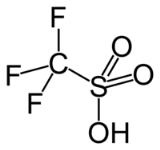
Trifluoromethanesulfonic acid, also known as triflic acid or TfOH, is a sulfonic acid
Sulfonic acid

Sulfonic acid usually refers to a member of the class of organic acids with the general formula R-S2-OH, where R is usually a hydrocarbon side chain....
 with the chemical formula CF3SO3H . It is often regarded as one of the strongest acids, and is one of a number of so-called "superacids". It is about 1000 times stronger than sulfuric acid
Sulfuric acid

Sulfuric acid, hydrogen2sulfuroxygen4, is a strong mineral acid. It is soluble in water at all concentrations. Sulfuric acid has many applications, and is one of the top products of the chemical industry....
. Triflic acid is widely used especially as a catalyst and a precursor in organic chemistry
Organic chemistry

Organic chemistry is a discipline within chemistry which involves the science study of the structure, properties, composition, chemical reaction, and preparation of chemical compounds that contain carbon....
.

lic acid is a hygroscopic, colorless liquid at room temperature.


Discussion
Ask a question about 'Trifluoromethanesulfonic acid'
Start a new discussion about 'Trifluoromethanesulfonic acid'
Answer questions from other users
Full Discussion Forum


Recent Posts


Encyclopedia


Trifluoromethanesulfonic acid, also known as triflic acid or TfOH, is a sulfonic acid
Sulfonic acid

Sulfonic acid usually refers to a member of the class of organic acids with the general formula R-S2-OH, where R is usually a hydrocarbon side chain....
 with the chemical formula CF3SO3H . It is often regarded as one of the strongest acids, and is one of a number of so-called "superacids". It is about 1000 times stronger than sulfuric acid
Sulfuric acid

Sulfuric acid, hydrogen2sulfuroxygen4, is a strong mineral acid. It is soluble in water at all concentrations. Sulfuric acid has many applications, and is one of the top products of the chemical industry....
. Triflic acid is widely used especially as a catalyst and a precursor in organic chemistry
Organic chemistry

Organic chemistry is a discipline within chemistry which involves the science study of the structure, properties, composition, chemical reaction, and preparation of chemical compounds that contain carbon....
.

Properties

Triflic acid is a hygroscopic, colorless liquid at room temperature. It is soluble in polar
Polar bond

Polar bond may refer to:Polar bond* Chemical polarity* Covalent bond* Bond dipole moment* Partial charge* Dipoles#Molecular dipoles* Electronegativity...
 solvent
Solvent

A solvent is a liquid or gas that dissolves a solid, liquid, or gaseous solute, resulting in a solution.The most common solvent in everyday life is water....
s such as DMF
DMF

DMF may be an abbreviation for:*Organic compounds:**N,N-Dimethylformamide, a common solvent.**Dimethyl fumarate, is the methyl ester of fumaric acid, a potent allergen, often used for mold inhibition....
, DMSO
Dimethyl sulfoxide

Dimethyl sulfoxide is the chemical compound with the chemical formula 2SO. It was first synthesized in 1866 by the Russian scientist Alexander Saytzeff, who reported his findings in a German chemistry journal in 1867....
, acetonitrile
Acetonitrile

Acetonitrile is the chemical compound with chemical formula CH3CN. This colourless liquid is the simplest organic nitrile and is widely used as a solvent....
, and dimethyl sulfone. Addition of triflic acid to polar solvents can be dangerously exothermic
Exothermic

File:Explosion1.JPG In thermodynamics, the term exothermic describes a process or reaction that releases energy usually in the form of heat, but also in form of light , electricity , or sound....
.

With an Ka
Acid dissociation constant

An acid dissociation constant, Ka, is a quantitative measure of the strong acid in solution. It is the equilibrium constant for a chemical reaction known as Dissociation in the context of acid-base reactions....
 = 8.0 ×10¹⁴ (pKa ~ -15) mol/kg, HOTf qualifies as a superacid
Superacid

A superacid is an acid with an acidity greater than that of 100% sulfuric acid, which has a Hammett acidity function of -12. Commercially available superacids include trifluoromethanesulfonic acid , also known as triflic acid, and fluorosulfuric acid , both of which are about a thousand times stronger than sulfuric acid....
. Triflic acid owes many of its useful properties to its great thermal and chemical stability. Both the acid and its conjugate base CF3SO3-, known as triflate
Triflate

Triflate, more formally known as trifluoromethanesulfonate, is a functional group with the formula CF3SO3-. The triflate group is often represented by -OTf, as opposed to -Tf....
, resist oxidation/reduction
Redox

Redox describes all chemical reactions in which atoms have their oxidation number changed.This can be either a simple redox process such as the oxidation of carbon to yield carbon dioxide or the reduction of carbon by hydrogen to yield methane , or it can be a complex process such as the oxidation of sugar in the human body through a ser...
 reactions, whereas many strong acids are oxidizing, e.g. HClO4 and HNO3. The triflate anion is immune to attack by even strong nucleophile
Nucleophile

In chemistry, a nucleophile is a reagent that forms a chemical bond to its reaction partner by donating both bonding electrons. Because nucleophiles donate electrons, they are by definition Lewis bases ....
s. Because of it resistance to oxidation and reduction, triflic acid is a very useful and versatile reagent. Further recommending its use, triflic acid does not sulfonate substrates, which can be a problem with sulfuric acid
Sulfuric acid

Sulfuric acid, hydrogen2sulfuroxygen4, is a strong mineral acid. It is soluble in water at all concentrations. Sulfuric acid has many applications, and is one of the top products of the chemical industry....
, fluorosulfuric acid
Fluorosulfuric acid

Fluorosulfuric acid is FSO3H; it is one of the strongest acids commercially available. It is also known by the alternative name, fluorosulfonic acid....
, and chlorosulfonic acid. Below is a prototypical sulfonation, which HOTf does not undergo: C6H6 + H2SO4 ? C6H5(SO3H) + H2O

Triflic acid fumes in moist air and forms a stable solid monohydrate, CF3SO3H·H2O, melting point 34 °C.

History and syntheses

Trifluoromethanesulfonic acid was first synthesized in 1954 by Haszeldine and Kidd by the following reaction:

Trifluoromethanesulfonate Synthesis1 Transp
Other ways to synthesize trifluoromethanesulfonic acid including electrochemical fluorination (ECF).

Trifluoromethanesulfonate Synthesis2 Transp
The industrial synthesis involves hydrolysis of CF3SO2F, followed by acidification. Triflic acid is purified by distillation
Distillation

Distillation is a method of separation process mixtures based on differences in their Volatility in a boiling liquid mixture. Distillation is a unit operation, or a physical separation process, and not a chemical reaction....
 from triflic anhydride
Triflic anhydride

Triflic anhydride is the chemical compound with the formula 2O. This compound is a particularly strong electrophile, useful for introducing the CF3SO2 group....
.

Uses

Triflic acid is useful in protonations because the conjugate base of triflic acid will not react with other reagents.

Salt formation

Trifluoromethanesulfonic acid exothermically reacts with metal carbonate
Carbonate

In chemistry, a carbonate is a salt or ester of carbonic acid....
s and hydroxide
Hydroxide

In chemistry, hydroxide is the name for the Diatomic molecule anion OH-, consisting of oxygen and hydrogen atoms, usually derived from the Dissociation of a base ....
s. Illustrative is the synthesis of Cu(OTf)2. CuCO3 + 2 CF3SO3H ? Cu(O3SCF3)2 + H2O + CO2 Far more interesting to the synthetic chemist is the conversion of chloro complexes to the corresponding triflates. Illustrative is the synthesis of [Co(NH3)5OTf]2+: 3 CF3SO3H + [Co(NH3)5Cl]Cl2 ? [Co(NH3)5O3SCF3](O3SCF3)2 + 3 HCl This conversion is conducted in neat HOTf at 100 °C, followed by precipitation of the salt by the addition of ether.

Organic reactions

Triflic acid reacts with acyl halides to give mixed anhydrides, which are strong acylating agents, e.g. in Friedel-Crafts reactions. CH3C(O)Cl + CF3SO3H ? CH3C(O)OSO2CF3 + HCl CH3C(O)OSO2CF3 + C6H6 ? CH3C(O)C6H5 + CF3SO3H Triflic acid catalyzes the reaction of aromatic compounds with sulfonyl chlorides, probably also via the intermediacy of a mixed anhydride.

This is a very similar reaction to what would be done if one wanted to create polymers using triflic acid in the synthesis. Other Friedel-Crafts type reactions using triflic acid include cracking of alkanes and alkylation of alkenes which are very important to the petroleum industry. These triflic acid derivative catalysts are very effective in isomerizing straight chain or slightly branched hydrocarbons that can increase the octane rating
Octane rating

The octane rating is a measure of the resistance of gasoline and other fuels to detonation in spark plug internal combustion engines. High-performance engines typically have higher compression ratios and are therefore more prone to detonation, so they require higher octane fuel....
 of a particular petroleum based fuel.

Triflic acid reacts exothermically with alcohols to produce ethers and olefins. It can be used as a catalyst for the condensation of alcohols and carboxylic acids.

Further reading