

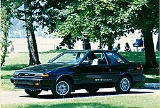
Toyota AE86

Encyclopedia
The AE86 generation of the Toyota Corolla Levin and Toyota Sprinter Trueno is a small, lightweight coupe
introduced by Toyota in 1983 as part of the fifth generation Toyota Corolla
lineup. For the purpose of brevity, the insider-chassis code of "AE86" is used to describe the whole range. In classic Toyota code, the "A" represents the engine that came in the car (4A series), "E" represents the Corolla, "8" represents the fifth generation (E80 series) and "6" represents the variation within this generation. The Levin has fixed-headlights and the Trueno has retractable headlights. The export model name Corolla covers both variations. The AE86 (along with the lower spec 1452 cc AE85 and 1587 cc SR5 versions) was rear wheel drive (unlike the front wheel drive CE80, EE80 and AE82 models), and is among the last rear-drive cars of its type, at a time when most passenger cars were being switched to front-drive. In 1987, there was a limited edition model of the AE86 called "Black Limited" that served as a send-off model before the AE86 chassis was replaced later that year by the front wheel drive AE92 Corolla/Sprinter range. In Japan, the AE86 was also known as the , Japanese
for "eight-six".
in Japan and Europe which was also used in the first-generation Toyota MR2
(AW11). This engine had a maximum gross power output of 130 PS and 110 lbft of torque
in standard form, though it was later down-rated to 120 PS and 105 lbft in net output. The AE86 came with a 5-speed manual gearbox, and later came with the option of an automatic. The 4A-GE engines used in the AE86 and AW11 were equipped with T-VIS
(Toyota Variable Intake System). The AE86 had an optional LSD
.
In North America, a modified 4A-GEC engine was used to comply with California emissions regulations. Power was rated at 112 bhp (84 kW), and 96 ft·lbf (136 Nm) of torque.
The AE86 used ventilated disc brake
s. The car was equipped with a MacPherson strut style independent suspension
at the front and a four-link live axle with coil springs for the rear. Stabilizer bars were present at both ends.
Lower-spec American AE86 SR5 models used the 1587 cc 4A-C SOHC unit, did not have an optional LSD, and had rear drum brakes. Also, the SR5 model had a softer suspension, and small styling and interior changes.
Models equipped with the 4A-GE engine received a 6.7" rear differential, while 4A-U, and 4A-C models received a smaller, weaker, 6.38" rear differential.
The AE86 SR5 (4A-C equipped) had an optional automatic transmission
, though the GT-S model (with the 4A-GE DOHC engine) only came with a standard 5-speed manual gearbox.
One of the staff who was behind the car's engineering work was Nobuaki Katayama
, who would later head the company's motorsport department and who would become chief engineer of the Altezza
project a decade later. An article in Car Magazine in April 1999, stated he has a photo of an AE86 hung in his office.
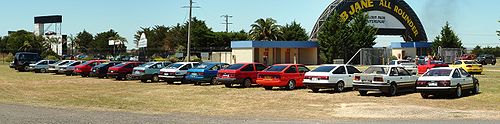
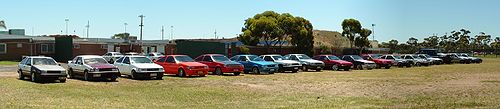 Both the Levin and Trueno variants were offered with either a 2-door coupe or 3-door liftback (sometimes called hatchback) body style. The Levin and Trueno were generally identical, apart from fixed, rectangular headlights on the Levin and pop-up headlights on the Trueno. Minor bodywork changes were made in 1986 which resulted in different tail lights for both Levin and Trueno models, along with the coupe and hatchback styles. The models sold between 1983–1985 are sometimes referred to as "zenki" (前期, lit. early period), and the models sold from 1986–1987 are referred to as "kouki" (後期, lit. latter period). The coupe version is considered to be the more rigid and lighter version of the two.
as the Corolla Levin or Sprinter Trueno. In North America, the top-spec DOHC 4A-GEC was sold as the Corolla GT-S (with AE86 on the build plate in the engine bay but AE88 in the VIN), with the SOHC 4A-C being sold as the Corolla SR5 (with AE86 on the build plate and in the VIN). Both versions were sold with pop-up headlights only. Euro spec models were sold as the Corolla GT with DOHC engines and fixed Levin-style headlights. The Middle East received the same basic model as the North American market, with pop-up headlights and the regulated 5 mph (8 km/h) bumpers.
The lightest AE86 is the Japanese 2 door GT model which weighs 910 kg (2,006 lb). It has the same exterior as the GTV trim, but with the interior of the AE85 with the exception of the gauges, and is equipped with rear drum brakes.
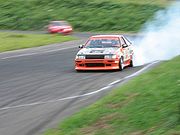 During its production life, the AE86 was a popular choice for showroom stock, Group A
, and Group N
racing, especially in rallying
and circuit races. Even after production of the car was discontinued, many privateer teams still raced the AE86, and it is still a popular choice for rallying and club races today. Part of the continued appeal of the AE86 for motorsports is its rear-drive configuration, a feature not available in most newer lightweight coupes. In Group A world rally cars (1600 cc class) the 4A-GZE engine was popular. In Group A touring car races
, the car either dominated the lower category where eligible or fought it out with Honda Civic
s or the later AE92s and AE101s whilst maintaining its competitiveness. In Ireland, where rallying is considered one of the most popular forms of motorsport, as organizing regulations are more relaxed compared to that of other countries, the AE86 was popular when new, and is still so popular that teams will purchase cars from the UK due to local shortages. The AE86 is also popular for rally use in Finland, where the cars can be competitive in the F-Cup competition for naturally aspirated 2WD cars.
The semi-factory supported Kraft team entered a spaceframe Trueno at the JGTC with a 3S-GTE
engine that came from a SW20 MR-2 Turbo producing about 300 hp for the JGTC GT300 regulations in 1998. Despite being popular with the racefans, the car had minor success and was abandoned from use halfway through the 2001 season in favor of a newly delivered MR-S.
The rear wheel drive configuration, combined with the AE86's light weight (approximately 2300 lb (950–970 kg) curb weight), balance and relatively powerful (and easy to tune) 4A-GEU engine made it popular among the Japanese hashiriya (street racers in Japanese), many of whom raced in mountain passes (touge
in Japanese) where the corners suited the AE86 best, especially on the downhill. Among those who utilized this car was Japanese racing legend Keiichi Tsuchiya
also known as the Dori-Kin ("Drift King" in Japanese). Mitsu Ide helped popularize the sport of drifting
, which involves taking a car on a set of controlled slides through corners. The AE86's FR configuration made it well suited to this kind of cornering, and currently the car is a mainstay of drift shows and competitions.
, Takumi Fujiwara, uses his father's AE86 Trueno for racing and making his tofu deliveries. Also in Initial D, Itsuki Takeuchi drives an AE85 Levin, mistaken for an AE86.
Coupé
A coupé or coupe is a closed car body style , the precise definition of which varies from manufacturer to manufacturer, and over time...
introduced by Toyota in 1983 as part of the fifth generation Toyota Corolla
Toyota Corolla
The Toyota Corolla is a line of subcompact and compact cars manufactured by the Japanese automaker Toyota, which has become very popular throughout the world since the nameplate was first introduced in 1966. In 1997, the Corolla became the best selling nameplate in the world, with over 35 million...
lineup. For the purpose of brevity, the insider-chassis code of "AE86" is used to describe the whole range. In classic Toyota code, the "A" represents the engine that came in the car (4A series), "E" represents the Corolla, "8" represents the fifth generation (E80 series) and "6" represents the variation within this generation. The Levin has fixed-headlights and the Trueno has retractable headlights. The export model name Corolla covers both variations. The AE86 (along with the lower spec 1452 cc AE85 and 1587 cc SR5 versions) was rear wheel drive (unlike the front wheel drive CE80, EE80 and AE82 models), and is among the last rear-drive cars of its type, at a time when most passenger cars were being switched to front-drive. In 1987, there was a limited edition model of the AE86 called "Black Limited" that served as a send-off model before the AE86 chassis was replaced later that year by the front wheel drive AE92 Corolla/Sprinter range. In Japan, the AE86 was also known as the , Japanese
Japanese language
is a language spoken by over 130 million people in Japan and in Japanese emigrant communities. It is a member of the Japonic language family, which has a number of proposed relationships with other languages, none of which has gained wide acceptance among historical linguists .Japanese is an...
for "eight-six".
Engine/technical
The AE86 was available with a fuel-injected 4-cylinder twin-cam 1587 cc 4A-GE engineToyota A engine
The A Series engines are a family of straight-4 internal combustion engines with displacement from 1.3 L to 1.8 L produced by Toyota Motor Corporation...
in Japan and Europe which was also used in the first-generation Toyota MR2
Toyota MR2
The Toyota MR2 is a two-seat, mid-engined, rear wheel drive sports car produced by Central Motors, a part of Toyota, from 1984 until July 2007 when production stopped in Japan...
(AW11). This engine had a maximum gross power output of 130 PS and 110 lbft of torque
Torque
Torque, moment or moment of force , is the tendency of a force to rotate an object about an axis, fulcrum, or pivot. Just as a force is a push or a pull, a torque can be thought of as a twist....
in standard form, though it was later down-rated to 120 PS and 105 lbft in net output. The AE86 came with a 5-speed manual gearbox, and later came with the option of an automatic. The 4A-GE engines used in the AE86 and AW11 were equipped with T-VIS
T-VIS
Toyota Variable Induction System, or T-VIS, is a variable intake system designed by Toyota to improve the low-end performance of multi-valve engines....
(Toyota Variable Intake System). The AE86 had an optional LSD
Limited slip differential
A limited slip differential is a type of differential gear arrangement that allows for some difference in angular velocity of the output shafts, but imposes a mechanical bound on the disparity...
.
In North America, a modified 4A-GEC engine was used to comply with California emissions regulations. Power was rated at 112 bhp (84 kW), and 96 ft·lbf (136 Nm) of torque.
The AE86 used ventilated disc brake
Disc brake
The disc brake or disk brake is a device for slowing or stopping the rotation of a wheel while it is in motion.A brake disc is usually made of cast iron, but may in some cases be made of composites such as reinforced carbon–carbon or ceramic matrix composites. This is connected to the wheel and/or...
s. The car was equipped with a MacPherson strut style independent suspension
Independent suspension
Independent suspension is a broad term for any automobile suspension system that allows each wheel on the same axle to move vertically independently of each other. This is contrasted with a beam axle, live axle or deDion axle system in which the wheels are linked – movement on one side affects...
at the front and a four-link live axle with coil springs for the rear. Stabilizer bars were present at both ends.
Lower-spec American AE86 SR5 models used the 1587 cc 4A-C SOHC unit, did not have an optional LSD, and had rear drum brakes. Also, the SR5 model had a softer suspension, and small styling and interior changes.
Models equipped with the 4A-GE engine received a 6.7" rear differential, while 4A-U, and 4A-C models received a smaller, weaker, 6.38" rear differential.
The AE86 SR5 (4A-C equipped) had an optional automatic transmission
Automatic transmission
An automatic transmission is one type of motor vehicle transmission that can automatically change gear ratios as the vehicle moves, freeing the driver from having to shift gears manually...
, though the GT-S model (with the 4A-GE DOHC engine) only came with a standard 5-speed manual gearbox.
One of the staff who was behind the car's engineering work was Nobuaki Katayama
Nobuaki Katayama
Nobuaki Katayama is a Japanese automotive engineer and former racing driver who was the chief engineer for the first generation Lexus IS, the Toyota Altezza in Japan, the first generation Lexus SC 400/SC 300, and the final generation of the Toyota Supra...
, who would later head the company's motorsport department and who would become chief engineer of the Altezza
Lexus IS
The Lexus IS is a series of entry-level luxury cars / compact executive cars sold by Lexus since 1998. The IS was introduced as an entry-level sport model slotted below the ES in the Lexus lineup...
project a decade later. An article in Car Magazine in April 1999, stated he has a photo of an AE86 hung in his office.
Body styles
Models/specifications
In Japan, the DOHC 4A-GEU AE86 was offered in GT, GT-APEX and GTV trimsTrim package
A trim package is an automotive package composed by a set of cosmetic embellishments to a vehicle. In some cases the trim package may include a specific model or ending name...
as the Corolla Levin or Sprinter Trueno. In North America, the top-spec DOHC 4A-GEC was sold as the Corolla GT-S (with AE86 on the build plate in the engine bay but AE88 in the VIN), with the SOHC 4A-C being sold as the Corolla SR5 (with AE86 on the build plate and in the VIN). Both versions were sold with pop-up headlights only. Euro spec models were sold as the Corolla GT with DOHC engines and fixed Levin-style headlights. The Middle East received the same basic model as the North American market, with pop-up headlights and the regulated 5 mph (8 km/h) bumpers.
The lightest AE86 is the Japanese 2 door GT model which weighs 910 kg (2,006 lb). It has the same exterior as the GTV trim, but with the interior of the AE85 with the exception of the gauges, and is equipped with rear drum brakes.
North American AE86 specifications
There are three types of Corolla Sport RWD for the US market: DX, SR5, and GT-S, though the DX was generally an internal Toyota designation, as brochures, and advertising do not include the DX designation; it consisted of a lower trim level, lighter duty suspension parts and the like.- Model Years of production: 1983 to 1987
- Versions: DX, SR5 and GT-S (85+ Only)
- Drag Coefficient: 0.39
DX & SR5 specifications
- Chassis code: AE86 (which may differ from the VIN)
- Horsepower: 87 hp (64 kW) @ 4800 rpm* Torque: 85 ft·lbf (115 N·m) @ 2800 rpm*
- Weight: approximately 2200 lb (998 kg) to 2400 lb (1089 kg)
- Engine: 4A-C, 1587 cc
- Engine type: SOHC 8-valve Inline-4 carburated
- M/T transmission: T50, 6-bolt flywheel
- A/T transmission: A42DL, 4-speed overdrive w/lockup torque converter, mechanically controlled, with electronically engaged overdrive
- Compression: 9.0:1
- Differential: 6.38" Open with 4.10:1 Ratio, 2-pinion (Automatic) (S292) or 3.91:1 ratio, 4-pinion (5-speed) (S314)
- Wheels/tires: 13x5" +33 mm offset rims with 185/70R13 tires
- First 7 characters of VIN: JT2AE85 (DX) or JT2AE86 (SR5)
GT-S specifications
- Chassis code: AE86 (which may differ from the VIN)
- Horsepower: 112 hp (84 kW) @ 6600 rpm* Torque: 97 ft·lbf (132 N·m) @ 4800 rpm*
- Weight: approximately 2200 lb (998 kg) to 2400 lb (1089 kg)
- Engine: 4A-GE, 1587 cc
- Engine type: DOHC 16-valve Inline-4 AFM Multiport Fuel Injection w/T-VIS
- Transmission: T50, 8-bolt flywheel
- Injector size: approx. 180 cc, low impedance
- Compression: 9.4:1
- Differential: 6.7" Open (T282) or optional LSD (USA Only) (T283) with 4.30:1 Ratio, 2-pinion
- Wheels/tires: 14x5.5" +27 mm Offset Rims with 185/60R14 82H Tires (195/60R14 85H for 86+ models)
- First 7 characters of VIN: JT2AE88
The AE86 in motorsports
Group A
In relation to motorsport governed by the FIA, Group A referred to a set of regulations providing production-derived vehicles for outright competition. In contrast to the short-lived Group B and Group C, the Group A referred to production-derived vehicles limited in terms of power, weight, allowed...
, and Group N
Group N
In relation to motorsport governed by the FIA, Group N refers to a set of regulations providing 'standard' production vehicles for competition, often referred to as the "Showroom Class"....
racing, especially in rallying
Rallying
Rallying, also known as rally racing, is a form of auto racing that takes place on public or private roads with modified production or specially built road-legal cars...
and circuit races. Even after production of the car was discontinued, many privateer teams still raced the AE86, and it is still a popular choice for rallying and club races today. Part of the continued appeal of the AE86 for motorsports is its rear-drive configuration, a feature not available in most newer lightweight coupes. In Group A world rally cars (1600 cc class) the 4A-GZE engine was popular. In Group A touring car races
Touring car racing
Touring car racing is a general term for a number of distinct auto racing competitions in heavily-modified street cars. It is notably popular in Argentina, Australia, Brazil, Germany, Japan, Scandinavia and Britain.-Characteristics of a touring car:...
, the car either dominated the lower category where eligible or fought it out with Honda Civic
Honda Civic
The Honda Civic is a line of subcompact and subsequently compact cars made and manufactured by Honda. The Civic, along with the Accord and Prelude, comprised Honda's vehicles sold in North America until the 1990s, when the model lineup was expanded...
s or the later AE92s and AE101s whilst maintaining its competitiveness. In Ireland, where rallying is considered one of the most popular forms of motorsport, as organizing regulations are more relaxed compared to that of other countries, the AE86 was popular when new, and is still so popular that teams will purchase cars from the UK due to local shortages. The AE86 is also popular for rally use in Finland, where the cars can be competitive in the F-Cup competition for naturally aspirated 2WD cars.
The semi-factory supported Kraft team entered a spaceframe Trueno at the JGTC with a 3S-GTE
Toyota 3S-GTE engine
The 3S-GTE is an in-line 4-cylinder 1998cc engine from Toyota, based on the 3S-GE with reduced compression ratio and addition of a turbocharger.There are four generations of this engine, which were manufactured from 1986 to 2007....
engine that came from a SW20 MR-2 Turbo producing about 300 hp for the JGTC GT300 regulations in 1998. Despite being popular with the racefans, the car had minor success and was abandoned from use halfway through the 2001 season in favor of a newly delivered MR-S.
The rear wheel drive configuration, combined with the AE86's light weight (approximately 2300 lb (950–970 kg) curb weight), balance and relatively powerful (and easy to tune) 4A-GEU engine made it popular among the Japanese hashiriya (street racers in Japanese), many of whom raced in mountain passes (touge
Touge
is a Japanese word literally meaning "pass." It refers to a mountain pass or any of the narrow, winding roads that can be found in and around the mountains of Japan and other geographically similar areas, like the legendary Nordschleife in Germany....
in Japanese) where the corners suited the AE86 best, especially on the downhill. Among those who utilized this car was Japanese racing legend Keiichi Tsuchiya
Keiichi Tsuchiya
is a professional race car driver. He is also known as the "Drift King" for his nontraditional use of drifting in non-drifting racing events and his role in popularizing drifting as a motorsport...
also known as the Dori-Kin ("Drift King" in Japanese). Mitsu Ide helped popularize the sport of drifting
Drifting (motorsport)
Drifting refers to a driving technique and to a motorsport where the driver intentionally over steers, causing loss of traction in the rear wheels through turns, while maintaining vehicle control and a high exit speed...
, which involves taking a car on a set of controlled slides through corners. The AE86's FR configuration made it well suited to this kind of cornering, and currently the car is a mainstay of drift shows and competitions.
Initial D
The main character of the anime and manga Initial DInitial D
is a manga by Shuichi Shigeno which has been serialized in Kodansha's Young Magazine since 1995. It has been adapted into a long-running anime series by OB Planning, Studio Comet, Studio Gallop, Pastel, and A.C.G.T, and a live action film by Avex and Media Asia...
, Takumi Fujiwara, uses his father's AE86 Trueno for racing and making his tofu deliveries. Also in Initial D, Itsuki Takeuchi drives an AE85 Levin, mistaken for an AE86.