
|
|
|
|
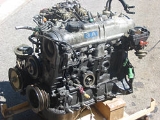
Toyota A engine
|
| |
|
| |
The A Series engines are a family of straight-4 internal combustion engines with displacement from 1.3 L to 1.8 L produced by Toyota Motor Corporation. The series has cast iron engine blocks and aluminum cylinder heads. The series began in the late 1970s with the 1A, an SOHC engine with a displacement of 1.5 L. Toyota joint venture partner Tianjin FAW Xiali still produces 1.3 L 8A and recently restarted production of the 5A. In between, many interesting variations were produced, including one of the first 5-valve engines (the 4A) and the 170 hp (127 kW) supercharged 4A-GZE.
1A The 1.5 L (1452 cc) 1A was produced in 1978 and 1979.

Discussion
Ask a question about 'Toyota A engine'
Start a new discussion about 'Toyota A engine'
Answer questions from other users
|
Recent Posts

Encyclopedia
The A Series engines are a family of straight-4 internal combustion engines with displacement from 1.3 L to 1.8 L produced by Toyota Motor Corporation. The series has cast iron engine blocks and aluminum cylinder heads. The series began in the late 1970s with the 1A, an SOHC engine with a displacement of 1.5 L. Toyota joint venture partner Tianjin FAW Xiali still produces 1.3 L 8A and recently restarted production of the 5A. In between, many interesting variations were produced, including one of the first 5-valve engines (the 4A) and the 170 hp (127 kW) supercharged 4A-GZE.
1A The 1.5 L (1452 cc) 1A was produced in 1978 and 1979. It was a 2-valve SOHC engine.
2A The 1.3 L (1295 cc) 2A was produced from 1979 through 1986. Cylinder bore was 75 mm (2.99 in) and stroke was 71.4 mm (2.81 in). It was a 2-valve SOHC design like its predecessor.
Output ranged from 65-75 hp) at 3000-3100 rpm
Toyota models that had this engine:
3A The 1.5 L (1452 cc) 3A was produced from 1979 through 1988. Cylinder bore was 77.5 mm (3.05 in) and stroke was 77 mm (3.03 in). It was a 2-valve SOHC like the 1A and 2A. There were California-spec (3A-C), Japan-spec (3A-U), transverse (3A-L), and swirl-intake (3A-S) versions of the same basic design.
Power output ranged from just 62 hp (46 kW) at 4800 rpm all the way to 90 hp (67 kW) at 6000 rpm. Torque was less spread from 75 ft·lbf (101 N·m) at 2800 rpm to 89 ft·lbf (120 N·m) at 4000 rpm.
Toyota models that had this engine:
4A The 4A was produced from 1980 through 1998. All 4A engines have a displacement of 1.6 L (1587 cc). The cylinder bore was enlarged from the previous 3A engines at 81 mm (3.19 in), but the stroke remained the same as the 3A at 77 mm (3.03 in), giving it an over-square bore/stroke ratio which favours high RPMs.
Numerous variations of the basic 4A design were produced, from SOHC 2-valve all the way to DOHC 5-valve versions. The power output also varied greatly between versions, from 70 hp (52 kW) at 4800 rpm in the basic California-spec 4A-C to 170 hp (127 kW) at 6400 rpm in the supercharged 4A-GZE.
4A-C The 4A-C was a SOHC inline four (I4) 8-valve carburettor-equipped engine which produces 78-90hp (58-67kW) @ 4800 rpm, torque: 85 ft·lbf (115 N·m) @ 2800 rpm* (may vary). The power and torque output figures vary between different regions of the world.
North American market engines:
- 4A-C 1.6 L I4, 8-valve SOHC, carb, 90 hp (67 kW)
European market engines:
- 4A-C 1.6 L, I4, 8-valve SOHC, carb, 84 hp (63 kW)
Australian market engines:
- 4A-C 1.6 L, I4, 8-valve SOHC, carb, 78 hp (58 kW)
Toyota models that had this engine:
- Corolla AE71 RWD
- Corolla AE86 RWD (Australian model)
- Corolla AE82 FWD
4A-E Fuel injection was added for the 1981 through 1988 4A-E. This increased output to 78 hp (58 kW) at 5600 rpm and 87 ft·lbf (117 N·m) at 4000 rpm in export form.
A special Japan-specification transverse 4A-ELU was also produced in 1986. Output for this engine was 100 hp (75 kW) at 5600 rpm and 101 ft·lbf (136 N·m) at 4000 rpm.
4A-F A narrow-valve (22.3°) DOHC 16-valve carb-equipped version, the 4A-F, was produced from 1987 through 1990. Output was 96 hp (67 kW) at 6000 rpm and 95 ft·lbf (128 N·m) at 3600 rpm.
Toyota models that had this engine:
- Corolla AE92 SR5: FWD
- Corolla AE92 sedan: FWD
- Corolla AE92 Break: FWD
4A-FE
The 1987–1998 4A-FE is the descendant of the carbureted 4A-F. This version, although from the same series and the same generation as the 4A-GE, is different from its "brother" in terms of performance and power. Although both have the same displacement and are DOHC, they were optimized for different uses. The first obvious difference are the valves, the engine's intake and exhaust valves were placed 22.3° apart (compared to 50° in the G-Engines). The second is that it employed a "slave cam system", the camshafts being geared together and driven off one camshaft's sprocket (both camshafts' sprockets on the G-Engine are rotated by the timing belt). Some of the less directly visible differences were poorly shaped ports in the earlier versions, a slow burning combustion chamber with heavily shrouded valves, less aggressive camshaft profiles, ports of a small cross sectional area, a very restrictive intake manifold with long runners joined to a small displacement plenum and other changes. Even though the valve angle is closer to what is considered in some racing circles to be ideal for power (approximately 25 degrees), its other design differences and the intake which is tuned for a primary harmonic resonance at low RPMs means that it has about 20% less power compared to the 4A-GE engine. The advantage of this engine design is that it improved fuel efficiency and torque, the disadvantage is that it compromises power. Power rating varies during certain generations that had the engine.
The difference between the two generations of this engine can be identified by the external shape of the engine, the first generation (1987–1993) have a more rugged look, a plate on the head which read "16valve EFI", and the fuel injectors in the head. The second generation had a higher profile cams design in the head, the cam cover having ribs throughout its length and the injectors in the intake manifold runners. The second generation engine was produced from 1992 until 1998.
Toyota designed this engine with fuel economy in mind. The 4A-FE is basically the same as the 4A-F (introduced in the previous generation of Corollas), the most apparent difference being the fuel delivery system. The 4A-F used a carburetor, while the 4A-FE used electronic fuel injection system (notice the "E"). Also, the 4A-FE had more power. The engine was succeeded by the 3ZZ-FE, a 1.6-liter engine with VVT-i technology.
- Engine displacement: 1.6 liters (1587 cc)
- Layout: DOHC Inline-4 (Straight-4)
- Valves: 16, 4 for each cylinder
- Power: 105 hp (77 kW) @ 5800 rpm
(Europe/Japan spec: 115 hp (84 kW) @ 6000 rpm)
- Torque: 101 ft·lbf (137 N·m) @ 4800 rpm
- Redline: 6300 rpm
- Fuel Delivery System: MPFI
Note: power and torque specs are from the 1988–1992 North American Corollas.
Although not as powerful as the 4A-GE, both engines are renowned for the power they produce from such a low displacement (relative to other engines). Toyota engineers had skillfully optimized the power and torque from the company's relatively low-displacement engines.
The engine was used in the Toyota Corolla Sedan from 1988 to 1996 and in the 5th Generation Celica ST models from 1989 to 1993 both in North America and Europe. The European-market Camry used this engine from 1987 to 1991.
4A-GE (16-valve)
The next major modification was the high-performance 4A-G, with the fuel injected version, the 4A-GE, being the most powerful. The 4A-GE was one of the earliest inline-4 engines to have both a DOHC 16 valve configuration (four valves per cylinder, two intake, two exhaust) and electronic fuel injection (EFI).
The cylinder head was developed by Yamaha Motor Corporation. It is speculated that the 4A-GE is actually based on the Ford Cosworth BDA racing engine, reverse engineered by Toyota as the bore and stroke dimensions are similar and there are many similarities in the engine design, making it a reliable engine for motorsports applications. The reliability and performance of these engines has earned them a fair number of enthusiasts and a fan base as they are a popular choice for an engine swap into other Toyota cars such as the KE70 and KP61. New performance parts are still available for sale even today because of its strong fan base. Production of the various models of this version lasted for five generations, from 1983 through 1991 for 16-valve versions and the 5-valve 4A-GE lasted through 1998.
The first-generation 4A-GE which was introduced in 1983 replaced the 2T-G in most applications. This engine was identifiable via silver cam covers with the lettering on the upper cover painted black and blue, as well as the presence of three reinforcement ribs on the back side of the block. It was extremely light and strong for a production engine using an all-iron block, and produced at 6600 rpm and 97 ft·lbf (131N·m) of torque at 4800 rpm in the American market. The use of an air flow meter (MAF) sensor, which restricted air flow slightly but produced cleaner emissions that conformed to the U.S. regulations, limited the power to whereas the Japanese model — which used a manifold absolute pressure (MAP) sensor — produced .
Toyota designed the engine for performance; the valve angle was a relatively wide 50 degrees, which at the time was believed to be ideal for high power production. Today, it is to be noted that more modern high-revving engines have since decreased the valve angle to 20 to 25 degrees, which is now believed to be ideal for high-revving engines with high power per litre. The first generation 4A-GE is nicknamed the "bigport" engine because it had intake ports of a very large cross-sectional area. While the port cross-section was suitable for a very highly modified engine at very high RPMs it caused a considerable drop in low down torque due to the decreased air speeds at those RPMs. To compensate for the reduced air speed, the first-generation engines included the T-VIS feature, in which dual intake runners are fitted with butterfly valves that opened at approxmently 4200 rpm. The effect was that at lower RPMs where the airspeed would normally be slow, four of the eight runners were closed, this forced the engine to draw in all its air through half the runners in the manifold. This raised the airspeed which caused better cylinder filling and also better fuel atomisation. This enabled the torque curve to still be intact at lower engine speeds, allowing for better performance across the entire speed band and a broad, flat torque curve around the crossover point. During rising engine speed, a slight lurch can occur at the crossover point and an experienced driver will be able to detect the shift in performance. Production of the first-generation engine model lasted through 1987.
The second-generation 4A-GE produced from 1987 to 1989 featured larger diameter bearings for the connecting-rod big ends (42 mm) and added four additional reinforcement ribs on the back of the engine block, for a total of seven. The T-VIS feature is maintained. It is visually similar to the first-generation engine and the power output is unchanged, but the upper cam cover now featured red and black lettering. The first- and second-generation engines are very popular with racers and tuners because of the ease of modification, simple design, and lightness. The T-VIS equipped model is an ideal candidate for the addition of a turbocharger because it contains the so-called "big-port head", meaning the head had the large cross-sectional area intake ports.
The third-generation appeared in 1989 and was in production until 1991. This engine has the silver cam covers with the words only written in red, hence the nickname "red top". Toyota increased the compression ratio from 9.4:1 to 10.3:1. To correct the air-speed problems of the earlier generations, the intake ports in this cylinder head were re-designed to have a smaller cross-section, and hence it has been nick-named the "smallport head". This change in the intake ports negated the need for the earlier twin runner intake manifold and it was replaced with a single runner manifold. Additional engine modifications to extend life and reliability included under-piston cooling oil squirters, thicker connecting rods and other components. Also of note, the pistons were changed to accept a 20 mm fully floating gudgen pin unlike the 18 mm pressed-in pins of the earlier versions. All non-U.S. market 4A-GEs continued to use a MAP sensor, while all of the U.S.-market 4A-GE engines came with a MAF sensor. The only exception was the U.S.-market 1990-91 Geo Prizm GSi, which was equipped with the MAP. This change increased the power to 138 hp (103 kW) at 7200 rpm with a torque of 110 ft·lbf (149 N·m) at 4800 rpm.
The 4A-GE engine was first introduced in the 1983 Sprinter Trueno AE86 and the Corolla Levin AE86 sports version. The AE86 marked the end of the 4A-GE as a rear wheel drive (RWD or FR) mounted engine, alongside the RWD AE86/AE85 coupes a front wheel drive (FWD or FF) corolla (the AE82) was produced and all future Corollas/Sprinters were based around the FF layout. The engine was retired from North American Corollas in 1991, although it continued to be available in the Geo Prizm GSi (sold through Chevrolet dealerships) from 1990 to 1992.
Clarification: In the U.S. market, the 4A-GE engine was first used in the 1985 model year Corolla GT-S only, which is identified as an "AE88" in the VIN but uses the AE86 chassis code on the firewall as the AE88 is a "sub" version of the AE86. The 4A-GE engines for the 1985 model year are referred to as "blue top" as opposed to the later "red top" engines, because the paint color on the valve covers is different, to show the different engine revision, using different port sizes, different airflow metering, and other minor differences on the engine.
The American Spec AE86 (VIN AE88, or GT-S) carried the 4A-GE engine. In other markets, other designations were used. Much confusion exists, even among dealers, as to which models contained what equipment, especially since Toyota split the Corolla line into both RWD and FWD versions, and the GT-S designation was only well known as a Celica version at that time.
Toyota models that have had this engine:
- Toyota MR2 AW11: Mid-engine RWD
- Corolla AE86 GT-S: RWD (often referred to as generic AE86 chassis group)
- Corolla AE82 FX-16: FWD
- Corolla AE92 GT-S: FWD
- SE Sedan (North America): (RWD from 1983-87 and FWD from 1988-91)
Other models equipped with the 4A-GE:
- Chevrolet Nova (based on Toyota AE82 chassis; only some 1988 model year Novas had the 4A-GE engine, rare)
- Geo Prizm GSi (based on Toyota AE92 chassis; 1990–1992)
Specifications:
- Engine displacement: 1.6 litres (1587 cc)
- Layout: DOHC Inline-4 (Straight-4)
- Bore and Stroke: 81 mm × 77 mm
- Valves: 16, 4 per each cylinder
- Power: 115–140 hp (96–103 kW) @ 6600 rpm
- Torque: 109 ft·lbf (148 N·m) @ 5800 rpm
- Redline: 7600 rpm
- Fuel Delivery System: MPFI
Toyota sponsored the Champ Car Atlantic Championship from 1990 to 2005. A kit version of the 4A-GE from Toyota Racing Development was used to power Formula Atlantic cars during this period. This engine used a modified 16-valve head and produced approximately at 8400 rpm, revving out to 10-12,000 rpm.
4A-GE (20-valve)
 Fourth Generation "Silver-Top"
The fourth-generation 4A-GE engine was produced from 1991 to 1995. It has silver cam covers with chrome lettering, hence the nick-name "silver top". This engine yet again features a completely revamped cylinder head which replaces the 16-valve design with a 20-valve design. The Toyota Variable Valve Timing (VVT) system is used on the intake cam for improved low-RPM torque and fuel economy, an increased compression ratio (10.5:1), the valve angle was decreased to 37.5 degrees from the previous 50 degrees and the intake system was replaced with a short manifold and four individual throttle bodies governed by an air flow sensor. Another large change from the previous 4A-GE engines was the intake port angle, while the previous engines used an old-fashioned curved intake port, the 20-valve engines used a very upright straight port. This engine produces 158 hp (118 kW) at 7400 rpm with 162 N·m at 5200 rpm of torque.
Applications:
AE101: GT Apex, GT-V Models 1992 Toyota Corolla AE101: GT, FX Models
Fifth Generation "Black-Top"
The fifth-generation 4A-GE engine produced from 1995 to 1998 is the final version of the 4A-GE engine and has black cam covers. This engine is fondly known as the "black top", and yet again features an even higher compression ratio (11:1), the air flow sensor is replaced with a MAP sensor, the diameter of the four individual throttle bodies was increased from 42 mm to 45 mm, the exhaust port diameter was increased, the intake cam lift was increased from 7.9 mm to 8.2 mm and the intake ports were significantly improved in shape, contour and also the width at opening at the head was increased. This revision increased the power to 162 hp (121 kW) at 7800 rpm with 162 N·m at 5200 rpm of torque.
Applications:
- 1995 Toyota Levin/Trueno AE111: BZG, BZR, BZV Models
- 1998 Toyota Corolla AE111: GT, Carib BZ, RSi Models
4A-GZE The 4A-GZE (produced in various forms from 1986 through 1995) was a supercharged version. Based on the same block and cylinder head, the 4A-GZE engine was equipped with a roots-type supercharger and therefore the compression ratio was lowered via the use of forged dished pistons. Although fitted with forged pistons they still had the same ports, valve timing and head gasket as the standard 4A-GE engine. It was used in the supercharged AW11 Toyota MR2, rated at 145 hp (108 kW) and 140 ft·lbf (190 N·m). Later versions of this engine are rated 165 hp (127 kW) and 155 ft·lbf (210 N·m) for the AE92 and AE101 Corolla. These engines are also popular for a turbo conversion, as many parts do not need to be modified to support the extra boost.
5A
A smaller 1.5 L (1498 cc) 5A-F was produced in 1987 and the fuel injected 5A-FE was produced that year and again from 1995 through 1998. Both used a cylinder bore of 78.7 mm (3.1 in) and a stroke of 77 mm (3.0 in). Both had 4 valves per cylinder with DOHC heads and used the narrow 22.3° valve angle.
Toyota joint venture partner Tianjin FAW Xiali now produces the 5A-FE (dubbed 5A+) for its Vela and Weizhi (C1) subcompact sedans.
Output for the carb version was 85 hp (63 kW) at 6000 rpm and 90 ft·lbf (122 N·m) at 3600 rpm. Output for the 1987 FI version was 104 hp (78 kW) at 6000 rpm and 97 ft·lbf (131 N·m) at 4800 rpm. The later one produced 100 hp (75 kW) at 5600 rpm and 102 ft·lbf (138 N·m) @ 4400 rpm. The version now produced by Xiali produces 100 hp (75 kW) at 6000 rpm and 96 ft·lbf (130 N·m) @ 4400 rpm.
6A The 1.4 L (1397 cc) 6A-FC was the only 1.4 variant, produced from 1989 through 1992. Output was 82 hp (61 kW) at rpm and 87 ft·lbf (117 N·m) at rpm. Cylinder bore was 76 mm (3 in) and stroke was 77 mm (3.03 in) for this 4-valve DOHC engine.
7A The largest A-series engine was the 1.8 L (1762 cc) 7A-FE. Produced from 1993 to 1998, it was a 4-valve DOHC narrow-valve-angle economy engine. Cylinder bore was 81 mm (3.19 in) and stroke was 85.5 mm (3.37 in).
An early Canadian version produced 115 hp (86 kW) at 5600 rpm and 110 ft·lbf (149 N·m) at 2800 rpm. The common (1993 to 1994 North American) version is rated at 115 hp (86 kW) at 5600 rpm and 115 ft·lbf (155 N·m) at 2800 rpm. The engine output was changed for the 1995 to 1997 (North American) version mainly due to a change in the intake camshaft which made it rate at 105 hp (78 kW) at 5200 rpm and 117 ft·lbf (159 N·m) torque at 2800 rpm
In the United States, the 7A-FE's most common application was in the 1993–1997 Toyota Corolla (7th generation). The engine was also used in some 1994–1999 Toyota Celicas (6th generation) at the base ST trim level, as well as the Toyota Corolla's clone, the Geo Prizm.
Since the 7A shares the same layout as the 4A it is possible to create a 7A-G(Z)E out of a 7A-FE bottom and a 4A-G(Z)E head and pistons. Since the 7A is a very common engine the upgrade from 4A-G(Z)E to 7A-G(Z)E should be relatively cheap. This is a popular upgrade amongst drifters (mostly AE86 drivers) who are always in need of more torque.
The Indonesian and Russian version of the 7A-FE has the strongest output, 120 hp (89 kW) at 6000 rpm and 16 kgf·m (157 N·m) at 4400 rpm, with 9.5 compression ratio. It appears in the 8th generation Corolla (AE112).
It is a non-interference type engine.
8A A 1.3 L (1342 cc) 8A is now produced by Tianjin FAW Xiali for its Daihatsu and Toyota-based subcompacts. It uses the same cylinder bore of 78.7 mm (3.1 in) as the 5A with a reduced stroke of 69 mm (2.7 in) and a 4 valves per cylinder DOHC head.
Output is 86 hp (64 kW) at 6000 rpm and 81 ft·lbf (110 N·m) @ 5200 rpm.
See also
External links
- —Articles & photos of 4AGE engined vehicles
- —A good how-to
-
-
-
-
-
- —Well documented
-
- —Converting a 20V cooling system to RWD
-
- - AE86 Driving club
ja:???·A????? (2??)
|
| |
|
|