


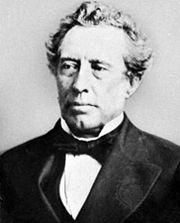
Theophilus Shepstone

Encyclopedia
Statesman
A statesman is usually a politician or other notable public figure who has had a long and respected career in politics or government at the national and international level. As a term of respect, it is usually left to supporters or commentators to use the term...
who was responsible for the annexation of the Transvaal to Britain in 1877.
Early life
Theophilus Shepstone was born at Westbury-on-Trym near BristolBristol
Bristol is a city, unitary authority area and ceremonial county in South West England, with an estimated population of 433,100 for the unitary authority in 2009, and a surrounding Larger Urban Zone with an estimated 1,070,000 residents in 2007...
, England. When he was three years old his father, the Rev. William Theophilus, emigrated to Cape Colony
Cape Colony
The Cape Colony, part of modern South Africa, was established by the Dutch East India Company in 1652, with the founding of Cape Town. It was subsequently occupied by the British in 1795 when the Netherlands were occupied by revolutionary France, so that the French revolutionaries could not take...
. Young Shepstone was educated at the native mission stations at which his father worked, and the lad acquired great proficiency in the indigenous
Indigenous peoples of Africa
The indigenous people of Africa are those people of Africa whose way of life, attachment or claims to particular lands, and social and political standing in relation to other more dominant groups have resulted in their substantial marginalisation within modern African states The indigenous people...
languages of South Africa, a circumstance which determined his career. In the Xhosa War
Xhosa wars
The Xhosa Wars, also known as the Cape Frontier Wars, were a series of nine wars between the Xhosa people and European settlers, from 1779 to 1879 in what is now the Eastern Cape in South Africa....
of 1835 he served as headquarters interpreter on the staff of the governor, Sir Benjamin d'Urban
Benjamin d'Urban
Lieutenant-General Sir Benjamin d'Urban, GCB, KCH, KCTS was a British general and colonial administrator, who is best known for his frontier policy when he was the Governor in the Cape Colony .-Early career:...
, and at the end of the campaign remained on the frontier as clerk to the agent for the native tribes.
Natal
In 1838 he was one of the party sent from Cape Colony to occupy Port Natal on behalf of Britain. This force was recalled in 1839, when Shepstone was appointed British resident among the Fingo and other tribes in KaffrariaKaffraria
Kaffraria was the descriptive name given to the southeast part of what is today the Eastern Cape of South Africa. Kaffraria, i.e. the land of the Kaffirs, is no longer an official designation...
. Here he remained until the definite establishment of British rule in Natal and its organization as an administrative entity, when Shepstone was made (1845) agent for the native tribes. In 1848 he became captain-general of the native levies; in 1855 judicial assessor in native causes; and, in 1856, on the remodelling of the Natal government, secretary for native affairs and a member of the executive and legislative councils. This position he held until 1877.
Thus for over thirty years he was the director of native policy in Natal. A man of strong will and pronounced views he gained a great influence over the indigenous people, by whom he was called "father," and ironically named "Somtseu" (a famed black hunter) by the Zulus when he fled before an elephant. The main line of his policy was to maintain tribal customs as far as consistent with principles of humanity, and not to attempt to force civilization. The result of his policy is still traceable In the condition and status of the Natal peoples. While he remained in charge there was but one serious revolt--that of Langalibalele
Langalibalele
Langalibalele , also known as Mtetwa, was king of the amaHlubi, a bantu tribe in what is the modern-day province of KwaZulu-Natal, South Africa. He was born on the eve of the arrival of European settlers in the province. During the diamond rush, many of his young men worked on the mines in...
in 1873 against a demand that guns be registered.
Shepstone's influence with the Zulus was made use of by the Natal government; in 1861 he visited Zululand and obtained from Mpande
Mpande
Mpande , uMsimude owavela ngesiluba phakathi kwamaNgisi namaQadasi, as he was praised, was king of the Zulu nation from 1840 to 1872, making him the longest reigning Zulu king. He was a half-brother of Shaka and Dingane, who both preceded him as kings of the Zulu...
a public recognition of Cetshwayo
Cetshwayo
Cetshwayo kaMpande was the King of the Zulu Kingdom from 1872 to 1879 and their leader during the Anglo-Zulu War . His name has been transliterated as Cetawayo, Cetewayo, Cetywajo and Ketchwayo.- Early life :...
as his successor. Twelve years later Shepstone attended the proclamation of Cetshwayo as king, the Zulu chief promising Shepstone to live at peace with his neighbors. In 1874 and again in 1876 Shepstone travelled to London on South African affairs.
Transvaal
When in London in 1876 Shepstone was entrusted by the 4th earl of Carnarvon, then secretary of state for the colonies, with a special commission to confer with the Transvaal executive on the question of the federation of the South African states, and given power, should he deem it necessary, to annex the country, subject to the confirmation of the British government.Shepstone went to Pretoria
Pretoria
Pretoria is a city located in the northern part of Gauteng Province, South Africa. It is one of the country's three capital cities, serving as the executive and de facto national capital; the others are Cape Town, the legislative capital, and Bloemfontein, the judicial capital.Pretoria is...
in January 1877, and on 12 April issued a proclamation announcing the establishment of British authority over the Transvaal. Shepstone's force consisted of twenty-five mounted policemen only, but no overt opposition was made to the annexation; the republic at the time was in a condition bordering on anarchy. "Nothing but annexation," wrote Sir Theophilus to the Colonial Office, "will or can save the state, and nothing else can save South Africa from the direst consequences. All the thinking and intelligent people know this, and will be thankful to be delivered from the thraldom of petty factions by which they are perpetually kept in a state of excitement and unrest because the government and everything connected with it is a thorough sham" (Martineau's Life of Sir Bartle Frere, ch. 18). Shepstone's action has been condemned as premature. He had, however, reason to believe that if Britain remained inactive, Germany would be induced to undertake the protection of the Transvaal.
Moreover, had the policy of self-government for the Boers which he outlined in his annexation proclamation been carried out, the revolt of 1880-81 might not have occurred. Shepstone remained in Pretoria as administrator of the Transvaal until January 1879; his rule was marked, according to Sir Bartle Frere, who described him as "a singular type of an Africander Talleyrand," by an "apparent absence of all effort to devise or substitute a better system" than that which had characterized the previous regime. Shepstone had been summoned home to advise the Colonial Office on South African affairs and he reached England in May 1879; on his return to Natal he retired (1880) from the public service. In 1883, however, he was commissioned to replace Cetshwayo as king in Zululand. He was active in church matters in Natal, and was, prior to the Langalibalele "rebellion", a close friend of Bishop Colenso
John William Colenso
John William Colenso , first Anglican bishop of Natal, mathematician, theologian, Biblical scholar and social activist.-Biography:Colenso was born at St Austell, Cornwall, on 24 January 1814...
. The two men, though, became estranged following Colenso's gradual realisation that Shepstone exerted a malign influence on Zulu affairs. Shepstone opposed the grant of self-government to Natal. He died at Pietermaritzburg
Pietermaritzburg
Pietermaritzburg is the capital and second largest city in the province of KwaZulu-Natal, South Africa. It was founded in 1838, and is currently governed by the Msunduzi Local Municipality. Its "purist" Zulu name is umGungundlovu, and this is the name used for the district municipality...
on the 23rd of June 1893.
Although Shepstone's life and work have at times been celebrated by Britons and South Africans, experts on the period such as South African historian Jeff Guy implicate him in building a conspiracy to promote the invasion of the Zulu kingdom and its dismemberment by forces from Natal and the Transvaal. His motive seems to have been both to fill the increasing demand for labor in Natal colony and to win back the friendship of the Transvaal government.
Family
Shepstone married in 1833 Maria, daughter of Charles Palmer, commissary-general at Cape TownCape Town
Cape Town is the second-most populous city in South Africa, and the provincial capital and primate city of the Western Cape. As the seat of the National Parliament, it is also the legislative capital of the country. It forms part of the City of Cape Town metropolitan municipality...
, and had six sons and three daughters. One of his sons was killed at Isandhlwana; of the other sons HC Shepstone (b. 1840) was secretary for native affairs in Natal from 1884 to 1893; Theophilus was adviser to the Swazis (1887-1891); and AJ Shepstone (b. 1852) served in various native expeditions, as assistant-commissioner in Zululand, in the South African War, 1899-1902, and became in 1909 secretary for native affairs (Natal) and secretary of the Natal native trust. A younger brother of Sir Theophilus, John Wesley Shepstone (b. 1827), filled between 1846 and 1896 various offices in Natal in connection with the administration of native affairs.