

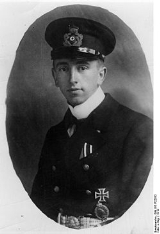
Theo Osterkamp

Encyclopedia
Theodor "Theo" Osterkamp (15 April 1892 – 2 January 1975) was a World War I
and World War II
Luftwaffe
fighter ace
. He flew in the first World War, scoring 32 victories. In World War II he led Jagdgeschwader 51
through the Battle of Britain and claimed a further 6 victories, in the process becoming one of only a few men to score victories in both World Wars.
. On 14 August 1914 he joined the Marinefliegerkorps. He then flew with the 2. Marine-Fliegerabteilung in Flanders
. During 1915–1916 he served as an air observer, and became the first German pilot to fly a land-based aircraft to England
on a reconnaissance-mission. In March 1917 he joined the Kampffliegerschule (Combat pilot school) in Putzig and then joined the Marine-Jagdstaffel 1. On 15 October 1917 Leutnant Osterkamp took command over Marine-Jagdstaffel 2. He scored a total of 32 victories during the war, and was awarded the Prussian military order Pour le Mérite
on 2 September 1918, and was the last individual to receive it.
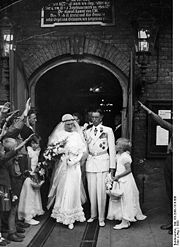 Between the two World Wars Osterkamp was involved in the formation of the new Luftwaffe, amongst other things by setting up Jagdfliegerschule 1
. He also participated in the second, third and fourth FAI
International Tourist Plane Contest Challenge 1930
(11th place), Challenge 1932
(12th place) and Challenge 1934
(5th place).
Osterkamp was appointed Geschwaderkommodore
of Jagdgeschwader 51
(JG 51). During the Battle of France
he claimed four victories, the first on 12 May 1940. During the Kanalkampf period of the Battle of Britain
he claimed a further two victories, bringing his total to six. He was replaced as commander of JG 51 by Werner Mölders
on 23 July. Promoted to Generalmajor, Osterkamp was awarded his Ritterkreuz
on 22 August 1940. Following his replacement from JG 51, Osterkamp was appointed Jagdfliegerführer 2
, the commander of fighter aircraft in Luftflotte 2
.
On 1 August 1942 he was transferred to Luftgaustab z.b.V. Afrika. On 5 April 1943 he was appointed Jagdfliegerführer Sizilien
and served until replaced on 15 July by Adolf Galland
. He then served in a number of Staff positions until being appointed Inspekteur der Luftwaffen-Bodenorganisation (Inspector of Luftwaffe ground organisation) in 1944. After criticism from High Command
he was dismissed from the service on 21 December 1944.
World War I
World War I , which was predominantly called the World War or the Great War from its occurrence until 1939, and the First World War or World War I thereafter, was a major war centred in Europe that began on 28 July 1914 and lasted until 11 November 1918...
and World War II
World War II
World War II, or the Second World War , was a global conflict lasting from 1939 to 1945, involving most of the world's nations—including all of the great powers—eventually forming two opposing military alliances: the Allies and the Axis...
Luftwaffe
Luftwaffe
Luftwaffe is a generic German term for an air force. It is also the official name for two of the four historic German air forces, the Wehrmacht air arm founded in 1935 and disbanded in 1946; and the current Bundeswehr air arm founded in 1956....
fighter ace
Fighter Ace
Fighter Ace was a massively multiplayer online computer game in which one flies World War II fighter and bomber planes in combat against other players and virtual pilots...
. He flew in the first World War, scoring 32 victories. In World War II he led Jagdgeschwader 51
Jagdgeschwader 51
Jagdgeschwader 51 Mölders was a Luftwaffe fighter wing during World War II, named after the fighter ace Werner Mölders in 1942. JG 51's pilots won more Ritterkreuz des Eisernen Kreuzes than any other Jagdgeschwader, and flew combat from 1939 in all major theatres of war. Flying Bf 109s and then...
through the Battle of Britain and claimed a further 6 victories, in the process becoming one of only a few men to score victories in both World Wars.
World War I
Osterkamp flew as a naval pilot operating over the Western FrontWestern Front (World War I)
Following the outbreak of World War I in 1914, the German Army opened the Western Front by first invading Luxembourg and Belgium, then gaining military control of important industrial regions in France. The tide of the advance was dramatically turned with the Battle of the Marne...
. On 14 August 1914 he joined the Marinefliegerkorps. He then flew with the 2. Marine-Fliegerabteilung in Flanders
Flanders
Flanders is the community of the Flemings but also one of the institutions in Belgium, and a geographical region located in parts of present-day Belgium, France and the Netherlands. "Flanders" can also refer to the northern part of Belgium that contains Brussels, Bruges, Ghent and Antwerp...
. During 1915–1916 he served as an air observer, and became the first German pilot to fly a land-based aircraft to England
England
England is a country that is part of the United Kingdom. It shares land borders with Scotland to the north and Wales to the west; the Irish Sea is to the north west, the Celtic Sea to the south west, with the North Sea to the east and the English Channel to the south separating it from continental...
on a reconnaissance-mission. In March 1917 he joined the Kampffliegerschule (Combat pilot school) in Putzig and then joined the Marine-Jagdstaffel 1. On 15 October 1917 Leutnant Osterkamp took command over Marine-Jagdstaffel 2. He scored a total of 32 victories during the war, and was awarded the Prussian military order Pour le Mérite
Pour le Mérite
The Pour le Mérite, known informally as the Blue Max , was the Kingdom of Prussia's highest military order for German soldiers until the end of World War I....
on 2 September 1918, and was the last individual to receive it.
Interwar years
Jagdfliegerschule
The German Luftwaffe of the Wehrmacht had seven Jagdfliegerschulen or Fighter Pilot Schools.- Jagdfliegerschule Werneuchen or Jagdfliegerschule 1 :...
. He also participated in the second, third and fourth FAI
Fédération Aéronautique Internationale
The Fédération Aéronautique Internationale is the world governing body for air sports and aeronautics and astronautics world records. Its head office is in Lausanne, Switzerland. This includes man-carrying aerospace vehicles from balloons to spacecraft, and unmanned aerial vehicles...
International Tourist Plane Contest Challenge 1930
Challenge 1930
The International Touring Competition in 1930 was the second FAI international touring aircraft contest, that took place between July 18 and August 8, 1930 in Berlin, Germany. Four Challenges, from 1929 to 1934, were major aviation events in pre-war Europe....
(11th place), Challenge 1932
Challenge 1932
The Challenge 1932 was the third FAI International Tourist Plane Contest , that took place between 12 and August 28, 1932 in Berlin, Germany. The four Challenges, from 1929 to 1934, were major aviation events in pre-war Europe.-Overview:...
(12th place) and Challenge 1934
Challenge 1934
The Challenge 1934 was the fourth and last FAI International Tourist Plane Contest , that took place between August 28 and September 16, 1934 in Warsaw, Poland. The four Challenges, from 1929 to 1934, were major aviation events in pre-war Europe...
(5th place).
World War II
On 19 September 1939 OberstOberst
Oberst is a military rank in several German-speaking and Scandinavian countries, equivalent to Colonel. It is currently used by both the ground and air forces of Austria, Germany, Switzerland, Denmark and Norway. The Swedish rank överste is a direct translation, as are the Finnish rank eversti...
Osterkamp was appointed Geschwaderkommodore
Geschwaderkommodore
Geschwaderkommodore is a Luftwaffe position , originating during World War II, that is the equivalent of a RAF Group Commander or USAF Wing Commander. A Geschwaderkommodore is usually of Oberstleutnant or Oberst rank...
of Jagdgeschwader 51
Jagdgeschwader 51
Jagdgeschwader 51 Mölders was a Luftwaffe fighter wing during World War II, named after the fighter ace Werner Mölders in 1942. JG 51's pilots won more Ritterkreuz des Eisernen Kreuzes than any other Jagdgeschwader, and flew combat from 1939 in all major theatres of war. Flying Bf 109s and then...
(JG 51). During the Battle of France
Battle of France
In the Second World War, the Battle of France was the German invasion of France and the Low Countries, beginning on 10 May 1940, which ended the Phoney War. The battle consisted of two main operations. In the first, Fall Gelb , German armoured units pushed through the Ardennes, to cut off and...
he claimed four victories, the first on 12 May 1940. During the Kanalkampf period of the Battle of Britain
Battle of Britain
The Battle of Britain is the name given to the World War II air campaign waged by the German Air Force against the United Kingdom during the summer and autumn of 1940...
he claimed a further two victories, bringing his total to six. He was replaced as commander of JG 51 by Werner Mölders
Werner Mölders
Werner Mölders was a World War II German Luftwaffe pilot and the leading German fighter ace in the Spanish Civil War. Mölders became the first pilot in aviation history to claim 100 aerial victories—that is, 100 aerial combat encounters resulting in the destruction of the enemy aircraft, and was...
on 23 July. Promoted to Generalmajor, Osterkamp was awarded his Ritterkreuz
Knight's Cross of the Iron Cross
The Knight's Cross of the Iron Cross was a grade of the 1939 version of the 1813 created Iron Cross . The Knight's Cross of the Iron Cross was the highest award of Germany to recognize extreme battlefield bravery or successful military leadership during World War II...
on 22 August 1940. Following his replacement from JG 51, Osterkamp was appointed Jagdfliegerführer 2
Jagdfliegerführer 2
Jagdfliegerführer 2 was part of Luftflotte 2 , one of the primary divisions of the German Luftwaffe in World War II. It was formed December 21, 1939 in Dortmund. On September 6, 1943 the unit redesignated Jagdfliegerführer 4 and reformed again in September 1943 from Stab/Jagdfliegerführer Deutsche...
, the commander of fighter aircraft in Luftflotte 2
Luftflotte 2
Luftflotte 2 was one of the primary divisions of the German Luftwaffe in World War II. It was formed February 1, 1939 in Braunschweig and transferred to Italy on November 15, 1941...
.
On 1 August 1942 he was transferred to Luftgaustab z.b.V. Afrika. On 5 April 1943 he was appointed Jagdfliegerführer Sizilien
Jagdfliegerführer Sizilien
Jagdfliegerführer Sizilien was part of Luftflotte 2 , one of the primary divisions of the German Luftwaffe in World War II. It was formed on April 5, 1943 in Trapani, subordinated to the II. Fliegerkorps. The command moved to Rome in July 1943, and was then known as Jagdfliegerführer Luftflotte 2....
and served until replaced on 15 July by Adolf Galland
Adolf Galland
Adolf "Dolfo" Joseph Ferdinand Galland was a German Luftwaffe General and flying ace who served throughout World War II in Europe. He flew 705 combat missions, and fought on the Western and the Defence of the Reich fronts...
. He then served in a number of Staff positions until being appointed Inspekteur der Luftwaffen-Bodenorganisation (Inspector of Luftwaffe ground organisation) in 1944. After criticism from High Command
Oberkommando der Luftwaffe
The Oberkommando der Luftwaffe was the air force High Command of the Third Reich.Air Force Commanders-in-Chief* Reich Marshal Hermann Göring * Field Marshal Robert Ritter von Greim -History:...
he was dismissed from the service on 21 December 1944.
Awards and decorations
- Abzeichen für Marine-FlugzeugführerAviator BadgeAn Aviator Badge is an insignia used in most of the world’s militaries to designate those who have received training and qualification in military aviation...
- Iron CrossIron CrossThe Iron Cross is a cross symbol typically in black with a white or silver outline that originated after 1219 when the Kingdom of Jerusalem granted the Teutonic Order the right to combine the Teutonic Black Cross placed above a silver Cross of Jerusalem....
(1914)- 2nd Class
- 1st Class
- Knight's Cross of the Royal House Order of Hohenzollern with SwordsHouse Order of HohenzollernThe House Order of Hohenzollern was an order of chivalry of the House of Hohenzollern. It was both a military and a civil award...
- Baltic Cross
- 2nd Class
- Pour le MéritePour le MériteThe Pour le Mérite, known informally as the Blue Max , was the Kingdom of Prussia's highest military order for German soldiers until the end of World War I....
(2 September 1918) - Cross of HonorCross of HonorThe Cross of Honor, also known as the Honor Cross or, popularly, the Hindenburg Cross, was a commemorative medal inaugurated on July 13, 1934 by Reichspräsident Paul von Hindenburg for those soldiers of Imperial Germany who fought in World War I...
- Flugzeugführer- und Beobachter-AbzeichenCombined Pilots-Observation BadgeCombined Pilots-Observation Badge was a German military award instituted on 26 March 1936 by the Commander in Chief of the Luftwaffe Hermann Göring to commemorate soldiers or servicemen who had already been awarded the Pilot's badge or Observer badge...
- Iron CrossIron CrossThe Iron Cross is a cross symbol typically in black with a white or silver outline that originated after 1219 when the Kingdom of Jerusalem granted the Teutonic Order the right to combine the Teutonic Black Cross placed above a silver Cross of Jerusalem....
(1939)- 2nd Class
- 1st Class
- Knight's Cross of the Iron CrossKnight's Cross of the Iron CrossThe Knight's Cross of the Iron Cross was a grade of the 1939 version of the 1813 created Iron Cross . The Knight's Cross of the Iron Cross was the highest award of Germany to recognize extreme battlefield bravery or successful military leadership during World War II...
- Knight's Cross on 22 August 1940 as Generalmajor and Jagdfliegerführer of Luftflotte 2
- Ärmelband AfrikaCuff titleA cuff title is a form of insignia placed on the sleeve, near the cuff of German military and paramilitary uniforms, most commonly seen in the Second World War but also seen postwar....