

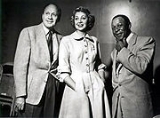
The Jack Benny Program

Encyclopedia
The Jack Benny Program, starring Jack Benny
, is a radio-TV comedy series that ran for more than three decades and is generally regarded as a high-water mark in 20th-century American comedy.
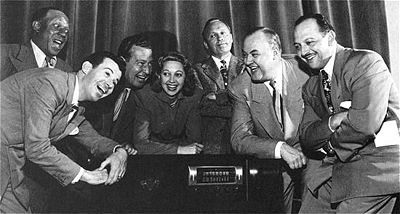
Earlier cast members include:
in 1932. He was then given his own show later that year, with Canada Dry Ginger Ale as a sponsor —The Canada Dry Program, beginning May 2, 1932, on the NBC Blue Network
and continuing there for six months until October 26, moving the show to CBS
on October 30. With Ted Weems leading the band, Benny stayed on CBS until January 26, 1933.
Arriving at NBC
on March 17, Benny did The Chevrolet Program until April 1, 1934. He continued with The General Tire Revue for the rest of that season, and in the fall of 1934, for General Foods
as The Jell-O Program Starring Jack Benny (1934–42) and, when sales of Jell-O
were affected by sugar rationing during World War II
, The Grape Nuts Flakes Program Starring Jack Benny (Later the Grape Nuts and Grape Nuts Flakes Program) (1942–44). On October 1, 1944, the show became The Lucky Strike Program Starring Jack Benny, when American Tobacco's Lucky Strike
cigarettes took over as his radio sponsor, through the mid-1950s. By that time, the practice of using the sponsor's name as the title began to fade.
The show returned to CBS on January 2, 1949, as part of CBS president William S. Paley
's notorious "raid" of NBC talent in 1948-49. There it stayed for the remainder of its radio run, which ended on May 22, 1955. CBS aired repeats of previous 1953-55 radio episodes from 1956 to 1958 as The Best of Benny for State Farm Insurance
, who later sponsored his television program from 1960 through 1965.
from October 28, 1950, to September 15, 1964, and on NBC
from September 25, 1964, to September 10, 1965. 343 episodes were produced. His TV sponsors included American Tobacco's Lucky Strike
(1950–59), Lever Brothers
' Lux
(1959–60), State Farm Insurance
(1960–65), Lipton
Tea (1960–62), General Foods
' Jell-O
(1962–64), and Miles Laboratories
(1964–65).
The television show was a seamless continuation of Benny's radio program, employing many of the same players, the same approach to situation comedy and some of the same scripts. The suffix "Program" instead of "Show" was also a carryover from radio, where "program" rather than "show" was used frequently for presentations in the non-visual medium. Occasionally, in several live episodes, the title card read, "The Jack Benny Show". During one live episode, both titles were used.
The Jack Benny Program appeared infrequently during its first two years on CBS TV. Benny moved into television slowly: in his first season (1950–1951), he only performed on four shows, but by the 1951-1952 season, he was ready to do one show approximately every six weeks. In the third season (1952–1953), the show was broadcast every four weeks. During the 1953-1954 season, The Jack Benny Program aired every three weeks. From 1954-1960, the program aired every other week, rotating with such shows as Private Secretary
and Bachelor Father. Beginning in the 1960-1961 season, The Jack Benny Program began airing every week. It is also worth noting that the show moved from CBS to NBC prior to the 1964-65 season. During the 1953-54 season, a handful of episodes were filmed during the summer and the others were live, a schedule which allowed Benny to continue doing his radio show. In the 1953-1954 season, Dennis Day had his own short-lived comedy and variety show on NBC, The Dennis Day Show
.
In his unpublished autobiography, I Always Had Shoes (portions of which were later incorporated by Jack's daughter, Joan, into her memoir of her parents, Sunday Nights at Seven), Benny said that he, not NBC, made the decision to end his TV series in 1965. He said that while the ratings were still very good (he cited a figure of some 18,000,000 viewers per week, although he qualified that figure by saying he never believed the ratings services were doing anything more than guessing, no matter what they promised), advertisers [the alternate sponsors during his final season in 1964-65 were State Farm Insurance
and Miles Laboratories
(Alka-Seltzer
, One-a-Day) were complaining that commercial time on his show was costing nearly twice as much as what they paid for most other shows, and he had grown tired of what was called the "rat race." Thus, after some three decades on radio and television in a weekly program, Jack Benny went out on top.
In Jim Bishop
's book A Day in the Life of President Kennedy, John F. Kennedy
said that he was too busy to watch most television but that he made the time to watch The Jack Benny Program each week.
Four classic episodes of the show ran on CBS during the summer of 1991. Reruns also appear on PBS
stations.
The series has yet to receive an "official" DVD release, however public domain episodes have been available on budget DVDs (and VHS) for years. In 2008 25 public domain episodes of the show that were thought to be lost were located in the CBS vault. To date, CBS has refused to digitally preserve or release the shows, despite the support of Jack Benny's estate and a funding offer by the Jack Benny Fan Club.
, per se. The show would usually open with a song by the orchestra or banter between Benny and Don Wilson. There would then be banter between Benny and the regulars about the news of the day or about one of running jokes on the program, such as Benny's age, Day's stupidity or Mary's letters from her mother. There would then be a song by the tenor followed by situation comedy involving an event of the week, a mini-play, or a satire of a current movie.
by some, his attitudes were unusually sardonic for such a role, and Benny treats him as an equal, not as a servant. In many routines, Rochester gets the better of Benny, often pricking his boss' ego, or simply outwitting him. The show's portrayal of black characters could be seen as advanced for its time; in a 1956 episode, African-American actor Roy Glenn
plays a friend of Rochester, and he is portrayed as a well-educated, articulate man not as the typical "darkie stereotype" seen in many films of the time. Glenn's role was a recurring one on the series, where he was often portrayed as having to support two people on one unemployment check (i.e., himself and Rochester).
Jack Benny
Jack Benny was an American comedian, vaudevillian, and actor for radio, television, and film...
, is a radio-TV comedy series that ran for more than three decades and is generally regarded as a high-water mark in 20th-century American comedy.
Cast
- Jack BennyJack BennyJack Benny was an American comedian, vaudevillian, and actor for radio, television, and film...
- Himself - Eddie AndersonEddie Anderson (comedian)Edmund Lincoln Anderson , also known as Eddie "Rochester" Anderson, was an American comedian and actor. His most famous role was that of Rochester van Jones, valet of Jack Benny, on his radio and television shows.-Early life:Anderson was born in Oakland, California...
- Rochester Van Jones, Jack's valet and chauffeur. Early in the show's run, he often talked of gambling or going out with women. Later on, he generally complained about his lack of salary. - Don WilsonDon Wilson (announcer)Don Wilson was an American announcer and occasional actor in radio and television, with a Falstaffian vocal presence, remembered best as the rotund announcer and comic foil to the star of The Jack Benny Program.-Career:...
- Himself. Don generally opened the show and also did the commercial. He was the target of Jack's jokes, mostly about his weight. - Dennis DayDennis DayDennis Day born Owen Patrick Eugene McNulty, was an Irish-American singer and radio, television and film personality.-Early life:...
- Himself. Dennis was always in his early 20s no matter how old he actually was. He was sweet but not very bright. When called upon, he could use a wide variety of accents, which was especially useful in plays. He usually sang a song about 10 minutes into the program. If the episode was a flashback to a previous time, a ruse would be used such as Dennis singing his song for Jack so he could hear it before the show. - Mary LivingstoneMary LivingstoneMary Livingstone , was an American radio comedienne and the wife and radio partner of comedy great Jack Benny . Enlisted almost entirely by accident to perform on her husband's popular program, she proved a talented comedienne...
- Herself. Although in real life she was Jack Benny's wife, on air (TV or Radio) she only played a friend to Jack. Sometimes she was presented as a date, sometimes as a love interest and sometimes she was just there. Her role changed from plot to plot and she was never a steady girlfriend for Jack. - Phil HarrisPhil HarrisHarris and Faye married in 1941; it was a second marriage for both and lasted 54 years, until Harris's death. Harris engaged in a fistfight at the Trocadero nightclub in 1938 with RKO studio mogul Bob Stevens; the cause was reported to be over Faye after Stevens and Faye had ended a romantic...
- A skirt-chasing, arrogant, hip-talking bandleader who constantly put Jack down (in a mostly friendly way, of course). He referred to Mary as "Livvy" or "Liv", and Jack as "Jackson". An on-air joke explains this by saying, "It's as close to 'jackass' as I can get without being fired or getting into trouble with a censor." Spun-off into The Phil Harris-Alice Faye Show with his wife, actress Alice FayeAlice FayeAlice Faye was an American actress and singer, called by The New York Times "one of the few movie stars to walk away from stardom at the peak of her career." She is remembered first for her stardom at 20th Century Fox and, later, as the radio comedy partner of her husband, bandleader and comedian...
. Harris left the radio show in 1952 and his character did not make the transition to television. - Mel BlancMel BlancMelvin Jerome "Mel" Blanc was an American voice actor and comedian. Although he began his nearly six-decade-long career performing in radio commercials, Blanc is best remembered for his work with Warner Bros...
- Carmichael the Polar Bear, Professor Pierre LeBlanc, Sy the Mexican, Polly (Jack's parrot), The Maxwell and many other assorted voices. An occasional running gag went along the lines of how the various characters Mel portrayed all looked alike. He was also the sound effects of Jack's barely functional Maxwell automobileMaxwell automobileThe Maxwell was a brand of automobiles manufactured in the United States of America from about 1904 to 1925. The present-day successor to the Maxwell company is Chrysler Group.-History:...
—a role he played again in the cartoon The Mouse that Jack BuiltThe Mouse that Jack BuiltThe Mouse that Jack Built is a Merrie Melodies cartoon short, directed by Robert McKimson and released by Warner Brothers studios in 1959.-Production:The cartoon was released on April 4, 1959...
. Another participating voice actor was Bert GordonBert GordonBert Gordon was an American comedian and voice actor. His birth name was Barney Gorodetsky. He appeared in many roles over his lengthy career and was known by the moniker "the Mad Russian"....
. - Frank Nelson - The "Yeeee-essss?" man. He was constantly the person who waits on Jack wherever he was, from the railroad station, to the clerk in the store, to the doorman, to the waiter. Frank always delighted in aggravating Jack, as apparently, he was constantly aggravated by Jack's presence.
- Sheldon LeonardSheldon LeonardSheldon Leonard was a pioneering American film and television producer, director, writer, and actor.-Biography:...
- A racetrack toutToutIn British English, a tout is any person who solicits business or employment in a persistent and annoying manner...
(originated by Benny RubinBenny RubinBenny Rubin was an American comedian and film actor. Born in Boston, Massachusetts, Rubin made more than 200 radio, film and television appearances over a span of 50 years.-Radio and television:...
) who frequently offered unsolicited advice to Benny on a variety of non-racing-related subjects. Ironically, he never gave out information on horse racing, unless Jack demanded it. One excuse the tout gave was "Who knows about horses?" His catchphrase was "Hey, bud... c'mere a minute." He also participated with Benny in producing the longest laugh (that's the claim, anyway) in radio history. Leonard was a holdup man who approached Benny demanding "your money or your life." The long laugh resulted from Benny NOT responding at all; finally, Leonard said "Well!?" Benny responded "I'm thinking it over!" - Joseph KearnsJoseph KearnsJoseph Sherrard Kearns was an American actor, who is best remembered for his role as George Wilson in the CBS television series Dennis the Menace from 1959 until his death in 1962.-Biography:...
- Ed, the superannuated security guard in Jack's money vault. Ed had allegedly been guarding Jack's vault since (variously) the founding of Los Angeles (1781), the American Civil WarAmerican Civil WarThe American Civil War was a civil war fought in the United States of America. In response to the election of Abraham Lincoln as President of the United States, 11 southern slave states declared their secession from the United States and formed the Confederate States of America ; the other 25...
, the American Revolutionary WarAmerican Revolutionary WarThe American Revolutionary War , the American War of Independence, or simply the Revolutionary War, began as a war between the Kingdom of Great Britain and thirteen British colonies in North America, and ended in a global war between several European great powers.The war was the result of the...
, or when Jack had just turned 38 years old. Burt MustinBurt MustinBurton Hill "Burt" Mustin was an American character actor.-Early life:Born in Pittsburgh, Pennsylvania to W. I. and Sadie Mustin, Mustin was a 1903 graduate of the Pennsylvania Military College , earning his degree in civil engineering...
took over the role on television following Kearns' death in 1962. {Mel Blanc played the part of Ed the Guard in the 1959 cartoon The Mouse that Jack BuiltThe Mouse that Jack BuiltThe Mouse that Jack Built is a Merrie Melodies cartoon short, directed by Robert McKimson and released by Warner Brothers studios in 1959.-Production:The cartoon was released on April 4, 1959...
who asks if the US had won World War I!} - Artie AuerbachArtie AuerbachArthur Auerbach , was an American comic actor and professional photographer who became famous as “Mr. Kitzel”, first on the Al Pearce radio show in 1937 then as a regular on the Jack Benny radio show for 12 years...
- Mr. Kitzel [who originally appeared on Al PearceAl PearceAlbert Pearce was a comedian, singer and banjoist who was a popular personality on several radio networks from 1928 to 1947....
's radio show in the late 1930s, where his famous catch phrase was, "Hmmmm... eh, could be!", and several years later as a regular on The Abbott & Costello Show], who originally started out as a Yiddish hot dog vendor selling hot dogs during the Rose BowlRose Bowl GameThe Rose Bowl is an annual American college football bowl game, usually played on January 1 at the Rose Bowl in Pasadena, California. When New Year's Day falls on a Sunday, the game is played on Monday, January 2...
. In later episodes, he would go on to lose his hot dog stand, and move on to various other jobs. A big part of his schtick involved garbling names with his accent, such as referring to Nat King ColeNat King ColeNathaniel Adams Coles , known professionally as Nat King Cole, was an American musician who first came to prominence as a leading jazz pianist. Although an accomplished pianist, he owes most of his popular musical fame to his soft baritone voice, which he used to perform in big band and jazz genres...
as "Nat King Cohen", or mentioning his favorite baseball player, "Rabbi MaranvilleRabbit MaranvilleWalter James Vincent Maranville , better known as Rabbit Maranville due to his speed and small stature , was a Major League Baseball shortstop. At the time of his retirement in 1935, he had played in a record 23 seasons in the National League, a mark which wasn't broken until 1986 by Pete Rose...
". He often complained about his wife, an unseen characterUnseen characterIn fiction, an unseen character is a character that is never directly observed by the audience but is only described by other characters. They are a common device in drama and have been called "triumphs of theatrical invention". They are continuing characters — characters who are currently in...
who was described as a large, domineering woman who, on one occasion, Kitzel visualized as "...from the front, she looks like Don Wilson from the side!" He often sang various permutations of his jingle, "Pickle in the middle and the mustard on top!" Kitzel was often heard to say, "Hoo-hoo-hoo" in response to questions asked of him. - Bob CrosbyBob CrosbyGeorge Robert "Bob" Crosby was an American dixieland bandleader and vocalist, best known for his group the Bob-Cats.-Family:...
- In 1952, Crosby replaced Phil Harris as the bandleader, remaining until Benny retired the radio show in 1955. In joining the show, he became the leader of the same group of musicians who had played under Harris. Many of his running jokes focused on the wealth and lifestyle of his older brother, Bing CrosbyBing CrosbyHarry Lillis "Bing" Crosby was an American singer and actor. Crosby's trademark bass-baritone voice made him one of the best-selling recording artists of the 20th century, with over half a billion records in circulation....
. - Benny RubinBenny RubinBenny Rubin was an American comedian and film actor. Born in Boston, Massachusetts, Rubin made more than 200 radio, film and television appearances over a span of 50 years.-Radio and television:...
- Played a variety of characters on both the radio and television versions. His most memorable bit was as an information desk attendant. Jack would ask a series of questions that Rubin would answer with an ever-increasing irritated, "I don't know!" followed by the punchline {among them: "Well, if you don't know, why are you standing behind that counter?"/"I gotta stand behind something; somebody stole my pants!"}. - Dale White - Harlow Wilson, played the son of Don & Lois Wilson on TV.
- Bea BenaderetBea BenaderetBea Benaderet was an American actress born in New York City and raised in San Francisco, California. She is best remembered for her wide variety of television work, which included a starring role in the 1960s television series Petticoat Junction and Green Acres as Shady Rest Hotel owner Kate...
and Sara Berner - "Gertrude Gearshift" and "Mabel Flapsaddle," a pair of telephone switchboardTelephone switchboardA switchboard was a device used to connect a group of telephones manually to one another or to an outside connection, within and between telephone exchanges or private branch exchanges . The user was typically known as an operator...
operators who always traded barbs with Jack (and sometimes each other) when he tried to put through a call. Whenever the scene shifted to them, they would subtly plug a current picture in an insult such as "Mr. Benny's line is flashing!" "Oh, I wonder what Dial M for MoneyDial M for MurderDial M for Murder is a 1954 American thriller film adapted from a successful stage play by Frederick Knott, directed by Alfred Hitchcock and starring Ray Milland, Grace Kelly, and Robert Cummings. The movie was released by the Warner Bros...
wants now?" or "Mr. Benny's line is flashing!" "I wonder what Schmoe VadisQuo Vadis (1951 film)Quo Vadis is a 1951 epic film made by MGM. It was directed by Mervyn LeRoy and produced by Sam Zimbalist, from a screenplay by John Lee Mahin, S. N. Behrman and Sonya Levien, adapted from Henryk Sienkiewicz's classic 1896 novel Quo Vadis. The music score was by Miklós Rózsa and the cinematography...
wants now?" - James StewartJames Stewart (actor)James Maitland Stewart was an American film and stage actor, known for his distinctive voice and his everyman persona. Over the course of his career, he starred in many films widely considered classics and was nominated for five Academy Awards, winning one in competition and receiving one Lifetime...
and his wife, Gloria - Themselves. Recurring guest stars on the television series playing Benny's often imposed upon neighbors, in roles similar to those performed on radio by Ronald and Benita Colman (see below), although re-tailored for Stewart's on-screen persona.
Earlier cast members include:
- Ronald ColmanRonald ColmanRonald Charles Colman was an English actor.-Early years:He was born in Richmond, Surrey, England, the second son and fourth child of Charles Colman and his wife Marjory Read Fraser. His siblings included Eric, Edith, and Marjorie. He was educated at boarding school in Littlehampton, where he...
and his wife, Benita - Themselves. Not actually members of the cast, they were among Benny's most popular guest stars on the radio series, portraying his long-suffering next door neighbors. On the show, the Colmans were often revolted by Jack's eccentricities and by the fact that he always borrowed odds and ends from them. Dennis Day often impersonated Ronald Colman. In real life, the Colmans lived a few blocks away from Benny's home. - Kenny BakerKenny Baker (singer/actor)Kenneth Laurence "Kenny" Baker was an American singer/actor who first gained notice as the featured singer on radio's The Jack Benny Program during the 1930s....
- The show's tenor singer who originally played the young, dopey character replaced by Dennis Day - Andy DevineAndy DevineAndrew Vabre "Andy" Devine was an American character actor and comic cowboy sidekick known for his distinctive raspy voice.-Early life:...
- Jack's friend who lived on a farm with his ma and pa. He usually told a story about his folks and life around the farm. His catchphrase was "Hiya, Buck!"
- Schlepperman (played by Sam Hearn) - A Jewish character who spoke with a Yiddish accent (his catch phrase- "Hullo, Stranger!"). He would return again as the "Hi, Rube!" guy, a hick farmer from the town of Calabasas who always insisted on referring to Jack as "rube."
- Mr. Billingsly - Played by writer and bit player Ed Beloin, Mr. Billingsly was a boarder who rented a room in Jack's home. Mr. Billingsly was a polite but very eccentric man. He appeared in the early 1940s.
- Larry Stevens - Tenor singer who substituted for Dennis Day from November 5, 1944 to March 10, 1946, when Dennis served in the Navy. He returned as a guest star and substituted for Dennis in a few episodes.
- Mary Kelly - The Blue Fairy, a clumsy, overweight fairy who appeared in several storytelling episodes. Kelly had been an old flame of Jack's, who had fallen on hard times. Benny was unsure of whether to give Kelly a regular role and instead appealed to friend George Burns who put her on his show as Mary "Bubbles" Kelly, best friend to Gracie.
- Gisele MackenzieGisele MacKenzieGisèle MacKenzie was a Canadian-American singer, most famous for her performances on the popular television program Your Hit Parade.-Biography:...
- Singer and violin player, she guest starred seven times on the program. Benny was co-executive producerExecutive producerAn executive producer is a producer who is not involved in any technical aspects of the film making or music process, but who is still responsible for the overall production...
of her NBC series The Gisele MacKenzie ShowThe Gisele MacKenzie ShowThe Gisele MacKenzie Show in an American variety show hosted by Gisele MacKenzie. The series aired live on NBC from September 28, 1957, to March 29, 1958. The Curfew Kids appeared on the program as semi-regulars....
(1957–1958). - Blanche Stewart - A variety of characters and animal sounds
Radio
Jack Benny first appeared on radio as a guest of Ed SullivanEd Sullivan
Edward Vincent "Ed" Sullivan was an American entertainment writer and television host, best known as the presenter of the TV variety show The Ed Sullivan Show. The show was broadcast from 1948 to 1971 , which made it one of the longest-running variety shows in U.S...
in 1932. He was then given his own show later that year, with Canada Dry Ginger Ale as a sponsor —The Canada Dry Program, beginning May 2, 1932, on the NBC Blue Network
Blue Network
The Blue Network, and its immediate predecessor, the NBC Blue Network, were the on-air names of an American radio production and distribution service from 1927 to 1945...
and continuing there for six months until October 26, moving the show to CBS
CBS
CBS Broadcasting Inc. is a major US commercial broadcasting television network, which started as a radio network. The name is derived from the initials of the network's former name, Columbia Broadcasting System. The network is sometimes referred to as the "Eye Network" in reference to the shape of...
on October 30. With Ted Weems leading the band, Benny stayed on CBS until January 26, 1933.
Arriving at NBC
NBC
The National Broadcasting Company is an American commercial broadcasting television network and former radio network headquartered in the GE Building in New York City's Rockefeller Center with additional major offices near Los Angeles and in Chicago...
on March 17, Benny did The Chevrolet Program until April 1, 1934. He continued with The General Tire Revue for the rest of that season, and in the fall of 1934, for General Foods
General Foods
General Foods Corporation was a company whose direct predecessor was established in the USA by Charles William Post as the Postum Cereal Company in 1895. The name General Foods was adopted in 1929, after several corporate acquisitions...
as The Jell-O Program Starring Jack Benny (1934–42) and, when sales of Jell-O
Jell-O
Jell-O is a brand name belonging to U.S.-based Kraft Foods for a number of gelatin desserts, including fruit gels, puddings and no-bake cream pies. The brand's popularity has led to it being used as a generic term for gelatin dessert across the U.S. and Canada....
were affected by sugar rationing during World War II
World War II
World War II, or the Second World War , was a global conflict lasting from 1939 to 1945, involving most of the world's nations—including all of the great powers—eventually forming two opposing military alliances: the Allies and the Axis...
, The Grape Nuts Flakes Program Starring Jack Benny (Later the Grape Nuts and Grape Nuts Flakes Program) (1942–44). On October 1, 1944, the show became The Lucky Strike Program Starring Jack Benny, when American Tobacco's Lucky Strike
Lucky Strike
Lucky Strike is a brand of cigarette owned by the R.J. Reynolds Tobacco Company and British American Tobacco groups. Often referred to as "Luckies", Lucky Strike was the top selling cigarette in the United States during the 1930s.- History :...
cigarettes took over as his radio sponsor, through the mid-1950s. By that time, the practice of using the sponsor's name as the title began to fade.
The show returned to CBS on January 2, 1949, as part of CBS president William S. Paley
William S. Paley
William S. Paley was the chief executive who built Columbia Broadcasting System from a small radio network into one of the foremost radio and television network operations in the United States.-Early life:...
's notorious "raid" of NBC talent in 1948-49. There it stayed for the remainder of its radio run, which ended on May 22, 1955. CBS aired repeats of previous 1953-55 radio episodes from 1956 to 1958 as The Best of Benny for State Farm Insurance
State Farm Insurance
State Farm Insurance is a group of insurance and financial services companies in the United States. The company also has operations in Canada....
, who later sponsored his television program from 1960 through 1965.
Television
Jack Benny made his TV debut in the 1949 season. There is a kinescope of his later November 1949 TV appearance on the intermittent Jack Benny Program special appearances of the time. Benny ran shorter runs in his early seasons on TV into the early 1950's, as he was still firmly dedicated to radio. The regular and continuing Jack Benny Program was telecast on CBSCBS
CBS Broadcasting Inc. is a major US commercial broadcasting television network, which started as a radio network. The name is derived from the initials of the network's former name, Columbia Broadcasting System. The network is sometimes referred to as the "Eye Network" in reference to the shape of...
from October 28, 1950, to September 15, 1964, and on NBC
NBC
The National Broadcasting Company is an American commercial broadcasting television network and former radio network headquartered in the GE Building in New York City's Rockefeller Center with additional major offices near Los Angeles and in Chicago...
from September 25, 1964, to September 10, 1965. 343 episodes were produced. His TV sponsors included American Tobacco's Lucky Strike
Lucky Strike
Lucky Strike is a brand of cigarette owned by the R.J. Reynolds Tobacco Company and British American Tobacco groups. Often referred to as "Luckies", Lucky Strike was the top selling cigarette in the United States during the 1930s.- History :...
(1950–59), Lever Brothers
Lever Brothers
Lever Brothers was a British manufacturer founded in 1885 by William Hesketh Lever and his brother, James Darcy Lever . The brothers had invested in and promoted a new soap making process invented by chemist William Hough Watson, it was a huge success...
' Lux
Lux
The lux is the SI unit of illuminance and luminous emittance, measuring luminous flux per unit area. It is used in photometry as a measure of the intensity, as perceived by the human eye, of light that hits or passes through a surface...
(1959–60), State Farm Insurance
State Farm Insurance
State Farm Insurance is a group of insurance and financial services companies in the United States. The company also has operations in Canada....
(1960–65), Lipton
Lipton
Lipton is a brand of tea currently owned by Unilever.-History of Lipton Tea:Lipton was created at the end of the 19th century by a grocer, Sir Thomas Lipton, in Glasgow, Scotland. In 1893, he established the Thomas J. Lipton Co., a tea packing company with its headquarters and factory in Hobo ken,...
Tea (1960–62), General Foods
General Foods
General Foods Corporation was a company whose direct predecessor was established in the USA by Charles William Post as the Postum Cereal Company in 1895. The name General Foods was adopted in 1929, after several corporate acquisitions...
' Jell-O
Jell-O
Jell-O is a brand name belonging to U.S.-based Kraft Foods for a number of gelatin desserts, including fruit gels, puddings and no-bake cream pies. The brand's popularity has led to it being used as a generic term for gelatin dessert across the U.S. and Canada....
(1962–64), and Miles Laboratories
Miles Laboratories
Miles Laboratories was founded as the Dr. Miles Medical Company in Elkhart, Indiana, in 1884 by Franklin Miles, a specialist in the treatment of eye and ear disorders, with an interest in the connection of the nervous system to overall health...
(1964–65).
The television show was a seamless continuation of Benny's radio program, employing many of the same players, the same approach to situation comedy and some of the same scripts. The suffix "Program" instead of "Show" was also a carryover from radio, where "program" rather than "show" was used frequently for presentations in the non-visual medium. Occasionally, in several live episodes, the title card read, "The Jack Benny Show". During one live episode, both titles were used.
The Jack Benny Program appeared infrequently during its first two years on CBS TV. Benny moved into television slowly: in his first season (1950–1951), he only performed on four shows, but by the 1951-1952 season, he was ready to do one show approximately every six weeks. In the third season (1952–1953), the show was broadcast every four weeks. During the 1953-1954 season, The Jack Benny Program aired every three weeks. From 1954-1960, the program aired every other week, rotating with such shows as Private Secretary
Private Secretary
In the United Kingdom government, a Private Secretary is a civil servant in a Department or Ministry, responsible to the Secretary of State or Minister...
and Bachelor Father. Beginning in the 1960-1961 season, The Jack Benny Program began airing every week. It is also worth noting that the show moved from CBS to NBC prior to the 1964-65 season. During the 1953-54 season, a handful of episodes were filmed during the summer and the others were live, a schedule which allowed Benny to continue doing his radio show. In the 1953-1954 season, Dennis Day had his own short-lived comedy and variety show on NBC, The Dennis Day Show
The Dennis Day Show
The Dennis Day Show was a half-hour 1953–1954 NBC comedy/variety show starring Irish singer and radio and television personality Dennis Day , whose career otherwise was rooted as a supporting cast member of the long-running The Jack Benny Program on CBS and later NBC.From 1952 to 1953, Day hosted...
.
In his unpublished autobiography, I Always Had Shoes (portions of which were later incorporated by Jack's daughter, Joan, into her memoir of her parents, Sunday Nights at Seven), Benny said that he, not NBC, made the decision to end his TV series in 1965. He said that while the ratings were still very good (he cited a figure of some 18,000,000 viewers per week, although he qualified that figure by saying he never believed the ratings services were doing anything more than guessing, no matter what they promised), advertisers [the alternate sponsors during his final season in 1964-65 were State Farm Insurance
State Farm Insurance
State Farm Insurance is a group of insurance and financial services companies in the United States. The company also has operations in Canada....
and Miles Laboratories
Miles Laboratories
Miles Laboratories was founded as the Dr. Miles Medical Company in Elkhart, Indiana, in 1884 by Franklin Miles, a specialist in the treatment of eye and ear disorders, with an interest in the connection of the nervous system to overall health...
(Alka-Seltzer
Alka-Seltzer
Alka-Seltzer is an effervescent antacid and pain reliever first marketed by the Dr. Miles Medicine Company. It was developed by Treneer in Elkhart Indiana. Alka-Seltzer is marketed for relief of minor aches, pains, inflammation, fever, headache, heartburn, sour stomach, indigestion, and hangovers,...
, One-a-Day) were complaining that commercial time on his show was costing nearly twice as much as what they paid for most other shows, and he had grown tired of what was called the "rat race." Thus, after some three decades on radio and television in a weekly program, Jack Benny went out on top.
In Jim Bishop
Jim Bishop
James Alonzo "Jim" Bishop was an American journalist and author.Born in Jersey City, New Jersey, he dropped out of school after eighth grade. In 1923, he studied typing, shorthand and bookkeeping, and in 1929 began work as a copy boy at the New York Daily News...
's book A Day in the Life of President Kennedy, John F. Kennedy
John F. Kennedy
John Fitzgerald "Jack" Kennedy , often referred to by his initials JFK, was the 35th President of the United States, serving from 1961 until his assassination in 1963....
said that he was too busy to watch most television but that he made the time to watch The Jack Benny Program each week.
Four classic episodes of the show ran on CBS during the summer of 1991. Reruns also appear on PBS
Public Broadcasting Service
The Public Broadcasting Service is an American non-profit public broadcasting television network with 354 member TV stations in the United States which hold collective ownership. Its headquarters is in Arlington, Virginia....
stations.
The series has yet to receive an "official" DVD release, however public domain episodes have been available on budget DVDs (and VHS) for years. In 2008 25 public domain episodes of the show that were thought to be lost were located in the CBS vault. To date, CBS has refused to digitally preserve or release the shows, despite the support of Jack Benny's estate and a funding offer by the Jack Benny Fan Club.
Format
Whether on television or radio, the format of the Jack Benny Program never wavered. The program utilized a loose show-within-a-show format, wherein the main characters were playing versions of themselves. There was not really a fourth wallFourth wall
The fourth wall is the imaginary "wall" at the front of the stage in a traditional three-walled box set in a proscenium theatre, through which the audience sees the action in the world of the play...
, per se. The show would usually open with a song by the orchestra or banter between Benny and Don Wilson. There would then be banter between Benny and the regulars about the news of the day or about one of running jokes on the program, such as Benny's age, Day's stupidity or Mary's letters from her mother. There would then be a song by the tenor followed by situation comedy involving an event of the week, a mini-play, or a satire of a current movie.
Racial attitudes
Although Eddie Anderson's Rochester may be considered a stereotypeStereotype
A stereotype is a popular belief about specific social groups or types of individuals. The concepts of "stereotype" and "prejudice" are often confused with many other different meanings...
by some, his attitudes were unusually sardonic for such a role, and Benny treats him as an equal, not as a servant. In many routines, Rochester gets the better of Benny, often pricking his boss' ego, or simply outwitting him. The show's portrayal of black characters could be seen as advanced for its time; in a 1956 episode, African-American actor Roy Glenn
Roy Glenn
-Career:Glenn's career spanned five decades, beginning in radio with shows such as Amos 'n Andy and The Jack Benny Show. He made numerous appearances on television, from its early days until 1970. His first film appearance was in 1937; his career included roles in A Raisin in the Sun , with Sidney...
plays a friend of Rochester, and he is portrayed as a well-educated, articulate man not as the typical "darkie stereotype" seen in many films of the time. Glenn's role was a recurring one on the series, where he was often portrayed as having to support two people on one unemployment check (i.e., himself and Rochester).