


Grass court

Encyclopedia
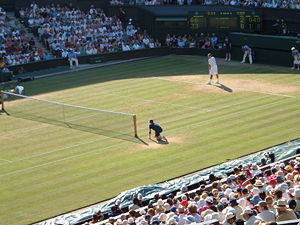
A grass court is one of the four different types of tennis
Tennis
Tennis is a sport usually played between two players or between two teams of two players each . Each player uses a racket that is strung to strike a hollow rubber ball covered with felt over a net into the opponent's court. Tennis is an Olympic sport and is played at all levels of society at all...
court
Tennis court
A tennis court is where the game of tennis is played. It is a firm rectangular surface with a low net stretched across the center. The same surface can be used to play both doubles and singles.-Dimensions:...
. Grass courts are made of rye grass in different compositions depending on the tournament. Wimbledon
The Championships, Wimbledon
The Championships, Wimbledon, or simply Wimbledon , is the oldest tennis tournament in the world, considered by many to be the most prestigious. It has been held at the All England Club in Wimbledon, London since 1877. It is one of the four Grand Slam tennis tournaments, the other three Majors...
, with 100 percent rye grass, is considered to be slower than other grass courts such as Queen's
Queen's Club
The Queen's Club is a private sporting club in West Kensington, London, England. Founded in 1886, the Queen's Club was the world's first multipurpose sports complex and named after Queen Victoria, its first patron...
in London
London
London is the capital city of :England and the :United Kingdom, the largest metropolitan area in the United Kingdom, and the largest urban zone in the European Union by most measures. Located on the River Thames, London has been a major settlement for two millennia, its history going back to its...
, and 's-Hertogenbosch in the Netherlands
Netherlands
The Netherlands is a constituent country of the Kingdom of the Netherlands, located mainly in North-West Europe and with several islands in the Caribbean. Mainland Netherlands borders the North Sea to the north and west, Belgium to the south, and Germany to the east, and shares maritime borders...
.
Although more traditional than other types of tennis courts, maintenance
Turf management
Turf management or pitchcare describes the work needed to keep a sporting pitch ready for use. This article looks at the various types of sporting pitches and the type of challenges which they present....
costs of grass courts are higher than those of hard courts and clay courts. Grass courts need to be reseeded every year, and (in the absence of suitable covers) must be left for the day if rain appears, as the grass becomes very slippery when wet.
Grass courts are most common in Britain, although there are still a few others remaining elsewhere in the world.
Play
Because the court is often slippery, the ball often skids and bounces low, rarely rising above knee height, while retaining most of its speed, and, in addition, there are often bad bounces. Therefore, players must reach the ball faster, and, as a result, the fast, low bounces keep the rallies short; therefore, speed is rewarded on grass. As a result, on grass, the serve and return play a huge part in determining the outcome of the point, so it is very important to hold serve. Since points tend to be short, it is important to keep good focus, because any lapse of concentration can lead to a service break.Consequently, most grass courts heavily favour serve and volleyers who are more aggressive and willing to sacrifice points in order for more winners overall. Serve and volleyers make it a target to finish the points off quickly, and allow the ball to bounce as little as possible on their side of the net. Serve and volley
Serve and volley
Serve and volley is a style of play in tennis where the player serving moves quickly towards the net after hitting a serve. The server then attempts to hit a volley , as opposed to the baseline style, where the server would stay back following the serve and attempt to hit a groundstroke Serve and...
players take advantage of the surface by serving the ball (usually a slice serve because of its effectiveness on grass), and then running to the net to cut off the return of serve, leaving their opponent with little time to reach the low-bouncing, fast-moving ball. Therefore, it is important to move in after the serve or the short/mid-court ball, and win the point with a volley or overhead. In addition, players often hit flatter shots to increase power, and allow the ball to travel faster after and before the ball hits the ground.
Movement on grass courts is somewhat different from movement on any other surface. Even the way a foot lands on the grass is rather different from the full-weight of landing and sliding on clay. Also, the slipperiness demands using a lot of small adjustment steps to get in to the correct position. Players will probably need to lower their centre of gravity to get down to the low or bad bounce. However, playing on grass is easier on the knees due to it being a natural surface, but it cannot be slid upon à la clay. Quick adjustments in the swing pattern and footwork are constantly needed, so any movement or co-ordination weaknesses will show up immediately. In addition, most grass court players also succeed on hardcourts, although there are some exceptions.
Players
Historically, there have been seven outstanding grass players in the open era: Roger FedererRoger Federer
Roger Federer is a Swiss professional tennis player who held the ATP no. 1 position for a record 237 consecutive weeks, and 285 weeks overall. As of 28 November 2011, he is ranked World No. 3 by the Association of Tennis Professionals . Federer has won a men's record 16 Grand Slam singles titles...
, Pete Sampras
Pete Sampras
Pete Sampras is a retired American tennis player and former world no. 1. During his 15-year tour career, he won 14 Grand Slam singles titles and became recognized as one of the greatest tennis players of all time....
, Steffi Graf
Steffi Graf
Steffi Graf is a former World No. 1 German tennis player.In total, Graf won 22 Grand Slam singles titles, second among male and female players only to Margaret Court's 24...
, Martina Navratilova, Björn Borg
Björn Borg
Björn Rune Borg is a former world no. 1 tennis player from Sweden. Between 1974 and 1981 he won 11 Grand Slam singles titles. He won five consecutive Wimbledon singles titles and six French Open singles titles...
, Venus Williams
Venus Williams
Venus Ebony Starr Williams is an American professional tennis player who is a former World No. 1 and is ranked World No. 101 as of 10 October 2011 in singles and World No. 20 in doubles as of 2011. She has been ranked World No. 1 in singles by the Women's Tennis Association on three separate...
, and Billie Jean King
Billie Jean King
Billie Jean King is a former professional tennis player from the United States. She won 12 Grand Slam singles titles, 16 Grand Slam women's doubles titles, and 11 Grand Slam mixed doubles titles. King has been an advocate against sexism in sports and society...
. All have won at least 5 Wimbledon singles championships; Navratilova won 9, Sampras and Graf each won 7. Other players who have been relatively successful at Wimbledon
The Championships, Wimbledon
The Championships, Wimbledon, or simply Wimbledon , is the oldest tennis tournament in the world, considered by many to be the most prestigious. It has been held at the All England Club in Wimbledon, London since 1877. It is one of the four Grand Slam tennis tournaments, the other three Majors...
are Boris Becker
Boris Becker
Boris Franz Becker is a former World No. 1 professional tennis player from Germany. He is a six-time Grand Slam singles champion, an Olympic gold medalist, and the youngest-ever winner of the men's singles title at Wimbledon at the age of 17...
, John McEnroe
John McEnroe
John Patrick McEnroe, Jr. is a former world no. 1 professional tennis player from the United States. During his career, he won seven Grand Slam singles titles , nine Grand Slam men's doubles titles, and one Grand Slam mixed doubles title...
, Chris Evert
Chris Evert
Christine Marie "Chris" Evert is a former world number 1 professional tennis player from the United States. She won 18 Grand Slam singles championships, including a record seven championships at the French Open and a record six championships at the U.S. Open. She was the year-ending World No...
, and Serena Williams
Serena Williams
Serena Jameka Williams is an American professional tennis player and a former world no. 1. The Women's Tennis Association has ranked her world no. 1 in singles on five separate occasions. She became the world no. 1 for the first time on July 8, 2002 and regained this ranking for the fifth time on...
.
Pete Sampras
Pete Sampras
Pete Sampras is a retired American tennis player and former world no. 1. During his 15-year tour career, he won 14 Grand Slam singles titles and became recognized as one of the greatest tennis players of all time....
is lauded by many tennis analysts as the greatest grass-court player of all time. He has won 7 Wimbledon
The Championships, Wimbledon
The Championships, Wimbledon, or simply Wimbledon , is the oldest tennis tournament in the world, considered by many to be the most prestigious. It has been held at the All England Club in Wimbledon, London since 1877. It is one of the four Grand Slam tennis tournaments, the other three Majors...
singles titles in 8 years from 1993 through 2000 losing for the only time in between in 1996 quarter finals. The most successful male player currently is Roger Federer
Roger Federer
Roger Federer is a Swiss professional tennis player who held the ATP no. 1 position for a record 237 consecutive weeks, and 285 weeks overall. As of 28 November 2011, he is ranked World No. 3 by the Association of Tennis Professionals . Federer has won a men's record 16 Grand Slam singles titles...
, a six-time Wimbledon
The Championships, Wimbledon
The Championships, Wimbledon, or simply Wimbledon , is the oldest tennis tournament in the world, considered by many to be the most prestigious. It has been held at the All England Club in Wimbledon, London since 1877. It is one of the four Grand Slam tennis tournaments, the other three Majors...
singles champion. His variety in the shots, speed, footwork, and slices, are his biggest weapons. Before being beaten in 2008 at Wimbledon by Rafael Nadal
Rafael Nadal
Rafael "Rafa" Nadal Parera is a Spanish professional tennis player and a former World No. 1. , he is ranked No. 2 by the Association of Tennis Professionals...
, Federer had a 65-match winning streak on Grass, and 41 consecutive wins at Wimbledon alone.
The most successful female player currently is Venus Williams
Venus Williams
Venus Ebony Starr Williams is an American professional tennis player who is a former World No. 1 and is ranked World No. 101 as of 10 October 2011 in singles and World No. 20 in doubles as of 2011. She has been ranked World No. 1 in singles by the Women's Tennis Association on three separate...
, winning five out of her eight Wimbledon finals appearances (losing the remaining three to her sister Serena Williams
Serena Williams
Serena Jameka Williams is an American professional tennis player and a former world no. 1. The Women's Tennis Association has ranked her world no. 1 in singles on five separate occasions. She became the world no. 1 for the first time on July 8, 2002 and regained this ranking for the fifth time on...
) and achieving 4 titles in the ladies' doubles.
Grass-court specialist
A grass-court specialist is a tennisTennis
Tennis is a sport usually played between two players or between two teams of two players each . Each player uses a racket that is strung to strike a hollow rubber ball covered with felt over a net into the opponent's court. Tennis is an Olympic sport and is played at all levels of society at all...
player who excels on grass courts but does not perform to the same standard on hard courts, clay courts or other surfaces. The term is generally only applied to professional players on the ATP
Association of Tennis Professionals
The Association of Tennis Professionals or ATP was formed in 1972 by Donald Dell, Jack Kramer, and Cliff Drysdale to protect the interests of male professional tennis players. Since 1990, the association has organized the worldwide tennis tour for men and linked the title of the tour with the...
and WTA
Women's Tennis Association
The Women's Tennis Association , founded in 1973 by Billie Jean King, is the principal organizing body of Women's Professional Tennis. It governs the WTA Tour which is the worldwide professional tennis tour for women. Its counterpart organization in the men's professional game is the Association of...
tours, rather than to average players.
A common feature of grass court specialists is their ability to serve and volley
Serve and volley
Serve and volley is a style of play in tennis where the player serving moves quickly towards the net after hitting a serve. The server then attempts to hit a volley , as opposed to the baseline style, where the server would stay back following the serve and attempt to hit a groundstroke Serve and...
. A serve-and-volley player is at a distinct advantage on a grass court because his or her service is quickened enough to force the receiver to handle it quite defensively rather than aggressively, as can be the case on a slower surface. Their effectiveness at the net is therefore greatly improved. Grass court specialists are in direct contrast to clay court specialists, and the two differing styles (and players) generally do poorly on the other surface.
The term "grass court specialist" is used somewhat less often than "hard-court specialist
Hard-court specialist
A hard-court specialist is a tennis player who excels on hard courts, but does not perform to the same standard on clay courts, grass courts, or other surfaces. The term is most frequently applied to professional players on the ATP or WTA tours rather than to average players...
" and much less often than "clay-court specialist", because fewer players meet the description.
Some examples of prominent past and present players who are frequently referred to as grass court specialists are Martina Navartilova, Pat Cash
Pat Cash
Patrick Hart "Pat" Cash is a retired Australian professional tennis player who won the men's singles title at Wimbledon in 1987.-Early career:...
, and Tim Henman
Tim Henman
Timothy Henry "Tim" Henman OBE is a retired English professional tennis player and former British Number One. Henman played a serve-and-volley style of tennis that suited the grass courts of Wimbledon. He was the first player from the United Kingdom since Roger Taylor in the 1970s to reach the...
. While rarely referred to as grass court specialists, Boris Becker
Boris Becker
Boris Franz Becker is a former World No. 1 professional tennis player from Germany. He is a six-time Grand Slam singles champion, an Olympic gold medalist, and the youngest-ever winner of the men's singles title at Wimbledon at the age of 17...
, Stefan Edberg
Stefan Edberg
Stefan Bengt Edberg is a former World No. 1 professional tennis player from Sweden. A major proponent of the serve-and-volley style of tennis, he won six Grand Slam singles titles and three Grand Slam men's doubles titles. He also won one season ending championship title the Masters Grand Prix...
, Pete Sampras
Pete Sampras
Pete Sampras is a retired American tennis player and former world no. 1. During his 15-year tour career, he won 14 Grand Slam singles titles and became recognized as one of the greatest tennis players of all time....
, Venus Williams
Venus Williams
Venus Ebony Starr Williams is an American professional tennis player who is a former World No. 1 and is ranked World No. 101 as of 10 October 2011 in singles and World No. 20 in doubles as of 2011. She has been ranked World No. 1 in singles by the Women's Tennis Association on three separate...
, Jana Novotná
Jana Novotná
Jana Novotná is a former professional tennis player from the Czech Republic. She played a serve and volley game, an increasingly rare style of play among women during her career. She won the women's singles title at Wimbledon in 1998 and was runner-up in three previous Grand Slam tournaments...
, Roger Federer
Roger Federer
Roger Federer is a Swiss professional tennis player who held the ATP no. 1 position for a record 237 consecutive weeks, and 285 weeks overall. As of 28 November 2011, he is ranked World No. 3 by the Association of Tennis Professionals . Federer has won a men's record 16 Grand Slam singles titles...
and Lleyton Hewitt
Lleyton Hewitt
Lleyton Glynn Hewitt born 24 February 1981) is an Australian professional tennis player and former world no. 1.In 2000, Hewitt had won ATP titles on all three major surfaces and reached one final on carpet. By 2001, he became the youngest male ever to be ranked no. 1 at the age of 20...
have all had their best results on grass.
Professional tournaments played on grass
The professional grass court season is very short, consisting only of Wimbledon, two weeks of tournaments in Britain and Europe leading up to it, and the Hall of Fame Championships in the United States the week after.ATP
AEGON ChampionshipQueen's Club Championships
The Queen's Club Championships is an annual tournament for male tennis players, held on grass courts at the Queen's Club in West Kensington, London. Between 1970 and 1989 it was part of the Grand Prix tennis circuit. The event is now an ATP World Tour 250 series tournament on the Association of...
(Queen's Club
Queen's Club
The Queen's Club is a private sporting club in West Kensington, London, England. Founded in 1886, the Queen's Club was the world's first multipurpose sports complex and named after Queen Victoria, its first patron...
, London
London
London is the capital city of :England and the :United Kingdom, the largest metropolitan area in the United Kingdom, and the largest urban zone in the European Union by most measures. Located on the River Thames, London has been a major settlement for two millennia, its history going back to its...
, England
England
England is a country that is part of the United Kingdom. It shares land borders with Scotland to the north and Wales to the west; the Irish Sea is to the north west, the Celtic Sea to the south west, with the North Sea to the east and the English Channel to the south separating it from continental...
, UK) Gerry Weber Open
Gerry Weber Open
The Gerry Weber Open is a tennis tournament held in Halle, North Rhine-Westphalia, Germany. Held since 1993, the tournament is played on four outdoor grass courts and is a part of the ATP World Tour 250 series on the ATP Tour schedule....
(Halle
Halle, North Rhine-Westphalia
Halle is a town in the German Bundesland of North Rhine-Westphalia and belongs to the district of Gütersloh....
, Germany
Germany
Germany , officially the Federal Republic of Germany , is a federal parliamentary republic in Europe. The country consists of 16 states while the capital and largest city is Berlin. Germany covers an area of 357,021 km2 and has a largely temperate seasonal climate...
) AEGON International (Eastbourne
Eastbourne
Eastbourne is a large town and borough in East Sussex, on the south coast of England between Brighton and Hastings. The town is situated at the eastern end of the chalk South Downs alongside the high cliff at Beachy Head...
, England
England
England is a country that is part of the United Kingdom. It shares land borders with Scotland to the north and Wales to the west; the Irish Sea is to the north west, the Celtic Sea to the south west, with the North Sea to the east and the English Channel to the south separating it from continental...
, UK) UNICEF Open ('s-Hertogenbosch, Netherlands
Netherlands
The Netherlands is a constituent country of the Kingdom of the Netherlands, located mainly in North-West Europe and with several islands in the Caribbean. Mainland Netherlands borders the North Sea to the north and west, Belgium to the south, and Germany to the east, and shares maritime borders...
) Campbell's Hall of Fame Tennis Championships (Newport, Rhode Island
Newport, Rhode Island
Newport is a city on Aquidneck Island in Newport County, Rhode Island, United States, about south of Providence. Known as a New England summer resort and for the famous Newport Mansions, it is the home of Salve Regina University and Naval Station Newport which houses the United States Naval War...
, USA)
WTA
AEGON Classic (EdgbastonEdgbaston
Edgbaston is an area in the city of Birmingham in England. It is also a formal district, managed by its own district committee. The constituency includes the smaller Edgbaston ward and the wards of Bartley Green, Harborne and Quinton....
, Birmingham
Birmingham
Birmingham is a city and metropolitan borough in the West Midlands of England. It is the most populous British city outside the capital London, with a population of 1,036,900 , and lies at the heart of the West Midlands conurbation, the second most populous urban area in the United Kingdom with a...
, UK) AEGON International (Eastbourne
Eastbourne
Eastbourne is a large town and borough in East Sussex, on the south coast of England between Brighton and Hastings. The town is situated at the eastern end of the chalk South Downs alongside the high cliff at Beachy Head...
, England
England
England is a country that is part of the United Kingdom. It shares land borders with Scotland to the north and Wales to the west; the Irish Sea is to the north west, the Celtic Sea to the south west, with the North Sea to the east and the English Channel to the south separating it from continental...
, UK) UNICEF Open ('s-Hertogenbosch, Netherlands
Netherlands
The Netherlands is a constituent country of the Kingdom of the Netherlands, located mainly in North-West Europe and with several islands in the Caribbean. Mainland Netherlands borders the North Sea to the north and west, Belgium to the south, and Germany to the east, and shares maritime borders...
)
ATP Challenger/ITF Women's Tour
AEGON TrophyAEGON Trophy
The AEGON Trophy is an yearly tennis tournament played in Nottingham, England. The tournament is currently part of the Association of Tennis Professionals Challenger Tour, and of the International Tennis Federation Women's Circuit as a 50k event. The tournament's key sponor is Dutch insurance...
(Nottingham
Nottingham
Nottingham is a city and unitary authority in the East Midlands of England. It is located in the ceremonial county of Nottinghamshire and represents one of eight members of the English Core Cities Group...
, England
England
England is a country that is part of the United Kingdom. It shares land borders with Scotland to the north and Wales to the west; the Irish Sea is to the north west, the Celtic Sea to the south west, with the North Sea to the east and the English Channel to the south separating it from continental...
, UK) AEGON Nottingham Challenge
AEGON Nottingham Challenge
The AEGON Nottingham Challenge is a yearly tennis tournament played in Nottingham, England. The tournament is currently part of the Association of Tennis Professionals Challenger Tour, and of the International Tennis Federation Women's Circuit....
(Nottingham
Nottingham
Nottingham is a city and unitary authority in the East Midlands of England. It is located in the ceremonial county of Nottinghamshire and represents one of eight members of the English Core Cities Group...
, England
England
England is a country that is part of the United Kingdom. It shares land borders with Scotland to the north and Wales to the west; the Irish Sea is to the north west, the Celtic Sea to the south west, with the North Sea to the east and the English Channel to the south separating it from continental...
, UK)