

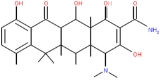
Tetracycline antibiotics

Encyclopedia

Broad-spectrum antibiotic
The term broad-spectrum antibiotic refers to an antibiotic that acts against a wide range of disease-causing bacteria. A broad-spectrum antibiotic acts against both Gram-positive and Gram-negative bacteria, in contrast to a narrow-spectrum antibiotic, which is effective against specific families of...
s whose general usefulness has been reduced with the onset of bacterial resistance. Despite this, they remain the treatment of choice for some specific indications.
They are so named for their four (“tetra-”) hydrocarbon
Hydrocarbon
In organic chemistry, a hydrocarbon is an organic compound consisting entirely of hydrogen and carbon. Hydrocarbons from which one hydrogen atom has been removed are functional groups, called hydrocarbyls....
rings (“-cycl-”) derivation (“-ine”). To be specific, they are defined as "a subclass of polyketides having an octahydrotetracene-2-carboxamide skeleton". They are collectively known as "derivatives of polycyclic naphthacene carboxamide".
Therapeutic uses
Tetracyclines are generally used in the treatment of infections of the respiratory tract, sinuses, middle ear, urinary tract, and intestines, and is used in the treatment of gonorrhoea, especially in patients allergic to β-lactamsBeta-lactam
A β-lactam ring, is a four-membered lactam. It is named as such, because the nitrogen atom is attached to the β-carbon relative to the carbonyl...
and macrolide
Macrolide
The macrolides are a group of drugs whose activity stems from the presence of a macrolide ring, a large macrocyclic lactone ring to which one or more deoxy sugars, usually cladinose and desosamine, may be attached. The lactone rings are usually 14-, 15-, or 16-membered...
s; however, their use for these indications is less popular than it once was due to widespread resistance
Antibiotic resistance
Antibiotic resistance is a type of drug resistance where a microorganism is able to survive exposure to an antibiotic. While a spontaneous or induced genetic mutation in bacteria may confer resistance to antimicrobial drugs, genes that confer resistance can be transferred between bacteria in a...
development in the causative organisms.
Their most common current use is in the treatment of moderately severe acne
Acne vulgaris
Acne vulgaris is a common human skin disease, characterized by areas of skin with seborrhea , comedones , papules , pustules , Nodules and possibly scarring...
and rosacea
Rosacea
Rosacea is a chronic condition characterized by facial erythema . Pimples are sometimes included as part of the definition. Unless it affects the eyes, it is typically a harmless cosmetic condition...
(tetracycline, oxytetracycline
Oxytetracycline
Oxytetracycline was the second of the broad-spectrum tetracycline group of antibiotics to be discovered.Oxytetracycline works by interfering with the ability of bacteria to produce proteins that are essential to them. Without these proteins the bacteria cannot grow, multiply and increase in numbers...
, doxycycline
Doxycycline
Doxycycline INN is a member of the tetracycline antibiotics group, and is commonly used to treat a variety of infections. Doxycycline is a semisynthetic tetracycline invented and clinically developed in the early 1960s by Pfizer Inc. and marketed under the brand name Vibramycin. Vibramycin...
, or minocycline
Minocycline
Minocycline is a broad-spectrum tetracycline antibiotic, and has a broader spectrum than the other members of the group. It is a bacteriostatic antibiotic, classified as a long-acting type...
).
Doxycycline
Doxycycline
Doxycycline INN is a member of the tetracycline antibiotics group, and is commonly used to treat a variety of infections. Doxycycline is a semisynthetic tetracycline invented and clinically developed in the early 1960s by Pfizer Inc. and marketed under the brand name Vibramycin. Vibramycin...
is also used as a prophylactic treatment for infection by Bacillus anthracis
Bacillus anthracis
Bacillus anthracis is the pathogen of the Anthrax acute disease. It is a Gram-positive, spore-forming, rod-shaped bacterium, with a width of 1-1.2µm and a length of 3-5µm. It can be grown in an ordinary nutrient medium under aerobic or anaerobic conditions.It is one of few bacteria known to...
(anthrax
Anthrax
Anthrax is an acute disease caused by the bacterium Bacillus anthracis. Most forms of the disease are lethal, and it affects both humans and other animals...
) and is effective against Yersinia pestis
Yersinia pestis
Yersinia pestis is a Gram-negative rod-shaped bacterium. It is a facultative anaerobe that can infect humans and other animals....
, the infectious agent of bubonic plague
Bubonic plague
Plague is a deadly infectious disease that is caused by the enterobacteria Yersinia pestis, named after the French-Swiss bacteriologist Alexandre Yersin. Primarily carried by rodents and spread to humans via fleas, the disease is notorious throughout history, due to the unrivaled scale of death...
. It is also used for malaria
Malaria
Malaria is a mosquito-borne infectious disease of humans and other animals caused by eukaryotic protists of the genus Plasmodium. The disease results from the multiplication of Plasmodium parasites within red blood cells, causing symptoms that typically include fever and headache, in severe cases...
treatment and prophylaxis, as well as treating elephantiasis
Elephantiasis
Elephantiasis is a disease that is characterized by the thickening of the skin and underlying tissues, especially in the legs and male genitals. In some cases the disease can cause certain body parts, such as the scrotum, to swell to the size of a softball or basketball. It is caused by...
.
Tetracyclines remain the treatment of choice for infections caused by chlamydia
Chlamydia (bacterium)
Chlamydia is a genus of bacteria that are obligate intracellular parasites. Chlamydia infections are the most common bacterial sexually transmitted infections in humans and are the leading cause of infectious blindness worldwide....
(trachoma
Trachoma
Trachoma is an infectious disease causing a characteristic roughening of the inner surface of the eyelids. Also called granular conjunctivitis and Egyptian ophthalmia, it is the leading cause of infectious blindness in the world...
, psittacosis
Psittacosis
In medicine , psittacosis — also known as parrot disease, parrot fever, and ornithosis — is a zoonotic infectious disease caused by a bacterium called Chlamydophila psittaci and contracted from parrots, such as macaws, cockatiels and budgerigars, and pigeons, sparrows, ducks, hens, gulls and many...
, salpingitis
Salpingitis
Salpingitis is an infection and inflammation in the fallopian tubes. It is often used synonymously with Pelvic inflammatory disease , although PID lacks an accurate definition and can refer to several diseases of the female upper genital tract, such as endometritis, oophoritis, myometritis,...
, urethritis
Urethritis
Urethritis is inflammation of the urethra. The most common symptom is painful or difficult urination.-Causes:The disease is classified as either gonococcal urethritis, caused by Neisseria gonorrhoeae, or non-gonococcal urethritis , most commonly caused by Chlamydia trachomatis...
, and L. venereum infection
Lymphogranuloma venereum
Lymphogranuloma venereum is a sexually transmitted disease caused by the invasive serovars L1, L2, L2a or L3 of Chlamydia trachomatis....
), Rickettsia
Rickettsia
Rickettsia is a genus of non-motile, Gram-negative, non-sporeforming, highly pleomorphic bacteria that can present as cocci , rods or thread-like . Being obligate intracellular parasites, the Rickettsia survival depends on entry, growth, and replication within the cytoplasm of eukaryotic host cells...
(typhus
Typhus
Epidemic typhus is a form of typhus so named because the disease often causes epidemics following wars and natural disasters...
, Rocky Mountain spotted fever
Rocky Mountain spotted fever
Rocky Mountain spotted fever is the most lethal and most frequently reported rickettsial illness in the United States. It has been diagnosed throughout the Americas. Some synonyms for Rocky Mountain spotted fever in other countries include “tick typhus,” “Tobia fever” , “São Paulo fever” or “febre...
), brucellosis
Brucellosis
Brucellosis, also called Bang's disease, Crimean fever, Gibraltar fever, Malta fever, Maltese fever, Mediterranean fever, rock fever, or undulant fever, is a highly contagious zoonosis caused by ingestion of unsterilized milk or meat from infected animals or close contact with their secretions...
, and spirochetal infections (borreliosis, syphilis
Syphilis
Syphilis is a sexually transmitted infection caused by the spirochete bacterium Treponema pallidum subspecies pallidum. The primary route of transmission is through sexual contact; however, it may also be transmitted from mother to fetus during pregnancy or at birth, resulting in congenital syphilis...
, and Lyme disease
Lyme disease
Lyme disease, or Lyme borreliosis, is an emerging infectious disease caused by at least three species of bacteria belonging to the genus Borrelia. Borrelia burgdorferi sensu stricto is the main cause of Lyme disease in the United States, whereas Borrelia afzelii and Borrelia garinii cause most...
). In addition, they may be used to treat anthrax
Anthrax
Anthrax is an acute disease caused by the bacterium Bacillus anthracis. Most forms of the disease are lethal, and it affects both humans and other animals...
, plague
Bubonic plague
Plague is a deadly infectious disease that is caused by the enterobacteria Yersinia pestis, named after the French-Swiss bacteriologist Alexandre Yersin. Primarily carried by rodents and spread to humans via fleas, the disease is notorious throughout history, due to the unrivaled scale of death...
, tularemia
Tularemia
Tularemia is a serious infectious disease caused by the bacterium Francisella tularensis. A Gram-negative, nonmotile coccobacillus, the bacterium has several subspecies with varying degrees of virulence. The most important of those is F...
, and Legionnaires' disease
Legionellosis
Legionellosis is a potentially fatal infectious disease caused by gram negative, aerobic bacteria belonging to the genus Legionella. Over 90% of legionellosis cases are caused by Legionella pneumophila, a ubiquitous aquatic organism that thrives in temperatures between , with an optimum temperature...
. It is also used in veterinary medicine
Veterinary medicine
Veterinary Medicine is the branch of science that deals with the prevention, diagnosis and treatment of disease, disorder and injury in non-human animals...
on pigs and alike.
They may have a role in reducing the duration and severity of cholera
Cholera
Cholera is an infection of the small intestine that is caused by the bacterium Vibrio cholerae. The main symptoms are profuse watery diarrhea and vomiting. Transmission occurs primarily by drinking or eating water or food that has been contaminated by the diarrhea of an infected person or the feces...
, although drug-resistance is occurring, and their effects on overall mortality is questioned.
Demeclocycline
Demeclocycline
Demeclocycline is a tetracycline antibiotic.It is derived from a strain of Streptomyces aureofaciens.-In infections:...
has an additional use in the treatment of SIADH
Syndrome of inappropriate antidiuretic hormone
The syndrome of inappropriate antidiuretic hormone hypersecretion is characterized by excessive release of antidiuretic hormone from the posterior pituitary gland or another source. The result is hyponatremia and sometimes fluid overload...
.
Tetracycline derivatives are currently being investigated for the treatment of certain inflammatory disorders.
Side effects
Side-effects from tetracyclines are not common, but of particular note is phototoxicity. It increases the risk of sunburn under exposure to light from the sun or other sources. This may be of particular importance for those intending to take on vacations long-term doxycycline as a malaria prophylaxis.They may cause stomach or bowel upsets, and, on rare occasions, allergic reactions. Very rarely, severe headache and vision problems may be signs of dangerous secondary intracranial hypertension
Idiopathic intracranial hypertension
Idiopathic intracranial hypertension , sometimes called by the older names benign intracranial hypertension or pseudotumor cerebri , is a neurological disorder that is characterized by increased intracranial pressure in the absence of a tumor or other diseases...
, also known as pseudotumor cerebri.
Tetracyclines are teratogens due to the likelihood of causing teeth discolouration in the fetus as they develop in infancy. For this same reason, tetracyclines are contraindicated for use in children under 8 years of age. They are, however, safe to use in the first 18 weeks of pregnancy.
Some patients taking tetracyclines require medical supervision because they can cause steatosis
Steatosis
In cellular pathology, steatosis is the process describing the abnormal retention of lipids within a cell. It reflects an impairment of the normal processes of synthesis and elimination of triglyceride fat. Excess lipid accumulates in vesicles that displace the cytoplasm...
and hepatotoxicity
Hepatotoxicity
Hepatotoxicity implies chemical-driven liver damage.The liver plays a central role in transforming and clearing chemicals and is susceptible to the toxicity from these agents. Certain medicinal agents, when taken in overdoses and sometimes even when introduced within therapeutic ranges, may injure...
.
Cautions
Tetracyclines should be used with caution in those with liver impairment and those that are soluble in water and urine worsen renal failure (this is not true of the lipid soluble agents doxycycline and minocycline). They may increase muscle weakness in myasthenia gravisMyasthenia gravis
Myasthenia gravis is an autoimmune neuromuscular disease leading to fluctuating muscle weakness and fatiguability...
and exacerbate systemic lupus erythematosus
Systemic lupus erythematosus
Systemic lupus erythematosus , often abbreviated to SLE or lupus, is a systemic autoimmune disease that can affect any part of the body. As occurs in other autoimmune diseases, the immune system attacks the body's cells and tissue, resulting in inflammation and tissue damage...
. Antacids reduce the absorption of all tetracyclines, and dairy products reduce absorption greatly for all but minocycline
Minocycline
Minocycline is a broad-spectrum tetracycline antibiotic, and has a broader spectrum than the other members of the group. It is a bacteriostatic antibiotic, classified as a long-acting type...
.
The breakdown products of tetracyclines are toxic and can cause Fanconi Syndrome
Fanconi syndrome
Falconi syndrome is a disease of the proximal renal tubules of the kidney in which glucose, amino acids, uric acid, phosphate and bicarbonate are passed into the urine, instead of being reabsorbed. Fanconi syndrome affects the proximal tubule, which is the first part of the tubule to process fluid...
, a potentially fatal disease affecting proximal tubular function in the nephrons of the kidney. Prescriptions of these drugs should be discarded once expired because they can cause hepatotoxicity
Hepatotoxicity
Hepatotoxicity implies chemical-driven liver damage.The liver plays a central role in transforming and clearing chemicals and is susceptible to the toxicity from these agents. Certain medicinal agents, when taken in overdoses and sometimes even when introduced within therapeutic ranges, may injure...
.
It was once believed that tetracycline antibiotics impair the effectiveness of many types of hormonal contraception
Hormonal contraception
Hormonal contraception refers to birth control methods that act on the endocrine system. Almost all methods are composed of steroid hormones, although in India one selective estrogen receptor modulator is marketed as a contraceptive. The original hormonal method—the combined oral contraceptive...
. Recent research has shown no significant loss of effectiveness in oral contraceptives while using most tetracyclines. Despite these studies, many physicians still recommend the use of barrier contraception for people taking any tetracyclines to prevent unwanted pregnancy.
Contraindications
Tetracycline use should be avoided in pregnant or lactating women, and in children with developing teeth because they may result in permanent staining (dark yellow-gray teeth with a darker horizontal band that goes across the top and bottom rows of teeth), and possibly affect the growth of teeth and bones.Usage during the first 12 weeks of pregnancy does not appear to increase the risk of any major birth defects. There may be a small increased risk for minor birth defects such as an inguinal hernia
Inguinal hernia
An inguinal hernia is a protrusion of abdominal-cavity contents through the inguinal canal. They are very common , and their repair is one of the most frequently performed surgical operations....
, but the number of reports is too small to be sure if there actually is any risk.
In tetracycline preparation, stability must be considered in order to avoid formation of toxic epi-anhydrotetracyclines.
Mechanism of action
Tetracycline antibiotics are protein synthesis inhibitorProtein synthesis inhibitor
A protein synthesis inhibitor is a substance that stops or slows the growth or proliferation of cells by disrupting the processes that lead directly to the generation of new proteins....
s, inhibiting the binding of aminoacyl-tRNA
Aminoacyl-tRNA
Aminoacyl-tRNA is tRNA to which its cognated amino acid is adhered. Its role is to deliver the amino acid to the ribosome where it will be incorporated into the polypeptide chain that is being produced...
to the mRNA-ribosome complex. They do so mainly by binding to the 30S ribosomal subunit in the mRNA translation complex.
Tetracyclines also have been found to inhibit matrix metalloproteinases. This mechanism does not add to their antibiotic effects, but has led to extensive research on chemically modified tetracyclines or CMTs (like incyclinide) for the treatmet of rosacea
Rosacea
Rosacea is a chronic condition characterized by facial erythema . Pimples are sometimes included as part of the definition. Unless it affects the eyes, it is typically a harmless cosmetic condition...
, acne
Acne
Acne is a general term used for acneiform eruptions. It is usually used as a synonym for acne vulgaris, but may also refer to:*Acne aestivalis*Acne conglobata*Acne cosmetica*Acne fulminans*Acne keloidalis nuchae*Acne mechanica...
, diabetes and various types of neoplasms.
Since incyclinide was announced to be ineffective for rosacea in September 2007, no drugs of this group will be marketed in the near-future.
Several trials have examined modified and unmodified tetracyclines for the treatment of human cancers, of those very promising results were achieved with CMT-3 for patients with Kaposi Sarcoma.
Mechanism and resistance
Tetracycline inhibits cell growth by inhibiting translationTranslation (genetics)
In molecular biology and genetics, translation is the third stage of protein biosynthesis . In translation, messenger RNA produced by transcription is decoded by the ribosome to produce a specific amino acid chain, or polypeptide, that will later fold into an active protein...
. It binds to the 16S
16S ribosomal RNA
16S ribosomal RNA is a component of the 30S subunit of prokaryotic ribosomes. It is approximately 1.5kb in length...
part of the 30S
30S
30S is the smaller subunit of the 70S ribosome of prokaryotes. It is a complex of ribosomal RNA and ribonucleoproteins that functions in mRNA translation...
ribosomal
Ribosome
A ribosome is a component of cells that assembles the twenty specific amino acid molecules to form the particular protein molecule determined by the nucleotide sequence of an RNA molecule....
subunit and prevents the amino-acyl tRNA
Transfer RNA
Transfer RNA is an adaptor molecule composed of RNA, typically 73 to 93 nucleotides in length, that is used in biology to bridge the three-letter genetic code in messenger RNA with the twenty-letter code of amino acids in proteins. The role of tRNA as an adaptor is best understood by...
from binding to the A site of the ribosome. The binding is reversible in nature.
Cells become resistant to tetracycline by at least three mechanisms: enzymatic
Enzyme
Enzymes are proteins that catalyze chemical reactions. In enzymatic reactions, the molecules at the beginning of the process, called substrates, are converted into different molecules, called products. Almost all chemical reactions in a biological cell need enzymes in order to occur at rates...
inactivation of tetracycline, efflux, and ribosomal protection. Inactivation is the rarest type of resistance, where an acetyl group is added to the molecule, causing inactivation of the drug. In efflux, a resistance gene encodes a membrane protein that actively pumps tetracycline out of the cell. This is the mechanism of action of the tetracycline resistance gene on the artificial plasmid
Plasmid
In microbiology and genetics, a plasmid is a DNA molecule that is separate from, and can replicate independently of, the chromosomal DNA. They are double-stranded and, in many cases, circular...
pBR322
PBR322
pBR322 is a plasmid and was the first widely-used E. coli cloning vectors. Created in 1977, it was named after its Mexican creators, p standing for plasmid, and BR for Bolivar and Rodriguez....
. In ribosomal protection, a resistance gene encodes a protein that can have several effects, depending on what gene
Gene
A gene is a molecular unit of heredity of a living organism. It is a name given to some stretches of DNA and RNA that code for a type of protein or for an RNA chain that has a function in the organism. Living beings depend on genes, as they specify all proteins and functional RNA chains...
is transferred. Six classes of ribosomal protection genes/proteins have been found, all with high sequence homology
Homology (biology)
Homology forms the basis of organization for comparative biology. In 1843, Richard Owen defined homology as "the same organ in different animals under every variety of form and function". Organs as different as a bat's wing, a seal's flipper, a cat's paw and a human hand have a common underlying...
, suggesting a common evolutionary ancestor.
Possible mechanisms of action of these protective proteins include:
- blocking tetracyclines from binding to the ribosome
- binding to the ribosome and distorting the structure to still allow t-RNA binding while tetracycline is bound
- binding to the ribosome and dislodging tetracycline.
All of these changes to ribosomes are reversible (non-covalent) because ribosomes isolated from both tetracycline-resistant and susceptible organisms bind tetracycline equally well in vitro
In vitro
In vitro refers to studies in experimental biology that are conducted using components of an organism that have been isolated from their usual biological context in order to permit a more detailed or more convenient analysis than can be done with whole organisms. Colloquially, these experiments...
.
Administration
When ingested, it is usually recommended that the more water-soluble, short-acting tetracyclines (plain tetracycline, chlortetracycline, Oxytetracycline, demeclocycline and methacycline) be taken with a full glass of water, either two hours after eating, or two hours before eating. This is partly because most tetracyclines bind with food and also easily with magnesiumMagnesium
Magnesium is a chemical element with the symbol Mg, atomic number 12, and common oxidation number +2. It is an alkaline earth metal and the eighth most abundant element in the Earth's crust and ninth in the known universe as a whole...
, aluminium
Aluminium
Aluminium or aluminum is a silvery white member of the boron group of chemical elements. It has the symbol Al, and its atomic number is 13. It is not soluble in water under normal circumstances....
, iron
Iron
Iron is a chemical element with the symbol Fe and atomic number 26. It is a metal in the first transition series. It is the most common element forming the planet Earth as a whole, forming much of Earth's outer and inner core. It is the fourth most common element in the Earth's crust...
, and calcium
Calcium
Calcium is the chemical element with the symbol Ca and atomic number 20. It has an atomic mass of 40.078 amu. Calcium is a soft gray alkaline earth metal, and is the fifth-most-abundant element by mass in the Earth's crust...
, which reduces their ability to be completely absorbed by the body. Dairy products, antacids, or preparations containing iron are particularly recommended to be avoided near the time of taking the drug. Partial exceptions to these rules occur for doxycycline and minocycline, which may be taken with food (though not iron, antacids, or calcium supplements). Minocycline
Minocycline
Minocycline is a broad-spectrum tetracycline antibiotic, and has a broader spectrum than the other members of the group. It is a bacteriostatic antibiotic, classified as a long-acting type...
, can be taken with dairy products because it does not chelate calcium as readily, although dairy products do decrease absorption of minocycline slightly.
History
The first member of the group to be discovered is ChlortetracyclineChlortetracycline
Chlortetracycline is a tetracycline antibiotic, and was the first tetracycline to be identified. It was discovered in 1945 by Dr. Benjamin Duggar working at Lederle Laboratories under the supervision of Dr.Subba Rao...
(Aureomycin) in the late 1940s by Dr. Benjamin Duggar
Benjamin Minge Duggar
Benjamin Minge Duggar was an American plant physiologist, born at Gallion, Hale County, Alabama. He studied at several Southern schools, including Alabama Polytechnic Institute , and at Harvard, Cornell , and in Germany, Italy, and France...
, a scientist employed by American Cyanamid
American Cyanamid
American Cyanamid was a large, diversified, American chemical manufacturer, founded by Frank Washburn in 1907. It was the only United States firm manufacturing the polio vaccine of the Sabin type....
- Lederle Laboratories, who derived the substance from a golden-colored, fungus-like, soil-dwelling bacterium named Streptomyces aureofaciens
Streptomyces aureofaciens
Streptomyces aureofaciens is a species of Streptomyces.It is the source of many tetracycline antibiotics....
. Oxytetracycline
Oxytetracycline
Oxytetracycline was the second of the broad-spectrum tetracycline group of antibiotics to be discovered.Oxytetracycline works by interfering with the ability of bacteria to produce proteins that are essential to them. Without these proteins the bacteria cannot grow, multiply and increase in numbers...
(Terramycin) was discovered shortly afterwards by AC Finlay et al.; it came from a similar soil bacterium named Streptomyces rimosus. Robert Burns Woodward
Robert Burns Woodward
Robert Burns Woodward was an American organic chemist, considered by many to be the preeminent organic chemist of the twentieth century...
determined the structure of Oxytetracycline enabling Lloyd H. Conover
Lloyd Conover
Lloyd Conover is the inventor of Tetracycline. For this invention, he was inducted into the National Inventors Hall of Fame. Conover was the first to make an antibiotic by chemically modifying a naturally produced drug....
to successfully produce tetracycline itself as a synthetic product. The development of many chemically altered antibiotics formed this group. In June 2005, tigecycline
Tigecycline
Tigecycline is a glycylcycline antibiotic developed by Francis Tally and marketed by Wyeth under the brand name Tygacil. It was given a U.S. Food and Drug Administration fast-track approval and was approved on June 17, 2005...
, the first member of a new subgroup of tetracyclines named glycylcycline
Glycylcycline
Glycylcyclines are a new class of antibiotics derived from tetracycline. These tetracycline analogues are specifically designed to overcome two common mechanisms of tetracycline resistance, namely resistance mediated by acquired efflux pumps and/or ribosomal protection...
s, was introduced to treat infections that are resistant to other antimicrobics including conventional tetracyclines. While tigecycline is the first tetracycline approved in over 20 years, other, newer versions of tetracyclines are currently in human clinical trials.
Examples
According to source:- Naturally occurring
- Tetracycline
- ChlortetracyclineChlortetracyclineChlortetracycline is a tetracycline antibiotic, and was the first tetracycline to be identified. It was discovered in 1945 by Dr. Benjamin Duggar working at Lederle Laboratories under the supervision of Dr.Subba Rao...
- OxytetracyclineOxytetracyclineOxytetracycline was the second of the broad-spectrum tetracycline group of antibiotics to be discovered.Oxytetracycline works by interfering with the ability of bacteria to produce proteins that are essential to them. Without these proteins the bacteria cannot grow, multiply and increase in numbers...
- DemeclocyclineDemeclocyclineDemeclocycline is a tetracycline antibiotic.It is derived from a strain of Streptomyces aureofaciens.-In infections:...
- Semi-synthetic
- DoxycyclineDoxycyclineDoxycycline INN is a member of the tetracycline antibiotics group, and is commonly used to treat a variety of infections. Doxycycline is a semisynthetic tetracycline invented and clinically developed in the early 1960s by Pfizer Inc. and marketed under the brand name Vibramycin. Vibramycin...
- LymecyclineLymecyclineLymecycline is a tetracycline broad-spectrum antibiotic marketed by the pharmeceutical company Galderma. It is approximately 5000 times more soluble than tetracycline base and is unique amongst tetracyclines in that it is absorbed by an active transport process across the intestinal wall, making...
- MeclocyclineMeclocyclineMeclocycline is a tetracycline antibiotic. It is used topically as it is totally insoluble in water and may cause liver and kidney damage if given systemically....
- Methacycline
- MinocyclineMinocyclineMinocycline is a broad-spectrum tetracycline antibiotic, and has a broader spectrum than the other members of the group. It is a bacteriostatic antibiotic, classified as a long-acting type...
- RolitetracyclineRolitetracyclineRolitetracycline is a tetracycline antibiotic. Tetracycline is N-Mannich base prodrug that is prepared from tetracycline by condensation with pyrrolidine and formaldehyde to produce rolitetracycline....
- Doxycycline
According to duration of action:
- Short-acting (Half-life is 6-8 hrs)
- Tetracycline
- ChlortetracyclineChlortetracyclineChlortetracycline is a tetracycline antibiotic, and was the first tetracycline to be identified. It was discovered in 1945 by Dr. Benjamin Duggar working at Lederle Laboratories under the supervision of Dr.Subba Rao...
- OxytetracyclineOxytetracyclineOxytetracycline was the second of the broad-spectrum tetracycline group of antibiotics to be discovered.Oxytetracycline works by interfering with the ability of bacteria to produce proteins that are essential to them. Without these proteins the bacteria cannot grow, multiply and increase in numbers...
- Intermediate-acting (Half-life is ~12 hrs)
- DemeclocyclineDemeclocyclineDemeclocycline is a tetracycline antibiotic.It is derived from a strain of Streptomyces aureofaciens.-In infections:...
- Methacycline
- Demeclocycline
- Long-acting (Half-life is 16 hrs or more)
- DoxycyclineDoxycyclineDoxycycline INN is a member of the tetracycline antibiotics group, and is commonly used to treat a variety of infections. Doxycycline is a semisynthetic tetracycline invented and clinically developed in the early 1960s by Pfizer Inc. and marketed under the brand name Vibramycin. Vibramycin...
- MinocyclineMinocyclineMinocycline is a broad-spectrum tetracycline antibiotic, and has a broader spectrum than the other members of the group. It is a bacteriostatic antibiotic, classified as a long-acting type...
- TigecyclineTigecyclineTigecycline is a glycylcycline antibiotic developed by Francis Tally and marketed by Wyeth under the brand name Tygacil. It was given a U.S. Food and Drug Administration fast-track approval and was approved on June 17, 2005...
- Doxycycline
Tigecycline
Tigecycline
Tigecycline is a glycylcycline antibiotic developed by Francis Tally and marketed by Wyeth under the brand name Tygacil. It was given a U.S. Food and Drug Administration fast-track approval and was approved on June 17, 2005...
may also be considered a tetracycline antibiotic, though it is usually classified as a glycylcycline
Glycylcycline
Glycylcyclines are a new class of antibiotics derived from tetracycline. These tetracycline analogues are specifically designed to overcome two common mechanisms of tetracycline resistance, namely resistance mediated by acquired efflux pumps and/or ribosomal protection...
antibiotic.
See also
- GlycylcyclineGlycylcyclineGlycylcyclines are a new class of antibiotics derived from tetracycline. These tetracycline analogues are specifically designed to overcome two common mechanisms of tetracycline resistance, namely resistance mediated by acquired efflux pumps and/or ribosomal protection...
- Tetracycline controlled transcriptional activation
- Animal Drug Availability Act 1996Animal Drug Availability Act 1996The Animal Drug Availability Act 1996 ADAA is a United States federal law. President Clinton signed the ADAA in October 1996. While still obligated to public health concerns; the act intends more rapid drug and medicated feed approval to assist the animal health industry .-Overview:The Act...