
All Topics  
Rocky Mountain spotted fever


   Email Print
   Bookmark   Link


Rocky Mountain spotted fever


Rocky Mountain spotted fever is the most lethal and most frequently reported rickettsia
Rickettsia

Rickettsia is a genus of Motility, Gram-negative, Endospore, highly pleomorphic Bacterium that can present as cocci , rods or thread-like ....
l illness in the United States
United States

The United States of America is a Federal government constitutional republic comprising U.S. state and a federal district. The country is situated mostly in central North America, where its Contiguous United States and Washington, D.C., the Capital districts and territories, lie between the Pacific Ocean and Atlantic Oceans, Borders of the U...
. It has been diagnosed throughout the Americas
Americas

The Americas are the region of the Western hemisphere that consists of the continents of North America and South America with their associated islands and regions....
. Some synonyms for Rocky Mountain spotted fever in other countries include “tick
Tick

Tick is the common name for the small arachnids in superfamily Ixodoidea that, along with other mites, constitute the Acarina. Ticks are ectoparasites , living by hematophagy on the blood of mammals, birds, and occasionally reptiles and amphibians....
 typhus
Typhus

Epidemic typhus is a form of typhus so named because the disease often causes epidemics following wars and natural disasters. The causative organism is Rickettsia prowazekii, transmitted by the human body louse ....
,” “Tobia fever
Fever

Fever is a frequent medical sign that describes an increase in internal body temperature to levels above normal. Fever is most accurately characterized as a temporary elevation in the body's thermoregulatory set-point, usually by about 1?2 ?C ....
” (Colombia
Colombia

Colombia , officially the Republic of Colombia , is a country in north-western South America. Colombia is bordered to the east by Venezuela and Brazil; to the south by Ecuador and Peru; to the north by the Caribbean Sea; to the north west by Panama; and to the west by the Pacific Ocean....
), “São Paulo
São Paulo

S?o Paulo is the largest city in Brazil, and along with Tokyo, Seoul and Mexico City is among the four largest metropolitan regions of the world....
 fever
Fever

Fever is a frequent medical sign that describes an increase in internal body temperature to levels above normal. Fever is most accurately characterized as a temporary elevation in the body's thermoregulatory set-point, usually by about 1?2 ?C ....
” or “febre maculosa” (Brazil
Brazil

Brazil , officially the Federative Republic of Brazil , is a country in South America. It is the List of countries and outlying territories by total area country by geographical area, occupying nearly half of South America, the List of countries by population country, and the fourth most populous democracy in the world....
), and “fiebre manchada” (Mexico
Mexico

The United Mexican States , commonly known as Mexico , is a federalism constitutionalism republic in North America. It is bordered on the north by the United States; on the south and west by the Pacific Ocean; on the southeast by Guatemala, Belize, and the Caribbean Sea; and on the east by the Gulf of Mexico....
). It is distinct from the viral tick-borne infection, Colorado tick fever
Colorado tick fever

Colorado Tick Fever is an acute viral infection transmitted from the bite of an infected wood tick . It should not be confused with the bacterial tick-borne infection, Rocky Mountain Spotted Fever....
. The disease is caused by Rickettsia rickettsii
Rickettsia rickettsii

Rickettsia ricketsii is native to the New World and causes the malady known as Rocky Mountain spotted fever . RMSF is transmitted by the bite of an infected tick while feeding on warm-blooded animals, including humans....
, a species of bacterium that is spread to humans by ixodid (hard) ticks.


Discussion
Ask a question about 'Rocky Mountain spotted fever'
Start a new discussion about 'Rocky Mountain spotted fever'
Answer questions from other users
Full Discussion Forum


Encyclopedia


Rocky Mountain spotted fever is the most lethal and most frequently reported rickettsia
Rickettsia

Rickettsia is a genus of Motility, Gram-negative, Endospore, highly pleomorphic Bacterium that can present as cocci , rods or thread-like ....
l illness in the United States
United States

The United States of America is a Federal government constitutional republic comprising U.S. state and a federal district. The country is situated mostly in central North America, where its Contiguous United States and Washington, D.C., the Capital districts and territories, lie between the Pacific Ocean and Atlantic Oceans, Borders of the U...
. It has been diagnosed throughout the Americas
Americas

The Americas are the region of the Western hemisphere that consists of the continents of North America and South America with their associated islands and regions....
. Some synonyms for Rocky Mountain spotted fever in other countries include “tick
Tick

Tick is the common name for the small arachnids in superfamily Ixodoidea that, along with other mites, constitute the Acarina. Ticks are ectoparasites , living by hematophagy on the blood of mammals, birds, and occasionally reptiles and amphibians....
 typhus
Typhus

Epidemic typhus is a form of typhus so named because the disease often causes epidemics following wars and natural disasters. The causative organism is Rickettsia prowazekii, transmitted by the human body louse ....
,” “Tobia fever
Fever

Fever is a frequent medical sign that describes an increase in internal body temperature to levels above normal. Fever is most accurately characterized as a temporary elevation in the body's thermoregulatory set-point, usually by about 1?2 ?C ....
” (Colombia
Colombia

Colombia , officially the Republic of Colombia , is a country in north-western South America. Colombia is bordered to the east by Venezuela and Brazil; to the south by Ecuador and Peru; to the north by the Caribbean Sea; to the north west by Panama; and to the west by the Pacific Ocean....
), “São Paulo
São Paulo

S?o Paulo is the largest city in Brazil, and along with Tokyo, Seoul and Mexico City is among the four largest metropolitan regions of the world....
 fever
Fever

Fever is a frequent medical sign that describes an increase in internal body temperature to levels above normal. Fever is most accurately characterized as a temporary elevation in the body's thermoregulatory set-point, usually by about 1?2 ?C ....
” or “febre maculosa” (Brazil
Brazil

Brazil , officially the Federative Republic of Brazil , is a country in South America. It is the List of countries and outlying territories by total area country by geographical area, occupying nearly half of South America, the List of countries by population country, and the fourth most populous democracy in the world....
), and “fiebre manchada” (Mexico
Mexico

The United Mexican States , commonly known as Mexico , is a federalism constitutionalism republic in North America. It is bordered on the north by the United States; on the south and west by the Pacific Ocean; on the southeast by Guatemala, Belize, and the Caribbean Sea; and on the east by the Gulf of Mexico....
). It is distinct from the viral tick-borne infection, Colorado tick fever
Colorado tick fever

Colorado Tick Fever is an acute viral infection transmitted from the bite of an infected wood tick . It should not be confused with the bacterial tick-borne infection, Rocky Mountain Spotted Fever....
. The disease is caused by Rickettsia rickettsii
Rickettsia rickettsii

Rickettsia ricketsii is native to the New World and causes the malady known as Rocky Mountain spotted fever . RMSF is transmitted by the bite of an infected tick while feeding on warm-blooded animals, including humans....
, a species of bacterium that is spread to humans by ixodid (hard) ticks. Initial signs and symptoms of the disease include sudden onset of fever
Fever

Fever is a frequent medical sign that describes an increase in internal body temperature to levels above normal. Fever is most accurately characterized as a temporary elevation in the body's thermoregulatory set-point, usually by about 1?2 ?C ....
, headache
Headache

In medicine a headache or wiktionary:cephalalgia is a symptom of a number of different conditions of the head and sometimes neck. Some of the causes are benign while others are medical emergencies....
, and muscle pain
Myalgia

Myalgia means "muscle pain" and is a symptom of many diseases and disorders. The most common causes are overuse or over-stretching of a muscle or group of muscles....
, followed by development of rash. The disease can be difficult to diagnose in the early stages, and without prompt and appropriate treatment it can be fatal.

The name “Rocky Mountain spotted fever” is somewhat of a misnomer
Misnomer

A misnomer is a term which suggests an interpretation that is known to be untrue. Such incorrect terms sometimes derived their names because of the form, action, or origin of the subject?becoming named popularly or widely referenced?long before their true natures were known....
. Beginning in the 1930s, it became clear that this disease occurred in many areas of the United States other than the Rocky Mountain
Rocky Mountains

The Rocky Mountains, often called the Rockies, are a mountain range in western North America. The Rocky Mountains stretch more than 4,800 kilometre from the northernmost part of British Columbia, in Canada, to New Mexico, in the United States....
 region. It is now recognized that this disease is broadly distributed throughout the continental United States, and occurs as far north as Canada
Canada

Canada is a country occupying most of northern North America, extending from the Atlantic Ocean in the east to the Pacific Ocean in the west and northward into the Arctic Ocean....
 and as far south as Central America
Central America

Central America is a central geography region of the Americas. It is the southernmost, isthmus portion of the North American continent, which connects with South America on the southeast....
 and parts of South America
South America

South America is the southern continent of the Americas, situated entirely in the Western Hemisphere and mostly in the Southern Hemisphere, with a relatively small portion in the Northern Hemisphere....
. Between 1981 and 1996, this disease was reported from every U.S. state except Hawaii, Vermont
Vermont

Vermont is a U.S. state in the New England region of the Northeastern United States United States. The state ranks 43rd by land area, , and 45th by total area....
, Maine
Maine

The State of Maine is a U.S. state in the New England region of the northeastern United States of America, bordering the Atlantic Ocean to the southeast, New Hampshire to the southwest, the Canadian provinces of Quebec to the northwest and New Brunswick to the northeast....
, and Alaska
Alaska

Alaska is the largest U.S. state of the United States by area; it is situated in the northwest extremity of the North American continent, with Canada to the east, the Arctic Ocean to the north, and the Pacific Ocean to the west and south, with Russia further west across the Bering Strait....
.

Rocky Mountain spotted fever remains a serious and potentially life-threatening infectious disease today. Despite the availability of effective treatment and advances in medical care, approximately 3% to 5% of individuals who become ill with Rocky Mountain spotted fever still die from the infection. However, effective antibiotic
Antibiotic

In common usage, an antibiotic is a substance or compound that kills or inhibits the growth of bacteria. Antibiotics belong to the group of antimicrobial compounds used to treat infections caused by microorganisms, including fungus and protozoa....
 therapy has dramatically reduced the number of deaths caused by Rocky Mountain spotted fever; before the discovery of tetracycline
Tetracycline

Tetracycline is a broad-spectrum polyketide antibiotic produced by the Streptomyces genus of Actinobacteria, indicated for use against many bacterial infections....
 and chloramphenicol
Chloramphenicol

Chloramphenicol is a bacteriostatic antimicrobial originally derived from the bacterium Streptomyces venezuelae, isolated by David Gottlieb, and introduced into clinical practice in 1949....
 in the late 1940s, as many as 30% of persons infected with R. rickettsii died.

Natural history

Rocky Mountain spotted fever, like all rickettsial infections, is classified as a zoonosis
Zoonosis

A zoonosis or zoonose is any infectious disease that is able to be transmitted from other animals, both wild and domestic, to humans or from humans to animals ....
. Zoonoses are diseases of animals that can be transmitted to humans. Many zoonotic diseases require a vector
Vector (biology)

In epidemiology, a vector is an organism that does not cause disease itself but that transmits infection by conveying pathogens from one Host to another, serving as a transmission ....
 (e.g., a mosquito, tick, or mite) in order to be transmitted from the animal host to the human host. In the case of Rocky Mountain spotted fever, ticks are the natural hosts, serving as both reservoirs and vectors of R. rickettsii. Ticks transmit the organism to vertebrate
Vertebrate

Vertebrates are members of the subphylum Vertebrata, chordates with Vertebras or Vertebral columns. The grouping sometimes includes the hagfish, which have no vertebrae, but are genetically quite closely related to lampreys, which do have vertebrae....
s primarily by their bite. Less commonly, infections may occur following exposure to crushed tick tissues, fluids, or tick feces.
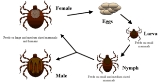
Life Cycle of Ticks Family Ixodidae
A female tick can transmit R. rickettsii to her eggs in a process called transovarial transmission
Transovarial transmission

Transovarial transmission occurs in certain arthropod Vector s as they transmit disease-causing bacteria from parent arthropod to offspring arthropod....
. Ticks can also become infected with R. rickettsii while feeding on blood from the host in either the larval or nymphal stage. After the tick develops into the next stage, the R. rickettsii may be transmitted to the second host during the feeding process. Furthermore, male ticks may transfer R. rickettsii to female ticks through body fluids or spermatozoa during the mating process. These types of transmission represent how generations or life stages of infected ticks are maintained. Once infected, the tick can carry the pathogen for life.

Rickettsiae are transmitted to a vertebrate
Vertebrate

Vertebrates are members of the subphylum Vertebrata, chordates with Vertebras or Vertebral columns. The grouping sometimes includes the hagfish, which have no vertebrae, but are genetically quite closely related to lampreys, which do have vertebrae....
 host through saliva while a tick is feeding. It usually takes several hours of attachment and feeding before the rickettsiae are transmitted to the host. The risk of exposure to a tick carrying R. rickettsii is low. In general, about 1%-3% of the tick population carries R. rickettsii, even in areas where the majority of human cases are reported.

There are two major vectors of R. rickettsii in the United States, the American dog tick and the Rocky Mountain wood tick. American dog ticks (Dermacentor variabilis) are widely distributed east of the Rocky Mountains and also occur in limited areas on the Pacific Coast. Dogs and medium-sized mammals are the preferred hosts of adult D. variabilis, although it feeds readily on other large mammals, including humans. This tick is the most commonly identified species responsible for transmitting R. rickettsii to humans. Rocky Mountain wood ticks (Dermacentor andersoni) are found in the Rocky Mountain states and in southwestern Canada. The life cycle of this tick may require up to 2 to 3 years for completion. Adult ticks feed primarily on large mammals. Larvae and nymphs feed on small rodents.

Other tick species have been shown to be naturally infected with R. rickettsii or serve as experimental vectors in the laboratory. However, these species are likely to play only a minor role in the ecology of R. rickettsii.

There are only 800 cases reported in the U.S. a year and only 20% find the tick.

Signs and symptoms

Rocky Mountain spotted fever can be very difficult to diagnose in its early stages, even among experienced physicians who are familiar with the disease.

People infected with R. rickettsii usually notice symptoms following an incubation period of one to two weeks after a tick bite. The early clinical presentation of Rocky Mountain spotted fever is nonspecific and may resemble a variety of other infectious and non-infectious diseases.

Initial symptoms may include:

  • fever
    Fever

    Fever is a frequent medical sign that describes an increase in internal body temperature to levels above normal. Fever is most accurately characterized as a temporary elevation in the body's thermoregulatory set-point, usually by about 1?2 ?C ....
  • nausea
    Nausea

    Nausea is the sensation of unease and discomfort in the stomach with an urge to vomit....
  • emesis
    Vomiting

    Vomiting is the forceful expulsion of the contents of one's stomach through the mouth and sometimes the nose. Undesired vomiting may result from many causes, ranging from gastritis or poisoning to brain tumors, or elevated intracranial pressure....
  • severe headache
    Headache

    In medicine a headache or wiktionary:cephalalgia is a symptom of a number of different conditions of the head and sometimes neck. Some of the causes are benign while others are medical emergencies....
  • muscle pain
    Myalgia

    Myalgia means "muscle pain" and is a symptom of many diseases and disorders. The most common causes are overuse or over-stretching of a muscle or group of muscles....
  • lack of appetite


Later signs and symptoms include:

  • maculopapular rash
    Maculopapular rash

    A maculopapular rash is a medical term used to describe a unique type of rash. It is a portmanteau of the terms macule and papule . It is usually also described as erythematous, or red....
  • petechial rash
  • abdominal pain
    Abdominal pain

    Abdominal pain can be one of the symptoms associated with transient disorders or serious disease. Making a definitive diagnosis of the cause of abdominal pain can be difficult, because many diseases can result in this symptom....
  • joint pain


The classic triad of findings for this disease are fever, rash, and history of tick bite. However, this combination is often not identified when the patient initially presents for care. The rash has a centripetal,or "inward" pattern of spread, meaning it begins at the extremities and courses towards the trunk.

The rash first appears 2-5 days after the onset of fever and is often very subtle. Younger patients usually develop the rash earlier than older patients. Most often it begins as small, flat, pink, non-itchy spots (macules) on the wrists, forearms, and ankles. These spots turn pale when pressure is applied and eventually become raised on the skin. The characteristic red, spotted (petechial) rash of Rocky Mountain spotted fever is usually not seen until the sixth day or later after onset of symptoms, but this type of rash occurs in only 35% to 60% of patients with Rocky Mountain spotted fever. The rash involves the palms or soles in as many as 50% to 80% of patients; however, this distribution may not occur until later in the course of the disease. As many as 10% to 15% of patients may never develop a rash.

Abnormal laboratory findings seen in patients with Rocky Mountain spotted fever may include thrombocytopenia
Thrombocytopenia

Thrombocytopenia is the presence of relatively few platelets in blood.Generally speaking, in humans, a normal platelet count ranges from 150,000 and 450,000 per mm3....
, hyponatremia
Hyponatremia

Hyponatremia is an electrolyte disturbance in which the sodium concentration in the blood plasma is too low .Severe or rapidly progressing hyponatremia can result in swelling of the brain , and the symptoms of hyponatremia are mainly neurology....
, or elevated liver enzyme levels.

Rocky Mountain spotted fever can be a very severe illness and patients often require hospitalization. Because R. rickettsii infects the cells lining blood vessel
Blood vessel

The blood vessels are the part of the circulatory system that transport blood throughout the body. There are three major types of blood vessels: the artery, which carry the blood away from the heart, the capillary, which enable the actual exchange of water and chemicals between the blood and the tissues; and the veins, which carry blood from...
s throughout the body, severe manifestations of this disease may involve the respiratory system
Respiratory system

A respiratory system?s function is to allow gas exchange. The space between the alveoli and the capillaries, the anatomy or structure of the exchange system, and the precise physiological uses of the exchanged gases vary depending on the organism....
, central nervous system
Central nervous system

The central nervous system is the part of the nervous system that functions to coordinate the activity of all parts of the bodies of multicellular organisms....
, gastrointestinal system, or renal system. Host factors associated with severe or fatal Rocky Mountain spotted fever include advanced age, male sex, African-American race, chronic alcohol abuse, and glucose-6-phosphate dehydrogenase
Glucose-6-phosphate dehydrogenase

Glucose-6-phosphate dehydrogenase is a cytosolic enzyme in the pentose phosphate pathway , a metabolic pathway that supplies reducing energy to cells by maintaining the level of the co-enzyme nicotinamide adenine dinucleotide ....
 (G6PD) deficiency. Deficiency of G6PD is a sex-linked genetic condition affecting approximately 12% of the U.S. African-American male population; deficiency of this enzyme is associated with a high proportion of severe cases of Rocky Mountain spotted fever. This is a rare clinical course that is often fatal within 5 days of onset of illness.

Long-term health problems following acute Rocky Mountain spotted fever infection include partial paralysis
Paralysis

Paralysis is the complete loss of muscle function for one or more muscle groups. Paralysis can cause loss of feeling or loss of mobility in the affected area....
 of the lower extremities, gangrene
Gangrene

For the American football team nicknamed "Gang Green," see New York Jets.Gangrene is a complication of necrosis characterized by the decay of biological tissues, which become black and malodorous....
 requiring amputation of fingers, toes, or arms or legs, hearing loss, loss of bowel or bladder control, movement disorders, and language disorders. These complications are most frequent in persons recovering from severe, life-threatening disease, often following lengthy hospitalizations.

Treatment

Appropriate antibiotic treatment is initiated immediately when there is a suspicion of Rocky Mountain spotted fever on the basis of clinical and epidemiological findings. Treatment should not be delayed until laboratory confirmation is obtained. In fact, failure to respond to a tetracycline antibiotic argues against a diagnosis of Rocky Mountain spotted fever. Severely ill patients may require longer periods before their fever resolves, especially if they have experienced damage to multiple organ systems. Preventive therapy in non-ill patients who have had recent tick bites is not recommended and may, in fact, only delay the onset of disease.

Doxycycline
Doxycycline

Doxycycline is a member of the tetracycline antibiotics group and is commonly used to treat a variety of infections. Doxycycline is a semi-synthetic tetracycline invented and clinically developed in the early 1960s by Pfizer and marketed under the brand name Vibramycin....
 (For adults, 100 mg every 12 hours. For children under 45 kg [100 lb], 4 mg/kg body weight per day in two divided doses) is the drug of choice for patients with Rocky Mountain spotted fever. Therapy is continued for at least 3 days after fever subsides and until there is unequivocal evidence of clinical improvement, generally for a minimum total course of 5 to 10 days. Severe or complicated disease may require longer treatment courses. Doxycycline is also the preferred drug for patients with ehrlichiosis
Ehrlichiosis

Ehrlichiosis is a tick-borne disease of dogs usually caused by the organism Ehrlichia canis. Ehrlichia canis is the pathogen of animals....
, another tick-transmitted infection with signs and symptoms that may resemble Rocky Mountain spotted fever.

Chloramphenicol
Chloramphenicol

Chloramphenicol is a bacteriostatic antimicrobial originally derived from the bacterium Streptomyces venezuelae, isolated by David Gottlieb, and introduced into clinical practice in 1949....
 is an alternative drug that can be used to treat Rocky Mountain spotted fever; however, this drug may be associated with a wide range of side effects and may require careful monitoring of blood levels (as it can cause aplastic anemia
Aplastic anemia

Aplastic anemia is a condition where bone marrow does not produce sufficient new cell s to replenish blood cells.The term 'aplastic' means the marrow suffers from an aplasia that renders it unable to function properly....
).

History


Rocky Mountain spotted fever was first recognized in 1896 in the Snake River Valley
Snake River Plain

The Snake River Plain is a geology feature located primarily within the state of Idaho in the United States of America. It stretches about westward from northwest of the state of Wyoming to the Idaho-Oregon border....
 of Idaho
Idaho

The State of Idaho is a U.S. state in the Pacific Northwest region of the United States of America. The state's largest city and Capital is Boise, Idaho....
 and was originally called “black measles” because of the characteristic rash. It was a dreaded and frequently fatal disease that affected hundreds of people in this area. By the early 1900s, the recognized geographic distribution of this disease grew to encompass parts of the United States as far north as Washington and Montana
Montana

Montana is a U.S. state in the Western United States. The western third of the state contains numerous mountain ranges; other 'island' ranges are found in the central third of the state, for a total of 77 named ranges of the Rocky Mountains....
 and as far south as California
California

California is a U.S. state on the West Coast of the United States of the United States, along the Pacific Ocean. It is bordered by Oregon to the north, Nevada to the east, Arizona to the southeast, and to the south the Mexico state of Baja California....
, Arizona
Arizona

The State of Arizona is a U.S. state located in the Southwestern United States of the United States. The capital and largest city is Phoenix, Arizona....
, and New Mexico
New Mexico

New Mexico is a U. S. State located in the Southwestern United States of the United States. Inhabited by Native Americans in the United States populations for many centuries, it has also has been part of the Spanish Empire viceroyalty of New Spain, part of Mexico, and a U.S....
.

Howard T. Ricketts was the first to establish the identity of the infectious organism that causes this disease. He and others characterized the basic epidemiological
Epidemiology

Epidemiology is the study of factors affecting the health and illness of populations, and serves as the foundation and logic of interventions made in the interest of public health and preventive medicine....
 features of the disease, including the role of tick vectors. Their studies found that Rocky Mountain spotted fever is caused by Rickettsia rickettsii. This species is maintained in nature by a complex cycle involving ticks and mammals; humans are considered to be accidental hosts and are not involved in the natural transmission cycle of this pathogen. Tragically—and ironically
Irony

Irony is a Literary technique or rhetorical device, in which there is an wiktionary:incongruous or wiktionary:discordance between what one says or does and what one means or what is generally understood....
—Dr. Ricketts died of typhus (another rickettsial disease) in Mexico
Mexico

The United Mexican States , commonly known as Mexico , is a federalism constitutionalism republic in North America. It is bordered on the north by the United States; on the south and west by the Pacific Ocean; on the southeast by Guatemala, Belize, and the Caribbean Sea; and on the east by the Gulf of Mexico....
 in 1910, shortly after completing his remarkable studies on Rocky Mountain spotted fever.

Much of the early research was conducted at the Rocky Mountain Laboratory, which is the source of the name of the condition.

External links