

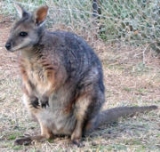
Tammar Wallaby

Encyclopedia
The Tammar Wallaby also known as the Dama Wallaby or Darma Wallaby, is a small member of the kangaroo
family and is the model species for research on kangaroos and marsupial
s. It is found on offshore islands on the South Australia
n and Western Australian coast. It persists in large numbers on Kangaroo Island
, where it seasonally breeds
in large numbers and can become a problem to farmers through competition for pasture and grain crops. High densities of these animals also have impact on the density of low vegetation across the Island. The Tammar Wallaby was seen on West Wallabi Island
in the Houtman Abrolhos
off Western Australia
by survivors of the 1628 Batavia
shipwreck
, and recorded by Francisco Pelsart in his 1629 Ongeluckige Voyagie. This represents the first recorded sighting of a macropod by Europeans, and probably also the first sighting of an Australian mammal.
in 1817. It specific name comes from Eugene Hamelin, Commander of the ship Naturaliste. Its common name is derived from the thickets of the local shrub Allocasuarina campestris that it sheltered in in Western Australia. It is classified along with the kangaroos and larger wallabies in the genus Macropus
. Within this, it is placed in the subgenus Notomacropus along with several species of wallaby, all members of which have a facial stripe.
The tammar wallabies on Flinders Island
were described as having a greyer coat and thinner head than the tammars on Kangaroo Island and were given a separate name, while East and West Wallabi Islands are smaller than the Kangaroo Island tammars. Other early naturalists suspected that all island populations composed one species. A more recent study has compared tammar wallaby skulls in museums around the world with skulls from extant populations on the Abrolhos Islands, Garden Island, Middle Island and Kangaroo Island as well as those from New Zealand and found that there were three distinct groups; one group made of populations from mainland Western Australia, East and West Wallabi Islands, Garden Island and Middle Island, a second ground composed of population form Flinders Island and mainland Southern Australia in the 19th century as well as populations from New Zealand and a third group composed of the Kangaroo Island population.
on the sides of the body and the limbs, especially in males are pale grey-buff below. The tammar wallaby exhibits significant sexual dimorphism
, with the maximum recorded weight in males being 9.1 kg and maximum recorded weight in females is 6.9 kg. The body length is 59 to 68 cm in males and 52 to 63 cm in females. Both males and females are about 45 cm in height. The tails of males range from 38 to 45 cm and that of females from 33 to 44 cm.
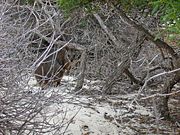 Since European occupation, tammar wallaby populations on both mainland Australia and some islands have been greatly reduced or even eradicated. The mainland population of tammars have been descripted as "very plentiful in many parts of the south-west, but rapidly disappearing in the cultivated districts, especially towards the northern end of its range." The region was cleared for wheat and sheep which caused the decline to continue and tammars are only restricted to a few isolated pockets where foxes are controlled. In the 19th century, tammars were so common on the Eyre Peninsula
and around Adelaide that battues were organised to protect crops and pastures by destroy large numbers of the animals. This has caused drastic declines resulting in the tammar becoming extinct in Adelaide by the 1920s and in the Eyre Peninsula probably by the 1970s. However the genotype of Eyre tammars survives as they were introduced to New Zealand on Kawau Island
and Rotorua
. Farming activities led to the extinction of the tammar on Flinders Island and St. Peter’s Island. According to one source, only on Kangaroo Island are tammars abundant and secure. However, the tammar wallbay is listed as Least Concern
by the IUCN, due to "its wide distribution, presumed large population, occurrence in a number of protected areas, and because it is unlikely to be declining at nearly the rate required to qualify for listing in a threatened category."
, Austrodanthonia setacea
, and Corymbia calophylla
.
Tammars maintain their body temperature against high ambient temperatures by licking their forearms and panting. When the ambient temperature is above 30°C, the respiratory system of the tammar increases steeply and evaporate water loss also increases. When the ambient temperature is above 40°C, it can no longer control its body temperature and will die unless it can get away from the heat. Tammars pass less water in urine and reabsorb water from the distal colon which causes them to have only about 40% water content in their feces. This allows them to avoid dehydration. Tammars live on several islands that have no fresh water and must subsist on seawater or the moisture in plants. Tammars have been observed going to the nearest beach and drink seawater. They can live on seawater because their renal concentrating capacity is far greater than those of other small macropods.
is established. The more dominant males spend more time guarding, checking and disrupting the consortships of the estrous females. Mating chases, in which a post-partum female is pursued by several males, have been observed. The female tammar conceives a few hours after giving birth and suckles her young in her pouch for the next seven months. During the first five months of her lacation, the dormant embryo in her uterus will only develop if the young in her pouch is lost or removed. However, after the winter solstice in June the embryo will not develop if the pouch young is removed, nor does it develop when the older young leaves the pouch in October but instead continues to remain dormant in the uterus until after the summer solstice in December.
of the family Reoviridae
. It does not occur south of Sydney, and captive populations of tammar wallabies in New South Wales have suffered subsequent infections in summer months.
, because marsupials are at an ideal degree of evolutionary divergence from humans: mice
are too close and have not developed many different functions, while birds are genetically too remote. The tammar wallaby is one of the model organism
s as it is cheap to maintain and relatively tractable to scientific study. The tammar genome is about 3.6 Gb, with a relatively short genetic map length of 1172 cM. Researchers managed to isolate tammar bacterial artificial chromosomes (BACs) containing key immune genes from the tammar BAC library. Using fluorescence in situ hybridisation (FISH), BACs containing T cell receptor (TCR) and immunoglobulin (Ig) genes were physically mapped in tammar wallaby chromosomes. This research has highlighted the conservation of genomic context of these important immune genes in marsupials. Human and tammar genome comparisons have lend to the discovery of new human genes, such as RBMX
and several related genes.
Australian scientists, led by Dr. Ben Cocks, have found a compound in the milk of the tammar wallaby called AGG01
which has the potential to be a new and powerful form of antibiotic. AGG01 is a protein and in laboratory testing AGG01 has been shown to be 100 times more effective than penicillin
, killing over 99% of the pathogenic bacteria (both gram-positive and gram–negative) and fungus that it was incubated with, including Salmonella
, Proteus vulgaris
and golden staphylococcus.
Kangaroo
A kangaroo is a marsupial from the family Macropodidae . In common use the term is used to describe the largest species from this family, especially those of the genus Macropus, Red Kangaroo, Antilopine Kangaroo, Eastern Grey Kangaroo and Western Grey Kangaroo. Kangaroos are endemic to the country...
family and is the model species for research on kangaroos and marsupial
Marsupial
Marsupials are an infraclass of mammals, characterized by giving birth to relatively undeveloped young. Close to 70% of the 334 extant species occur in Australia, New Guinea, and nearby islands, with the remaining 100 found in the Americas, primarily in South America, but with thirteen in Central...
s. It is found on offshore islands on the South Australia
Australia
Australia , officially the Commonwealth of Australia, is a country in the Southern Hemisphere comprising the mainland of the Australian continent, the island of Tasmania, and numerous smaller islands in the Indian and Pacific Oceans. It is the world's sixth-largest country by total area...
n and Western Australian coast. It persists in large numbers on Kangaroo Island
Kangaroo Island
Kangaroo Island is Australia's third-largest island after Tasmania and Melville Island. It is southwest of Adelaide at the entrance of Gulf St Vincent. Its closest point to the mainland is off Cape Jervis, on the tip of the Fleurieu Peninsula in the state of South Australia. The island is long...
, where it seasonally breeds
Seasonal breeder
Seasonal breeders are animal species that successfully mate only during certain times of the year. These times of year allow for the births at a time optimal for the survival of the young in terms of factors such as temperature, food and water. Related sexual interest and behaviors are expressed...
in large numbers and can become a problem to farmers through competition for pasture and grain crops. High densities of these animals also have impact on the density of low vegetation across the Island. The Tammar Wallaby was seen on West Wallabi Island
West Wallabi Island
West Wallabi Island is an island in the Wallabi Group of the Houtman Abrolhos, located in the Indian Ocean off the west coast of mainland Australia.-History:...
in the Houtman Abrolhos
Houtman Abrolhos
The Houtman Abrolhos is a chain of 122 islands, and associated coral reefs, in the Indian Ocean off the west coast of Australia. Nominally located at , it lies about eighty kilometres west of Geraldton, Western Australia...
off Western Australia
Western Australia
Western Australia is a state of Australia, occupying the entire western third of the Australian continent. It is bounded by the Indian Ocean to the north and west, the Great Australian Bight and Indian Ocean to the south, the Northern Territory to the north-east and South Australia to the south-east...
by survivors of the 1628 Batavia
Batavia (ship)
Batavia was a ship of the Dutch East India Company . It was built in Amsterdam in 1628, and armed with 24 cast iron cannons and a number of bronze guns. Batavia was shipwrecked on her maiden voyage, and was made famous by the subsequent mutiny and massacre that took place among the survivors...
shipwreck
Shipwreck
A shipwreck is what remains of a ship that has wrecked, either sunk or beached. Whatever the cause, a sunken ship or a wrecked ship is a physical example of the event: this explains why the two concepts are often overlapping in English....
, and recorded by Francisco Pelsart in his 1629 Ongeluckige Voyagie. This represents the first recorded sighting of a macropod by Europeans, and probably also the first sighting of an Australian mammal.
Taxonomy
The tammar wallaby was first described by French naturalist Anselme Gaëtan DesmarestAnselme Gaëtan Desmarest
Anselme Gaëtan Desmarest was a French zoologist and author. He was the son of Nicolas Desmarest and father of Anselme Sébastien Léon Desmarest...
in 1817. It specific name comes from Eugene Hamelin, Commander of the ship Naturaliste. Its common name is derived from the thickets of the local shrub Allocasuarina campestris that it sheltered in in Western Australia. It is classified along with the kangaroos and larger wallabies in the genus Macropus
Macropus
Macropus is a marsupial genus that belongs to the family Macropodidae, it has 14 species which are further divided into 3 subgenera. The genus includes all terrestrial kangaroos, wallaroos and several species of wallaby. The term itself is derived from the Ancient Greek makros "long" and pous...
. Within this, it is placed in the subgenus Notomacropus along with several species of wallaby, all members of which have a facial stripe.
The tammar wallabies on Flinders Island
Flinders Island
Flinders Island may refer to:In Australia:* Flinders Island , in the Furneaux Group, is the largest and best known* Flinders Island * Flinders Island , in the Investigator Group* Flinders Island...
were described as having a greyer coat and thinner head than the tammars on Kangaroo Island and were given a separate name, while East and West Wallabi Islands are smaller than the Kangaroo Island tammars. Other early naturalists suspected that all island populations composed one species. A more recent study has compared tammar wallaby skulls in museums around the world with skulls from extant populations on the Abrolhos Islands, Garden Island, Middle Island and Kangaroo Island as well as those from New Zealand and found that there were three distinct groups; one group made of populations from mainland Western Australia, East and West Wallabi Islands, Garden Island and Middle Island, a second ground composed of population form Flinders Island and mainland Southern Australia in the 19th century as well as populations from New Zealand and a third group composed of the Kangaroo Island population.
Subspecies
As such, three subspecies of tammar wallaby are currently recognised:- M. e. derbianus (Western Australia and nearby islands)
- M. e. decres (Kangaroo IslandKangaroo IslandKangaroo Island is Australia's third-largest island after Tasmania and Melville Island. It is southwest of Adelaide at the entrance of Gulf St Vincent. Its closest point to the mainland is off Cape Jervis, on the tip of the Fleurieu Peninsula in the state of South Australia. The island is long...
, South Australia) - M. e. eugenii (Extinct in South Australia and Flinders Island but introduced to New Zealand).
Evolution
Fossil evidence exists from the late Pleistocene, with remains found in the Naracoorte Caves. Island tammar wallabies have been isolated from those on the mainland for 15,000-7,000 years, since the end of the last Ice Age and each population shows genetic differences from each other. It is likely that tammars originated in South Australia and spread to Western Australia and evolved tolerance of sodium fluoroacetate. The lethal dose for mainland Western tammars is greater than 5 mg/kg, while the lethal dose for tammars on East and West Wallabi Islands and Garden Island is less than 2 mg/kg. Plant species that have sodium fluoroacetate do not occur on the islands and thus tammars must have retained their tolerance since their islolation 11,500–7000 years ago. By contrast tammars from the eastern part of their range are highly susceptible to the poison with the lethal dose for tammars on Kangaroo Island being less than 0.2 mg/kg. There are also differences in serum proteins, iron-building transferrin protein and red cell antigens, between the Garden Island and Kangaroo Island populations, which are at two ends of the species’ continuum.Description
The tammar wallaby is the smallest wallaby species. It has a small head and large ears; the tail is long and thick at the base. It is dark, grizzled grey-brown above, becomes rufousRufous
Rufous is a colour that may be described as reddish-brown or brownish-red, as of rust or oxidised iron.The first recorded use of rufous as a colour name in English was in the year 1782....
on the sides of the body and the limbs, especially in males are pale grey-buff below. The tammar wallaby exhibits significant sexual dimorphism
Sexual dimorphism
Sexual dimorphism is a phenotypic difference between males and females of the same species. Examples of such differences include differences in morphology, ornamentation, and behavior.-Examples:-Ornamentation / coloration:...
, with the maximum recorded weight in males being 9.1 kg and maximum recorded weight in females is 6.9 kg. The body length is 59 to 68 cm in males and 52 to 63 cm in females. Both males and females are about 45 cm in height. The tails of males range from 38 to 45 cm and that of females from 33 to 44 cm.
Conservation and introduction to New Zealand
Eyre Peninsula
Eyre Peninsula is a triangular peninsula in South Australia. It is bounded on the east by Spencer Gulf, the west by the Great Australian Bight, and the north by the Gawler Ranges. It is named after explorer Edward John Eyre who explored some of it in 1839-1841. The coastline was first explored by...
and around Adelaide that battues were organised to protect crops and pastures by destroy large numbers of the animals. This has caused drastic declines resulting in the tammar becoming extinct in Adelaide by the 1920s and in the Eyre Peninsula probably by the 1970s. However the genotype of Eyre tammars survives as they were introduced to New Zealand on Kawau Island
Kawau Island
Kawau Island is an island in the Hauraki Gulf, close to the north-eastern coast of the North Island of New Zealand. At its closest point it lies off the coast of the North Auckland Peninsula, just south of Tawharanui Peninsula, and about by sea journey from Sandspit Wharf, and shelters Kawau Bay...
and Rotorua
Rotorua
Rotorua is a city on the southern shores of the lake of the same name, in the Bay of Plenty region of the North Island of New Zealand. The city is the seat of the Rotorua District, a territorial authority encompassing the city and several other nearby towns...
. Farming activities led to the extinction of the tammar on Flinders Island and St. Peter’s Island. According to one source, only on Kangaroo Island are tammars abundant and secure. However, the tammar wallbay is listed as Least Concern
Least Concern
Least Concern is an IUCN category assigned to extant taxon or lower taxa which have been evaluated but do not qualify for any other category. As such they do not qualify as threatened, Near Threatened, or Conservation Dependent...
by the IUCN, due to "its wide distribution, presumed large population, occurrence in a number of protected areas, and because it is unlikely to be declining at nearly the rate required to qualify for listing in a threatened category."
Ecology and life history
On Kangaroo Island, tammar wallabies shelter under divaricating bushes which cover most of the island. Tammars are nocturnal, being most active after dusk and before dawn. During this time, they forage for acacia seeds in the shrubs and feed on grassy clearing or farmland pasture. Tammars live in well-defined home ranges of 42 ha in summer and 16 ha in winter, and the ranges overlap with each other. Tammars occupy a daytime area of scrub for shelter from the sun and then move to another area of grassland at night. In summer, grass dries off and the tammars move over greater distances than in winter to higher quality food. Plant species in their diet include Gastrolobium bilobumGastrolobium bilobum
Gastrolobium bilobum, commonly known as Heart-leaved Poison, is a bushy shrub which is endemic to south west Western Australia. The species is a member of the family Fabaceae and is probably the most toxic species in the genus Gastrolobium, containing high levels of monofluroacetic acid.The...
, Austrodanthonia setacea
Austrodanthonia setacea
Austrodanthonia setacea, known by various common names including Small-flowered Wallaby-grass, Mulga- or Bristly Wallaby-grass, is a species of grass native to Australia. Originally described by Robert Brown in 1810, it was transferred into Austrodanthonia by Hans Peter Linder in 1993, and there it...
, and Corymbia calophylla
Corymbia calophylla
Corymbia calophylla is a bloodwood native to Western Australia. Common names include Marri and Port Gregory Gum, and a long standing usage has been Red Gum due to the red gum effusions often found on trunks.It is distinctive among bloodwoods for its very large buds and fruit Corymbia calophylla...
.
Tammars maintain their body temperature against high ambient temperatures by licking their forearms and panting. When the ambient temperature is above 30°C, the respiratory system of the tammar increases steeply and evaporate water loss also increases. When the ambient temperature is above 40°C, it can no longer control its body temperature and will die unless it can get away from the heat. Tammars pass less water in urine and reabsorb water from the distal colon which causes them to have only about 40% water content in their feces. This allows them to avoid dehydration. Tammars live on several islands that have no fresh water and must subsist on seawater or the moisture in plants. Tammars have been observed going to the nearest beach and drink seawater. They can live on seawater because their renal concentrating capacity is far greater than those of other small macropods.
Breeding
The tammar wallaby has a promiscuous mating system with females mating with multiple males. Breeding is strictly seasonal and mating is highly synchronised with a large proportion of births occurring in late January and early February. Females have a post-partum estrous cycle within hours of giving birth and all mating activity concludes within four hours of parturition when the wallabies are undisturbed. The testis size of male tammars have little seasonal variation. Concentrations of sperm and testosterone peak at the onset of the breeding season but are low the rest of the year. Around two weeks before the females give birth, the males will begin sniffing the uro-gential openings and pouches of the females to evaluate their reproductive status. Females allow males to mate with them soon during post-partum, although the first ejaculations are delayed due to intense inter-male aggression directed towards any male which attempts to mate with an estrous female. Mate-guarding is an important contributor to male reproductive success. During the estrous period a clear dominance hierarchyDominance hierarchy
A dominance hierarchy is the organization of individuals in a group that occurs when competition for resources leads to aggression...
is established. The more dominant males spend more time guarding, checking and disrupting the consortships of the estrous females. Mating chases, in which a post-partum female is pursued by several males, have been observed. The female tammar conceives a few hours after giving birth and suckles her young in her pouch for the next seven months. During the first five months of her lacation, the dormant embryo in her uterus will only develop if the young in her pouch is lost or removed. However, after the winter solstice in June the embryo will not develop if the pouch young is removed, nor does it develop when the older young leaves the pouch in October but instead continues to remain dormant in the uterus until after the summer solstice in December.
TSDS
In late 1998, between 120 and 230 tammar wallabies died suddenly in research facilities and zoos in New South Wales and Queensland, perishing less than twelve hours after exhibiting the first symptoms. and most exhibiting no symptoms at all. Post mortem examination revealed haemorrhage of muscle, and abdominal and thoracic organs. The syndrome is known as Tammar Sudden Death Syndrome (TSDS) and the pathogen is an orbivirusOrbivirus
The genus Orbivirus is a member of the Reoviridae family. This genus currently contains 22 species and at least 130 different serotypes. Orbiviruses can infect and replicate within a wide range of arthropod and vertebrate hosts...
of the family Reoviridae
Reoviridae
Reoviridae is a family of viruses that can affect the gastrointestinal system and respiratory tract. Viruses in the family Reoviridae have genomes consisting of segmented, double-stranded RNA...
. It does not occur south of Sydney, and captive populations of tammar wallabies in New South Wales have suffered subsequent infections in summer months.
Genome
The tammar wallaby was the second marsupial to have its genome sequenced. It was the first Australian marsupial to be sequenced (although it was the second published). The genome of a marsupial is of great interest to scientists studying comparative genomicsComparative genomics
Comparative genomics is the study of the relationship of genome structure and function across different biological species or strains. Comparative genomics is an attempt to take advantage of the information provided by the signatures of selection to understand the function and evolutionary...
, because marsupials are at an ideal degree of evolutionary divergence from humans: mice
MICE
-Fiction:*Mice , alien species in The Hitchhiker's Guide to the Galaxy*The Mice -Acronyms:* "Meetings, Incentives, Conferencing, Exhibitions", facilities terminology for events...
are too close and have not developed many different functions, while birds are genetically too remote. The tammar wallaby is one of the model organism
Model organism
A model organism is a non-human species that is extensively studied to understand particular biological phenomena, with the expectation that discoveries made in the organism model will provide insight into the workings of other organisms. Model organisms are in vivo models and are widely used to...
s as it is cheap to maintain and relatively tractable to scientific study. The tammar genome is about 3.6 Gb, with a relatively short genetic map length of 1172 cM. Researchers managed to isolate tammar bacterial artificial chromosomes (BACs) containing key immune genes from the tammar BAC library. Using fluorescence in situ hybridisation (FISH), BACs containing T cell receptor (TCR) and immunoglobulin (Ig) genes were physically mapped in tammar wallaby chromosomes. This research has highlighted the conservation of genomic context of these important immune genes in marsupials. Human and tammar genome comparisons have lend to the discovery of new human genes, such as RBMX
RBMX
Heterogeneous nuclear ribonucleoprotein G is a protein that in humans is encoded by the RBMX gene.-Interactions:RBMX has been shown to interact with SFRS10 and CDC5L.-Further reading:...
and several related genes.
Australian scientists, led by Dr. Ben Cocks, have found a compound in the milk of the tammar wallaby called AGG01
AGG01
AGG01 is the tentative name of a new peptide antibiotic discovered in the breast milk of the Tammar wallaby, reportedly one hundred times more powerful than penicillin.This compound was found to be effective against MRSA, E...
which has the potential to be a new and powerful form of antibiotic. AGG01 is a protein and in laboratory testing AGG01 has been shown to be 100 times more effective than penicillin
Penicillin
Penicillin is a group of antibiotics derived from Penicillium fungi. They include penicillin G, procaine penicillin, benzathine penicillin, and penicillin V....
, killing over 99% of the pathogenic bacteria (both gram-positive and gram–negative) and fungus that it was incubated with, including Salmonella
Salmonella
Salmonella is a genus of rod-shaped, Gram-negative, non-spore-forming, predominantly motile enterobacteria with diameters around 0.7 to 1.5 µm, lengths from 2 to 5 µm, and flagella which grade in all directions . They are chemoorganotrophs, obtaining their energy from oxidation and reduction...
, Proteus vulgaris
Proteus vulgaris
Proteus vulgaris is a rod-shaped, Gram negative bacterium that inhabits the intestinal tracts of humans and animals. It can be found in soil, water and fecal matter. It is grouped with the enterobacteriaceae and is an opportunistic pathogen of humans...
and golden staphylococcus.