

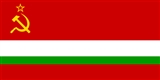
Tajik SSR

Encyclopedia
The Tajik Soviet Socialist Republic ( Respublikai Sovetii Sotsialistii Tojikiston; Tadzhikskaya Sovetskaya Sotsialisticheskaya Respublika), also known as the Tajik SSR for short, was one of the 15 republics
that made up the Soviet Union
. Located in Central Asia
, the Tajik SSR was created on 5 December 1929 as a national entity for the Tajik people within the Soviet Union. It succeeded the Tajik Autonomous Soviet Socialist Republic (Tajik ASSR), which had been created on 14 October 1924 as a part of the predominantly Turkic Uzbek SSR in the process of national delimitation in Soviet Central Asia. On 9 September 1991, Tajik SSR declared independence from the Soviet Union and was renamed the Republic of Tajikistan
.
Uzbek SSR as an Autonomous Soviet Socialist Republic (Tajik ASSR) – one rank below a Soviet Socialist Republic
in USSR geopolitical hierarchy. The new autonomous republic included what had been eastern Bukhara
and had a population of about 740,000, out of a total population of nearly 5 million in the Uzbek Soviet Socialist Republic as a whole. Its capital was established in Dyushambe (today's Dushanbe
), which had been a village of 3,000 in 1920. In December 1929, Tajik ASSR was detached from the Uzbek SSR and given full status as a Soviet Socialist Republic
– Tajik SSR. At that time, its capital was renamed Stalinabad and the territory that is now northern Tajikistan (Sughd Province) was added to the new republic. Even with the additional territory, the Tajik SSR remained the smallest Central Asia
n republic.
With the creation of a Tajik republic defined in national terms came the creation of institutions that, at least in form, were likewise national. The first Tajik-language newspaper in Soviet Tajikistan began publication in 1926. New educational institutions also began operation at about the same time. The first state schools, available to both children and adults and designed to provide basic education, opened in 1926. The central government also trained a small number of Tajiks for public office, either by putting them through courses offered by government departments or by sending them to schools in the Uzbek SSR.
The Tajik Republic was also featured in the 1985 film, "Spies Like Us
".
Republics of the Soviet Union
The Republics of the Soviet Union or the Union Republics of the Soviet Union were ethnically-based administrative units that were subordinated directly to the Government of the Soviet Union...
that made up the Soviet Union
Soviet Union
The Soviet Union , officially the Union of Soviet Socialist Republics , was a constitutionally socialist state that existed in Eurasia between 1922 and 1991....
. Located in Central Asia
Central Asia
Central Asia is a core region of the Asian continent from the Caspian Sea in the west, China in the east, Afghanistan in the south, and Russia in the north...
, the Tajik SSR was created on 5 December 1929 as a national entity for the Tajik people within the Soviet Union. It succeeded the Tajik Autonomous Soviet Socialist Republic (Tajik ASSR), which had been created on 14 October 1924 as a part of the predominantly Turkic Uzbek SSR in the process of national delimitation in Soviet Central Asia. On 9 September 1991, Tajik SSR declared independence from the Soviet Union and was renamed the Republic of Tajikistan
Tajikistan
Tajikistan , officially the Republic of Tajikistan , is a mountainous landlocked country in Central Asia. Afghanistan borders it to the south, Uzbekistan to the west, Kyrgyzstan to the north, and China to the east....
.
History
One of the new states created in the process of national delimitation of Soviet Central Asia in October 1924 was the Uzbek Soviet Socialist Republic – Uzbek SSR or Soviet Uzbekistan. Soviet Tajikistan was created at the same time within the predominantly TurkicTurkic peoples
The Turkic peoples are peoples residing in northern, central and western Asia, southern Siberia and northwestern China and parts of eastern Europe. They speak languages belonging to the Turkic language family. They share, to varying degrees, certain cultural traits and historical backgrounds...
Uzbek SSR as an Autonomous Soviet Socialist Republic (Tajik ASSR) – one rank below a Soviet Socialist Republic
Republics of the Soviet Union
The Republics of the Soviet Union or the Union Republics of the Soviet Union were ethnically-based administrative units that were subordinated directly to the Government of the Soviet Union...
in USSR geopolitical hierarchy. The new autonomous republic included what had been eastern Bukhara
Bukhara
Bukhara , from the Soghdian βuxārak , is the capital of the Bukhara Province of Uzbekistan. The nation's fifth-largest city, it has a population of 263,400 . The region around Bukhara has been inhabited for at least five millennia, and the city has existed for half that time...
and had a population of about 740,000, out of a total population of nearly 5 million in the Uzbek Soviet Socialist Republic as a whole. Its capital was established in Dyushambe (today's Dushanbe
Dushanbe
-Economy:Coal, lead, and arsenic are mined nearby in the cities of Nurek and Kulob allowing for the industrialization of Dushanbe. The Nurek Dam, the world's highest as of 2008, generates 95% of Tajikistan's electricity, and another dam, the Roghun Dam, is planned on the Vakhsh River...
), which had been a village of 3,000 in 1920. In December 1929, Tajik ASSR was detached from the Uzbek SSR and given full status as a Soviet Socialist Republic
Republics of the Soviet Union
The Republics of the Soviet Union or the Union Republics of the Soviet Union were ethnically-based administrative units that were subordinated directly to the Government of the Soviet Union...
– Tajik SSR. At that time, its capital was renamed Stalinabad and the territory that is now northern Tajikistan (Sughd Province) was added to the new republic. Even with the additional territory, the Tajik SSR remained the smallest Central Asia
Central Asia
Central Asia is a core region of the Asian continent from the Caspian Sea in the west, China in the east, Afghanistan in the south, and Russia in the north...
n republic.
With the creation of a Tajik republic defined in national terms came the creation of institutions that, at least in form, were likewise national. The first Tajik-language newspaper in Soviet Tajikistan began publication in 1926. New educational institutions also began operation at about the same time. The first state schools, available to both children and adults and designed to provide basic education, opened in 1926. The central government also trained a small number of Tajiks for public office, either by putting them through courses offered by government departments or by sending them to schools in the Uzbek SSR.
The Tajik Republic was also featured in the 1985 film, "Spies Like Us
Spies Like Us
Spies Like Us is a 1985 American comedy film directed by John Landis and starring Chevy Chase, Dan Aykroyd, Steve Forrest, and Donna Dixon...
".
External links
- Tajikistan, land of sunshine by Nazarsho Dodkhudoev