
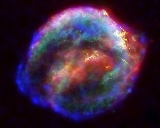
Supernova nucleosynthesis is the production of new
chemical elementA chemical element is a pure chemical substance consisting of one type of atom distinguished by its atomic number, which is the number of protons in its nucleus. Familiar examples of elements include carbon, oxygen, aluminum, iron, copper, gold, mercury, and lead.As of November 2011, 118 elements...
s inside supernovae. It occurs primarily due to explosive
nucleosynthesisNucleosynthesis is the process of creating new atomic nuclei from pre-existing nucleons . It is thought that the primordial nucleons themselves were formed from the quark–gluon plasma from the Big Bang as it cooled below two trillion degrees...
during explosive oxygen burning and silicon burning. Those fusion reactions create the elements
siliconSilicon is a chemical element with the symbol Si and atomic number 14. A tetravalent metalloid, it is less reactive than its chemical analog carbon, the nonmetal directly above it in the periodic table, but more reactive than germanium, the metalloid directly below it in the table...
,
sulfurSulfur or sulphur is the chemical element with atomic number 16. In the periodic table it is represented by the symbol S. It is an abundant, multivalent non-metal. Under normal conditions, sulfur atoms form cyclic octatomic molecules with chemical formula S8. Elemental sulfur is a bright yellow...
,
chlorineChlorine is the chemical element with atomic number 17 and symbol Cl. It is the second lightest halogen, found in the periodic table in group 17. The element forms diatomic molecules under standard conditions, called dichlorine...
,
argonArgon is a chemical element represented by the symbol Ar. Argon has atomic number 18 and is the third element in group 18 of the periodic table . Argon is the third most common gas in the Earth's atmosphere, at 0.93%, making it more common than carbon dioxide...
,
sodiumSodium is a chemical element with the symbol Na and atomic number 11. It is a soft, silvery-white, highly reactive metal and is a member of the alkali metals; its only stable isotope is 23Na. It is an abundant element that exists in numerous minerals, most commonly as sodium chloride...
,
potassiumPotassium is the chemical element with the symbol K and atomic number 19. Elemental potassium is a soft silvery-white alkali metal that oxidizes rapidly in air and is very reactive with water, generating sufficient heat to ignite the hydrogen emitted in the reaction.Potassium and sodium are...
,
calciumCalcium is the chemical element with the symbol Ca and atomic number 20. It has an atomic mass of 40.078 amu. Calcium is a soft gray alkaline earth metal, and is the fifth-most-abundant element by mass in the Earth's crust...
,
scandiumScandium is a chemical element with symbol Sc and atomic number 21. A silvery-white metallic transition metal, it has historically been sometimes classified as a rare earth element, together with yttrium and the lanthanoids...
,
titaniumTitanium is a chemical element with the symbol Ti and atomic number 22. It has a low density and is a strong, lustrous, corrosion-resistant transition metal with a silver color....
and
iron peakThe iron peak is a local maximum in the vicinity of Fe on the graph of the abundances of chemical elements, as seen below....
elements:
vanadiumVanadium is a chemical element with the symbol V and atomic number 23. It is a hard, silvery gray, ductile and malleable transition metal. The formation of an oxide layer stabilizes the metal against oxidation. The element is found only in chemically combined form in nature...
,
chromiumChromium is a chemical element which has the symbol Cr and atomic number 24. It is the first element in Group 6. It is a steely-gray, lustrous, hard metal that takes a high polish and has a high melting point. It is also odorless, tasteless, and malleable...
,
manganeseManganese is a chemical element, designated by the symbol Mn. It has the atomic number 25. It is found as a free element in nature , and in many minerals...
,
ironIron is a chemical element with the symbol Fe and atomic number 26. It is a metal in the first transition series. It is the most common element forming the planet Earth as a whole, forming much of Earth's outer and inner core. It is the fourth most common element in the Earth's crust...
,
cobaltCobalt is a chemical element with symbol Co and atomic number 27. It is found naturally only in chemically combined form. The free element, produced by reductive smelting, is a hard, lustrous, silver-gray metal....
, and
nickelNickel is a chemical element with the chemical symbol Ni and atomic number 28. It is a silvery-white lustrous metal with a slight golden tinge. Nickel belongs to the transition metals and is hard and ductile...
. As a result of their ejection from individual supernovae, their abundances grow increasingly larger within the interstellar medium. Heavy elements (heavier than nickel) are created primarily by a
neutronThe neutron is a subatomic hadron particle which has the symbol or , no net electric charge and a mass slightly larger than that of a proton. With the exception of hydrogen, nuclei of atoms consist of protons and neutrons, which are therefore collectively referred to as nucleons. The number of...
capture process known as the
r processThe r-process is a nucleosynthesis process, likely occurring in core-collapse supernovae responsible for the creation of approximately half of the neutron-rich atomic nuclei that are heavier than iron. The process entails a succession of rapid neutron captures on seed nuclei, typically Ni-56,...
. However, there are other processes thought to be responsible for some of the element
nucleosynthesisNucleosynthesis is the process of creating new atomic nuclei from pre-existing nucleons . It is thought that the primordial nucleons themselves were formed from the quark–gluon plasma from the Big Bang as it cooled below two trillion degrees...
, notably a
protonThe proton is a subatomic particle with the symbol or and a positive electric charge of 1 elementary charge. One or more protons are present in the nucleus of each atom, along with neutrons. The number of protons in each atom is its atomic number....
capture process known as the
rp processThe rp-process consists of consecutive proton captures onto seed nuclei to produce heavier elements. It is a nucleosynthesis process and, along with the s process and the r process, may be responsible for the generation of many of the heavy elements present in the universe...
and a
photodisintegrationPhotodisintegration is a physical process in which an extremely high energy gamma ray interacts with an atomic nucleus and causes it to enter an excited state, which immediately decays by emitting a subatomic particle. A single proton or neutron is effectively knocked out of the nucleus by the...
process known as the
gamma (or p) processThe term p-process is used in two ways in the scientific literature concerning the astrophysical origin of the elements . Originally it referred to a proton capture process which is the source of certain, naturally occurring, proton-rich isotopes of the elements from selenium to mercury...
. The latter synthesizes the lightest, most neutron-poor, isotopes of the heavy elements.
Supernova
A supernova is a massive explosion of a star that occurs under two principal scenarios. The first is that a
white dwarfA white dwarf, also called a degenerate dwarf, is a small star composed mostly of electron-degenerate matter. They are very dense; a white dwarf's mass is comparable to that of the Sun and its volume is comparable to that of the Earth. Its faint luminosity comes from the emission of stored...
starA star is a massive, luminous sphere of plasma held together by gravity. At the end of its lifetime, a star can also contain a proportion of degenerate matter. The nearest star to Earth is the Sun, which is the source of most of the energy on Earth...
undergoes a nuclear based explosion after it reaches its
Chandrasekhar limitWhen a star starts running out of fuel, it usually cools off and collapses into one of three compact forms, depending on its total mass:* a White Dwarf, a big lump of Carbon and Oxygen atoms, almost like one huge molecule...
from absorbing mass from a neighboring star (usually a
red giantA red giant is a luminous giant star of low or intermediate mass in a late phase of stellar evolution. The outer atmosphere is inflated and tenuous, making the radius immense and the surface temperature low, somewhere from 5,000 K and lower...
). The second, and more common, cause is when a massive star, usually a
red giantA red giant is a luminous giant star of low or intermediate mass in a late phase of stellar evolution. The outer atmosphere is inflated and tenuous, making the radius immense and the surface temperature low, somewhere from 5,000 K and lower...
, reaches Nickel-56 in its
nuclear fusionNuclear fusion is the process by which two or more atomic nuclei join together, or "fuse", to form a single heavier nucleus. This is usually accompanied by the release or absorption of large quantities of energy...
(or burning) processes. This isotope undergoes radioactive decay into
Iron-56Iron-56 is the most common isotope of iron. About 91.754% of all iron is iron-56.Of all isotopes, iron-56 has the lowest mass per nucleon. With 8.8 MeV binding energy per nucleon, iron-56 is one of the most tightly bound nuclei....
, which has one of the highest
binding energiesBinding energy is the mechanical energy required to disassemble a whole into separate parts. A bound system typically has a lower potential energy than its constituent parts; this is what keeps the system together—often this means that energy is released upon the creation of a bound state...
of all of the isotopes, and is the last element that can be produced by
nuclear fusionNuclear fusion is the process by which two or more atomic nuclei join together, or "fuse", to form a single heavier nucleus. This is usually accompanied by the release or absorption of large quantities of energy...
,
exothermicIn thermodynamics, the term exothermic describes a process or reaction that releases energy from the system, usually in the form of heat, but also in the form of light , electricity , or sound...
ally. All nuclear fusion reactions from here on are
endothermicIn thermodynamics, the word endothermic describes a process or reaction in which the system absorbs energy from the surroundings in the form of heat. Its etymology stems from the prefix endo- and the Greek word thermasi,...
and so the star loses energy. The star's gravity then pulls its outer layers rapidly inward. The star collapses very quickly, and then explodes.
Elements fused
Due to the large amounts of energy released in a supernova explosion, much higher temperatures are reached than stellar temperatures. These higher temperatures allow for an environment where
transuranium elementIn chemistry, transuranium elements are the chemical elements with atomic numbers greater than 92...
s might be formed. In
nuclear fusionNuclear fusion is the process by which two or more atomic nuclei join together, or "fuse", to form a single heavier nucleus. This is usually accompanied by the release or absorption of large quantities of energy...
processes in
stellar nucleosynthesisStellar nucleosynthesis is the collective term for the nuclear reactions taking place in stars to build the nuclei of the elements heavier than hydrogen. Some small quantity of these reactions also occur on the stellar surface under various circumstances...
, the maximum weight for an element fused is that of iron, reaching an isotope with an atomic mass of 56. Fusion of elements between silicon and iron occurs only in the largest of stars, which end as supernova explosions (see
Silicon burning processIn astrophysics, silicon burning is a very brief sequence of nuclear fusion reactions that occur in massive stars with a minimum of about 8–11 solar masses. Silicon burning is the final stage of fusion for massive stars that have run out of the fuels that power them for their long lives in the main...
). A neutron capture process known as the
s processThe S-process or slow-neutron-capture-process is a nucleosynthesis process that occurs at relatively low neutron density and intermediate temperature conditions in stars. Under these conditions the rate of neutron capture by atomic nuclei is slow relative to the rate of radioactive beta-minus decay...
which also occurs during
stellar nucleosynthesisStellar nucleosynthesis is the collective term for the nuclear reactions taking place in stars to build the nuclei of the elements heavier than hydrogen. Some small quantity of these reactions also occur on the stellar surface under various circumstances...
can create elements up to
bismuthBismuth is a chemical element with symbol Bi and atomic number 83. Bismuth, a trivalent poor metal, chemically resembles arsenic and antimony. Elemental bismuth may occur naturally uncombined, although its sulfide and oxide form important commercial ores. The free element is 86% as dense as lead...
with an atomic mass of approximately 209. However, the s process occurs primarily in low-mass stars that evolve more slowly.
The r-process
During supernova nucleosynthesis, the
r processThe r-process is a nucleosynthesis process, likely occurring in core-collapse supernovae responsible for the creation of approximately half of the neutron-rich atomic nuclei that are heavier than iron. The process entails a succession of rapid neutron captures on seed nuclei, typically Ni-56,...
(r for rapid) creates very neutron-rich heavy isotopes, which decay after the event to the first stable
isotopeIsotopes are variants of atoms of a particular chemical element, which have differing numbers of neutrons. Atoms of a particular element by definition must contain the same number of protons but may have a distinct number of neutrons which differs from atom to atom, without changing the designation...
, thereby creating the neutron-rich stable isotopes of all heavy elements. This
neutronThe neutron is a subatomic hadron particle which has the symbol or , no net electric charge and a mass slightly larger than that of a proton. With the exception of hydrogen, nuclei of atoms consist of protons and neutrons, which are therefore collectively referred to as nucleons. The number of...
capture process occurs in high neutron density with high temperature conditions. In the r process, any heavy nuclei are bombarded with a large neutron
fluxIn the various subfields of physics, there exist two common usages of the term flux, both with rigorous mathematical frameworks.* In the study of transport phenomena , flux is defined as flow per unit area, where flow is the movement of some quantity per time...
to form highly unstable neutron rich
nucleiThe nucleus is the very dense region consisting of protons and neutrons at the center of an atom. It was discovered in 1911, as a result of Ernest Rutherford's interpretation of the famous 1909 Rutherford experiment performed by Hans Geiger and Ernest Marsden, under the direction of Rutherford. The...
which very rapidly undergo
beta decayIn nuclear physics, beta decay is a type of radioactive decay in which a beta particle is emitted from an atom. There are two types of beta decay: beta minus and beta plus. In the case of beta decay that produces an electron emission, it is referred to as beta minus , while in the case of a...
to form more stable nuclei with higher
atomic numberIn chemistry and physics, the atomic number is the number of protons found in the nucleus of an atom and therefore identical to the charge number of the nucleus. It is conventionally represented by the symbol Z. The atomic number uniquely identifies a chemical element...
and the same
atomic weightAtomic weight is a dimensionless physical quantity, the ratio of the average mass of atoms of an element to 1/12 of the mass of an atom of carbon-12...
. The neutron flux is astonishingly high, about 10
22 neutrons per square centimeter per
secondThe second is a unit of measurement of time, and is the International System of Units base unit of time. It may be measured using a clock....
. First calculation of a dynamic r process, showing the evolution of calculated results with time, also suggested that the r process abundances are a superposition of differing neutron
fluenceIn physics, fluence is the flux integrated over time. For particles, it is defined as the total number of particles that intersect a unit area in a specific time interval of interest, and has units of m–2...
s. Small fluence produces the first r process abundance peak near atomic weight A=130 but no actinides, whereas large fluence produces the actinides uranium and thorium but no longer contains the A=130 abundance peak. These processes occur in a fraction of a second to a few seconds, depending on details. Hundreds of subsequent papers published have utilized this time-dependent approach. Interestingly, the only modern nearby supernova, 1987A, has not revealed r process enrichments. Modern thinking is that the r process yield may be ejected from some supernovae but swallowed up in others as part of the residual neutron star or black hole.
See also
- Critical mass
- Supernova
A supernova is a stellar explosion that is more energetic than a nova. It is pronounced with the plural supernovae or supernovas. Supernovae are extremely luminous and cause a burst of radiation that often briefly outshines an entire galaxy, before fading from view over several weeks or months...
- Nuclear decay
- Nuclear fusion
Nuclear fusion is the process by which two or more atomic nuclei join together, or "fuse", to form a single heavier nucleus. This is usually accompanied by the release or absorption of large quantities of energy...
- Nuclear fission
In nuclear physics and nuclear chemistry, nuclear fission is a nuclear reaction in which the nucleus of an atom splits into smaller parts , often producing free neutrons and photons , and releasing a tremendous amount of energy...
- Nucleosynthesis
Nucleosynthesis is the process of creating new atomic nuclei from pre-existing nucleons . It is thought that the primordial nucleons themselves were formed from the quark–gluon plasma from the Big Bang as it cooled below two trillion degrees...
- Stellar nucleosynthesis
Stellar nucleosynthesis is the collective term for the nuclear reactions taking place in stars to build the nuclei of the elements heavier than hydrogen. Some small quantity of these reactions also occur on the stellar surface under various circumstances...
- Big bang nucleosynthesis
In physical cosmology, Big Bang nucleosynthesis refers to the production of nuclei other than those of H-1 during the early phases of the universe...
Other reading
- E. M. Burbidge, G. R. Burbidge, W. A. Fowler, F. Hoyle, Synthesis of the Elements in Stars, Rev. Mod. Phys.
The Reviews of Modern Physics is a journal of the American Physical Society. The journal started in paper form. All volumes are also online by subscription.Issue 1, Volume 1 consisted of the review by...
29 (1957) 547 (article at the Physical ReviewPhysical Review is an American scientific journal founded in 1893 by Edward Nichols. It publishes original research and scientific and literature reviews on all aspects of physics. It is published by the American Physical Society. The journal is in its third series, and is split in several...
Online Archive).
- D. D. Clayton, "Handbook of Isotopes in the Cosmos", Cambridge University Press, 2003, ISBN 0 521 823811.
External links