


SuperDisk

Encyclopedia
- Not to be confused with SuperDriveSuperDriveSuperDrive is a trademark used by Apple Inc. for two different storage drives: from 1988–99 to refer to a high-density floppy disk drive capable of reading all major 3.5" disk formats; and from 2001 onwards to refer to a combined CD/DVD reader/writer....
, a trademark used by Apple Computer for various disk drive products.
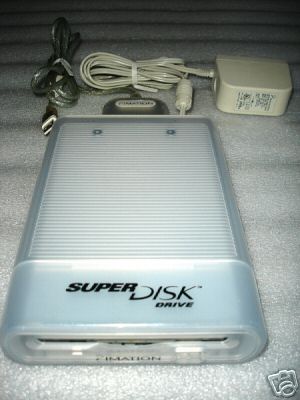
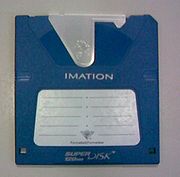
The SuperDisk, sometimes marketed as LS-120 and a later variant LS-240, is a high-speed, high-capacity alternative to the 90 mm (3.5 in), 1.44 MB
Megabyte
The megabyte is a multiple of the unit byte for digital information storage or transmission with two different values depending on context: bytes generally for computer memory; and one million bytes generally for computer storage. The IEEE Standards Board has decided that "Mega will mean 1 000...
floppy disk
Floppy disk
A floppy disk is a disk storage medium composed of a disk of thin and flexible magnetic storage medium, sealed in a rectangular plastic carrier lined with fabric that removes dust particles...
. The Superdisk hardware was introduced by 3M
3M
3M Company , formerly known as the Minnesota Mining and Manufacturing Company, is an American multinational conglomerate corporation based in Maplewood, Minnesota, United States....
's storage products group (later known as Imation
Imation
Imation is a US based multi-national technology corporation that designs, manufactures and sells recordable data storage media, consumer electronics products and accessories.The company is a 1996 spin off of 3M and is headquartered in Oakdale, Minnesota...
) circa 1997. Imation mainly sold Matsushita-built drives under the SuperDisk name; other companies tended to use the LS-120 name, and sold the Mitsubishi drives. However, the system was not a huge success. Few OEM
Original Equipment Manufacturer
An original equipment manufacturer, or OEM, manufactures products or components that are purchased by a company and retailed under that purchasing company's brand name. OEM refers to the company that originally manufactured the product. When referring to automotive parts, OEM designates a...
s supported it, aside from Compaq
Compaq
Compaq Computer Corporation is a personal computer company founded in 1982. Once the largest supplier of personal computing systems in the world, Compaq existed as an independent corporation until 2002, when it was acquired for US$25 billion by Hewlett-Packard....
.
History
The design of the SuperDisk system came from an early 1990s project at IomegaIomega
Iomega is an American producer of consumer external, portable and networking storage hardware. Established in the 1980s, Iomega has sold more than 410 million digital storage drives and disks. On April 8, 2008, EMC Corporation announced its plans to acquire Iomega for a consideration of US $213M...
. It is one of the last examples of floptical
Floptical
Floptical refers to a type of disk drive that combines magnetic and optical technologies to store large amounts of data on media similar to 3½-inch floppy disks. The name is a portmanteau of the words 'floppy' and 'optical'...
technology, where laser
Laser
A laser is a device that emits light through a process of optical amplification based on the stimulated emission of photons. The term "laser" originated as an acronym for Light Amplification by Stimulated Emission of Radiation...
s are used to guide a magnetic head which is much smaller than those used in traditional floppy disk drives. Iomega orphaned the project around the time they decided to release the Zip drive
Zip drive
The Zip drive is a medium-capacity removable disk storage system that was introduced by Iomega in late 1994. Originally, Zip disks launched with capacities of 100 MB, but later versions increased this to first 250 MB and then 750 MB....
in 1994. The idea eventually ended up at 3M, where the concept was refined and the design was licensed to established floppy drive makers Matsushita (Panasonic) and Mitsubishi
Mitsubishi
The Mitsubishi Group , Mitsubishi Group of Companies, or Mitsubishi Companies is a Japanese multinational conglomerate company that consists of a range of autonomous businesses which share the Mitsubishi brand, trademark and legacy...
. Other companies involved in the development of SuperDisk included Compaq
Compaq
Compaq Computer Corporation is a personal computer company founded in 1982. Once the largest supplier of personal computing systems in the world, Compaq existed as an independent corporation until 2002, when it was acquired for US$25 billion by Hewlett-Packard....
and OR Technology.
Matsushita continued development of the technology and released the LS-240, which was still fairly available in Asia and Australia until 2003 but is now quite rare. It has double the capacity and the added feature of being able to format regular floppy disks to 32 MB capacity. However, this higher density comes at a price - the entire disk must be rewritten any time a change is made, much like early CD-RW
CD-RW
A CD-RW is a rewritable optical disc. It was introduced in 1997, and was known as "CD-Writable" during development. It was preceded by the CD-MO, which was never commercially released....
media.
A SuperDisk drive was used in two Panasonic digital camera
Digital camera
A digital camera is a camera that takes video or still photographs, or both, digitally by recording images via an electronic image sensor. It is the main device used in the field of digital photography...
s, the PV-SD4090 and PV-SD5000, which allowed them to use both SuperDisk (LS120) and 3.5" floppy disks as the memory media.
Technical Information
The SuperDisk's format was designed to supersede the floppy disk with its higher-capacity media that imitated the then ubiquitous format with its own 120MB (and later 240MB) disk storage while the SuperDisk drive itself was backwards compatible with 1.44 MB and 720 KB floppy formats (MFMModified Frequency Modulation
Modified Frequency Modulation, commonly MFM, is a line coding scheme used to encode the actual data-bits on most floppy disk formats, hardware examples include Amiga, most CP/M machines as well as IBM PC compatibles. Early hard disk drives also used this coding.MFM is a modification to the original...
). Superdisk drives read and write faster to these sorts of disks than conventional 1.44 MB or 720 KB floppy drives, due to the faster IDE interface. The newer LS-240 drives also have the ability to read and write regular 1.44 MB floppies at much higher densities.
The true capacity of these "120 MB" drives is 120.375 MiB (963/8/32 CHS
Cylinder-head-sector
Cylinder-head-sector, also known as CHS, was an early method for giving addresses to each physical block of data on a hard disk drive. In the case of floppy drives, for which the same exact diskette medium can be truly low-level formatted to different capacities, this is still true.Though CHS...
× 512). The "240 MB" drives have a true capacity of 240.750 MiB.
SuperDisk drives have been sold in parallel port
Parallel port
A parallel port is a type of interface found on computers for connecting various peripherals. In computing, a parallel port is a parallel communication physical interface. It is also known as a printer port or Centronics port...
, USB
Universal Serial Bus
USB is an industry standard developed in the mid-1990s that defines the cables, connectors and protocols used in a bus for connection, communication and power supply between computers and electronic devices....
, ATAPI and SCSI variants. All drives can read and write 1.44 MB (an abbreviation of 1440 KiB
Kibibyte
The kibibyte is a multiple of the unit byte for quantities of digital information. The binary prefix kibi means 1024; therefore, 1 kibibyte is . The unit symbol for the kibibyte is KiB. The unit was established by the International Electrotechnical Commission in 1999 and has been accepted for use...
) and 720 KiB
Kibibyte
The kibibyte is a multiple of the unit byte for quantities of digital information. The binary prefix kibi means 1024; therefore, 1 kibibyte is . The unit symbol for the kibibyte is KiB. The unit was established by the International Electrotechnical Commission in 1999 and has been accepted for use...
MFM
Modified Frequency Modulation
Modified Frequency Modulation, commonly MFM, is a line coding scheme used to encode the actual data-bits on most floppy disk formats, hardware examples include Amiga, most CP/M machines as well as IBM PC compatibles. Early hard disk drives also used this coding.MFM is a modification to the original...
floppies, as used on PCs, Apple Macintoshes (High Density format only, see below), and many workstation
Workstation
A workstation is a high-end microcomputer designed for technical or scientific applications. Intended primarily to be used by one person at a time, they are commonly connected to a local area network and run multi-user operating systems...
s.
Imation also released a version of the SuperDisk with "Secured Encryption Technology" which uses Blowfish
Blowfish (cipher)
Blowfish is a keyed, symmetric block cipher, designed in 1993 by Bruce Schneier and included in a large number of cipher suites and encryption products. Blowfish provides a good encryption rate in software and no effective cryptanalysis of it has been found to date...
with a 64 bit key to encrypt the contents.
Criticism and obsolescence
Apple MacintoshMacintosh
The Macintosh , or Mac, is a series of several lines of personal computers designed, developed, and marketed by Apple Inc. The first Macintosh was introduced by Apple's then-chairman Steve Jobs on January 24, 1984; it was the first commercially successful personal computer to feature a mouse and a...
users' primary complaint was that the SuperDisk drive cannot read the GCR
Group Code Recording
In computer science, group code recording refers to several distinct but related encoding methods for magnetic media. The first, used in 6250 cpi magnetic tape, is an error-correcting code combined with a run length limited encoding scheme...
800K or 400K diskettes used by older Macintoshes. These disks could be used in the SuperDisk drive on a Mac, but only if formatted to PC 720K MFM format.
The biggest hurdle standing in the way of success was that Iomega's Zip drive
Zip drive
The Zip drive is a medium-capacity removable disk storage system that was introduced by Iomega in late 1994. Originally, Zip disks launched with capacities of 100 MB, but later versions increased this to first 250 MB and then 750 MB....
had been out for 3 years at that point. It had enough popularity to leave the public uninterested in SuperDisk technology despite its superior design and its compatibility with the standard floppy disk.
By 2000, the entire removable magnetic disk category quickly faced obsolescence by the falling prices of CD-R
CD-R
A CD-R is a variation of the Compact Disc invented by Philips and Sony. CD-R is a Write Once Read Many optical medium, though the whole disk does not have to be entirely written in the same session....
and CD-RW
CD-RW
A CD-RW is a rewritable optical disc. It was introduced in 1997, and was known as "CD-Writable" during development. It was preceded by the CD-MO, which was never commercially released....
drives and solid-state
Solid-state drive
A solid-state drive , sometimes called a solid-state disk or electronic disk, is a data storage device that uses solid-state memory to store persistent data with the intention of providing access in the same manner of a traditional block i/o hard disk drive...
(USB flash drive
USB flash drive
A flash drive is a data storage device that consists of flash memory with an integrated Universal Serial Bus interface. flash drives are typically removable and rewritable, and physically much smaller than a floppy disk. Most weigh less than 30 g...
s or USB keydrives), and the SuperDisk was no exception; it has since been quietly discontinued, as were the other special disks, which are becoming hard to find.
Under Windows XP
Windows XP
Windows XP is an operating system produced by Microsoft for use on personal computers, including home and business desktops, laptops and media centers. First released to computer manufacturers on August 24, 2001, it is the second most popular version of Windows, based on installed user base...
, a USB-based SuperDisk drive will appear as a 3.5" floppy disk drive, receiving either the drive letter A: (if there is no floppy in the machine) or B: (if there already is one). This enables use by software that expects a floppy drive when 1.44MB or 720KB disks are inserted. 120MB disks are also accessed via A: or B:.
External links
- http://www.itreviews.co.uk/hardware/h97.htm
- http://www.itreviews.co.uk/hardware/h309.htm
- http://markhobley.yi.org/linux/howto/ls120/
- http://findarticles.com/p/articles/mi_m0EIN/is_/ai_19857372