


Sudanic languages

Encyclopedia
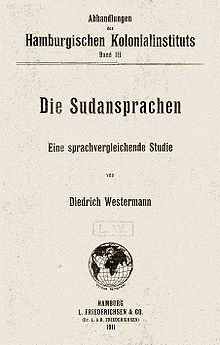
African languages
There are over 2100 and by some counts over 3000 languages spoken natively in Africa in several major language families:*Afro-Asiatic spread throughout the Middle East, North Africa, the Horn of Africa, and parts of the Sahel...
spoken in the Sahel
Sahel
The Sahel is the ecoclimatic and biogeographic zone of transition between the Sahara desert in the North and the Sudanian Savannas in the south.It stretches across the North African continent between the Atlantic Ocean and the Red Sea....
belt from Ethiopia
Ethiopia
Ethiopia , officially known as the Federal Democratic Republic of Ethiopia, is a country located in the Horn of Africa. It is the second-most populous nation in Africa, with over 82 million inhabitants, and the tenth-largest by area, occupying 1,100,000 km2...
in the east to Senegal
Senegal
Senegal , officially the Republic of Senegal , is a country in western Africa. It owes its name to the Sénégal River that borders it to the east and north...
in the west.
Scope
The grouping was based on geographic and loose typologicalLinguistic typology
Linguistic typology is a subfield of linguistics that studies and classifies languages according to their structural features. Its aim is to describe and explain the common properties and the structural diversity of the world's languages...
grounds. One of its proponents was the German linguist Carl Meinhof
Carl Meinhof
Carl Friedrich Michael Meinhof was a German linguist and one of the first linguists to study African languages.-Early years and career:...
. Meinhof had been working on the Bantu languages
Bantu languages
The Bantu languages constitute a traditional sub-branch of the Niger–Congo languages. There are about 250 Bantu languages by the criterion of mutual intelligibility, though the distinction between language and dialect is often unclear, and Ethnologue counts 535 languages...
, which have an elaborate noun-class
Noun class
In linguistics, the term noun class refers to a system of categorizing nouns. A noun may belong to a given class because of characteristic features of its referent, such as sex, animacy, shape, but counting a given noun among nouns of such or another class is often clearly conventional...
system, and he labeled all languages not in Hamito-Semitic or Bushman
Bushman
Bushman may refer to:* Bushmen, ethnic groups in Southern Africa* A colloquial term for a person who lives in the Australian bush* Bushman , a Jamaican reggae singer* Bushman , a Marvel Comics supervillain...
that lacked such a noun-class system Sudansprachen. There were two main branches; Eastern Sudanic was largely equivalent to Nilo-Saharan
Nilo-Saharan languages
The Nilo-Saharan languages are a proposed family of African languages spoken by some 50 million people, mainly in the upper parts of the Chari and Nile rivers , including historic Nubia, north of where the two tributaries of Nile meet...
sans Nilotic, and Western Sudanic to Niger–Congo
Niger–Congo languages
The Niger–Congo languages constitute one of the world's major language families, and Africa's largest in terms of geographical area, number of speakers, and number of distinct languages. They may constitute the world's largest language family in terms of distinct languages, although this question...
sans Bantu.
Background
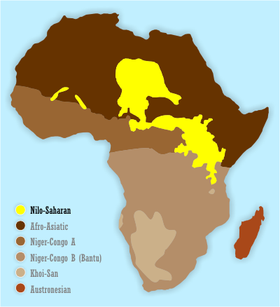
Diedrich Hermann Westermann
Diedrich Hermann Westermann was a German missionary, Africanist, and linguist. He substantially extended and revised the work of Carl Meinhof, his teacher, although he rejected some of Meinhof's theories only implicitly...
, pupil of Carl Meinhof, carried out comparative linguistic research on the then Sudanic languages during the first half of the twentieth century. In his 1911 study he established a basic division between 'East' and 'West' Sudanic, roughly comparable to today's distinction of Niger–Congo and Nilo-Saharan. His 1927 collaboration with Hermann Baumann was devoted to the historical reconstruction of the West Sudanic branch. He compared his results with Meinhof's Proto-Bantu reconstructions but did not state the obvious conclusion that they were related, perhaps out of respect for his teacher. French linguists like Delafosse
Maurice Delafosse
Maurice Delafosse was a French ethnographer and colonial official who also worked in the field of the languages of Africa...
and Homburger, not hindered by such concerns, were quite explicit about the unity of Sudanic and Bantu, mainly on the basis of synchronic lexicostatistical data. In his 1935 'Character und Einteilung der Sudansprachen', Westermann conclusively established the relationship between Bantu and West Sudanic.
Use of "Sudanic peoples" as an ethnological term
Although the language classification "Sudanic languages" is obsolete, sometimes for convenience the term "Sudanic peoples" is applied to all those Niger–Congo speaking peoples who speak languages other than the Bantu languages.See also
- Eastern Sudanic languagesEastern Sudanic languagesEhret 2001 [1984]Ehret, published in 2001 but circulating in manuscript form since at least 1984, calls the family "Eastern Sahelian", and idiosyncratically adds the Kuliak languages and Berta, which Bender assigns to higher-level branches of Nilo-Saharan, and reassigns Nyima to the southern branch...
- Mande languagesMande languagesThe Mande languages are spoken in several countries in West Africa by the Mandé people and include Mandinka, Soninke, Bambara, Bissa, Dioula, Kagoro, Bozo, Mende, Susu, Yacouba, Vai, and Ligbi...
- Nilo-Saharan languagesNilo-Saharan languagesThe Nilo-Saharan languages are a proposed family of African languages spoken by some 50 million people, mainly in the upper parts of the Chari and Nile rivers , including historic Nubia, north of where the two tributaries of Nile meet...
- Niger–Congo languagesNiger–Congo languagesThe Niger–Congo languages constitute one of the world's major language families, and Africa's largest in terms of geographical area, number of speakers, and number of distinct languages. They may constitute the world's largest language family in terms of distinct languages, although this question...