
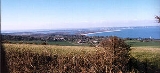
Studland is a small village on the
Isle of PurbeckThe Isle of Purbeck, not a true island but a peninsula, is in the county of Dorset, England. It is bordered by the English Channel to the south and east, where steep cliffs fall to the sea; and by the marshy lands of the River Frome and Poole Harbour to the north. Its western boundary is less well...
in the
EnglishEngland is a country that is part of the United Kingdom. It shares land borders with Scotland to the north and Wales to the west; the Irish Sea is to the north west, the Celtic Sea to the south west, with the North Sea to the east and the English Channel to the south separating it from continental...
county of
DorsetDorset , is a county in South West England on the English Channel coast. The county town is Dorchester which is situated in the south. The Hampshire towns of Bournemouth and Christchurch joined the county with the reorganisation of local government in 1974...
. It is famous for its
beachA beach is a geological landform along the shoreline of an ocean, sea, lake or river. It usually consists of loose particles which are often composed of rock, such as sand, gravel, shingle, pebbles or cobblestones...
es (named South Beach, Middle Beach and Knoll Beach) and
nature reserveFor details of National nature reserves in the United Kingdom see:*National Nature Reserves in England*National Nature Reserves in Northern Ireland*National Nature Reserves in Scotland*National Nature Reserves in Wales...
. In 2001 Studland had a population of 480, the lowest in 50 years. Many of the houses in the village have been bought up as holiday homes,
second homeSecond home may refer to:* Vacation property* Pied-à-terre* Second Home , an album by Marié Digby...
s, or guest houses, and the village's population varies depending upon the season. The village is five miles (8 km) south of the
conurbationThe South east Dorset conurbation is a multi-centred conurbation on the south coast of Dorset in England. The area is rapidly becoming an amalgamation with the area of South West Hampshire immediately on the fringe of the newly formed New Forest National Park...
of
PoolePoole is a large coastal town and seaport in the county of Dorset, on the south coast of England. The town is east of Dorchester, and Bournemouth adjoins Poole to the east. The Borough of Poole was made a unitary authority in 1997, gaining administrative independence from Dorset County Council...
and
BournemouthBournemouth is a large coastal resort town in the ceremonial county of Dorset, England. According to the 2001 Census the town has a population of 163,444, making it the largest settlement in Dorset. It is also the largest settlement between Southampton and Plymouth...
, but separated from it by
Poole HarbourPoole Harbour is a large natural harbour in Dorset, southern England, with the town of Poole on its shores. The harbour is a drowned valley formed at the end of the last ice age and is the estuary of several rivers, the largest being the Frome. The harbour has a long history of human settlement...
and the
Sandbanks FerrySandbanks Ferry is a vehicular chain ferry which crosses the entrance of Poole Harbour in the English county of Dorset. The route runs from Sandbanks to Studland and in doing so connects the coastal parts of the towns of Bournemouth and Poole with Swanage and the Isle of Purbeck...
. The village is five miles (8 km) north of the town of
SwanageSwanage is a coastal town and civil parish in the south east of Dorset, England. It is situated at the eastern end of the Isle of Purbeck, approximately 10 km south of Poole and 40 km east of Dorchester. The parish has a population of 10,124 . Nearby are Ballard Down and Old Harry Rocks,...
, over a steep
chalkChalk is a soft, white, porous sedimentary rock, a form of limestone composed of the mineral calcite. Calcite is calcium carbonate or CaCO3. It forms under reasonably deep marine conditions from the gradual accumulation of minute calcite plates shed from micro-organisms called coccolithophores....
ridge.
Geography
The bay is protected from the prevailing winds and storms by
Old Harry RocksThe Old Harry Rocks are two chalk sea stacks located at Handfast Point, on the Isle of Purbeck in Dorset, southern England.- Location :Old Harry Rocks lie directly east of Studland, about 4 kilometres northeast of Swanage, and about 10 kilometres south of the large towns of Poole and...
, the
chalkChalk is a soft, white, porous sedimentary rock, a form of limestone composed of the mineral calcite. Calcite is calcium carbonate or CaCO3. It forms under reasonably deep marine conditions from the gradual accumulation of minute calcite plates shed from micro-organisms called coccolithophores....
headlandHeadlands and bays are two related features of the coastal environment.- Geology and geography :Headlands and bays are often found on the same coastline. A bay is surrounded by land on three sides, whereas a headland is surrounded by water on three sides. Headlands are characterized by high,...
that separates Studland from
Swanage BaySwanage is a coastal town and civil parish in the south east of Dorset, England. It is situated at the eastern end of the Isle of Purbeck, approximately 10 km south of Poole and 40 km east of Dorchester. The parish has a population of 10,124 . Nearby are Ballard Down and Old Harry Rocks,...
. This has allowed, over a period of approximately 600 years, a sandy beach to be deposited against the reddened
sandstoneSandstone is a sedimentary rock composed mainly of sand-sized minerals or rock grains.Most sandstone is composed of quartz and/or feldspar because these are the most common minerals in the Earth's crust. Like sand, sandstone may be any colour, but the most common colours are tan, brown, yellow,...
cliffs, at the south end of the bay, and the
ReadingReading is a large town and unitary authority area in England. It is located in the Thames Valley at the confluence of the River Thames and River Kennet, and on both the Great Western Main Line railway and the M4 motorway, some west of London....
and
LondonLondon is the capital city of :England and the :United Kingdom, the largest metropolitan area in the United Kingdom, and the largest urban zone in the European Union by most measures. Located on the River Thames, London has been a major settlement for two millennia, its history going back to its...
clayClay is a general term including many combinations of one or more clay minerals with traces of metal oxides and organic matter. Geologic clay deposits are mostly composed of phyllosilicate minerals containing variable amounts of water trapped in the mineral structure.- Formation :Clay minerals...
formations at the north end of the bay. This deposition has led to the growth of a
psammosereA psammosere is a seral community, an ecological succession that began life on newly exposed coastal sand. Most common psammoseres are sand dune systems....
(sand dune system). The beach extends north, part way across the mouth of
Poole HarbourPoole Harbour is a large natural harbour in Dorset, southern England, with the town of Poole on its shores. The harbour is a drowned valley formed at the end of the last ice age and is the estuary of several rivers, the largest being the Frome. The harbour has a long history of human settlement...
.
Behind the sand dunes there is a large area of heathland, called Studland Heath and Poole Harbour. There is Little Sea, a freshwater lake amongst the dunes which was cut off from the sea by the development of the dunes. The lake is a haven for birds and other wildlife.
To the west of Studland Bay, there is a large area of heathland known as Godlingston Heath. Standing on a mound in the heath is the 400 tonne, 17 ft (5.2 m) high
Agglestone RockAgglestone Rock is a sandstone block of about 400 tonnes weight, perched on a conical hill, approximately 1 mile from the village of Studland, south Dorset Legend has it that the devil threw the rock from the Isle of Wight with the intention of hitting Corfe Castle.-Geology:The rock is an "eroded...
; the local myth states that the devil threw it there from the
Isle of WightThe Isle of Wight is a county and the largest island of England, located in the English Channel, on average about 2–4 miles off the south coast of the county of Hampshire, separated from the mainland by a strait called the Solent...
. In truth, it is more than likely part of a band of rocks that run across the whole of Godlingston Heath. The sandy earth was eroded around the firmer rock and left it standing proud. Other lumps in the landscape can be seen across the heath, including the Puckstone which, in years to come, may be another standing rock similar to the Agglestone.
The heath and harbour are home to
Britain'sThe United Kingdom of Great Britain and Northern IrelandIn the United Kingdom and Dependencies, other languages have been officially recognised as legitimate autochthonous languages under the European Charter for Regional or Minority Languages...
largest onshore oil field, and
BPBP p.l.c. is a global oil and gas company headquartered in London, United Kingdom. It is the third-largest energy company and fourth-largest company in the world measured by revenues and one of the six oil and gas "supermajors"...
's
Wytch FarmWytch Farm is an oil field and processing facility in the Purbeck district of Dorset, England. It is the largest onshore oil field in western Europe. The facility, operated by BP, is hidden in a coniferous forest on Wytch Heath on the southern shore of Poole Harbour, two miles north of Corfe Castle...
refineryA refinery is a production facility composed of a group of chemical engineering unit processes and unit operations refining certain materials or converting raw material into products of value.-Types of refineries:Different types of refineries are as follows:...
is hidden amongst a pine forest to the west of the heath.
Studland and Godlingston Heath NNRThe Studland and Godlingston Heaths NNR is located on the Isle of Purbeck bordering Studland Bay on the South Side of Poole Harbour, between Swanage and Sandbanks. Extending to 631ha, it is owned and managed by the National Trust following the Bankes bequest of the Kingston Lacy estate...
has been a
National Nature ReserveFor details of National nature reserves in the United Kingdom see:*National Nature Reserves in England*National Nature Reserves in Northern Ireland*National Nature Reserves in Scotland*National Nature Reserves in Wales...
since 1946, and the site is on
English NatureEnglish Nature was the United Kingdom government agency that promoted the conservation of wildlife, geology and wild places throughout England between 1990 and 2006...
's list of "Spotlight Reserves", the 31 most important reserves in England. The site is also a protected
Site of Special Scientific InterestA Site of Special Scientific Interest is a conservation designation denoting a protected area in the United Kingdom. SSSIs are the basic building block of site-based nature conservation legislation and most other legal nature/geological conservation designations in Great Britain are based upon...
,
Area of Outstanding Natural BeautyAn Area of Outstanding Natural Beauty is an area of countryside considered to have significant landscape value in England, Wales or Northern Ireland, that has been specially designated by the Countryside Agency on behalf of the United Kingdom government; the Countryside Council for Wales on...
, part of the
PurbeckPurbeck is a local government district in Dorset, England. The district is named after the Isle of Purbeck, a peninsula that forms a large proportion of the district's area. However the district extends significantly further north and west than the traditional boundary of the Isle of Purbeck along...
Heritage Coast, and a gateway to the
Jurassic CoastThe Jurassic Coast is a World Heritage Site on the English Channel coast of southern England. The site stretches from Orcombe Point near Exmouth in East Devon to Old Harry Rocks near Swanage in East Dorset, a distance of ....
World Heritage SiteA UNESCO World Heritage Site is a place that is listed by the UNESCO as of special cultural or physical significance...
. The site is one of only a few places (mostly in
DorsetDorset , is a county in South West England on the English Channel coast. The county town is Dorchester which is situated in the south. The Hampshire towns of Bournemouth and Christchurch joined the county with the reorganisation of local government in 1974...
) in Britain which is home to all
six native reptileReptiles are members of a class of air-breathing, ectothermic vertebrates which are characterized by laying shelled eggs , and having skin covered in scales and/or scutes. They are tetrapods, either having four limbs or being descended from four-limbed ancestors...
species. The site is owned and managed by the
National TrustThe National Trust for Places of Historic Interest or Natural Beauty, usually known as the National Trust, is a conservation organisation in England, Wales and Northern Ireland...
, who clear scrub, keep the beach tidy, and carefully manage the millions of visitors the site gets each summer.
The area is just across Poole Harbour from the
conurbationA conurbation is a region comprising a number of cities, large towns, and other urban areas that, through population growth and physical expansion, have merged to form one continuous urban and industrially developed area...
of
PoolePoole is a large coastal town and seaport in the county of Dorset, on the south coast of England. The town is east of Dorchester, and Bournemouth adjoins Poole to the east. The Borough of Poole was made a unitary authority in 1997, gaining administrative independence from Dorset County Council...
,
BournemouthBournemouth is a large coastal resort town in the ceremonial county of Dorset, England. According to the 2001 Census the town has a population of 163,444, making it the largest settlement in Dorset. It is also the largest settlement between Southampton and Plymouth...
and
ChristchurchChristchurch is a borough and town in the county of Dorset on the south coast of England. The town adjoins Bournemouth in the west and the New Forest lies to the east. Historically in Hampshire, it joined Dorset with the reorganisation of local government in 1974 and is the most easterly borough in...
. The five mile long beach is close enough to be convenient and accessible, but far enough to be free from the pollution and sewage associated with urban beaches. This and the careful management by the National Trust and calm shallow waters make it one of the most popular beaches in the country, and on hot summer weekends the beach fills up with thousands of people. The National Trust have restricted parking provision at the site to prevent overcrowding. A short northern stretch of the beach is reserved as a naturist beach.
The final stage of the
South West Coast PathThe South West Coast Path is Britain's longest waymarked long-distance footpath and a National Trail. It stretches for , running from Minehead in Somerset, along the coasts of Devon and Cornwall, to Poole Harbour in Dorset. Since it rises and falls with every river mouth, it is also one of the more...
(if walked in the conventional anti-clockwise direction, starting at
MineheadMinehead is a coastal town and civil parish in Somerset, England. It lies on the south bank of the Bristol Channel, north-west of the county town of Taunton, from the border with the county of Devon and in proximity of the Exmoor National Park...
,
SomersetThe ceremonial and non-metropolitan county of Somerset in South West England borders Bristol and Gloucestershire to the north, Wiltshire to the east, Dorset to the south-east, and Devon to the south-west. It is partly bounded to the north and west by the Bristol Channel and the estuary of the...
) follows Studland Bay and ends at South Haven Point, where a sculpture marks the end.
History
The
Royal National Institution for the Preservation of Life from ShipwreckThe Royal National Lifeboat Institution is a charity that saves lives at sea around the coasts of Great Britain, Ireland, the Channel Islands and the Isle of Man, as well as on selected inland waterways....
stationed a
lifeboatA rescue lifeboat is a boat rescue craft which is used to attend a vessel in distress, or its survivors, to rescue crewmen and passengers. It can be hand pulled, sail powered or powered by an engine...
at Studland in 1826, but it was withdrawn in 1848.
World War II
In 1940, the coastline at Studland Bay was one of the two stretches of Dorset coast where a German invasion was considered most likely and it was fortified as a part of
British anti-invasion preparations of World War IIBritish anti-invasion preparations of the Second World War entailed a large-scale division of military and civilian mobilisation in response to the threat of invasion by German armed forces in 1940 and 1941. The British army needed to recover from the defeat of the British Expeditionary Force in...
.
The village and beach were used as a training area before the
D-DayD-Day is a term often used in military parlance to denote the day on which a combat attack or operation is to be initiated. "D-Day" often represents a variable, designating the day upon which some significant event will occur or has occurred; see Military designation of days and hours for similar...
landing in the Second World War. On top of Redend Point, a small sandstone cliff which splits the beach in two at high tide, is Fort Henry. Built in 1943 by
CanadianCanada is a North American country consisting of ten provinces and three territories. Located in the northern part of the continent, it extends from the Atlantic Ocean in the east to the Pacific Ocean in the west, and northward into the Arctic Ocean...
engineers, it is 90 feet (27.4 m) long, with 3 foot (0.9144 m) walls and an 80 feet (24.4 m) recessed observation slit.
On April 18, 1944,
King George VIGeorge VI was King of the United Kingdom and the Dominions of the British Commonwealth from 11 December 1936 until his death...
, General Sir Bernard Montgomery and General
Dwight D. EisenhowerDwight David "Ike" Eisenhower was the 34th President of the United States, from 1953 until 1961. He was a five-star general in the United States Army...
, met here to observe the training troops and discuss the plans for the coming battle.
Beach management
In January 2004 the
BBCThe British Broadcasting Corporation is a British public service broadcaster. Its headquarters is at Broadcasting House in the City of Westminster, London. It is the largest broadcaster in the world, with about 23,000 staff...
televisionTelevision is a telecommunication medium for transmitting and receiving moving images that can be monochrome or colored, with accompanying sound...
series
The National TrustThe National Trust is a ten-part BBC television documentary examining various aspects of National Trust, first aired in 2005.Among the National Trust properties presented were Studland Beach & Nature Reserve, where local residents experience severe problems with the Trust, 251 Menlove Avenue, John...
investigated the conflicts between different groups of people who use the beach and heath at Studland. The series particularly covered the debate about
coastal managementIn some jurisdictions the terms sea defense and coastal protection are used to mean, respectively, defense against flooding and erosion...
at Studland. At present the cliffs and beach side shops are protected by rock walls (coastal defences). The National Trust proposes removing these defences to allow natural processes to shape the coastline. The popular Middle Beach Cafe which sits on the top of the rock gabions at the southern end of Middle Beach will fall into the sea in the next ten years if the defences are left to nature.
As of, and during, September 2010, large quantities of washed-up seaweed could be found in the margin between sea and beach between Shell Bay and Middle Beach. Although thought to be a natural accumulation it is not a typical seasonal occurrence.
Wildlife
Studland is a popular area for birdwatching, with Little Sea, Studland Heath, Brand's Bay, Shell Bay & Studland Bay being the best areas. Studland Bay is particularly good for rarer grebes and divers in winter, with up to 20
Black-necked GrebeThe Black-necked Grebe, Podiceps nigricollis, known in North America as the Eared Grebe, is a member of the grebe family of water birds. It occurs on every continent except Australia and Antarctica.-Taxonomy:There are three subspecies:*P. n...
and 5
Great Northern DiverThe Great Northern Loon, Great Northern Diver, or Common Loon , is a large member of the loon, or diver, family of birds...
recorded. The Studland Peninsula is also one of the best places to see
Dartford WarblerThe Dartford Warbler, Sylvia undata, is a typical warbler from the warmer parts of western Europe, and northwestern Africa. Its breeding range lies west of a line from southern England to the heel of Italy...
in the UK with 130 pairs nesting on the heath, this is about 7% of the UK population. It is the only place on the
British IslesThe British Isles are a group of islands off the northwest coast of continental Europe that include the islands of Great Britain and Ireland and over six thousand smaller isles. There are two sovereign states located on the islands: the United Kingdom of Great Britain and Northern Ireland and...
where all 6 native species of reptile can be found. Two species of
SeahorseSeahorses compose the fish genus Hippocampus within the family Syngnathidae, in order Syngnathiformes. Syngnathidae also includes the pipefishes. "Hippocampus" comes from the Ancient Greek hippos meaning "horse" and kampos meaning “sea monster”.There are nearly 50 species of seahorse...
the spiny seahorse, Hippocampus guttulatus and the short-snouted seahorse, Hippocampus hippocampus have been discovered in Studland Bay, specifically a
seagrassSeagrasses are flowering plants from one of four plant families , all in the order Alismatales , which grow in marine, fully saline environments.-Ecology:...
meadow at the southern end of the beach.
Anecdotal evidence from residents reported in the Studland Parish Magazine indicates that both types of seahorse have been found in the bay since at least the 1970s, possibly encouraged by the reputed growth in the seagrass beds.
Studland in popular culture
- Egdon Heath
Egdon Heath is a fictitious area of Thomas Hardy's Wessex inhabited sparsely by the people who cut the furze that grows there. The entire action of Hardy's novel The Return of the Native takes place on Egdon Heath, and it also features in The Mayor of Casterbridge and the short story The Withered...
, which figures prominently in Thomas HardyThomas Hardy, OM was an English novelist and poet. While his works typically belong to the Naturalism movement, several poems display elements of the previous Romantic and Enlightenment periods of literature, such as his fascination with the supernatural.While he regarded himself primarily as a...
's celebrated novel The Return of the NativeThe Return of the Native is Thomas Hardy's sixth published novel. It first appeared in the magazine Belgravia, a publication known for its sensationalism, and was presented in twelve monthly installments from January to December 1878...
, is a fictionalised version of Studland Heath.
- The beach, with Bournemouth in the background, was the setting of the opening scene from the first episode of Monty Python's Flying Circus
Monty Python’s Flying Circus is a BBC TV sketch comedy series. The shows were composed of surreality, risqué or innuendo-laden humour, sight gags and observational sketches without punchlines...
with Michael PalinMichael Edward Palin, CBE FRGS is an English comedian, actor, writer and television presenter best known for being one of the members of the comedy group Monty Python and for his travel documentaries....
staggering out of the shallow sea and collapsing on the beach before saying "It's...".
- The video for the Coldplay
Coldplay are a British alternative rock band formed in 1996 by lead vocalist Chris Martin and lead guitarist Jonny Buckland at University College London. After they formed Pectoralz, Guy Berryman joined the group as a bassist and they changed their name to Starfish. Will Champion joined as a...
single "Yellow" was filmed on the beach.
.
External links