
The
United States presidential election of 1860 set the stage for the
American Civil WarThe American Civil War , also known as the War Between the States and several other names, was a civil war in the United States of America. Eleven Southern slave states declared their secession from the United States and formed the Confederate States of America...
. The nation had been divided throughout most of the 1850s on questions of states' rights and
slaverySlavery is a form of forced labor in which people are considered to be the property of others. Slaves can be held against their will from the time of their capture, purchase or birth, and deprived of the right to leave, to refuse to work, or to receive compensation...
in the territories. In 1860 this issue finally came to a head, fracturing the formerly dominant Democratic Party into Southern and Northern factions and bringing
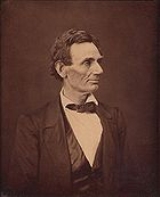
Abraham LincolnAbraham Lincoln was the 16th President of the United States, serving from March 1861 until his assassination in April 1865. He successfully led his country through its greatest internal crisis, the American Civil War, preserving the Union and ending slavery...
and the
Republican PartyThe United States Republican Party is the second oldest currently existing political party in the United States.-Creation:The Republican Party organized in 1854...
to power without the support of a single Southern state.
Hardly more than a month following Lincoln's victory came declarations of
secessionAttempts or aspirations of secession from the United States have been a feature of the politics of the country since its birth. The line between actions based on an alleged constitutional right of secession as opposed to actions justified by the extraconstitutional natural right of revolution has...
by South Carolina and other states, which were rejected as illegal by the then-current President,
James BuchananJames Buchanan, Jr. was the 15th President of the United States from 1857–1861 and the last to be born in the 18th century...
and President-elect Abraham Lincoln.
Background
The origins of the American Civil War lay in the complex issues of slavery, competing understandings of
federalismFederalism is political philosophy in which a group of members are bound together with a governing representative head. The term federalism is also used to describe a system of the government in which sovereignty is constitutionally divided between a central governing authority and constituent...
,
party politicsThe Second Party System is a term of periodization used by historians and political scientists to name the political system existing in the United States from about 1828 to 1854...
,
expansionismManifest Destiny is a term that was used in the 19th century to designate the belief that the United States was destined, even divinely ordained, to expand across the North American continent, from the Atlantic seaboard to the Pacific Ocean...
,
sectionalism-Defined:Sectionalism is loyalty to the interests of one's own region or section of the country, rather than the nation as a whole.-Historical examples:...
, tariffs,
economicsThe Panic of 1857 was a sudden downturn in the economy of the United States that occurred in 1857. A general recession first emerged late in 1856, but the successive failure of banks and businesses that characterized the panic began in mid-1857. While the overall economic downturn was brief, the...
, and modernization in the Antebellum Period.
After the Mexican-American War, the issue of slavery in the new
territoriesThis is a list of historic regions of the United States, defined as regions that were legal entities in the past.-Colonial era :-The Thirteen Colonies:* Province of New Hampshire* Province of Massachusetts Bay...
led to the
Compromise of 1850The Compromise of 1850 was a complex package of five bills, passed in September 1850, defusing a four-year confrontation between the slave states of the South and the free states of the North that arose from expectation of territorial expansion of the United States with the Texas Annexation and...
. While the compromise averted an immediate political crisis, it did not permanently resolve the issue of The Slave Power (the power of slaveholders to control the national government).
Amid the emergence of increasingly virulent and hostile sectional ideologies in national politics, the collapse of the old
Second Party SystemThe Second Party System is a term of periodization used by historians and political scientists to name the political system existing in the United States from about 1828 to 1854...
in the 1850s hampered efforts of the politicians to reach yet another compromise. The result was the
Kansas-Nebraska ActIn United States history, the Kansas-Nebraska Act of 1854 created the territories of Kansas and Nebraska, opened new lands, repealed the Missouri Compromise of 1820, and allowed settlers in those territories to determine if they would allow slavery within their boundaries...
, which alienated Northerners and Southerners alike. With the rise of the
Republican PartyThe United States Republican Party is the second oldest currently existing political party in the United States.-Creation:The Republican Party organized in 1854...
, the first truly sectional major party, the industrializing North and agrarian Midwest became committed to the economic ethos of free-labor industrial capitalism.
Republican Party nomination
Republican candidates:
- Abraham Lincoln
Abraham Lincoln was the 16th President of the United States, serving from March 1861 until his assassination in April 1865. He successfully led his country through its greatest internal crisis, the American Civil War, preserving the Union and ending slavery...
, former U.S. representative from IllinoisIllinois , the 21st state admitted to the United States of America, is the most populous and demographically diverse Midwestern state and the fifth most populous state in the nation...
- William H. Seward
William Henry Seward, Sr. was a Governor of New York, United States Senator and the United States Secretary of State under Abraham Lincoln and Andrew Johnson...
, U.S. senator from New YorkNew York is a state in the Mid-Atlantic and Northeastern regions of the United States and is the nation's third most populous. The state is bordered by New Jersey and Pennsylvania to the south, and Connecticut, Massachusetts and Vermont to the east...
- Simon Cameron
Simon Cameron was an American politician who served as United States Secretary of War for Abraham Lincoln at the start of the American Civil War. After making his fortune in railways and banking, he turned to a life of politics. He became a U.S. senator in 1845 for the state of Pennsylvania,...
, U.S. senator from PennsylvaniaThe Commonwealth of Pennsylvania , often colloquially referred to as PA by natives and Northeasterners, is a state located in the Northeastern and Middle Atlantic regions of the United States...
- Salmon P. Chase
Salmon Portland Chase was an American politician and jurist in the Civil War era who served as U.S. Senator from Ohio and Governor of Ohio; as U.S...
, former U.S. governor and senator from OhioOhio is a Midwestern state of the United States. The thirty-fourth largest state by area in the U.S., it is the seventh-most populous with nearly 11.5 million residents...
- Edward Bates
Edward Bates was a U.S. lawyer and statesman. He served as United States Attorney General under Abraham Lincoln from 1861 to 1864. He was also the brother of both Frederick Bates and James Woodson Bates.-Biography:...
, former U.S. representative from MissouriMissouri is a state in the Midwest region of the United States bordered by Iowa, Illinois, Kentucky, Tennessee, Arkansas, Oklahoma, Kansas and Nebraska. Missouri is the 18th most populous state with a 2008 estimated population of 5,911,605. It comprises 114 counties and one independent city....
Candidates gallery
The
Republican National ConventionThe Republican National Convention is the presidential nominating convention of the Republican Party of the United States. Convened by the Republican National Committee, the stated purpose of the convocation is to nominate an official candidate in an upcoming U.S...
met in mid-May, after the Democrats had been forced to adjourn their convention in Charleston. With the Democrats in disarray and with a sweep of the Northern states possible, the
RepublicansThe United States Republican Party is the second oldest currently existing political party in the United States.-Creation:The Republican Party organized in 1854...
were confident going into their convention in
ChicagoChicago is the largest city in the U.S. state of Illinois, and with more than 2.8 million people, the 3rd largest city in the United States...
.
William H. SewardWilliam Henry Seward, Sr. was a Governor of New York, United States Senator and the United States Secretary of State under Abraham Lincoln and Andrew Johnson...
of New York was considered the front runner, followed by
Abraham LincolnAbraham Lincoln was the 16th President of the United States, serving from March 1861 until his assassination in April 1865. He successfully led his country through its greatest internal crisis, the American Civil War, preserving the Union and ending slavery...
of Illinois,
Salmon P. ChaseSalmon Portland Chase was an American politician and jurist in the Civil War era who served as U.S. Senator from Ohio and Governor of Ohio; as U.S...
of Ohio, and Missouri's
Edward BatesEdward Bates was a U.S. lawyer and statesman. He served as United States Attorney General under Abraham Lincoln from 1861 to 1864. He was also the brother of both Frederick Bates and James Woodson Bates.-Biography:...
.
As the convention developed, however, it was revealed that Seward, Chase, and Bates had each alienated factions of the Republican Party. Delegates were concerned that Seward was too closely identified with the radical wing of the party, and his moves toward the center had alienated the radicals. Chase, a former Democrat, had alienated many of the former
WhigsThe Whig Party was a political party of the United States during the era of Jacksonian democracy. Considered integral to the Second Party System and operating from 1833 to 1856, the party was formed in opposition to the policies of President Andrew Jackson and the Democratic Party...
by his coalition with the Democrats in the late 1840s, had opposed tariffs demanded by
PennsylvaniaThe Commonwealth of Pennsylvania , often colloquially referred to as PA by natives and Northeasterners, is a state located in the Northeastern and Middle Atlantic regions of the United States...
, and critically, had opposition from his own delegation from
OhioOhio is a Midwestern state of the United States. The thirty-fourth largest state by area in the U.S., it is the seventh-most populous with nearly 11.5 million residents...
. Bates outlined his positions on extension of slavery into the territories and equal constitutional rights for all citizens, positions that alienated his supporters in the border states and southern conservatives.
German AmericanGerman Americans are Americans of German descent. They form the largest self-reported ancestry group in the United States, outnumbering the Irish and English. They account for 50 million people, or 17% of the U.S. population...
s in the party opposed Bates because of his past association with the
Know NothingThe Know Nothing movement was a nativist American political movement of the 1840s and 1850s. It was empowered by popular fears that the country was being overwhelmed by Irish Catholic immigrants, who were often regarded as hostile to U.S. values and controlled by the Pope in Rome...
s.
Since it was essential to carry the West, and because Lincoln had a national reputation from his debates and speeches as the most articulate moderate, he won the party's nomination on the third ballot on May 18, 1860. Senator
Hannibal HamlinHannibal Hamlin was the 15th Vice President of the United States, serving under President Abraham Lincoln from 1861-1865...
of
MaineThe State of Maine is a state in the New England region of the northeastern United States, bordering the Atlantic Ocean to the southeast, New Hampshire to the southwest, and the Canadian provinces of Quebec to the northwest and New Brunswick to the northeast. Maine is the northernmost portion of...
was nominated for vice president, defeating Cassius Clay of
KentuckyThe Commonwealth of Kentucky is a state located in the East Central United States of America. Kentucky is a Southern state situated in the Upland South, although the state is infrequently placed, geographically and culturally, in the Midwest. Kentucky is one of four U.S. states constituted as a...
.
| Presidential Ballot |
| Nominee | 1st | 2nd | 3rd | 3rd "corrected" |
Abraham LincolnAbraham Lincoln was the 16th President of the United States, serving from March 1861 until his assassination in April 1865. He successfully led his country through its greatest internal crisis, the American Civil War, preserving the Union and ending slavery... | 102 | 181 | 231.5 | 349 |
William H. SewardWilliam Henry Seward, Sr. was a Governor of New York, United States Senator and the United States Secretary of State under Abraham Lincoln and Andrew Johnson... | 173.5 | 184.5 | 180 | 111.5 |
Simon CameronSimon Cameron was an American politician who served as United States Secretary of War for Abraham Lincoln at the start of the American Civil War. After making his fortune in railways and banking, he turned to a life of politics. He became a U.S. senator in 1845 for the state of Pennsylvania,... | 50.5 | 2 | 0 | 0 |
Salmon P. ChaseSalmon Portland Chase was an American politician and jurist in the Civil War era who served as U.S. Senator from Ohio and Governor of Ohio; as U.S... | 49 | 42.5 | 24.5 | 2 |
Edward BatesEdward Bates was a U.S. lawyer and statesman. He served as United States Attorney General under Abraham Lincoln from 1861 to 1864. He was also the brother of both Frederick Bates and James Woodson Bates.-Biography:... | 48 | 35 | 22 | 0 |
William L. DaytonWilliam Lewis Dayton was an American politician.A distant relation of U.S. House Speaker and U.S. Constitution signatory Jonathan Dayton, he was born in Basking Ridge, New Jersey to farmer Joel Dayton and his wife... | 14 | 10 | 1 | 1 |
| John McLean John McLean was an American jurist and politician who served in the United States Congress, as U.S. Postmaster General, and as a justice on the Ohio and U.S... | 12 | 8 | 5 | 0.5 |
Jacob CollamerJacob Collamer was an American politician from Vermont.Jacob Collamer was born in Troy, New York. He graduated from the University of Vermont at Burlington, served in the War of 1812, studied law in St. Albans, Vermont, was admitted to the bar in 1813, and served as an officer in a militia unit... | 10 | 0 | 0 | 0 |
| Benjamin F. Wade | 3 | 0 | 0 | 0 |
| Cassius M. Clay | 0 | 2 | 1 | 1 |
John C. FremontJohn Charles Frémont , was an American military officer, explorer, the first candidate of the Republican Party for the office of President of the United States, and the first presidential candidate of a major party to run on a platform in opposition to slavery... | 1 | 0 | 0 | 0 |
| John M. Read John Meredith Read was an American lawyer, jurist, and politician from Philadelphia, Pennsylvania. He was one of the founders of the Republican Party and Chief Justice of the Pennsylvania Supreme Court.... | 1 | 0 | 0 | 0 |
Charles SumnerCharles Sumner was an American politician and statesman from Massachusetts. An academic lawyer and a powerful orator, Sumner was the leader of the antislavery forces in Massachusetts and a leader of the Radical Republicans in the United States Senate during the American Civil War and... | 1 | 0 | 0 | 0 |
| Vice Presidential Ballot |
| Ballot | 1st | 2nd |
Hannibal HamlinHannibal Hamlin was the 15th Vice President of the United States, serving under President Abraham Lincoln from 1861-1865... | 194 | 367 |
| Cassius M. Clay | 100.5 | 86 |
| John Hickman John Hickman was a Republican, Democratic and Anti-Lecompton Democratic member of the U.S. House of Representatives from Pennsylvania.-Early life:... | 57 | 13 |
| Andrew Horatio Reeder Andrew Horatio Reeder was the first governor of the Territory of Kansas.Reeder was born in Easton, Pennsylvania, to Absolom Reeder and Christina Reeder. He was educated at an academy in Lawrenceville, New Jersey. He read law in a Pennsylvania law office and was admitted to the bar there in 1828.... | 51 | 0 |
Nathaniel Prentice BanksNathaniel Prentice Banks was an American politician and soldier, served as Governor of Massachusetts, Speaker of the U.S. House of Representatives and as a Union general during the American Civil War.... | 38.5 | 0 |
| Henry Winter Davis Henry Winter Davis was a United States Representative from the 4th and 3rd congressional districts of Maryland, well known as one of the Radical Republicans during the Civil War.-Early life and career:... | 8 | 0 |
Sam HoustonSamuel Houston was a 19th century American statesman, politician, and soldier. Born on Timber Ridge, just north of Lexington in Rockbridge County, Virginia, in the Shenandoah Valley, Houston was a key figure in the history of Texas, including periods as President of the Republic of Texas, Senator... | 6 | 0 |
William L. DaytonWilliam Lewis Dayton was an American politician.A distant relation of U.S. House Speaker and U.S. Constitution signatory Jonathan Dayton, he was born in Basking Ridge, New Jersey to farmer Joel Dayton and his wife... | 3 | 0 |
| John M. Reed | 1 | 0 |
The party platform clearly stated that
slaverySlavery is a form of forced labor in which people are considered to be the property of others. Slaves can be held against their will from the time of their capture, purchase or birth, and deprived of the right to leave, to refuse to work, or to receive compensation...
would not be allowed to spread any further, and it also promised that tariffs protecting industry would be imposed, a
Homestead ActThe Homestead Act was a United States Federal law that gave an applicant freehold title up to 160 acres of undeveloped land outside of the original 13 colonies. The new law required three steps: file an application, improve the land, and file for deed of title. Anyone who had never taken up arms...
granting free farmland in the West to settlers, and the funding of a
transcontinental railroadA Transcontinental Railroad is a railroad that crosses a continent from "coast-to-coast". Terminals are at or connected to different oceans. Because Europe is criss-crossed by railways, railroads within Europe are usually not considered transcontinental, the Orient Express perhaps being an...
. All of these provisions were highly unpopular in the South.
Northern Democratic Party nomination
Northern Democratic candidates:
- Stephen A. Douglas
Stephen Arnold Douglas , son of Stephen Arnold Douglass and Sarah Fisk, was an American politician from the western state of Illinois, and was the Democratic Party nominee for President in 1860. He lost to the Republican Party's candidate, Abraham Lincoln, whom he had defeated two years earlier in...
, U.S. senator from IllinoisIllinois , the 21st state admitted to the United States of America, is the most populous and demographically diverse Midwestern state and the fifth most populous state in the nation...
- James Guthrie, former U.S. Treasury Secretary from Kentucky
The Commonwealth of Kentucky is a state located in the East Central United States of America. Kentucky is a Southern state situated in the Upland South, although the state is infrequently placed, geographically and culturally, in the Midwest. Kentucky is one of four U.S. states constituted as a...
- Robert M. T. Hunter, U.S. senator from Virginia
The Commonwealth of Virginia is a U.S. state on the Atlantic Coast of the Southern United States. Virginia is nicknamed the "Old Dominion" and sometimes the "Mother of Presidents" because it is the birthplace of eight U.S. presidents. The geography and climate of the state are shaped by the Blue...
- Joseph Lane
Joseph Lane was an American general during the Mexican-American War and a United States Senator from Oregon.-Early life:...
, U.S. senator from OregonOregon is a state in the Pacific Northwest region of the United States. It is located on the Pacific coast, with Washington to the north, California to the south, Nevada on the southeast and Idaho to the east. The Columbia and Snake rivers delineate much of Oregon's northern and eastern...
- Daniel S. Dickinson
Daniel Stevens Dickinson was a New York politician, most notable as a United States Senator from 1844 to 1851.-Biography:...
, former U.S. senator from New YorkNew York is a state in the Mid-Atlantic and Northeastern regions of the United States and is the nation's third most populous. The state is bordered by New Jersey and Pennsylvania to the south, and Connecticut, Massachusetts and Vermont to the east...
- Andrew Johnson
Andrew Johnson , the 17th President of the United States , was the first U.S. President to be impeached, as well as the first U.S. president to succeed to the presidency upon the assassination of his predecessor.At the time of the secession of the Southern states, Johnson was a U.S. Senator from...
, U.S. senator from TennesseeTennessee is a state located in the Southeastern United States. According to the 2008 census, it has a population of 6,214,888, an increase of nearly 9.5% since 2000. Tennessee is the 14th fastest growing state in the US and is ranked 17th by population. It is ranked 36th by total land area. In...
Candidates gallery
The
Democratic PartyThe Democratic Party is one of the two major contemporary political parties in the United States, along with the Republican Party. It is the oldest political party in continuous operation in the United States and it is one of the oldest parties in the world. In the U.S...
was divided over the issue of slavery. At the convention in Charleston in April 1860, 51 Southern Democrats walked out over a platform dispute, led by
William Lowndes YanceyWilliam Lowndes Yancey was a journalist, politician, orator, diplomat and an American leader of the Southern secession movement. A member of the group known as the Fire-Eaters, Yancey was one of the most effective agitators for secession and rhetorical defenders of slavery. An early critic of...
. Yancey and the Alabama delegation left the hall and they were followed by the delegates of Alabama, Florida, Georgia, Louisiana, Mississippi, South Carolina, Texas, three of the four delegates from Arkansas, and one of the three delegates from Delaware.
Six candidates were nominated:
Stephen A. DouglasStephen Arnold Douglas , son of Stephen Arnold Douglass and Sarah Fisk, was an American politician from the western state of Illinois, and was the Democratic Party nominee for President in 1860. He lost to the Republican Party's candidate, Abraham Lincoln, whom he had defeated two years earlier in...
of
IllinoisIllinois , the 21st state admitted to the United States of America, is the most populous and demographically diverse Midwestern state and the fifth most populous state in the nation...
, James Guthrie of Kentucky,
Robert Mercer Taliaferro HunterRobert Mercer Taliaferro Hunter American statesman, was born in Essex County, Virginia.-Career:
He entered the University of Virginia in his seventeenth year and was one of its first graduates; he then studied law at the Winchester Law School, and in 1830 was admitted to the bar...
of Virginia,
Joseph LaneJoseph Lane was an American general during the Mexican-American War and a United States Senator from Oregon.-Early life:...
of Oregon,
Daniel S. DickinsonDaniel Stevens Dickinson was a New York politician, most notable as a United States Senator from 1844 to 1851.-Biography:...
of New York, and
Andrew JohnsonAndrew Johnson , the 17th President of the United States , was the first U.S. President to be impeached, as well as the first U.S. president to succeed to the presidency upon the assassination of his predecessor.At the time of the secession of the Southern states, Johnson was a U.S. Senator from...
of Tennessee. Douglas, a moderate on the slavery issue who favored "
popular sovereigntyPopular sovereignty or the sovereignty of the people is the belief that the legitimacy of the state is created by the will or consent of its people, who are the source of all political power. It is closely associated with the social contract philosophers, among whom are Thomas Hobbes, John Locke,...
", was ahead on the first ballot, needing 56.5 more votes. On the 57th ballot, Douglas was still ahead, but still 50.5 votes short of nomination. In desperation, on May 3 the delegates agreed to stop voting and adjourn the convention.
| Charleston Presidential Ballot |
| Ballot | 1st | 2nd | 3rd | 4th | 5th | 6th | 7th | 8th | 9th | 10th | 11th | 12th | 13th | 14th | 15th | 16th | 17th | 18th | 19th | 20th | 21st | 22nd | 23rd | 24th | 25th | 26th | 27th | 28th | 29th |
Stephen A. DouglasStephen Arnold Douglas , son of Stephen Arnold Douglass and Sarah Fisk, was an American politician from the western state of Illinois, and was the Democratic Party nominee for President in 1860. He lost to the Republican Party's candidate, Abraham Lincoln, whom he had defeated two years earlier in... | 145.5 | 147 | 148.5 | 149 | 149.5 | 149.5 | 150.5 | 150.5 | 150.5 | 150.5 | 150.5 | 150.5 | 149.5 | 150 | 150 | 150 | 150 | 150 | 150 | 150 | 150.5 | 150.5 | 152.5 | 151.5 | 151.5 | 151.5 | 151.5 | 151.5 | 151.5 |
| James Guthrie | 35.5 | 36.5 | 42 | 37.5 | 37.5 | 39.5 | 38.5 | 38.5 | 41 | 39.5 | 39.5 | 39.5 | 39.5 | 41 | 41.5 | 42 | 42 | 41.5 | 41.5 | 42 | 41.5 | 41.5 | 41.5 | 41.5 | 41.5 | 41.5 | 42.5 | 42 | 42 |
| Robert M. T. Hunter | 42 | 41.5 | 36 | 41.5 | 41 | 41 | 41 | 40.5 | 39.5 | 39 | 38 | 38 | 28.5 | 27 | 26.5 | 26 | 26 | 26 | 26 | 26 | 26 | 26 | 25 | 25 | 35 | 25 | 25 | 25 | 25 |
Joseph LaneJoseph Lane was an American general during the Mexican-American War and a United States Senator from Oregon.-Early life:... | 6 | 6 | 6 | 6 | 6 | 7 | 6 | 6 | 6 | 5.5 | 6.5 | 6.5 | 20 | 20.5 | 20.5 | 20.5 | 20.5 | 20.5 | 20.5 | 20.5 | 20.5 | 20.5 | 19.5 | 19.5 | 9.5 | 9 | 8 | 8 | 7.5 |
Daniel S. DickinsonDaniel Stevens Dickinson was a New York politician, most notable as a United States Senator from 1844 to 1851.-Biography:... | 7 | 6.5 | 6.5 | 5 | 5 | 3 | 4 | 4.5 | 1 | 4 | 4 | 4 | 1 | 0.5 | 0.5 | 0.5 | 0.5 | 1 | 1 | 0.5 | 0.5 | 0.5 | 0.5 | 1.5 | 1.5 | 12 | 12 | 12.5 | 13 |
Andrew JohnsonAndrew Johnson , the 17th President of the United States , was the first U.S. President to be impeached, as well as the first U.S. president to succeed to the presidency upon the assassination of his predecessor.At the time of the secession of the Southern states, Johnson was a U.S. Senator from... | 12 | 12 | 12 | 12 | 12 | 12 | 11 | 11 | 12 | 12 | 12 | 12 | 12 | 12 | 12 | 12 | 12 | 12 | 12 | 12 | 12 | 12 | 12 | 12 | 12 | 12 | 12 | 12 | 12 |
Isaac TouceyIsaac Toucey was an American statesman who served as a U.S. Senator, Secretary of the Navy, Attorney General of the United States and Governor of Connecticut.... | 2.5 | 2.5 | 0 | 0 | 0 | 0 | 0 | 0 | 0 | 0 | 0 | 0 | 0 | 0 | 0 | 0 | 0 | 0 | 0 | 0 | 0 | 0 | 0 | 0 | 0 | 0 | 0 | 0 | 0 |
Jefferson DavisJefferson Finis Davis was an American politician who served as President of the Confederate States of America for its entire history, 1861 to 1865, during the American Civil War.... | 1.5 | 1 | 1 | 1 | 1 | 0 | 1 | 1 | 1 | 1.5 | 1.5 | 1.5 | 1.5 | 1 | 1 | 1 | 1 | 1 | 1 | 1 | 1 | 1 | 1 | 1 | 1 | 1 | 1 | 1 | 1 |
| James A. Pearce | 1 | 0 | 0 | 0 | 0 | 0 | 0 | 0 | 0 | 0 | 0 | 0 | 0 | 0 | 0 | 0 | 0 | 0 | 0 | 0 | 0 | 0 | 0 | 0 | 0 | 0 | 0 | 0 | 0 |
| Charleston Presidential Ballot |
| Ballot | 30th | 31st | 32nd | 33rd | 34th | 35th | 36th | 37th | 38th | 39th | 40th | 41st | 42nd | 43rd | 44th | 45th | 46th | 47th | 48th | 49th | 50th | 51st | 52nd | 53rd | 54th | 55th | 56th | 57th |
Stephen A. DouglasStephen Arnold Douglas , son of Stephen Arnold Douglass and Sarah Fisk, was an American politician from the western state of Illinois, and was the Democratic Party nominee for President in 1860. He lost to the Republican Party's candidate, Abraham Lincoln, whom he had defeated two years earlier in... | 151.5 | 151.5 | 152.5 | 152.5 | 152.5 | 152 | 151.5 | 151.5 | 151.5 | 151.5 | 151.5 | 151.5 | 151.5 | 151.5 | 151.5 | 151.5 | 151.5 | 151.5 | 151.5 | 151.5 | 151.5 | 151.5 | 151.5 | 151.5 | 151.5 | 151.5 | 151.5 | 151.5 |
| James Guthrie | 45 | 47.5 | 47.5 | 47.5 | 47.5 | 47.5 | 48 | 64.5 | 66 | 66.5 | 66.5 | 66.5 | 66.5 | 65.5 | 65.5 | 65.5 | 65.5 | 65.5 | 65.5 | 65.5 | 65.5 | 65.5 | 65.5 | 65.5 | 61 | 65.5 | 65.5 | 65.5 |
| Robert M. T. Hunter | 25 | 32.5 | 22.5 | 22.5 | 22.5 | 22 | 22 | 16 | 16 | 16 | 16 | 16 | 16 | 16 | 16 | 16 | 16 | 16 | 16 | 16 | 16 | 16 | 16 | 16 | 20.5 | 16 | 16 | 16 |
Joseph LaneJoseph Lane was an American general during the Mexican-American War and a United States Senator from Oregon.-Early life:... | 5.5 | 5.5 | 14.5 | 14.5 | 12.5 | 13 | 13 | 12.5 | 13 | 12.5 | 12.5 | 13 | 13 | 13 | 13 | 13 | 13 | 13 | 13 | 14 | 14 | 14 | 14 | 14 | 16 | 14 | 14 | 14 |
Daniel S. DickinsonDaniel Stevens Dickinson was a New York politician, most notable as a United States Senator from 1844 to 1851.-Biography:... | 13 | 3 | 3 | 3 | 5 | 4.5 | 4.5 | 5.5 | 5.5 | 5.5 | 5.5 | 5 | 5 | 5 | 5 | 5 | 5 | 5 | 5 | 4 | 4 | 4 | 4 | 4 | 2 | 4 | 4 | 4 |
Andrew JohnsonAndrew Johnson , the 17th President of the United States , was the first U.S. President to be impeached, as well as the first U.S. president to succeed to the presidency upon the assassination of his predecessor.At the time of the secession of the Southern states, Johnson was a U.S. Senator from... | 11 | 11 | 11 | 11 | 11 | 12 | 12 | 0.5 | 0 | 0 | 0 | 0 | 0 | 0 | 0 | 0 | 0 | 0 | 0 | 0 | 0 | 0 | 0 | 0 | 0 | 0 | 0 | 0 |
Isaac TouceyIsaac Toucey was an American statesman who served as a U.S. Senator, Secretary of the Navy, Attorney General of the United States and Governor of Connecticut.... | 0 | 0 | 0 | 0 | 0 | 0 | 0 | 0 | 0 | 0 | 0 | 0 | 0 | 0 | 0 | 0 | 0 | 0 | 0 | 0 | 0 | 0 | 0 | 0 | 0 | 0 | 0 | 0 |
Jefferson DavisJefferson Finis Davis was an American politician who served as President of the Confederate States of America for its entire history, 1861 to 1865, during the American Civil War.... | 1 | 1 | 1 | 1 | 1 | 1 | 1 | 1.5 | 0 | 0 | 0 | 0 | 0 | 1 | 1 | 1 | 1 | 1 | 1 | 1 | 1 | 1 | 1 | 1 | 1 | 1 | 1 | 1 |
| James A. Pearce | 0 | 0 | 0 | 0 | 0 | 0 | 0 | 0 | 0 | 0 | 0 | 0 | 0 | 0 | 0 | 0 | 0 | 0 | 0 | 0 | 0 | 0 | 0 | 0 | 0 | 0 | 0 | 0 |
The Democrats convened again at the Front Street Theater in Baltimore,
MarylandMaryland is a state located in the Mid Atlantic region of the United States, bordering Virginia, West Virginia and the District of Columbia to the south and west, Pennsylvania to the north, and Delaware to the east. It is comparable in size to the European country of Belgium. According to the U.S...
on June 18. This time 110 southern delegates (led by “
Fire-EatersIn United States history, the term Fire-Eaters refers to a group of extremist pro-slavery politicians from the South who urged the separation of southern states into a new nation, which became known as the Confederate States of America.-Impact:...
”) walked out when the convention would not adopt a resolution supporting extending slavery into territories whose voters did not want it. After two ballots, the remaining Democrats nominated the ticket of
Stephen A. DouglasStephen Arnold Douglas , son of Stephen Arnold Douglass and Sarah Fisk, was an American politician from the western state of Illinois, and was the Democratic Party nominee for President in 1860. He lost to the Republican Party's candidate, Abraham Lincoln, whom he had defeated two years earlier in...
of Illinois for President.
Benjamin FitzpatrickBenjamin Fitzpatrick was an American politician, who served as Governor of Alabama and as United States Senator from Alabama as a Democrat....
was nominated for vice president, but he refused the nomination. The nomination ultimately went to
Herschel Vespasian JohnsonHerschel Vespasian Johnson was an American politician. He was the governor of Georgia from 1853 to 1857 and the vice-presidential nominee of the Douglas wing of the Democratic Party in the 1860 US presidential election....
of Georgia.
| Baltimore Presidential Ballot |
| Ballot | 1st | 2nd |
Stephen A. DouglasStephen Arnold Douglas , son of Stephen Arnold Douglass and Sarah Fisk, was an American politician from the western state of Illinois, and was the Democratic Party nominee for President in 1860. He lost to the Republican Party's candidate, Abraham Lincoln, whom he had defeated two years earlier in... | 173.5 | 181.5 |
| James Guthrie | 9 | 5.5 |
John C. BreckinridgeJohn Cabell Breckinridge was an American lawyer and politician. He served as a U.S. Representative and U.S. Senator from Kentucky and was the 14th Vice President of the United States, to date the youngest vice president in U.S... | 5 | 7.5 |
Horatio SeymourHoratio Seymour was an American politician. He was governor of New York from 1853 to 1854 and from 1863 to 1864. He was the Democratic Party nominee for president of the United States in the presidential election of 1868, but lost the election to Republican Ulysses S. Grant.-Family:Horatio... | 1 | 0 |
| Thomas S. Bocock | 1 | 0 |
Daniel S. DickinsonDaniel Stevens Dickinson was a New York politician, most notable as a United States Senator from 1844 to 1851.-Biography:... | 0.5 | 0 |
Henry A. WiseHenry Alexander Wise was an American statesman from Virginia.-Early life:Wise was born in Drummondtown, Accomack County, Virginia, to Major John Wise and his second wife Sarah Corbin Cropper, whose families had been long settled there... | 0.5 | 0 |
Southern Democratic Party nomination
Southern Democratic candidates:
- John C. Breckinridge
John Cabell Breckinridge was an American lawyer and politician. He served as a U.S. Representative and U.S. Senator from Kentucky and was the 14th Vice President of the United States, to date the youngest vice president in U.S...
, U.S. Vice President from KentuckyThe Commonwealth of Kentucky is a state located in the East Central United States of America. Kentucky is a Southern state situated in the Upland South, although the state is infrequently placed, geographically and culturally, in the Midwest. Kentucky is one of four U.S. states constituted as a...
- Daniel S. Dickinson
Daniel Stevens Dickinson was a New York politician, most notable as a United States Senator from 1844 to 1851.-Biography:...
, former U.S. senator from New YorkNew York is a state in the Mid-Atlantic and Northeastern regions of the United States and is the nation's third most populous. The state is bordered by New Jersey and Pennsylvania to the south, and Connecticut, Massachusetts and Vermont to the east...
Candidates gallery
The Southern Democrats, led by Yancey, reconvened in
RichmondRichmond is the capital of the Commonwealth of Virginia, in the United States. Like all Virginia municipalities incorporated as cities, it is an independent city and not part of any county. Richmond is the center of the Richmond Metropolitan Statistical Area and the Greater Richmond area...
,
VirginiaThe Commonwealth of Virginia is a U.S. state on the Atlantic Coast of the Southern United States. Virginia is nicknamed the "Old Dominion" and sometimes the "Mother of Presidents" because it is the birthplace of eight U.S. presidents. The geography and climate of the state are shaped by the Blue...
, and on June 28 nominated the pro-slavery incumbent
Vice PresidentThe Vice President of the United States is the holder of a public office created by the United States Constitution. The Vice President, together with the President of the United States, is indirectly elected by the people through the Electoral College to a four-year term...
,
John Cabell BreckinridgeJohn Cabell Breckinridge was an American lawyer and politician. He served as a U.S. Representative and U.S. Senator from Kentucky and was the 14th Vice President of the United States, to date the youngest vice president in U.S...
of Kentucky, for President, and
Joseph LaneJoseph Lane was an American general during the Mexican-American War and a United States Senator from Oregon.-Early life:...
of Oregon for Vice President at the Maryland Institute, in Baltimore.
| Southern Presidential Ballot |
| Ballot | 1st |
John C. BreckinridgeJohn Cabell Breckinridge was an American lawyer and politician. He served as a U.S. Representative and U.S. Senator from Kentucky and was the 14th Vice President of the United States, to date the youngest vice president in U.S... | 81 |
Daniel S. DickinsonDaniel Stevens Dickinson was a New York politician, most notable as a United States Senator from 1844 to 1851.-Biography:... | 24 |
Constitutional Union Party nomination
Constitutional Union candidates:
- John Bell
John Bell was a U.S. politician, attorney, and plantation owner. A wealthy slaveholder from Tennessee, Bell served in the United States Congress in both the House of Representatives and Senate. He began his career as a Democrat, he eventually fell out with Andrew Jackson and became a Whig...
, former U.S. senator from TennesseeTennessee is a state located in the Southeastern United States. According to the 2008 census, it has a population of 6,214,888, an increase of nearly 9.5% since 2000. Tennessee is the 14th fastest growing state in the US and is ranked 17th by population. It is ranked 36th by total land area. In...
- Sam Houston
Samuel Houston was a 19th century American statesman, politician, and soldier. Born on Timber Ridge, just north of Lexington in Rockbridge County, Virginia, in the Shenandoah Valley, Houston was a key figure in the history of Texas, including periods as President of the Republic of Texas, Senator...
, U.S. governor of TexasTexas is the second-largest U.S. state in both area and population, and the largest state in the contiguous United States.The name had wide usage among native Americans, meaning "friends" or "allies"...
- John J. Crittenden
John Jordan Crittenden was an American statesman from Kentucky. He twice served as United States Attorney General. He represented Kentucky in both houses of Congress and served as the state's seventeenth governor....
, U.S. senator from KentuckyThe Commonwealth of Kentucky is a state located in the East Central United States of America. Kentucky is a Southern state situated in the Upland South, although the state is infrequently placed, geographically and culturally, in the Midwest. Kentucky is one of four U.S. states constituted as a...
- Edward Everett
Edward Everett was a Whig Party politician from Massachusetts. Everett was elected to the United States House of Representatives and United States Senate, and also served as President of Harvard University, United States Envoy Extraordinary and Minister Plenipotentiary to Britain, and Governor of...
, former U.S. senator from MassachusettsThe Commonwealth of Massachusetts is a state in the New England region of the northeastern United States. It is bordered by Rhode Island and Connecticut to the south, New York to the west, and Vermont and New Hampshire to the north; at its east lies the Atlantic Ocean. Most of its population of...
- William A. Graham
William A. Graham is a name shared by the following individuals:*William Alexander Graham , American political figure; Whig from North Carolina; served as U.S. Senator , Governor , Secretary of the Navy and was Winfield Scott's running mate in 1852 presidential election*William A...
, former U.S. senator from North CarolinaNorth Carolina is a state located on the Atlantic Seaboard in the southeastern United States. The state borders South Carolina and Georgia to the south, Tennessee to the west and Virginia to the north. North Carolina contains 100 counties...
- John McLean
John McLean was an American jurist and politician who served in the United States Congress, as U.S. Postmaster General, and as a justice on the Ohio and U.S...
, U.S. Supreme Court Associate Justice from OhioOhio is a Midwestern state of the United States. The thirty-fourth largest state by area in the U.S., it is the seventh-most populous with nearly 11.5 million residents...
Candidates gallery
Die-hard former
WhigsThe Whig Party was a political party of the United States during the era of Jacksonian democracy. Considered integral to the Second Party System and operating from 1833 to 1856, the party was formed in opposition to the policies of President Andrew Jackson and the Democratic Party...
and
Know NothingThe Know Nothing movement was a nativist American political movement of the 1840s and 1850s. It was empowered by popular fears that the country was being overwhelmed by Irish Catholic immigrants, who were often regarded as hostile to U.S. values and controlled by the Pope in Rome...
s who felt they could support neither the
Democratic PartyThe Democratic Party is one of the two major contemporary political parties in the United States, along with the Republican Party. It is the oldest political party in continuous operation in the United States and it is one of the oldest parties in the world. In the U.S...
nor the
Republican PartyThe Republican Party is one of the two major contemporary political parties in the United States, along with the Democratic Party. Founded by anti-slavery expansion activists in 1854, it is often called the Grand Old Party or the GOP, despite being the younger of the two major parties. In the U.S...
formed the
Constitutional Union PartyThe Constitutional Union Party was a political party in the United States created in 1860. It was made up of conservative former Whigs who wanted to avoid disunion over the slavery issue. These former Whigs teamed up with former Know-Nothings to form the Constitutional Union Party...
, nominating
John BellJohn Bell was a U.S. politician, attorney, and plantation owner. A wealthy slaveholder from Tennessee, Bell served in the United States Congress in both the House of Representatives and Senate. He began his career as a Democrat, he eventually fell out with Andrew Jackson and became a Whig...
of Tennessee for president over
Governor Sam HoustonSamuel Houston was a 19th century American statesman, politician, and soldier. Born on Timber Ridge, just north of Lexington in Rockbridge County, Virginia, in the Shenandoah Valley, Houston was a key figure in the history of Texas, including periods as President of the Republic of Texas, Senator...
of
TexasTexas is the second-largest U.S. state in both area and population, and the largest state in the contiguous United States.The name had wide usage among native Americans, meaning "friends" or "allies"...
on the second ballot.
Edward EverettEdward Everett was a Whig Party politician from Massachusetts. Everett was elected to the United States House of Representatives and United States Senate, and also served as President of Harvard University, United States Envoy Extraordinary and Minister Plenipotentiary to Britain, and Governor of...
was nominated for vice president at the convention in Baltimore on May 9, 1860 (one week before Lincoln was nominated).
John Bell was a former Whig who had opposed the
Kansas-Nebraska ActIn United States history, the Kansas-Nebraska Act of 1854 created the territories of Kansas and Nebraska, opened new lands, repealed the Missouri Compromise of 1820, and allowed settlers in those territories to determine if they would allow slavery within their boundaries...
and the
Lecompton ConstitutionThe Lecompton Constitution was the second of four proposed constitutions for the state of Kansas . The document was written in response to the anti-slavery position of the 1855 Topeka Constitution of James H. Lane and other free-state advocates...
. Edward Everett had been president of
Harvard UniversityHarvard University is a private university located in Cambridge, Massachusetts and a member of the Ivy League. Founded in 1636 by the colonial Massachusetts legislature, Harvard is the oldest institution of higher learning in the United States and currently comprises ten separate academic units...
and
Secretary of StateThe United States Secretary of State is the head of the United States Department of State, concerned with foreign affairs. The Secretary is a member of the President's Cabinet and the highest-ranking cabinet secretary both in line of succession and order of precedence. The current Secretary of...
in the Fillmore administration. The party platform advocated compromise to save the Union, with the slogan "the Union as it is, and the Constitution as it is."
| Presidential Ballot |
| Ballot | 1st | 2nd |
John BellJohn Bell was a U.S. politician, attorney, and plantation owner. A wealthy slaveholder from Tennessee, Bell served in the United States Congress in both the House of Representatives and Senate. He began his career as a Democrat, he eventually fell out with Andrew Jackson and became a Whig... | 68.5 | 138 |
Sam HoustonSamuel Houston was a 19th century American statesman, politician, and soldier. Born on Timber Ridge, just north of Lexington in Rockbridge County, Virginia, in the Shenandoah Valley, Houston was a key figure in the history of Texas, including periods as President of the Republic of Texas, Senator... | 57 | 69 |
John J. CrittendenJohn Jordan Crittenden was an American statesman from Kentucky. He twice served as United States Attorney General. He represented Kentucky in both houses of Congress and served as the state's seventeenth governor.... | 28 | 1 |
Edward EverettEdward Everett was a Whig Party politician from Massachusetts. Everett was elected to the United States House of Representatives and United States Senate, and also served as President of Harvard University, United States Envoy Extraordinary and Minister Plenipotentiary to Britain, and Governor of... | 25 | 9.5 |
| William A. Graham William A. Graham is a name shared by the following individuals:*William Alexander Graham , American political figure; Whig from North Carolina; served as U.S. Senator , Governor , Secretary of the Navy and was Winfield Scott's running mate in 1852 presidential election*William A... | 22 | 18 |
| John McLean John McLean was an American jurist and politician who served in the United States Congress, as U.S. Postmaster General, and as a justice on the Ohio and U.S... | 21 | 1 |
| William C. Rives | 13 | 0 |
| John M. Botts | 9.5 | 7 |
| William L. Sharkey William Lewis Sharkey was an American judge and politician from Mississippi.He was born in Sumner County, Tennessee, where he and his family lived until they moved to Warren County, Mississippi, when he was six years of age. In 1822, he was accepted into the bar at Natchez... | 7 | 8.5 |
| William L. Goggin William Leftwich Goggin was a nineteenth century politician and lawyer from Virginia.-Biography:Born near Bunker Hill, Virginia , Goggin attended country schools and was eventually graduated from Tucker’s Law School. He studied law and was admitted to the bar in 1828, commencing practice in... | 3 | 0 |
Campaign
The contest in the North was between Lincoln and Douglas, but only the latter took to the stump and gave speeches and interviews. In the South,
John C. BreckinridgeJohn Cabell Breckinridge was an American lawyer and politician. He served as a U.S. Representative and U.S. Senator from Kentucky and was the 14th Vice President of the United States, to date the youngest vice president in U.S...
and
John BellJohn Bell was a U.S. politician, attorney, and plantation owner. A wealthy slaveholder from Tennessee, Bell served in the United States Congress in both the House of Representatives and Senate. He began his career as a Democrat, he eventually fell out with Andrew Jackson and became a Whig...
were the main rivals, but Douglas had an important presence in southern cities, especially among
Irish AmericanIrish Americans are citizens of the United States who trace their ancestry to Ireland. A total of 36,495,800 Americans reported Irish ancestry in the 2006 American Community Survey. The only self-reported ancestral group larger than Irish Americans are German Americans...
s.
FusionElectoral fusion is an arrangement where two or more political parties support a common candidate, pooling the votes for all those parties. By offering to endorse or nominate a major party's candidate, minor parties can influence the candidate's platform....
tickets of the non-Republicans developed in
New YorkNew York is a state in the Mid-Atlantic and Northeastern regions of the United States and is the nation's third most populous. The state is bordered by New Jersey and Pennsylvania to the south, and Connecticut, Massachusetts and Vermont to the east...
and
Rhode IslandRhode Island and Providence Plantations, more commonly referred to as Rhode Island , is a state in the New England region of the United States. It is the smallest U.S. state by area...
, and partially in
New JerseyNew Jersey is a state in the Mid-Atlantic region of the United States. It is bordered on the north by New York, and to the east by the Hudson River, Upper New York Bay, the Kill Van Kull, Newark Bay, the Arthur Kill, Raritan Bay, Sandy Hook Bay, Westchester County, New York City, Long Island, and...
and
PennsylvaniaThe Commonwealth of Pennsylvania , often colloquially referred to as PA by natives and Northeasterners, is a state located in the Northeastern and Middle Atlantic regions of the United States...
(the northern state in which Breckenridge made the best showing).
Stephen A. DouglasStephen Arnold Douglas , son of Stephen Arnold Douglass and Sarah Fisk, was an American politician from the western state of Illinois, and was the Democratic Party nominee for President in 1860. He lost to the Republican Party's candidate, Abraham Lincoln, whom he had defeated two years earlier in...
was the first presidential candidate in American history to undertake a nationwide speaking tour; prior to his campaign, "people saw candidates in the flesh less often than they saw a perfect rainbow". He traveled to the South where he did not expect to win many electoral votes, but he spoke for the maintenance of the Union. The dispute over the
Dred ScottDred Scott , was a slave in the United States who sued unsuccessfully in St. Louis, Missouri for his freedom in the infamous Dred Scott v. Sandford case of 1857...
caseDred Scott v. Sandford, , was a decision by the United States Supreme Court that ruled that people of African descent imported into the United States and held as slaves, or their descendants—whether or not they were slaves—were not protected by the Constitution and could never be citizens of the...
had helped the Republicans easily dominate the Northern states' congressional delegations, allowing that party, although a newcomer on the political scene, easily to spread its popular influence.
Throughout the general election, Lincoln did not campaign or give speeches., This was handled by the state and county Republican organizations, who used the latest techniques to sustain party enthusiasm and thus obtain high turnout. There was little effort to convert non-Republicans, and there was virtually no campaigning in the South except for a few border cities such as
St. Louis, MissouriSt. Louis is an independent city in the U.S. state of Missouri. With an estimated population of 354,361 in 2008, it is the principal municipality of Greater St. Louis, population 2,866,517, the largest urban area in Missouri and sixteenth largest in the United States...
, and
Wheeling, VirginiaWheeling is the city and the seat of Ohio County in the U.S. state of West Virginia. Most of the city lies in Ohio County, though annexations have also included portions of Marshall County. Wheeling is considered part of the Pittsburgh Tri-State area and is the principal city of the Wheeling...
; indeed, the party did not even run a slate in most of the South. In the North, there were thousands of Republican speakers, tons of campaign posters and leaflets, and thousands of newspaper editorials. These focused first on the party platform, and second on Lincoln's life story, making the most of his boyhood poverty, his pioneer background, his native genius, and his rise from obscurity. His nicknames, "Honest Abe" and "the Rail-Splitter," were exploited to the full. The goal was to emphasize the superior power of "free labor," whereby a common farm boy could work his way to the top by his own efforts.
The 1860 campaign was less frenzied than
1856The United States presidential election of 1856 was unusually heated. Republican candidate John C. Frémont condemned the Kansas-Nebraska Act, and crusaded against the Slave Power and the expansion of slavery, while Democrat James Buchanan warned that the Republicans were extremists whose victory...
, when the Republicans had crusaded zealously, and their opponents counter-crusaded with warnings of civil war. In 1860 every observer calculated the Republicans had an almost unbeatable advantage in the Electoral College, since they dominated almost every northern state. Republicans felt victory at hand, and used para-military campaign organizations like the
Wide AwakesThe Wide Awakes was a paramilitary campaign organization affiliated with the Republican Party during the 1860 election. Similar organizations affiliated with the Democratic Party were called the "Douglas Invincibles", "Young Hickories" or "Earthquakes"...
to rally their supporters (see
American election campaigns in the 19th centuryIn the 19th century, the United States invented or developed a number of new methods for conducting American Election Campaigns. For the most part the techniques were original and were not copied from Europe or anywhere else...
for campaign techniques).
Results
The election was held on November 6. It was noteworthy for the exaggerated sectionalism of the vote in a country that was soon to dissolve into civil war. Of the eleven states that would later declare their secession from the Union, Lincoln was on the ballot only in Virginia, getting just 1.1 percent of the popular vote there. In the five states still permitting slavery where he was on the ballot, he came in fourth in every state except Delaware (where he finished third), winning only two counties of 996, both in the border state of Missouri. (In the 1856 election, the Republican candidate for president had received no votes in 13 of the 15 slave states).
Breckinridge, who was the sitting Vice-President of the United States and the only candidate to later support secession, won 11 of 15 slave states. He carried the border slave states of Delaware and Maryland, and nine of the eleven states that later formed the
ConfederacyThe Confederate States of America was a separatist political entity existing between 1861 to 1865, established by eleven southern slave states of the United States of America, each of which had previously declared their secession from the United States...
, missing Virginia and Tennessee. However, Breckinridge received very little support in the free states, showing strength only in California, Oregon, and Pennsylvania.
Bell carried Tennessee, Kentucky, and Virginia, finished second behind Breckinridge in the other slave states, and got tiny shares of the vote in the free states. Douglas had the most geographically widespread support, with 5-15% of the vote in most of the slave states and higher percentages in most of the free states where he was the main opposition to Lincoln. With his votes thusly scattered around the country, Douglas finished second in the popular vote with 29.5% but last in the Electoral College, winning only Missouri and New Jersey.
Lincoln won an electoral majority without an absolute majority of total popular votes. While Lincoln captured less than 40% of the popular vote, his concentration of votes in the free states allowed him to capture 17 states plus four electoral votes in New Jersey, for a total of 180 electoral votes. He would have won an outright majority in the electoral vote, 169-134, even if the 60% of voters who supported other candidates united behind a single candidate. Except for California, Oregon, and New Jersey, Lincoln won a popular majority in every state that cast its electoral votes for him. Only in California, Oregon, and Illinois was Lincoln's victory margin less than seven percent.
Contrary to popular myth, Lincoln was not a third party candidate. The Republicans had already established themselves as the second major party in the
1856 electionThe United States presidential election of 1856 was unusually heated. Republican candidate John C. Frémont condemned the Kansas-Nebraska Act, and crusaded against the Slave Power and the expansion of slavery, while Democrat James Buchanan warned that the Republicans were extremists whose victory...
by coming in second in that race.
The voter turnout rate in 1860 was the second-highest on record (81.2%, second only to 1876, with 81.8%). The Fusion ticket of non-Republicans drew 595,846 votes.
Had 25,069 New Yorkers voted for Douglas instead of Lincoln, Lincoln would have failed to achieve a majority in the Electoral College; without New York's 35 electoral votes, he would have received only 145 votes, seven short of the required 152. The vote would have then gone to the
United States House of RepresentativesThe United States House of Representatives, commonly referred to as the "House," is the lower house of the bicameral United States Congress, the upper house being the United States Senate. The composition and powers of the House and the Senate are established in Article One of the Constitution...
, and some historians have speculated that the Southern-controlled House of Representatives would have cast their vote for the Southern Democratic nomination, John C. Breckinridge, under the urging of William Yancey.
Source (Popular Vote):
Source (Electoral Vote):
(a) The popular vote figures exclude South CarolinaSouth Carolina is a U.S. state that borders Georgia to the south and North Carolina to the north. Originally part of the Province of Carolina, the Province of South Carolina was one of the 13 colonies that declared independence from the British Crown during the American Revolution. The colony was...
where the Electors were chosen by the state legislature rather than by popular vote.
Results by state
|
Abraham Lincoln Republican |
Stephen Douglas (Northern) Democrat |
John Breckinridge (Southern) Democrat |
John Bell Constitutional Union |
State Total |
| State |
electoral votes |
# |
% |
electoral votes |
# |
% |
electoral votes |
# |
% |
electoral votes |
# |
% |
electoral votes |
# |
|
| Alabama |
9 |
not on ballot |
13,618 |
15.1 |
- |
48,669 |
54.0 |
9 |
27,835 |
30.9 |
- |
90,122 |
AL |
| Arkansas |
4 |
not on ballot |
5,357 |
9.9 |
- |
28,732 |
53.1 |
4 |
20,063 |
37.0 |
- |
54,152 |
AR |
| California |
4 |
38,733 |
32.3 |
4 |
37,999 |
31.7 |
- |
33,969 |
28.4 |
- |
9,111 |
7.6 |
- |
119,812 |
CA |
| Connecticut |
6 |
43,488 |
58.1 |
6 |
15,431 |
20.6 |
- |
14,372 |
19.2 |
- |
1,528 |
2.0 |
- |
74,819 |
CT |
| Delaware |
3 |
3,822 |
23.7 |
- |
1,066 |
6.6 |
- |
7,339 |
45.5 |
3 |
3,888 |
24.1 |
- |
16,115 |
DE |
| Florida |
3 |
not on ballot |
223 |
1.7 |
- |
8,277 |
62.2 |
3 |
4,801 |
36.1 |
- |
13,301 |
FL |
| Georgia |
10 |
not on ballot |
11,581 |
10.9 |
- |
52,176 |
48.9 |
10 |
42,960 |
40.3 |
- |
106,717 |
GA |
| Illinois |
11 |
172,171 |
50.7 |
11 |
160,215 |
47.2 |
- |
2,331 |
0.7 |
- |
4,914 |
1.4 |
- |
339,631 |
IL |
| Indiana |
13 |
139,033 |
51.1 |
13 |
115,509 |
42.4 |
- |
12,295 |
4.5 |
- |
5,306 |
1.9 |
- |
272,143 |
IN |
| Iowa |
4 |
70,302 |
54.6 |
4 |
55,639 |
43.2 |
- |
1,035 |
0.8 |
- |
1,763 |
1.4 |
- |
128,739 |
IA |
| Kentucky |
12 |
1,364 |
0.9 |
- |
25,651 |
17.5 |
- |
53,143 |
36.3 |
- |
66,058 |
45.2 |
12 |
146,216 |
KY |
| Louisiana |
6 |
not on ballot |
7,625 |
15.1 |
- |
22,681 |
44.9 |
6 |
20,204 |
40.0 |
- |
50,510 |
LA |
| Maine |
8 |
62,811 |
62.2 |
8 |
29,693 |
29.4 |
- |
6,368 |
6.3 |
- |
2,046 |
2.0 |
- |
100,918 |
ME |
| Maryland |
8 |
2,294 |
2.5 |
- |
5,966 |
6.4 |
- |
42,482 |
45.9 |
8 |
41,760 |
45.1 |
- |
92,502 |
MD |
| Massachusetts |
13 |
106,684 |
62.9 |
13 |
34,370 |
20.3 |
- |
6,163 |
3.6 |
- |
22,331 |
13.2 |
- |
169,548 |
MA |
| Michigan |
6 |
88,481 |
57.2 |
6 |
65,057 |
42.0 |
- |
805 |
0.5 |
- |
415 |
0.3 |
- |
154,758 |
MI |
| Minnesota |
4 |
22,069 |
63.4 |
4 |
11,920 |
34.3 |
- |
748 |
2.2 |
- |
50 |
0.1 |
- |
34,787 |
MN |
| Mississippi |
7 |
not on ballot |
3,282 |
4.7 |
- |
40,768 |
59.0 |
7 |
25,045 |
36.2 |
- |
69,095 |
MS |
| Missouri |
9 |
17,028 |
10.3 |
- |
58,801 |
35.5 |
9 |
31,362 |
18.9 |
- |
58,372 |
35.3 |
- |
165,563 |
MO |
| New Hampshire |
5 |
37,519 |
56.9 |
5 |
25,887 |
39.3 |
- |
2,125 |
3.2 |
- |
412 |
0.6 |
- |
65,943 |
NH |
| New Jersey |
7 |
58,346 |
48.1 |
4 |
62,869 |
51.9 |
3 |
partial fusion ticket with Douglas |
121,215 |
NJ |
| New York |
35 |
362,646 |
53.7 |
35 |
312,510 |
46.3 |
- |
fusion ticket with Douglas |
675,156 |
NY |
| North Carolina |
10 |
not on ballot |
2,737 |
2.8 |
- |
48,846 |
50.5 |
10 |
45,129 |
46.7 |
- |
96,712 |
NC |
| Ohio |
23 |
231,709 |
52.3 |
23 |
187,421 |
42.3 |
- |
11,406 |
2.6 |
- |
12,194 |
2.8 |
- |
442,730 |
OH |
| Oregon |
3 |
5,329 |
36.1 |
3 |
4,136 |
28.0 |
- |
5,075 |
34.4 |
- |
218 |
1.5 |
- |
14,758 |
OR |
| Pennsylvania |
27 |
268,030 |
56.3 |
27 |
16,765 |
3.5 |
- |
178,871 |
37.5 |
- |
12,776 |
2.7 |
- |
476,442 |
PA |
| Rhode Island |
4 |
12,244 |
61.4 |
4 |
7,707 |
38.6 |
- |
fusion ticket with Douglas |
19,951 |
RI |
| South Carolina |
8 |
- |
- |
8 |
- |
- |
SC |
| Tennessee |
12 |
not on ballot |
11,281 |
7.7 |
- |
65,097 |
44.6 |
- |
69,728 |
47.7 |
12 |
146,106 |
TN |
| Texas |
4 |
not on ballot |
18 |
0.0 |
- |
47,454 |
75.5 |
4 |
15,383 |
24.5 |
- |
62,855 |
TX |
| Vermont |
5 |
33,808 |
75.7 |
5 |
8,649 |
19.4 |
- |
218 |
0.5 |
- |
1,969 |
4.4 |
- |
44,644 |
VT |
| Virginia |
15 |
1,887 |
1.1 |
- |
16,198 |
9.7 |
- |
74,325 |
44.5 |
- |
74,481 |
44.6 |
15 |
166,891 |
VA |
| Wisconsin |
5 |
86,110 |
56.6 |
5 |
65,021 |
42.7 |
- |
887 |
0.6 |
- |
161 |
0.1 |
- |
152,179 |
WI |
| TOTALS: |
303 |
1,865,908 |
39.8 |
180 |
1,380,202 |
29.5 |
12 |
848,019 |
18.1 |
72 |
590,901 |
12.6 |
39 |
4,685,030 |
|
| TO WIN: |
152 |
|
See also
- American election campaigns in the 19th century
In the 19th century, the United States invented or developed a number of new methods for conducting American Election Campaigns. For the most part the techniques were original and were not copied from Europe or anywhere else...
- Electoral history of Abraham Lincoln
Electoral history of Abraham Lincoln, the 16th President of the United States.-Illinois House of Representatives:1832 - Lost
1834 - Won
1836 - Won
1838 - Won
1840 - Won
...
- History of the United States (1849–1865)
The History of the United States included the American Civil War and the turbulent years leading up to it, during which occurred many events that were critical in its origins....
- History of the United States Democratic Party
- History of the United States Republican Party
The United States Republican Party is the second oldest currently existing political party in the United States.-Creation:The Republican Party organized in 1854...
- Third Party System
The Third Party System is a term of periodization used by some historians and political scientists to describe a period in American political history from about 1854 to the mid-1890s that featured profound developments in issues of nationalism, modernization, and race...
- United States House of Representatives elections, 1860
- Wide Awakes
The Wide Awakes was a paramilitary campaign organization affiliated with the Republican Party during the 1860 election. Similar organizations affiliated with the Democratic Party were called the "Douglas Invincibles", "Young Hickories" or "Earthquakes"...
External links