

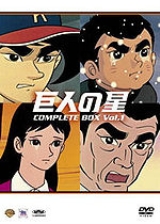
Star of the Giants

Encyclopedia
is a sports manga
written by Ikki Kajiwara
and drawn by Noboru Kawasaki
. It was adapted
as the first sports anime
television series broadcast in Japan
, in 1968. It later spawned 2 anime sequels and different anime movies.
The manga appeared in Weekly Shōnen Magazine
about the actual baseball team Yomiuri Giants
using fictional characters. It was launched by the "Yomiuri Group" which at the time owned not only the actual baseball team, but the TV network Nippon Television
, the newspaper Yomiuri Shimbun
, as well as Yomiuri Telecasting Corporation
.
The show targeted young audiences expanding the imagination of what is physically possible by dramatizing pitches and wind-up sequences. While staying true to being a sports anime, the contents are not simulated like real baseball. It was closer to fantasy surreal anime, though that was the norm within manga publications at the time.
until he was injured in World War II
and was forced to retire. The boy would join the ever popular Giants team, and soon he realized the difficulty of managing the high expectations. From the grueling training to battling the rival Mitsuru Hanagata in the Hanshin Tigers
, he would have to take out his best pitching magic to step up to the challenge.
by Capcom
on June 20, 2002. There were also a number of other games on the same platform.
Manga
Manga is the Japanese word for "comics" and consists of comics and print cartoons . In the West, the term "manga" has been appropriated to refer specifically to comics created in Japan, or by Japanese authors, in the Japanese language and conforming to the style developed in Japan in the late 19th...
written by Ikki Kajiwara
Ikki Kajiwara
was a Japanese author, manga writer, and film producer, also known under the pseudonym . His real name is . The pseudonym was used since he was writing for a rival magazine at the time. Having multiple names would not allow overlaps by the two magazines...
and drawn by Noboru Kawasaki
Noboru Kawasaki
is a Japanese manga artist. He is most famous for drawing the series Star of the Giants. He won the 14th Shogakukan Manga Award in 1969 for Animal 1 and Inakappe Taishō and the 2nd Kodansha Manga Award for shōnen in 1978 for Football Hawk....
. It was adapted
Film adaptation
Film adaptation is the transfer of a written work to a feature film. It is a type of derivative work.A common form of film adaptation is the use of a novel as the basis of a feature film, but film adaptation includes the use of non-fiction , autobiography, comic book, scripture, plays, and even...
as the first sports anime
Anime
is the Japanese abbreviated pronunciation of "animation". The definition sometimes changes depending on the context. In English-speaking countries, the term most commonly refers to Japanese animated cartoons....
television series broadcast in Japan
Japan
Japan is an island nation in East Asia. Located in the Pacific Ocean, it lies to the east of the Sea of Japan, China, North Korea, South Korea and Russia, stretching from the Sea of Okhotsk in the north to the East China Sea and Taiwan in the south...
, in 1968. It later spawned 2 anime sequels and different anime movies.
The manga appeared in Weekly Shōnen Magazine
Weekly Shonen Magazine
, also known as Shōnen Magazine, is a shōnen manga magazine published by Kodansha, first published on 17 March 1959. Despite some unusual censorship policies , it's mainly read by an older audience, with a large portion of its readership falling under the male high school or college...
about the actual baseball team Yomiuri Giants
Yomiuri Giants
The are a professional baseball team based in Bunkyo, Tokyo, Japan. The team competes in the Central League in Nippon Professional Baseball, the top level of professional play in Japan. They play their home games in the Tokyo Dome, opened in 1988. The English-language press occasionally calls the...
using fictional characters. It was launched by the "Yomiuri Group" which at the time owned not only the actual baseball team, but the TV network Nippon Television
Nippon Television
is a television network based in the Shiodome area of Minato, Tokyo, Japan and is controlled by the Yomiuri Shimbun publishing company. Broadcasting terrestrially across Japan, the network is commonly known as , contracted to , and abbreviated as "NTV" or "AX".-Offices:*The Headquarters : 6-1,...
, the newspaper Yomiuri Shimbun
Yomiuri Shimbun
The is a Japanese newspaper published in Tokyo, Osaka, Fukuoka, and other major Japanese cities. It is one of the five national newspapers in Japan; the other four are the Asahi Shimbun, the Mainichi Shimbun, Nihon Keizai Shimbun, and the Sankei Shimbun...
, as well as Yomiuri Telecasting Corporation
Yomiuri Telecasting Corporation
is a TV station joining Nippon News Network and Nippon Television Network System in Osaka Business Park, Osaka, Japan founded as "" on February 13, 1958...
.
The show targeted young audiences expanding the imagination of what is physically possible by dramatizing pitches and wind-up sequences. While staying true to being a sports anime, the contents are not simulated like real baseball. It was closer to fantasy surreal anime, though that was the norm within manga publications at the time.
Story
The story is about Hyuuma Hoshi, a promising young baseball pitcher who dreams of becoming a top star like his father Ittetsu Hoshi in the professional Japanese league. His father was once a 3rd basemanThird baseman
A third baseman, abbreviated 3B, is the player in baseball whose responsibility is to defend the area nearest to third base — the third of four bases a baserunner must touch in succession to score a run...
until he was injured in World War II
World War II
World War II, or the Second World War , was a global conflict lasting from 1939 to 1945, involving most of the world's nations—including all of the great powers—eventually forming two opposing military alliances: the Allies and the Axis...
and was forced to retire. The boy would join the ever popular Giants team, and soon he realized the difficulty of managing the high expectations. From the grueling training to battling the rival Mitsuru Hanagata in the Hanshin Tigers
Hanshin Tigers
The are a Nippon Professional Baseball team based in Koshien, Nishinomiya, Hyōgo Prefecture, Japan, and are in the Central League. Hanshin Electric Railway Co., Ltd., the subsidiary of Hankyu Hanshin Holdings Inc., owns the Hanshin Tigers directly...
, he would have to take out his best pitching magic to step up to the challenge.
Characters
- Hoshi Hyuuma: Tohru Furuya
- Hoshi Ittetsu: Seizō Katō
- Akiko: Fuyumi ShiraishiFuyumi Shiraishiis a Japanese voice actor.-Voice Roles:*Ashita no Joe *Osomatsu-kun 1966 *Obake no Q-Taro 1985 *Kaibutsu-kun 1968 *Mobile Suit Gundam 1979-1980 *Mobile Suit Zeta Gundam 1985...
- Ban Chuuta: Jōji YanamiJoji Yanamiis a Japanese voice actor currently represented by Aoni Production.- Television :* Ookami Shōnen Ken , Boss* Hustle Punch , Professor Garigari/Garigari Hagase* Osomatsu-kun , Tou-san...
- Hanagata Mitsuru: Makio InoueMakio Inoueis a Japanese voice actor. He began voice acting in the '60s, landing small roles in Astroboy, and was the actor of choice for deep-voiced, serious males in the '70s. These days, he rarely takes on new roles...
- Kawakami Tetsuharu: Tadashi Nakamura
- Masaichi KanedaMasaichi Kanedais a Japanese former professional baseball pitcher. He is one of the best known pitchers in Japanese baseball history, and is the only Japanese pitcher to have won 400 games. He was inducted in the Japanese Baseball Hall of Fame in 1988....
: Teiji ŌmiyaTeiji Omiyawas a Japanese voice and dramatic actor, and a member of the Tokyo Actor's Consumer's Cooperative Society when he died. He attended Nihon University, but withdrew before completing his degree. He was known for playing the roles of kind old men in many 1970s anime series... - Kyōko: Reiko MutōReiko Mutowas a Japanese voice actress. She is best known for playing the voice of Elizabeth Taylor in Japanese dubbed television and films, and playing main characters in Marvelous Melmo , Astro Boy as Uran , and Moomin...
Staff
- Original creator: Ikki KajiwaraIkki Kajiwarawas a Japanese author, manga writer, and film producer, also known under the pseudonym . His real name is . The pseudonym was used since he was writing for a rival magazine at the time. Having multiple names would not allow overlaps by the two magazines...
, Noboru KawasakiNoboru Kawasakiis a Japanese manga artist. He is most famous for drawing the series Star of the Giants. He won the 14th Shogakukan Manga Award in 1969 for Animal 1 and Inakappe Taishō and the 2nd Kodansha Manga Award for shōnen in 1978 for Football Hawk.... - Director: Tadao NagahamaTadao NagahamaTadao Nagahama was a director of both puppet shows and animation.He is best known as the director of Toei's Romantic Trilogy, which added human drama to the Super Robot Genre....
, Yoshio Kabashima, Tadaaki Tamazaki, Mamoru Sasaki - Script: Masaki TsujiMasaki Tsujiis a Japanese scenario writer of TV series and films as well as mystery fiction novels. Tsuji was most active in the business from the 1960s through the 1980s, and worked as a script writer on many popular anime TV series for Mushi Production, Toei Animation, and Tokyo Movie Shinsha.Among the...
, Seiji Matsuoka, Tooru Sawaki, Ryohei Ito, Toru Sawaki, Yoshiaki Yoshida - Music: Takeo WatanabeTakeo Watanabewas a Japanese musician and composer. In addition to composing the well known theme song for Cutie Honey he has also composed music for multiple television anime and films including Lone Wolf & Cub, Candy Candy, and Mobile Suit Gundam....
- Art director: Isamu Kageyama
- Animation director: Daikichirou Kusube
- Editing: Kazuo Inoue
Movies
The first Star of the Giants movie was debuted in 1969 as part of the vacation anime festival on large screen theatres in color. The draw was that most people had black and white TVs at the time. The Star of Giants vs Mighty Atoms TV special reached the U.S and was renamed to Astro Boy vs the Giants.| Japanese Name | English Name | Release Date | Type | Run time |
|---|---|---|---|---|
| 巨人の星 | Star of Giants the movie | 1969 | movie | 90 mins |
| Star of Giants vs the Mighty Atom | 1969 | TV special | 30 mins | |
| 巨人の星 行け行け飛雄馬 | Star of Giants: Ike Ike Hyuma | December 20, 1969 | movie | 75 mins |
| 巨人の星 大リーグボール | Star of Giants: Big League Ball | 1970 | movie | 70 mins |
| 巨人の星 宿命の対決 | Star of Giants: Shukumei no Taiketsu | 1970 | movie | 60 mins |
| 新巨人の星 | New Star of Giants | 1977 | series | 52 Episodes |
| 新巨人の星 | New Star of Giants the movie | 1977 | movie | |
| 新巨人の星II | New Star of Giants II | 1979 | series | 23 Episodes |
| Stars of Giants Special Edition: Fierce Tiger Mitsuru Hanagata | 2002 | series | 13 Episodes | |
Video games
Kyojin no Hoshi (The Anime Super Remix) was released for the PlayStation 2PlayStation 2
The PlayStation 2 is a sixth-generation video game console manufactured by Sony as part of the PlayStation series. Its development was announced in March 1999 and it was first released on March 4, 2000, in Japan...
by Capcom
Capcom
is a Japanese developer and publisher of video games, known for creating multi-million-selling franchises such as Devil May Cry, Chaos Legion, Street Fighter, Mega Man and Resident Evil. Capcom developed and published Bionic Commando, Lost Planet and Dark Void too, but they are less known. Its...
on June 20, 2002. There were also a number of other games on the same platform.
Impact
- Professional baseball player Ichiro SuzukiIchiro Suzuki, usually known simply as is a Major League Baseball right fielder for the Seattle Mariners. Ichiro has established a number of batting records, including the sport's single-season record for hits with 262...
used Star of Giants as a reference to his grueling childhood baseball training.
External links
- Star of Giants Official anime site by Tokyo Movie Shinsha.