


Standing wheelchair

Encyclopedia
Assistive technology
Assistive technology or adaptive technology is an umbrella term that includes assistive, adaptive, and rehabilitative devices for people with disabilities and also includes the process used in selecting, locating, and using them...
, similar to a standing frame
Standing frame
A standing frame is assistive technology that can be used by a person who relies on a wheelchair for mobility...
, that allows a wheelchair
Wheelchair
A wheelchair is a chair with wheels, designed to be a replacement for walking. The device comes in variations where it is propelled by motors or by the seated occupant turning the rear wheels by hand. Often there are handles behind the seat for someone else to do the pushing...
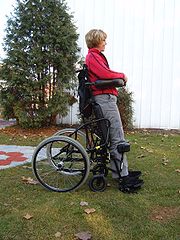
user to raise the chair from a seated to a standing position. The standing wheelchair supports the person in a standing position and enables interaction with people and objects at eye level.
Types and function
Three variations of standing wheelchairs are available:- Manual - Chair mobility and lifting mechanisms are not powered.
- Half-power - Chair features powered mobility but manual lifting mechanisms.
- Full-power - Chair features powered mobility and hydraulic or otherwise powered lifting mechanisms.
Standing wheelchairs can be either manually or power-operated, and are used both to achieve regular mobility and to stand the person up using hydraulics or other power sources. Some standing wheelchairs may be driven from the standing position, however there is some medical concern of an increased risk of long bone fractures while driving due to the legs being under a heavy load.
Diagnosis and users
Standing wheelchairs are used by people with mild to severe disabilities including: spinal cord injurySpinal cord injury
A spinal cord injury refers to any injury to the spinal cord that is caused by trauma instead of disease. Depending on where the spinal cord and nerve roots are damaged, the symptoms can vary widely, from pain to paralysis to incontinence...
, traumatic brain injury
Traumatic brain injury
Traumatic brain injury , also known as intracranial injury, occurs when an external force traumatically injures the brain. TBI can be classified based on severity, mechanism , or other features...
, cerebral palsy
Cerebral palsy
Cerebral palsy is an umbrella term encompassing a group of non-progressive, non-contagious motor conditions that cause physical disability in human development, chiefly in the various areas of body movement....
, spina bifida
Spina bifida
Spina bifida is a developmental congenital disorder caused by the incomplete closing of the embryonic neural tube. Some vertebrae overlying the spinal cord are not fully formed and remain unfused and open. If the opening is large enough, this allows a portion of the spinal cord to protrude through...
, muscular dystrophy
Muscular dystrophy
Muscular dystrophy is a group of muscle diseases that weaken the musculoskeletal system and hamper locomotion. Muscular dystrophies are characterized by progressive skeletal muscle weakness, defects in muscle proteins, and the death of muscle cells and tissue.In the 1860s, descriptions of boys who...
, multiple sclerosis
Multiple sclerosis
Multiple sclerosis is an inflammatory disease in which the fatty myelin sheaths around the axons of the brain and spinal cord are damaged, leading to demyelination and scarring as well as a broad spectrum of signs and symptoms...
, stroke
Stroke
A stroke, previously known medically as a cerebrovascular accident , is the rapidly developing loss of brain function due to disturbance in the blood supply to the brain. This can be due to ischemia caused by blockage , or a hemorrhage...
, rett syndrome
Rett syndrome
Rett syndrome is a neurodevelopmental disorder of the grey matter of the brain that almost exclusively affects females. The clinical features include small hands and feet and a deceleration of the rate of head growth . Repetitive hand movements, such as wringing and/or repeatedly putting hands into...
, post-polio syndrome
Post-polio syndrome
Post-polio syndrome is a condition that affects approximately 25–50% of people who have previously contracted poliomyelitis—a viral infection of the nervous system—after the initial infection. Typically the symptoms appear 15–30 years after recovery from the original paralytic attack, at an age of...
and more.
Spinal cord injury - Standing chairs are used by people with both paraplegia
Paraplegia
Paraplegia is an impairment in motor or sensory function of the lower extremities. The word comes from Ionic Greek: παραπληγίη "half-striking". It is usually the result of spinal cord injury or a congenital condition such as spina bifida that affects the neural elements of the spinal canal...
and quadriplegia
Quadriplegia
Tetraplegia, also known as quadriplegia, is paralysis caused by illness or injury to a human that results in the partial or total loss of use of all their limbs and torso; paraplegia is similar but does not affect the arms...
since a variety of standing options are available to accommodate for mild to severe disabilities.
Documentation and funding
MedicareMedicare (United States)
Medicare is a social insurance program administered by the United States government, providing health insurance coverage to people who are aged 65 and over; to those who are under 65 and are permanently physically disabled or who have a congenital physical disability; or to those who meet other...
may help fund some portion of a standing wheelchair, while Medicaid
Medicaid
Medicaid is the United States health program for certain people and families with low incomes and resources. It is a means-tested program that is jointly funded by the state and federal governments, and is managed by the states. People served by Medicaid are U.S. citizens or legal permanent...
funding varies from state-to-state in the U.S. Many insurance companies, vocational rehabilitation organizations, and medical case managers are increasingly funding standing wheelchairs because of the long-term health and quality of life benefits that come from passive standing.
Effective documentation
Funding (government funding or insurance) for standing equipment is achievable, but usually requires medical justification and a letter of medical necessityMedical necessity
Medical necessity is a United States legal doctrine, related to activities which may be justified as reasonable, necessary, and/or appropriate, based on evidence-based clinical standards of care. Other countries may have medical doctrines or legal rules covering broadly similar grounds...
(a detailed prescription
Medical prescription
A prescription is a health-care program implemented by a physician or other medical practitioner in the form of instructions that govern the plan of care for an individual patient. Prescriptions may include orders to be performed by a patient, caretaker, nurse, pharmacist or other therapist....
) written by a physical therapist or medical professional.
Funding sources
In the U.S. there are various funding options for purchasing durable medical equipmentDurable medical equipment
Durable medical equipment is a term of art used to describe any medical equipment used in the home to aid in a better quality of living. It is a benefit included in most insurances. In some cases certain Medicare benefits, that is, whether Medicare may pay for the item...
(DME) such as standing wheelchairs:
- Public insurance/government funding (i.e. MedicaidMedicaidMedicaid is the United States health program for certain people and families with low incomes and resources. It is a means-tested program that is jointly funded by the state and federal governments, and is managed by the states. People served by Medicaid are U.S. citizens or legal permanent...
, Waivers, etc.) - Private insurance companies (i.e.Blue Cross, health maintenance organizationHealth maintenance organizationA health maintenance organization is an organization that provides managed care for health insurance contracts in the United States as a liaison with health care providers...
s (HMOs), PPOs, etc.) - Worker's compensation
- Disability insurance
- Liability insurance (i.e. car, home, etc.)
- Out-of-pocketOut-of-pocket expensesOut-of-pocket expenses are direct outlays of cash which may or may not be later reimbursed.In operating a vehicle, gasoline, parking fees and tolls are considered out-of-pocket expenses for the trip...
(cash or credit card) - Possible payment plan through supplier
- Child’s school purchase for use at school (i.e. standing is part of child’s Individualized Education ProgramIndividualized Education ProgramIn the United States an Individualized Education Program, commonly referred to as an IEP, is mandated by the Individuals with Disabilities Education Act...
(IEP)) - Purchase by workplace for use while on the job
- Purchase through VA Hospital
- Assistance from local groups such (i.e. Rotary clubs, Lions, etc.)
- Assistance from disability groups (i.e. MDA, MS Society, etc.)
Most states have resources such as PAAT (Protection Advocacy for Assistive Technology) and State Technology Assistance Projects that are resources for consumers seeking funding or going through the appeals process.
Sources
- RESNA Position on Wheelchair Standing Devices
- Standing For Life is an article with case studies about standing wheelchair users written by physiotheraphist Marjorie D'Alecy.