
All Topics  
Spinal cord injury

 
Spinal Cord Injury

   Email Print
   Bookmark   Link


Spinal cord injury


Spinal cord injury causes myelopathy or damage to white matter or myelinated fiber tracts that carry sensation and motor signals to and from the brain. It also damages gray matter in the central part of the spine, causing segmental losses of interneurons and motorneurons. Spinal cord injury can occur from many causes, including: stages: a.stage of spinal shock:sensation below the level of lesion and motor power of all the muscles below level of lesion are lost.this stge lasts for 2-3 weeks in humans,some hours to days in lower animals due to less degree of encephalisation. b.stage of recovery: after 2-3 weeks of injury the injured nerves slightly recover but not to full extent,so segmemental reflexes return producing paraplefia in flexion c.stage of reflex failure:after some days the recovered reflexes again start to give away due to complete dege neration of nerve cells
Classification
The American Spinal Cord Injury Association or ASIA defined an international classification based on neurological levels, touch and pinprick sensations tested in each dermatome, and strength of ten key muscles on each side of the body, i.e.


Discussion
Ask a question about 'Spinal cord injury'
Start a new discussion about 'Spinal cord injury'
Answer questions from other users
Full Discussion Forum


Encyclopedia


Spinal cord injury causes myelopathy or damage to white matter or myelinated fiber tracts that carry sensation and motor signals to and from the brain. It also damages gray matter in the central part of the spine, causing segmental losses of interneurons and motorneurons. Spinal cord injury can occur from many causes, including:
  • Trauma such as automobile crashes, falls, gunshot
    Firearm

    A firearm is a tool that projects either single or multiple projectiles at high velocity through a controlled explosion. The firing is achieved by the gases produced through rapid, confined combustion of a propellant....
    s, diving accidents
    Diving

    Diving refers to the sport of performing acrobatics while jumping or falling into water from a platform or springboard of a certain height. Diving is an internationally-recognized sport that is part of the Olympic Games....
    , war injuries
    Casualty (person)

    A casualty is a person who is the victim of an accident, injury, or Physical trauma. The word casualties is most often used by the news media to describe deaths and injuries resulting from wars or disasters....
    , etc.
  • Tumor such as meningiomas, ependymomas, astrocytomas, and metastatic cancer.
  • Ischemia resulting from occlusion of spinal blood vessels, including dissecting aortic aneurysms
    Aortic aneurysm

    An aortic aneurysm is a general term for any swelling of the aorta, usually representing an underlying weakness in the wall of the aorta at that location....
    , emboli, arteriosclerosis
    Arteriosclerosis

    Arteriosclerosis refers to a stiffening of arteries.Arteriosclerosis is a general term describing any hardening of medium or large arteries ...
    .
  • Developmental disorders, such as spina bifida
    Spina bifida

    Spina bifida is a developmental birth defect involving the neural tube: incomplete closure of the embryonic neural tube results in an incompletely formed spinal cord....
    , meningomyolcoele, and other.
  • Neurodegenerative diseases, such as Friedreich's ataxia
    Friedreich's ataxia

    Friedreich's ataxia is an inherited disease that causes Progressive illness to the nervous system resulting in symptoms ranging from gait disturbance and speech problems to heart disease....
    , spinocerebellar ataxia
    Spinocerebellar ataxia

    Spinocerebellar ataxia is a genetic disease with multiple types, each of which could be considered a disease in its own right....
    , etc.
  • Demyelinative diseases, such as Multiple Sclerosis
    Multiple sclerosis

    Multiple sclerosis is an autoimmune disease in which the immune system attacks the central nervous system, leading to demyelinating disease. Disease onset usually occurs in young adults, and it is more common in females....
    .
  • Transverse myelitis, resulting from spinal cord stroke, inflammation
    Inflammation

    Inflammation is the complex biological response of Blood vessel tissues to harmful stimuli, such as pathogens, damaged cells, or irritants. It is a protective attempt by the organism to remove the injurious stimuli as well as initiate the healing process for the tissue....
    , or other causes.
  • Vascular malformations, such as arteriovenous malformation
    Arteriovenous malformation

    Arteriovenous malformation or AVM in the majority of cases is a congenital disorder consisting of a connection between veins and arteries, this pathology is universally known because of its occurrence in the central nervous system, but can appear in any location....
     (AVM), dural arteriovenous fistula
    Dural arteriovenous fistula

    A dural arteriovenous fistula, also called a dural arteriovenous malformation, is an abnormal direct connection between a meningeal artery and a meningeal vein or dural venous sinus....
     (AVF), spinal hemangioma
    Hemangioma

    A hemangioma is a congenital benign tumour or vascular malformation of endothelial cells .In infancy, it is the most common tumor....
    , cavernous angioma
    Cavernous angioma

    Cavernous angioma, also known as cerebral cavernous malformation , cavernous haemangioma, and cavernoma, is a vascular disorder of the central nervous system that may appear either sporadically or exhibit autosomal dominant inheritance....
     and aneurysm
    Aneurysm

    An aneurysm is a localized, blood-filled dilation of a blood vessel caused by disease or weakening of the vessel wall.Aneurysms most commonly occur in artery at the base of the brain and in the aorta ....
    .
stages: a.stage of spinal shock:sensation below the level of lesion and motor power of all the muscles below level of lesion are lost.this stge lasts for 2-3 weeks in humans,some hours to days in lower animals due to less degree of encephalisation. b.stage of recovery: after 2-3 weeks of injury the injured nerves slightly recover but not to full extent,so segmemental reflexes return producing paraplefia in flexion c.stage of reflex failure:after some days the recovered reflexes again start to give away due to complete dege neration of nerve cells

Classification


The American Spinal Cord Injury Association or ASIA defined an international classification based on neurological levels, touch and pinprick sensations tested in each dermatome, and strength of ten key muscles on each side of the body, i.e. shoulder shrug (C4
Cervical spinal nerve 4

The cervical spinal nerve 4 is a spinal nerve of the cervical segment..It originates from the spinal column from above the cervical vertebra 4 ....
), elbow flexion (C5
Cervical spinal nerve 5

The cervical spinal nerve 5 is a spinal nerve of the cervical segment..It originates from the spinal column from above the cervical vertebra 5 ....
), wrist extension (C6
Cervical spinal nerve 6

The cervical spinal nerve 6 is a spinal nerve of the cervical segment..It originates from the spinal column from above the cervical vertebra 6 ....
), elbow extension (C7
Cervical spinal nerve 7

The cervical spinal nerve 7 is a spinal nerve of the cervical segment..It originates from the spinal column from above the cervical vertebra 7 ....
), hip flexion (L2
Lumbar spinal nerve 2

The lumbar spinal nerve 2 is a spinal nerve of the lumbar segment..It originates from the spinal column from below the lumbar vertebra 2 ....
). Traumatic spinal cord injury is classified into five types by the American Spinal Injury Association and the International Spinal Cord Injury Classification System.
  • A indicates a "complete" spinal cord injury where no motor or sensory function is preserved in the sacral segments S4-S5. Since the S4-S5 segment is the lower segmental, absence of motor and sensory function indicates "complete" spinal cord injury.
  • B indicates an "incomplete" spinal cord injury where sensory but not motor function is preserved below the neurological level and includes the sacral segments S4-S5. This is typically a transient phase and if the person recovers any motor function below the neurological level, that person essentially becomes a motor incomplete, i.e. ASIA C or D.
  • C indicates an "incomplete" spinal cord injury where motor function is preserved below the neurological level and more than half of key muscles below the neurological level have a muscle grade of less than 3.
  • D indicates an "incomplete" spinal cord injury where motor function is preserved below the neurological level and at least half of the key muscles below the neurological level have a muscle grade of 3 or more.
  • E indicates "normal" where motor and sensory scores are normal. Note that it is possible to have spinal cord injury and neurological deficit with completely normal motor and sensory scores.


In addition, there are several clinical syndromes associated with incomplete spinal cord injuries.
  • The Central cord syndrome
    Central cord syndrome

    Central cord syndrome is an Acute cervical spinal cord injury . It was first described by Schneider in 1954.CCS has been reported to occur more frequently among older persons with cervical spondylosis, but it also may occur in younger individuals....
     is associated with greater loss of upper limb function compared to lower limbs.
  • The Brown-Séquard syndrome
    Brown-Séquard syndrome

    Brown-S?quard syndrome, also known as Brown-S?quard's hemiplegia and Brown-S?quard's paralysis, is a loss of sensation and motor function that is caused by the lateral hemisection of the spinal cord....
     results from injury to one side with the spinal cord, causing weakness and loss of proprioception on the side of the injury and loss of pain and thermal sensation of the other side.
  • The Anterior cord syndrome
    Anterior cord syndrome

    Anterior cord syndrome is a medical condition where the blood supply to the anterior portion of the spinal cord is interrupted. It is characterized by loss of motor function below the level of injury, loss of sensations carried by the anterior columns of the spinal cord , and preservation of sensations carried by the posterior columns ....
     results from injury to the anterior part of the spinal cord, causing weakness and loss of pain and thermal sensations below the injury site but preservation of proprioception that is usually carried in the posterior part of the spinal cord.
  • Tabes Dorsalis
    Tabes dorsalis

    Tabes dorsalis is a slow degeneration of the nerve cells and nerve fibers that carry sensory information to the brain. The degenerating nerves are in the dorsal columns of the spinal cord and carry information that help maintain a person's sense of position, vibration, and discriminative touch....
     results from injury to the posterior part of the spinal cord, usually from infection diseases such as syphilis, causing loss of touch and proprioceptive sensation.
  • Conus medullaris
    Conus medullaris

    The conus medullaris is the terminal end of the spinal cord. It occurs near lumbar nerves 1 and 2 . After the spinal cord tapers out, the spinal nerves continue as dangling nerve roots....
     syndrome results from injury to the tip of the spinal cord, located at L1 vertebra.
  • Cauda equina
    Cauda equina

    The cauda equina is a structure within the lower end of the spine of most vertebrates, that consists of nerve roots and rootlets from above. The space in which the cerebrospinal fluid is present is actually an extension of the subarachnoid space....
     syndrome is, strictly speaking, not really spinal cord injury but injury to the spinal roots below the L1 vertebra.


One can have spine injury without spinal cord injury. Many people suffer transient loss of function ("stingers") in sports accidents or pain in "whiplash" of the neck without neurological loss and relatively few of these suffer spinal cord injury sufficient to warrant hospitalization. In the United States, the incidence of spinal cord injury has been estimated to be about 35 cases per million per year, or approximately 10,500 per year (35 * 300). In China, the incidence of spinal cord injury was recently estimated to be as high as 65 cases per million per year in urban areas. If so, assuming a population of 1.3 billion, this would suggest an incidence of 84,500 per year (65 * 1300).

The prevalence of spinal cord injury is not well known in many large countries. In some countries, such as Sweden and Iceland, registries are available. About 450,000 people in the United States
United States

The United States of America is a Federal government constitutional republic comprising U.S. state and a federal district. The country is situated mostly in central North America, where its Contiguous United States and Washington, D.C., the Capital districts and territories, lie between the Pacific Ocean and Atlantic Oceans, Borders of the U...
 live with spinal cord injury (one in 670), and there are about 11,000 new spinal cord injuries every year (one in 30,000). The majority of them (78%) involve males between the ages of 16-30 and result from motor vehicle accidents (42%), violence (24%), or falls (27%). This is likely due to increased risk-taking behavior in men.

The Effects of Spinal Cord Injury


The exact effects of a spinal cord injury vary according to the type and level injury, and can be organized into two types:
  • In a complete injury, there is no function below the "neurological" level, defined as the lowest level that has intact neurological function. If a person has some level below which there is no motor and sensory function, the injury is said to be "complete". Recent evidence suggest that less than 5% of people with "complete" spinal cord injury recover locomotion.
  • A person with an incomplete injury retains some sensation or movement below the level of the injury. The lowest spinal cord level is S4-5, representing the anal sphincter and peri-anal sensation. So, if a person is able to contract the anal sphincter voluntarily
    Bulbocavernosus reflex

    The bulbocavernosus reflex is a chemical synapse reflex that is useful in testing for spinal shock and gaining information about the state of spinal cord injuries ....
     or is able to feel peri-anal pinprick or touch, the injury is said to be "incomplete". Recent evidence suggest that over 95% of people with "incomplete" spinal cord injury recover some locomotory ability.


In addition to a loss of sensation and motor function below the point of injury, individuals with spinal cord injuries will often experience other complications of spinal cord injury:
  • Bowel and bladder function is regulated by the sacral
    Sacral

    The adjective sacral may have one of the following meanings:*A synonym for "sacred"*Related to sacrum...
     region of the spine, so it is very common to experience dysfunction of the bowel and bladder, including infections of the bladder, and anal incontinence.
  • Sexual function is also associated with the sacral
    Sacral

    The adjective sacral may have one of the following meanings:*A synonym for "sacred"*Related to sacrum...
     region, and is often affected.
  • Injuries of the C-1, C-2 will often result in a loss of breathing, necessitating mechanical ventilators or phrenic nerve pacing
    Phrenic Nerve Pacing

    Phrenic Nerve Pacing or diaphragm pacing, is the rhythmic application of electrical impulses to the diaphragm, resulting in respiration for patients who would otherwise be dependent on a mechanical ventilator....
    .
  • Inability or reduced ability to regulate heart rate
    Heart rate

    Heart rate is a measure of the number of heart beats per minute . The average resting human heart rate is about 70 bpm for adult males and 75 bpm for adult females....
    , blood pressure
    Blood pressure

    Blood pressure is the pressure exerted by circulating blood on the walls of blood vessels, and constitutes one of the principal vital signs. The pressure of the circulating blood decreases as it moves away from the heart through artery and capillary, and toward the heart through veins....
    , sweating
    Sweating

    Perspiration is the production of a fluid, consisting primarily of water as well as various dissolved solids , that is excreted by the sweat glands in the skin of mammals....
     and hence body temperature.
  • Spasticity (increased reflexes and stiffness of the limbs).
  • Neuropathic pain.
  • Autonomic dysreflexia
    Autonomic dysreflexia

    Autonomic dysreflexia,"AD" or "autonomic hyperreflexia" is a condition characterized by a massive sympathetic nervous system discharge that can occur in association with spinal cord injury or disease ....
     or abnormal increases in blood pressure, sweating, and other autonomic responses to pain or sensory disturbances.
  • Atrophy of muscle.
  • Superior Mesenteric Artery Syndrome
    Superior mesenteric artery syndrome

    Superior mesenteric artery syndrome is a rare, life-threatening gastrointestinal disorder characterized by a compression of the third portion of the duodenum by the abdominal aorta and the overlying superior mesenteric artery....
  • Osteoporosis (loss of calcium) and bone degeneration.
  • Gallbladder and renal stones.


The Location of the Injury

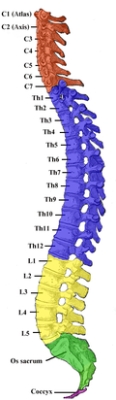
Knowing the exact level of the injury on the spinal cord is important when predicting what parts of the body might be affected by paralysis and loss of function.

Below is a list of typical effects of spinal cord injury by location (refer to the spinal cord map to the right). Please keep in mind that while the prognosis of complete injuries are predictable, incomplete injuries are very variable and may differ from the descriptions below.

Cervical injuries
Cervical (neck) injuries usually result in full or partial tetraplegia (Quadriplegia
Quadriplegia

Quadriplegia, also known as tetraplegia, is a symptom in which a human experiences paralysis affecting all four limbs, although not necessarily total paralysis or loss of function....
). Depending on the exact location of the injury, one with a spinal cord injury at the cervical level may retain some amount of function as detailed below, but are otherwise completely paralyzed
Paralysis

Paralysis is the complete loss of muscle function for one or more muscle groups. Paralysis can cause loss of feeling or loss of mobility in the affected area....
.

  • C3 vertebrae and above : Typically lose diaphragm function and require a ventilator to breathe.
  • C4 : May have some use of biceps and shoulders, but weaker
  • C5 : May retain the use of shoulders and biceps, but not of the wrists or hands.
  • C6 : Generally retain some wrist control, but no hand function.
  • C7 and T1 : Can usually straighten their arms but still may have dexterity problems with the hand and fingers. C7 is generally the level for functional independence.


Thoracic injuries
Injuries at the thoracic level and below result in paraplegia
Paraplegia

Paraplegia is an impairment in motor and/or sensory function of the lower extremities. It is usually the result of spinal cord injury or a congenital condition such as spina bifida which affects the neural elements of the spinal canal....
. The hands, arms, head, and breathing are usually not affected.

  • T1 to T8 : Most often have control of the hands, but lack control of the abdominal muscles so control of the trunk is difficult or impossible. Effects are less severe the lower the injury.
  • T9 to T12 : Allows good trunk and abdominal muscle control, and sitting balance is very good.


Lumbar and Sacral injuries
The effect of injuries to the lumbar
Lumbar

In anatomy, lumbar is an adjective that means of or pertaining to the abdominal segment of the torso, between the diaphragm and the sacrum ....
 or sacral
Sacral

The adjective sacral may have one of the following meanings:*A synonym for "sacred"*Related to sacrum...
 region of the spinal canal are decreased control of the leg
Human leg

In common usage, the human leg is the lower limb of the human body, extending from the knee to the ankle, and excluding the thigh,The largest bone in the human body, the femur, is in the leg ....
s and hips, urinary system, and anus.

Central Cord and Other Syndromes

Central cord syndrome

Central cord syndrome is an Acute cervical spinal cord injury . It was first described by Schneider in 1954.CCS has been reported to occur more frequently among older persons with cervical spondylosis, but it also may occur in younger individuals....
 (picture 1) is a form of incomplete spinal cord injury characterized by impairment in the arms and hands and, to a lesser extent, in the legs. This is also referred to as inverse paraplegia, because the hands and arms are paralyzed while the legs and lower extremities work correctly.

Most often the damage is to the cervical or upper thoracic regions of the spinal cord, and characterized by weakness in the arms with relative sparing of the legs with variable sensory loss.

This condition is associated with ischemia, hemorrhage, or necrosis involving the central portions of the spinal cord (the large nerve fibers that carry information directly from the cerebral cortex). Corticospinal fibers destined for the legs are spared due to their more external location in the spinal cord.

This clinical pattern may emerge during recovery from spinal shock due to prolonged swelling around or near the vertebrae, causing pressures on the cord. The symptoms may be transient or permanent.

Anterior cord syndrome

Anterior cord syndrome is a medical condition where the blood supply to the anterior portion of the spinal cord is interrupted. It is characterized by loss of motor function below the level of injury, loss of sensations carried by the anterior columns of the spinal cord , and preservation of sensations carried by the posterior columns ....
 (picture 2) is also an incomplete spinal cord injury. Below the injury, motor function, pain sensation, and temperature sensation is lost; touch, proprioception (sense of position in space), and vibration sense remain intact. Posterior cord syndrome
Posterior cord syndrome

Posterior cord syndrome is a condition caused by lesion of the posterior portion of the spinal cord. It can be caused by an interruption to the posterior spinal artery....
 (not pictured) can also occur, but is very rare.

Brown-Séquard syndrome

Brown-S?quard syndrome, also known as Brown-S?quard's hemiplegia and Brown-S?quard's paralysis, is a loss of sensation and motor function that is caused by the lateral hemisection of the spinal cord....
 (picture 3) usually occurs when the spinal cord is hemisectioned or injured on the lateral side. On the ipsilateral side of the injury (same side), there is a loss of motor function, proprioception, vibration, and light touch. Contralaterally (opposite side of injury), there is a loss of pain, temperature, and deep touch sensations

Treatment

Treatment options for acute traumatic none penetrating spinal cord injuries include giving a high dose methylprednisolone
Methylprednisolone

Methylprednisolone is a synthetic glucocorticoid drug. It is sold in the USA and Canada under the brand names Phocenta, Medrol, Solu-Medrol and Cadista....
. This can be given if the injury occurred within 8 hours. The recommendation is primarily based on the National Acute Spinal Cord Injury Studies (NASCIS) II and III however is disputed. Steroids are not recommended in penetrating spinal cord injuries.. Presently, administration of cold saline acutely after injury is gaining popularity, but scientific evidence for the beneficial effects of systemic hypothermia is scarce.

Scientists are investigating many promising avenues of treatment for spinal cord injury. Thousands of articles in the medical literature describe work, mostly in animal models, aimed at reducing the paralyzing effect of injury to the spinal cord and promoting regrowth of functional nerve fibers. Despite the devastating effects of the condition, commercial funding for spinal cord cure research is limited, owing primarily to the small size of the population of potential beneficiaries. Despite this, a number of experimental treatments have reached controlled human trials. In addition, nerve protection and regeneration strategies are being studied in more common conditions like Alzheimer's Disease
Alzheimer's disease

Alzheimer's disease , also called Alzheimer disease, Senile Dementia of the Alzheimer Type or simply Alzheimer's, is the most common form of dementia....
, Parkinson's Disease
Parkinson's disease

Parkinson's disease is a degenerative disorder of the central nervous system that often impairs the sufferer's motor skills and speech, as well as other functions....
, Amyotrophic Lateral Sclerosis
Amyotrophic lateral sclerosis

Amyotrophic Lateral Sclerosis is a progressive, usually fatal, neurodegenerative disease caused by the degeneration of motor neurons, the nerve cells in the central nervous system that control voluntary muscle movement....
 and Multiple sclerosis
Multiple sclerosis

Multiple sclerosis is an autoimmune disease in which the immune system attacks the central nervous system, leading to demyelinating disease. Disease onset usually occurs in young adults, and it is more common in females....
. There are many similarities between these neurodegenerative disease
Neurodegenerative disease

Neurodegenerative disease is a condition in which cells of the brain and spinal cord are lost. The brain and spinal cord are composed of neurons that do different functions such as controlling movements, processing sensory information, and making decisions....
s and spinal cord injury, and this research adds considerable new information relevant to spinal cord injury treatment.

Advances in the science of spinal cord injury treatment are newsworthy, and considerable media attention is drawn towards new developments. Aside from the use of methylprednisolone, none of these developments have reached even limited use in the clinical care of human spinal cord injury. Around the world, proprietary centers offering stem cell
Stem cell

Stem cells are Cell found in most, if not all, multi-cellular organisms. They are characterized by the ability to renew themselves through Mitosis cell division and Cellular differentiation into a diverse range of specialized cell types....
 transplants and treatment with neuroregenerative substances are fueled by glowing testimonial reports of neurological improvement. Independent validation of the results of these treatments is lacking. However, in January 2009, the Geron Corporation received FDA clearance to begin human safety testing of its stem cell treatment candidate, GRNOPC1, on newly injured patients with complete thoracic injury. A diverse array of other treatments are being researched, including biomaterial solutions, cell replacement therapies, and electronic stimulative devices.

See Also

  • Brown-Sequard Syndrome
    Brown-Séquard syndrome

    Brown-S?quard syndrome, also known as Brown-S?quard's hemiplegia and Brown-S?quard's paralysis, is a loss of sensation and motor function that is caused by the lateral hemisection of the spinal cord....


External links

  • Spinal Cord Injury Recovery Programme
  • Noted for experimental cooling protocol used on Kevin Everett
    Kevin Everett

    Kevin Everett is a former American football tight end who played for the Buffalo Bills of the National Football League. He was drafted by the Bills in the third round of the 2005 NFL Draft....
  • A membership organization dedicated to improving the quality of life of individuals with spinal cord injuries and related disorders.
  • (RRTC) on Spinal Cord Injury: Promoting Health and Preventing Complications through Exercise
  • - Images of Spinal Cord Injury
  • - Spinal Cord Injury Levels and Classification
  • Patient, Carer and Spouse Support
  • The Spinal Cord Injury Project, W.M. Keck Center for Collaborative Neuroscience at Rutgers University
  • European Multicenter Study about Spinal Cord Injury
  • Clinical trials for pain following SCI
  • SCI Support Forums
  • Research funding foundation, based in Zurich
  • Research funding foundation, based in Austria
  • Emergency Medicine for Spinal Cord Injuries
  • Trefethen, Tre. American Sexuality Magazine. Accessed 3-22-07.
  • Spinal Cord Injury FAQ for those with SCI, and their families, by Canadian Paraplegic Assocation - Ontario.