

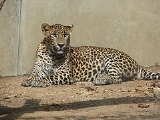
Sri Lanka Leopard

Encyclopedia
The Sri Lankan leopard (Panthera pardus kotiya), colloquially known as Kotiya (කොටියා) in Sinhala and Puli in Tamil
, is a subspecies of leopard
native to Sri Lanka
. Classified as Endangered
by IUCN, the population is believed to be declining due to numerous threats including poaching for trade
and human-leopard conflicts.
s. Seven females measured in the early 20th century averaged a weight of 64 lb (29 kg) and had a mean head-to-body-length of 3 in 5 in (1.04 m) with a 2 foot long tail, the largest being 3 in 9 in (1.14 m) with a 2 in 9 in (83.82 cm) long tail; 11 males averaged 124 lb (56.2 kg), the largest being 170 lb (77.1 kg), and measured 4 in 2 in (1.27 m) with a 2 in 10 in (86.36 cm) long tail, the largest being 4 in 8 in (1.42 m) with a 3 in 2 in (96.52 cm) long tail.
. Little has been known about it in the past, but ongoing studies in the framework of The Leopard Project, run by The Wilderness and Wildlife Conservation Trust, indicate that they are still distributed throughout the island both inside and outside of protected areas. The leopard has been observed in a variety of habitat
s including dry evergreen
monsoon
forest, arid scrub jungle, low and upper highland
forest, rainforest
, and wet zone intermediate forests.
A recent study has shown that Yala National Park
has one of the highest recorded densities of leopards in the world, although this animal is still considered to be endangered. The Wilpattu National Park
is also known as a good place to watch leopards. Leopards tend to be more readily observed in parts of Sri Lanka than in other countries where they share their habitat with more dominant competitors, such as lion
s or hyaena
s.
 A study in Yala National Park
indicates that Sri Lankan leopards are not any more social than other leopard subspecies. They are solitary hunters, with the exception of females with young. Both sexes live in overlapping territories with the ranges of males overlapping the smaller ranges of several females, as well as overlapping the ranges of neighbouring males. They prefer hunting at night, but are also active during dawn and dusk
, and daytime hours. They rarely haul their kills into trees, which is likely due to the lack of competition and the relative abundance of prey. Since leopards are the apex predator
s they don't need to protect their prey.
Like most cats, the Sri Lanka leopard is pragmatic in its choice of diet which can include small mammals, birds, reptiles as well as larger animals. Axis or spotted deer
make up the majority of its diet in the dry zone. The animal also preys on sambar
, barking deer, wild boar and monkeys.Kittle, A., Watson, A. (200?) A short report on research of an arid zone leopard population (Panthera pardus kotiya), Ruhuna (Yala) National Park, Sri Lanka. The Wilderness and Wildlife Conservation Trust, Sri Lanka.
The cat has been known to tackle almost fully grown buffalos.
The Sri Lankan leopard hunts like other leopards, silently stalking its prey until it is within striking distance where it unleashes a burst of speed to quickly pursue and pounce on its victim. The prey is usually dispatched with a single bite to the throat.
There appears to be no birth season or peak, with births scattered across months. A litter
usually consists of 2 cubs.
 The survival of the Sri Lankan leopard is threatened due to poaching
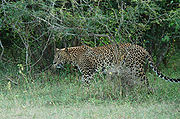
, habitat loss, and persecution. Despite these threats, the animal is highly adaptable and is able to live in close proximity to human settlements.
mishap that occurred in the late 1980s, "kotiyā" has now become the colloquial Sinhala term for tiger, and "diviyā" (දිවියා) is used for the leopard.
In late 80s and early 90s, the word 'kotiya' was being frequently incorrectly translated into English as "tiger
" in Sri Lankan media due to incorrect information that was received from the then head of the Wildlife Department in Sri Lanka. He had allegedly said that "there are no kotiyas (tigers) in Sri Lanka but diviyās", misinterpreting Panthera pardus kotiya as "diviyā", the Sinhala term used for small wild cats. Although it is correct that there are no tigers in Sri Lanka, the formal Sinhala word for tiger is "viyagraya" and not "kotiyā".
Sri Lankans started to use "kotiyā" to mean "tiger", so "diviyā" was chosen for "leopard".
The term "diviyā" has been used for centuries in Sri Lanka to refer to smaller wild species of the cat family such as "Handun Diviyā" or "Kola Diviyā" (both names are used interchangeably for the Fishing Cat
and the Rusty-spotted cat
).
A further complicating factor is that the Liberation Tigers of Tamil Eelam (Tamil Tigers) were colloquially known to the Sinhala-speaking community as 'Koti', the plural form of 'Kotiyā'.
Tamil language
Tamil is a Dravidian language spoken predominantly by Tamil people of the Indian subcontinent. It has official status in the Indian state of Tamil Nadu and in the Indian union territory of Pondicherry. Tamil is also an official language of Sri Lanka and Singapore...
, is a subspecies of leopard
Leopard
The leopard , Panthera pardus, is a member of the Felidae family and the smallest of the four "big cats" in the genus Panthera, the other three being the tiger, lion, and jaguar. The leopard was once distributed across eastern and southern Asia and Africa, from Siberia to South Africa, but its...
native to Sri Lanka
Sri Lanka
Sri Lanka, officially the Democratic Socialist Republic of Sri Lanka is a country off the southern coast of the Indian subcontinent. Known until 1972 as Ceylon , Sri Lanka is an island surrounded by the Indian Ocean, the Gulf of Mannar and the Palk Strait, and lies in the vicinity of India and the...
. Classified as Endangered
Endangered species
An endangered species is a population of organisms which is at risk of becoming extinct because it is either few in numbers, or threatened by changing environmental or predation parameters...
by IUCN, the population is believed to be declining due to numerous threats including poaching for trade
Wildlife trade
The international wildlife trade is a serious conservation problem, addressed by the United Nations' Convention of International Trade in Endangered Species of Wild Fauna and Flora CITES, which currently has 175 member countries called Parties. The 15th meeting of the Parties took place in Doha,...
and human-leopard conflicts.
Characteristics
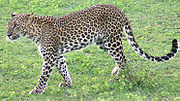
The Sri Lankan leopard has a tawny or rusty yellow coat with dark spots and close-set rosettes, which are smaller than in Indian leopardIndian leopard
The Indian leopard is a leopard subspecies widely distributed on the Indian subcontinent. It is one of the five big cats found in India, apart from Asiatic lion, Bengal tiger, snow leopard and clouded leopard....
s. Seven females measured in the early 20th century averaged a weight of 64 lb (29 kg) and had a mean head-to-body-length of 3 in 5 in (1.04 m) with a 2 foot long tail, the largest being 3 in 9 in (1.14 m) with a 2 in 9 in (83.82 cm) long tail; 11 males averaged 124 lb (56.2 kg), the largest being 170 lb (77.1 kg), and measured 4 in 2 in (1.27 m) with a 2 in 10 in (86.36 cm) long tail, the largest being 4 in 8 in (1.42 m) with a 3 in 2 in (96.52 cm) long tail.
Distribution and habitat
The Sri Lankan leopard is the country's top predatorPredation
In ecology, predation describes a biological interaction where a predator feeds on its prey . Predators may or may not kill their prey prior to feeding on them, but the act of predation always results in the death of its prey and the eventual absorption of the prey's tissue through consumption...
. Little has been known about it in the past, but ongoing studies in the framework of The Leopard Project, run by The Wilderness and Wildlife Conservation Trust, indicate that they are still distributed throughout the island both inside and outside of protected areas. The leopard has been observed in a variety of habitat
Habitat
* Habitat , a place where a species lives and grows*Human habitat, a place where humans live, work or play** Space habitat, a space station intended as a permanent settlement...
s including dry evergreen
Evergreen
In botany, an evergreen plant is a plant that has leaves in all seasons. This contrasts with deciduous plants, which completely lose their foliage during the winter or dry season.There are many different kinds of evergreen plants, both trees and shrubs...
monsoon
Monsoon
Monsoon is traditionally defined as a seasonal reversing wind accompanied by corresponding changes in precipitation, but is now used to describe seasonal changes in atmospheric circulation and precipitation associated with the asymmetric heating of land and sea...
forest, arid scrub jungle, low and upper highland
Montane
In biogeography, montane is the highland area located below the subalpine zone. Montane regions generally have cooler temperatures and often have higher rainfall than the adjacent lowland regions, and are frequently home to distinct communities of plants and animals.The term "montane" means "of the...
forest, rainforest
Rainforest
Rainforests are forests characterized by high rainfall, with definitions based on a minimum normal annual rainfall of 1750-2000 mm...
, and wet zone intermediate forests.
A recent study has shown that Yala National Park
Yala National Park
Yala National Park is the most visited and second largest national park in Sri Lanka. Actually it consists of five blocks, two of which are now open to the public; and also adjoining parks. The blocks have individual names also, like Ruhuna National Park for the block 1 and Kumana National Park or...
has one of the highest recorded densities of leopards in the world, although this animal is still considered to be endangered. The Wilpattu National Park
Wilpattu National Park
Wilpattu National Park is a park located on the island of Sri Lanka. The unique feature of this park is the existence of "Willus" - Natural, sand-rimmed water basins or depressions that fill with rainwater. Located in the Northwest coast lowland dry zone of Sri Lanka...
is also known as a good place to watch leopards. Leopards tend to be more readily observed in parts of Sri Lanka than in other countries where they share their habitat with more dominant competitors, such as lion
Lion
The lion is one of the four big cats in the genus Panthera, and a member of the family Felidae. With some males exceeding 250 kg in weight, it is the second-largest living cat after the tiger...
s or hyaena
Hyaena
For the Siouxsie and the Banshees album, see Hyæna.For the group of animals commonly known as "hyaena", see Hyena.Hyaena is a genus comprising two of the living species of hyenas: the striped hyena from western Asia and northern Africa and the brown hyena from southern Africa...
s.
Ecology and behaviour
Yala National Park
Yala National Park is the most visited and second largest national park in Sri Lanka. Actually it consists of five blocks, two of which are now open to the public; and also adjoining parks. The blocks have individual names also, like Ruhuna National Park for the block 1 and Kumana National Park or...
indicates that Sri Lankan leopards are not any more social than other leopard subspecies. They are solitary hunters, with the exception of females with young. Both sexes live in overlapping territories with the ranges of males overlapping the smaller ranges of several females, as well as overlapping the ranges of neighbouring males. They prefer hunting at night, but are also active during dawn and dusk
Crepuscular
Crepuscular animals are those that are active primarily during twilight, that is during dawn and dusk. The word is derived from the Latin word crepusculum, meaning "twilight." Crepuscular is, thus, in contrast with diurnal and nocturnal behavior. Crepuscular animals may also be active on a bright...
, and daytime hours. They rarely haul their kills into trees, which is likely due to the lack of competition and the relative abundance of prey. Since leopards are the apex predator
Apex predator
Apex predators are predators that have no predators of their own, residing at the top of their food chain. Zoologists define predation as the killing and consumption of another organism...
s they don't need to protect their prey.
Like most cats, the Sri Lanka leopard is pragmatic in its choice of diet which can include small mammals, birds, reptiles as well as larger animals. Axis or spotted deer
Sri lankan axis deer
The Sri Lankan axis deer or Ceylon Spotted Deer is a subspecies of axis deer that inhabits only Sri Lanka. The name chital is not used in Sri Lanka...
make up the majority of its diet in the dry zone. The animal also preys on sambar
Sambar Deer
The Sambar ' is a large deer native to southern and southeast Asia. Although it primarily refers to R. unicolor, the name "Sambar" is also sometimes used to refer to the Philippine Deer and the Rusa Deer...
, barking deer, wild boar and monkeys.Kittle, A., Watson, A. (200?) A short report on research of an arid zone leopard population (Panthera pardus kotiya), Ruhuna (Yala) National Park, Sri Lanka. The Wilderness and Wildlife Conservation Trust, Sri Lanka.
The cat has been known to tackle almost fully grown buffalos.
The Sri Lankan leopard hunts like other leopards, silently stalking its prey until it is within striking distance where it unleashes a burst of speed to quickly pursue and pounce on its victim. The prey is usually dispatched with a single bite to the throat.
There appears to be no birth season or peak, with births scattered across months. A litter
Litter (animal)
A litter is the offspring at one birth of animals from the same mother and usually from one set of parents. The word is most often used for the offspring of mammals, but can be used for any animal that gives birth to multiple young. In comparison, a group of eggs and the offspring that hatch from...
usually consists of 2 cubs.
Threats
Poaching
Poaching is the illegal taking of wild plants or animals contrary to local and international conservation and wildlife management laws. Violations of hunting laws and regulations are normally punishable by law and, collectively, such violations are known as poaching.It may be illegal and in...
, habitat loss, and persecution. Despite these threats, the animal is highly adaptable and is able to live in close proximity to human settlements.
Conservation
Further research into the Sri Lankan leopard is needed for any conservation measure to be effective. The Leopard Project under the Wilderness and Wildlife Conservation Trust (WWCT) is working closely with the government of Sri Lanka to ensure this occurs. The Sri Lanka Wildlife Conservation Society will also undertake some studies. The WWCT is engaged in the central hills region where fragmentation of the leopard's habitat is rapidly occurring.Local names
Panthera pardus kotiya is the kotiyā proper. But due to a nomenclatureNomenclature
Nomenclature is a term that applies to either a list of names or terms, or to the system of principles, procedures and terms related to naming - which is the assigning of a word or phrase to a particular object or property...
mishap that occurred in the late 1980s, "kotiyā" has now become the colloquial Sinhala term for tiger, and "diviyā" (දිවියා) is used for the leopard.
In late 80s and early 90s, the word 'kotiya' was being frequently incorrectly translated into English as "tiger
Tiger
The tiger is the largest cat species, reaching a total body length of up to and weighing up to . Their most recognizable feature is a pattern of dark vertical stripes on reddish-orange fur with lighter underparts...
" in Sri Lankan media due to incorrect information that was received from the then head of the Wildlife Department in Sri Lanka. He had allegedly said that "there are no kotiyas (tigers) in Sri Lanka but diviyās", misinterpreting Panthera pardus kotiya as "diviyā", the Sinhala term used for small wild cats. Although it is correct that there are no tigers in Sri Lanka, the formal Sinhala word for tiger is "viyagraya" and not "kotiyā".
Sri Lankans started to use "kotiyā" to mean "tiger", so "diviyā" was chosen for "leopard".
The term "diviyā" has been used for centuries in Sri Lanka to refer to smaller wild species of the cat family such as "Handun Diviyā" or "Kola Diviyā" (both names are used interchangeably for the Fishing Cat
Fishing Cat
The Fishing Cat is a medium-sized wild cat of South and Southeast Asia. In 2008, the IUCN classified the fishing cat as endangered since they are concentrated primarily in wetland habitats, which are increasingly being settled, degraded and converted...
and the Rusty-spotted cat
Rusty-spotted Cat
The Rusty-spotted Cat is the cat family's smallest member and found only in India and Sri Lanka. It has been listed as Vulnerable by IUCN in 2002 as the total effective population size is below 10,000 mature individuals, with a declining trend due to habitat loss, and no subpopulation containing...
).
A further complicating factor is that the Liberation Tigers of Tamil Eelam (Tamil Tigers) were colloquially known to the Sinhala-speaking community as 'Koti', the plural form of 'Kotiyā'.