

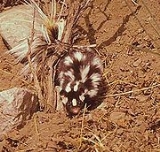
Spotted Skunk

Encyclopedia
The Eastern Spotted Skunk
(Spilogale putorius) is smaller and more weasel
-like than the striped skunk
. The spotted skunks are faster and more agile than the striped skunks and they have better pelts. For the last 100 years, the Eastern Spotted Skunk was bred for its fine silky fur. The furs and pelts were sold as "Marten
Fur."
Jerry Dragoo, in a 1997 paper co-authored by Rodney L. Honeycutt of Texas, named the new family classification Mephitidae after mephitis, the Latin word for a foul gas or smell.
Spilogale putorius is found throughout the central and southeastern United States, as well as, northeastern Mexico. In Mississippi, S. putorius is found throughout the whole state, except for the northwestern corner by the Mississippi river. In the Great Plains, there has been an observed increase in the geographical range of these skunks, and the cause of this is thought to be a result of an increase in agriculture. This would lead to an increase in mice, which happen to be one of the primary preys for S. putorius.
The typical body length of Spilogale putorius is 241 to 256 mm with a tail length of 110 to 192 mm, resulting in a total length of 351 to 448 mm. The feet are 40 to 53 mm, and the forefeet have claws approximately 7mm while the hind feet have claws that are around 3.5 mm. The feet are equipped with pads on the soles that aid in climbing. The large claws of the forefeet help the skunk dig and grasp prey. The total body weight of an adult ‘’S. putorius’’ ranges from 400 to 965 g.
In addition to performing a handstand before spraying a potential predator, Spirogale also performs what is known as foot stamping, which involves the
skunk stamping its feet on the ground in order to warn an approaching predator. The stamping can be heard for several meters away and is usually followed by the skunk spraying its odorous solution. When these skunks encounter an egg that they want to eat they will straddle the egg with their front legs and bite the egg open. If this fails they will then proceed to use their front legs to push the egg back kick it with one of their hind legs.
The liquid is secreted via paired anal subcutaneous glands that are connected to the body through striated muscles. The odorous solution is emitted as an atomized spray that is nearly invisible or as streams of larger droplets.
Skunks store about 1 tablespoon (15 g) of the oderous oil and can quickly spray five times in row. It takes about one week to replenish the oil.
The secretion of the spotted skunks differs from that of the striped skunks. The two major thiol
s of the striped skunks, (E)-2-butene-1-thiol and 3-methyl-1-butanethiol are the major components in the secretion of the spotted skunks along with a third thiol, 2-phenylethanethiol.
Thioacetate derivatives of the three thiols are present in the spray of the striped skunks but not the spotted skunks. They are not as odoriferous as the thiols. Water hydrolysis converts them to the more potent thiols. This chemical conversion may be why pets that have been sprayed by skunks will have a faint "skunky" odor on damp evenings.
s. Hydrogen peroxide
and baking soda (sodium bicarbonate
) are mild enough to be used on people and animals but changes hair color.
Stronger oxidizing agents, like sodium hypochlorite solutions—liquid laundry bleach—are cheap and effective for deodorizing other materials.
and will eat small rodent
s, fruit
s, berries
, bird
s, eggs
, insect
s and larva
e, lizard
s, snake
s, and carrion. Their diet may vary with the seasons as food availability fluctuates. They have a keen sense of smell that helps them find grubs and other food. Their hearing is acute but they have poor vision.
.
s can contract and carry rabies
. There have many many known occurrences of these skunks having Rabies in Mexico. Fears of a skunk walking about in daylight being rabid are not justified since they are crepuscular
and will sometimes come out during daylight for food.
Rabies surveillance report for 2001 finds an increase in the number of rabid skunks over raccoons. Yet most human infections do not come from skunks.
A skunk that bites a person, even a pet, will be killed and a necropsy performed to determine if the animal is rabid. If the animal is not caught the patient will undergo a series of preventive rabies shots.
Rabies vaccines for exposed humans were made from nerve tissue and had frequent serious adverse reactions. The cost of the vaccine was low but potency was inconsistent.
In 1983, a vaccinia-rabies glycoprotein (V-RG) recombinant virus vaccine was developed that has proved effective in raccoons and other reservoir species. In 1992, Cornell University experimented with aerial distribution of oral vaccine to raccoons and found it extremely effective.
Vaccination programs have eliminated rabies in domestic dogs in the US. Skunks in the US remain a reservoir for the disease. Iceland, Japan and the United Kingdom, Belgium, Finland, France, Greece, Norway, Portugal, Spain, Sweden and Switzerland, are now considered free of rabies. Until 1995, Australia was considered to be rabies-free, but in 1996 a rabies-related lyssavirus (type 7) was discovered in flying foxes, a bat species.
The species S. pygmaea is endemic to the Mexican Pacific coast and is currently threatened. The tropical dry forest of western Mexico, where these skunks live, is a highly threatened ecosystem that has been placed on conservation priority. S. pygmaea is also the smallest carnivore native to Mexico as well as one of the smallest worldwide.
Eastern Spotted Skunk
The Eastern Spotted Skunk is a small, relatively slender skunk found throughout the eastern United States and in small areas of Canada and Mexico....
(Spilogale putorius) is smaller and more weasel
Weasel
Weasels are mammals forming the genus Mustela of the Mustelidae family. They are small, active predators, long and slender with short legs....
-like than the striped skunk
Skunk
Skunks are mammals best known for their ability to secrete a liquid with a strong, foul odor. General appearance varies from species to species, from black-and-white to brown or cream colored. Skunks belong to the family Mephitidae and to the order Carnivora...
. The spotted skunks are faster and more agile than the striped skunks and they have better pelts. For the last 100 years, the Eastern Spotted Skunk was bred for its fine silky fur. The furs and pelts were sold as "Marten
Marten
The martens constitute the genus Martes within the subfamily Mustelinae, in family Mustelidae.-Description:Martens are slender, agile animals, adapted to living in taigas, and are found in coniferous and northern deciduous forests across the northern hemisphere. They have bushy tails, and large...
Fur."
Jerry Dragoo, in a 1997 paper co-authored by Rodney L. Honeycutt of Texas, named the new family classification Mephitidae after mephitis, the Latin word for a foul gas or smell.
Taxonomy and Etymology
The genus Spilogale is composed of four different species: S. gracilis, S. putorius, S. pygmaea, S. angustifrons. Mammalogists consider gracilis and putorius different species because of differences in reproductive patterns, bacular morphology, and chromosomal variation. However, interbreeding has never been falsified. The name Spilogale comes from the Greek word spilo, which means “spotted”, and gale, which means “weasel”. Putorius is the Latin word for “fetid odor”. Gracilis is the latin word for “slender”. Several other names attributed to S. putorius include: civet cat, polecat, hydrophobian skunk, phoby skunk, phoby cat, tree skunk, weasel skunk, black marten, little spotted skunk, four-lined skunk, four-striped skunk, and sachet kitty.Range
The western spotted skunk (Spilogale gracilis) can be found west of the Continental Divide from southern British Columbia to Central America, as well as in some parts of Montana, North Dakota, Wyoming, Colorado, and western Texas. Eastward, its range abuts that of the eastern spotted skunk (Spilogale putorius). Spilogale gracilis generally occupies lowland areas but they are sometimes found at higher elevations (2560 m). Although the western spotted skunk is now recognized as S. gracilis, previously, skunks west of the Cascade Crest in British Columbia, Washington, and Oregon as a distinct subspecies (S. p. latifrons).Spilogale putorius is found throughout the central and southeastern United States, as well as, northeastern Mexico. In Mississippi, S. putorius is found throughout the whole state, except for the northwestern corner by the Mississippi river. In the Great Plains, there has been an observed increase in the geographical range of these skunks, and the cause of this is thought to be a result of an increase in agriculture. This would lead to an increase in mice, which happen to be one of the primary preys for S. putorius.
Habitat
Spilogale usually like to reside in covered thickets, woods, riparian hardwood, shrubbery, and areas that are located near streams. However, S. putorius usually enjoy staying in rocky and woody habitats that have copious amounts of vegetation. These sly creatures prefer to dwell in a den to natural cavities such as stumps or hollow logs. Although they have very effective digging claws, they prefer to occupy dens that are made from gophers, wood rats, pocket gophers, striped skunks, or armadillos. They occupy dens that are positioned to be completely dark inside. Spilogale are very social creatures and frequently share dens with up to seven other skunks. Although skunks often live in this way, maternal dens are not open to non-maternal skunks.Characteristics
Spilogale putorius possess a small weasel-like body with fine, dense black fur that has 4 to 6 broken, white stripes. Two of the stripes are located at the median and four stripes are placed on the side running from the back of the head to the median. White markings are present on both cheeks, as well as on the tip of the tail. This is known as an aposematic fur pattern and is thought to act as a warning to predators.The typical body length of Spilogale putorius is 241 to 256 mm with a tail length of 110 to 192 mm, resulting in a total length of 351 to 448 mm. The feet are 40 to 53 mm, and the forefeet have claws approximately 7mm while the hind feet have claws that are around 3.5 mm. The feet are equipped with pads on the soles that aid in climbing. The large claws of the forefeet help the skunk dig and grasp prey. The total body weight of an adult ‘’S. putorius’’ ranges from 400 to 965 g.
Bone
Regarding the bone structure of S. putorius, the thyrohyal and ceratohyal protrude dorsally from the basihyal. In contrast to striped skunks who have 8 sternebra, Spilogale have 9, and a vertebral formula of 7 C, 14 T, 7 L, 2 S, 23 Ca, making a total of 53. These skunks have a unique characteristic, which is that they have dual articulation from their lesser multangular articulating with their first and second metacarpais.Behavior
Spilogale putorius are quite secretive and crafty creatures, and it is a rarity for humans to see them. They are also nocturnal and tend to be more active during dry cool nights rather than warm wet nights. Although these skunks do not hibernate, they do tend to greatly reduce their activity when enduring intensely warm summers or very cold winters. Generally speaking, out of the four species of Spilogale putorius is the most active. They are also more agile and vigilant than the other skunks dwelling in North America.In addition to performing a handstand before spraying a potential predator, Spirogale also performs what is known as foot stamping, which involves the
skunk stamping its feet on the ground in order to warn an approaching predator. The stamping can be heard for several meters away and is usually followed by the skunk spraying its odorous solution. When these skunks encounter an egg that they want to eat they will straddle the egg with their front legs and bite the egg open. If this fails they will then proceed to use their front legs to push the egg back kick it with one of their hind legs.
Reproduction
Around the time of March, the males’ testes begin to enlarge and are most massive by late September. The increase in size is accompanied by a larger testosterone production. Similarly, a female begins to experience an increase in ovarian activity in March. Spilogale begin to mate during March as well. Implantation occurs approximately 14-16 days after mating. For the western spotted skunk, most copulations occur in late September and the beginning of October. Although liter sizes vary considerably the average liter size is about 5.5 and the gender ratio is 65M: 35 F.Growth
The newborn skunks are covered with fine hair that shows the adult color pattern. The eyes open between 30 and 32 days. The kits start solid food at about 42 days and are weaned at about two months. They are full grown and reach adult size at about four months. The males do not help in raising the young.Defenses
Spotted skunks protect themselves by spraying a strong and unpleasant scent. Two glands on the sides of the anus release the odorous oil through nipples. When threatened, the skunk turns its body into a U-shape with the head and anus facing the attacker. Muscles around the nipples of the scent gland aim them, giving the skunk great accuracy on targets up to 15 feet away. As a warning before spraying, the skunk stamps its front feet, raises its tail, and hisses. They may warn with a unique "hand stand"—the back vertical and the tail waving.The liquid is secreted via paired anal subcutaneous glands that are connected to the body through striated muscles. The odorous solution is emitted as an atomized spray that is nearly invisible or as streams of larger droplets.
Skunks store about 1 tablespoon (15 g) of the oderous oil and can quickly spray five times in row. It takes about one week to replenish the oil.
The secretion of the spotted skunks differs from that of the striped skunks. The two major thiol
Thiol
In organic chemistry, a thiol is an organosulfur compound that contains a carbon-bonded sulfhydryl group...
s of the striped skunks, (E)-2-butene-1-thiol and 3-methyl-1-butanethiol are the major components in the secretion of the spotted skunks along with a third thiol, 2-phenylethanethiol.
Thioacetate derivatives of the three thiols are present in the spray of the striped skunks but not the spotted skunks. They are not as odoriferous as the thiols. Water hydrolysis converts them to the more potent thiols. This chemical conversion may be why pets that have been sprayed by skunks will have a faint "skunky" odor on damp evenings.
Deodorizing
Changing the thiols into compounds that have little or no odor can be done by oxidizing the thiols to sulfonic acidSulfonic acid
Sulfonic acid usually refers to a member of the class of organosulfur compounds with the general formula RS2–OH, where R is an alkyl or aryl. The formal part of acid, HS2–OH, are formally derivatives of the "parent" inorganic compound with the formula HSO2.-Preparation:Sulfonic acid is...
s. Hydrogen peroxide
Hydrogen peroxide
Hydrogen peroxide is the simplest peroxide and an oxidizer. Hydrogen peroxide is a clear liquid, slightly more viscous than water. In dilute solution, it appears colorless. With its oxidizing properties, hydrogen peroxide is often used as a bleach or cleaning agent...
and baking soda (sodium bicarbonate
Sodium bicarbonate
Sodium bicarbonate or sodium hydrogen carbonate is the chemical compound with the formula Na HCO3. Sodium bicarbonate is a white solid that is crystalline but often appears as a fine powder. It has a slightly salty, alkaline taste resembling that of washing soda . The natural mineral form is...
) are mild enough to be used on people and animals but changes hair color.
Stronger oxidizing agents, like sodium hypochlorite solutions—liquid laundry bleach—are cheap and effective for deodorizing other materials.
Diet
Skunks are omnivorousOmnivore
Omnivores are species that eat both plants and animals as their primary food source...
and will eat small rodent
Rodent
Rodentia is an order of mammals also known as rodents, characterised by two continuously growing incisors in the upper and lower jaws which must be kept short by gnawing....
s, fruit
Fruit
In broad terms, a fruit is a structure of a plant that contains its seeds.The term has different meanings dependent on context. In non-technical usage, such as food preparation, fruit normally means the fleshy seed-associated structures of certain plants that are sweet and edible in the raw state,...
s, berries
Berry
The botanical definition of a berry is a fleshy fruit produced from a single ovary. Grapes are an example. The berry is the most common type of fleshy fruit in which the entire ovary wall ripens into an edible pericarp. They may have one or more carpels with a thin covering and fleshy interiors....
, bird
Bird
Birds are feathered, winged, bipedal, endothermic , egg-laying, vertebrate animals. Around 10,000 living species and 188 families makes them the most speciose class of tetrapod vertebrates. They inhabit ecosystems across the globe, from the Arctic to the Antarctic. Extant birds range in size from...
s, eggs
Egg (biology)
An egg is an organic vessel in which an embryo first begins to develop. In most birds, reptiles, insects, molluscs, fish, and monotremes, an egg is the zygote, resulting from fertilization of the ovum, which is expelled from the body and permitted to develop outside the body until the developing...
, insect
Insect
Insects are a class of living creatures within the arthropods that have a chitinous exoskeleton, a three-part body , three pairs of jointed legs, compound eyes, and two antennae...
s and larva
Larva
A larva is a distinct juvenile form many animals undergo before metamorphosis into adults. Animals with indirect development such as insects, amphibians, or cnidarians typically have a larval phase of their life cycle...
e, lizard
Lizard
Lizards are a widespread group of squamate reptiles, with nearly 3800 species, ranging across all continents except Antarctica as well as most oceanic island chains...
s, snake
Snake
Snakes are elongate, legless, carnivorous reptiles of the suborder Serpentes that can be distinguished from legless lizards by their lack of eyelids and external ears. Like all squamates, snakes are ectothermic, amniote vertebrates covered in overlapping scales...
s, and carrion. Their diet may vary with the seasons as food availability fluctuates. They have a keen sense of smell that helps them find grubs and other food. Their hearing is acute but they have poor vision.
Life expectancy
Spotted skunks can live 6 years in captivity, but in the wild, about half the skunks die after 1 or 2 years.Skunks as pets
Skunks can be kept as pets in some states. For more information on skunk ownership, see Pet skunkPet skunk
A pet skunk is a skunk kept by humans for companionship and enjoyment. Although capable of living indoors with humans similarly to dogs or cats, pet skunks are relatively rare, partly due to restrictive laws and the complexity of their care...
.
Rabies
Skunks, like other wild mammalMammal
Mammals are members of a class of air-breathing vertebrate animals characterised by the possession of endothermy, hair, three middle ear bones, and mammary glands functional in mothers with young...
s can contract and carry rabies
Rabies
Rabies is a viral disease that causes acute encephalitis in warm-blooded animals. It is zoonotic , most commonly by a bite from an infected animal. For a human, rabies is almost invariably fatal if post-exposure prophylaxis is not administered prior to the onset of severe symptoms...
. There have many many known occurrences of these skunks having Rabies in Mexico. Fears of a skunk walking about in daylight being rabid are not justified since they are crepuscular
Crepuscular
Crepuscular animals are those that are active primarily during twilight, that is during dawn and dusk. The word is derived from the Latin word crepusculum, meaning "twilight." Crepuscular is, thus, in contrast with diurnal and nocturnal behavior. Crepuscular animals may also be active on a bright...
and will sometimes come out during daylight for food.
Rabies surveillance report for 2001 finds an increase in the number of rabid skunks over raccoons. Yet most human infections do not come from skunks.
- "Since 1990 [until 2001], 24 of 26 human cases of indigenously acquired rabies were associated, by genetic analysis, with variants of the rabies virus maintained by bats. Only 2 of these cases involved a report of a definite history of animal bite. The most likely route of infection remains transmission by bite during contact with a bat that either was ignored or unnoticed and subsequently forgotten." (Rabies surveillance in the United States during 2001, John W. Krebs, MS, Heather R. Noll, MPH, Charles E. Rupprecht, VMD, PhD, James E. Childs, ScD)
A skunk that bites a person, even a pet, will be killed and a necropsy performed to determine if the animal is rabid. If the animal is not caught the patient will undergo a series of preventive rabies shots.
Rabies vaccines for exposed humans were made from nerve tissue and had frequent serious adverse reactions. The cost of the vaccine was low but potency was inconsistent.
In 1983, a vaccinia-rabies glycoprotein (V-RG) recombinant virus vaccine was developed that has proved effective in raccoons and other reservoir species. In 1992, Cornell University experimented with aerial distribution of oral vaccine to raccoons and found it extremely effective.
Vaccination programs have eliminated rabies in domestic dogs in the US. Skunks in the US remain a reservoir for the disease. Iceland, Japan and the United Kingdom, Belgium, Finland, France, Greece, Norway, Portugal, Spain, Sweden and Switzerland, are now considered free of rabies. Until 1995, Australia was considered to be rabies-free, but in 1996 a rabies-related lyssavirus (type 7) was discovered in flying foxes, a bat species.
Conservation
The eastern spotted skunk, S. putorius, is not very much of a conservation concern. Management is hampered by an overall lack of information from surveying. . During the 1940s, Spilogale populations seemingly crashed and the species is currently listed by various state agencies as endangered, threatened, or ‘of concern’ across much of its range.The species S. pygmaea is endemic to the Mexican Pacific coast and is currently threatened. The tropical dry forest of western Mexico, where these skunks live, is a highly threatened ecosystem that has been placed on conservation priority. S. pygmaea is also the smallest carnivore native to Mexico as well as one of the smallest worldwide.