

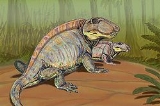
Sphenacodon

Encyclopedia
Sphenacodon was a pelycosaur
that was about 3 metres (9.8 ft) in length. Sphenacodon belongs to the family Sphenacodontidae
, a lineage that was related to the therapsids. It lived in the Early Permian
in present day Texas
and New Mexico
.
Sphenacodons vertebral spines were long, and probably acted as attachment points for massive back muscles, allowing the animal to lunge powerfully at its prey. It was closely related to Dimetrodon
, but lacked the large "sail" of that animal. It had heavy jaws with powerful teeth, including long canines and cutting cheek teeth, which indicate that it was probably carnivorous.
Pelycosaur
The pelycosaurs are an informal grouping composed of basal or primitive Late Paleozoic synapsid amniotes. Some species were quite large and could grow up to 3 meters or more, although most species were much smaller...
that was about 3 metres (9.8 ft) in length. Sphenacodon belongs to the family Sphenacodontidae
Sphenacodontidae
Sphenacodontidae is a family of small to large, advanced, carnivorous, Late Pennsylvanian to middle Permian pelycosaurs. Primitive forms were generally small in size , but during the later part of the early Permian these animals grew progressively larger , to become the top predators of their...
, a lineage that was related to the therapsids. It lived in the Early Permian
Permian
The PermianThe term "Permian" was introduced into geology in 1841 by Sir Sir R. I. Murchison, president of the Geological Society of London, who identified typical strata in extensive Russian explorations undertaken with Edouard de Verneuil; Murchison asserted in 1841 that he named his "Permian...
in present day Texas
Texas
Texas is the second largest U.S. state by both area and population, and the largest state by area in the contiguous United States.The name, based on the Caddo word "Tejas" meaning "friends" or "allies", was applied by the Spanish to the Caddo themselves and to the region of their settlement in...
and New Mexico
New Mexico
New Mexico is a state located in the southwest and western regions of the United States. New Mexico is also usually considered one of the Mountain States. With a population density of 16 per square mile, New Mexico is the sixth-most sparsely inhabited U.S...
.
Sphenacodons vertebral spines were long, and probably acted as attachment points for massive back muscles, allowing the animal to lunge powerfully at its prey. It was closely related to Dimetrodon
Dimetrodon
Dimetrodon was a predatory synapsid genus that flourished during the Permian period, living between 280–265 million years ago ....
, but lacked the large "sail" of that animal. It had heavy jaws with powerful teeth, including long canines and cutting cheek teeth, which indicate that it was probably carnivorous.