

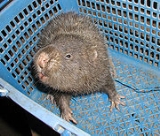
Spalacidae

Encyclopedia
The Spalacidae, or spalacids are a family
of rodent
s in the large and complex superfamily
Muroidea
. They are native to eastern Asia
, the Horn of Africa
, the Middle East
, and south-eastern Europe
. It includes the blind mole rat
s, bamboo rat
s, root rat
s, and zokor
s. This family represents the oldest split (excluding perhaps the Platacanthomyinae
) in the muroid superfamily, and comprises animals adapted to a subterranean way of life. It was thought that these rodents evolved adaptations to living underground independently until recent genetic studies demonstrated that they form a monophyletic group. Members of the Spalacidae are often placed in the family Muridae
along with all other members of the Muroidea.
to rat
sized rodents, adapted to burrowing and living underground. They have short limbs, wedge-shaped skulls, strong neck muscles, large incisor
teeth, and small eyes and external ears. In the zokors, which dig primarily with their feet, rather than their teeth, the front claw
s are also massively enlarged. These features are least extreme in the bamboo rats, which spend at least some of their time above ground, foraging for food. They are most highly developed in the blind mole rats, whose eyes are completely covered by skin, and entirely lack external ears or tails.
All of the spalacid species dig extensive underground burrows, which may include storage chambers for food, latrine
chambers, breeding nests, and so on. They are generally solitary animals, and do not share their tunnel complexes with other individuals. All the species are herbivore
s, feeding on root
s, bulbs, and tuber
s.
They give birth to litters of up to six young after a gestation
period of between three and seven weeks, depending on the species. As with many other muroids, the young are born blind, hairless, and helpless. They may stay with the mother for several months before setting off to establish their own burrows, although some species disperse as soon as they are weaned
.
Eumuroida
). These are "the reduction or absence of external eyes, reduced pinnae, stocky body, short tail (<50% head and body length), broad rostrum
, triangular-shaped braincase, infraorbital canal
ovoid shape and does not extend ventrally to the roof of the palate
, zygomatic
plate absent or much reduced, nasolacrimal canal inside infraorbital canal
, incisive foramina
small to medium-sized, extensive neck musculature and prominent points of attachment on the occipitum, minimal reduction in M3 relative to M1 and M2, and a distinct orientation of the manubrium of the malleus
bone."
, and 37 species
.
FAMILY SPALACIDAE
Family (biology)
In biological classification, family is* a taxonomic rank. Other well-known ranks are life, domain, kingdom, phylum, class, order, genus, and species, with family fitting between order and genus. As for the other well-known ranks, there is the option of an immediately lower rank, indicated by the...
of rodent
Rodent
Rodentia is an order of mammals also known as rodents, characterised by two continuously growing incisors in the upper and lower jaws which must be kept short by gnawing....
s in the large and complex superfamily
Taxonomic rank
In biological classification, rank is the level in a taxonomic hierarchy. Examples of taxonomic ranks are species, genus, family, and class. Each rank subsumes under it a number of less general categories...
Muroidea
Muroidea
Muroidea is a large superfamily of rodents. It includes hamsters, gerbils, true mice and rats, and many other relatives. They occupy a vast variety of habitats on every continent except Antarctica. Some authorities have placed all members of this group into a single family, Muridae, due to...
. They are native to eastern Asia
Asia
Asia is the world's largest and most populous continent, located primarily in the eastern and northern hemispheres. It covers 8.7% of the Earth's total surface area and with approximately 3.879 billion people, it hosts 60% of the world's current human population...
, the Horn of Africa
Horn of Africa
The Horn of Africa is a peninsula in East Africa that juts hundreds of kilometers into the Arabian Sea and lies along the southern side of the Gulf of Aden. It is the easternmost projection of the African continent...
, the Middle East
Middle East
The Middle East is a region that encompasses Western Asia and Northern Africa. It is often used as a synonym for Near East, in opposition to Far East...
, and south-eastern Europe
Europe
Europe is, by convention, one of the world's seven continents. Comprising the westernmost peninsula of Eurasia, Europe is generally 'divided' from Asia to its east by the watershed divides of the Ural and Caucasus Mountains, the Ural River, the Caspian and Black Seas, and the waterways connecting...
. It includes the blind mole rat
Blind mole rat
The genus Spalax contains the blind, fossorial, or subterranean mole rats, which are one of several types of rodents that are called mole rats. The hystricognath mole rats of the family Bathyergidae are completely unrelated, but some other forms are also in the family Spalacidae...
s, bamboo rat
Bamboo rat
The bamboo rats are four species of rodents of the subfamily Rhizomyinae. They are the sole living representatives of the tribe Rhizomyini. All are found in the eastern half of Asia.The species are:...
s, root rat
Tachyoryctes
Tachyoryctes is a genus of rodent in the Spalacidae family.It contains the following species:* Ankole Mole Rat * Mianzini Mole Rat * Audacious Mole Rat...
s, and zokor
Zokor
Zokors are Asiatic burrowing rodents resembling mole rats. They include two genera, Myospalax and Eospalax. Zokors are native to much of China, Kazhakstan, and Siberian Russia....
s. This family represents the oldest split (excluding perhaps the Platacanthomyinae
Platacanthomyinae
The rodent family Platacanthomyidae, or Oriental dormice, includes the spiny dormice and the Chinese pygmy dormice. In spite of their appearance, these animals are not true dormice, but are part of the large and complex superfamily Muroidea...
) in the muroid superfamily, and comprises animals adapted to a subterranean way of life. It was thought that these rodents evolved adaptations to living underground independently until recent genetic studies demonstrated that they form a monophyletic group. Members of the Spalacidae are often placed in the family Muridae
Muridae
Muridae is the largest family of mammals. It contains over 600 species found naturally throughout Eurasia, Africa, and Australia. They have been introduced worldwide. The group includes true mice and rats, gerbils, and relatives....
along with all other members of the Muroidea.
Characteristics
Spalacids are mouseMouse
A mouse is a small mammal belonging to the order of rodents. The best known mouse species is the common house mouse . It is also a popular pet. In some places, certain kinds of field mice are also common. This rodent is eaten by large birds such as hawks and eagles...
to rat
Rat
Rats are various medium-sized, long-tailed rodents of the superfamily Muroidea. "True rats" are members of the genus Rattus, the most important of which to humans are the black rat, Rattus rattus, and the brown rat, Rattus norvegicus...
sized rodents, adapted to burrowing and living underground. They have short limbs, wedge-shaped skulls, strong neck muscles, large incisor
Incisor
Incisors are the first kind of tooth in heterodont mammals. They are located in the premaxilla above and mandible below.-Function:...
teeth, and small eyes and external ears. In the zokors, which dig primarily with their feet, rather than their teeth, the front claw
Claw
A claw is a curved, pointed appendage, found at the end of a toe or finger in most mammals, birds, and some reptiles. However, the word "claw" is also often used in reference to an invertebrate. Somewhat similar fine hooked structures are found in arthropods such as beetles and spiders, at the end...
s are also massively enlarged. These features are least extreme in the bamboo rats, which spend at least some of their time above ground, foraging for food. They are most highly developed in the blind mole rats, whose eyes are completely covered by skin, and entirely lack external ears or tails.
All of the spalacid species dig extensive underground burrows, which may include storage chambers for food, latrine
Latrine
A latrine is a communal facility containing one or more commonly many toilets which may be simple pit toilets or in the case of the United States Armed Forces any toilet including modern flush toilets...
chambers, breeding nests, and so on. They are generally solitary animals, and do not share their tunnel complexes with other individuals. All the species are herbivore
Herbivore
Herbivores are organisms that are anatomically and physiologically adapted to eat plant-based foods. Herbivory is a form of consumption in which an organism principally eats autotrophs such as plants, algae and photosynthesizing bacteria. More generally, organisms that feed on autotrophs in...
s, feeding on root
Root
In vascular plants, the root is the organ of a plant that typically lies below the surface of the soil. This is not always the case, however, since a root can also be aerial or aerating . Furthermore, a stem normally occurring below ground is not exceptional either...
s, bulbs, and tuber
Tuber
Tubers are various types of modified plant structures that are enlarged to store nutrients. They are used by plants to survive the winter or dry months and provide energy and nutrients for regrowth during the next growing season and they are a means of asexual reproduction...
s.
They give birth to litters of up to six young after a gestation
Gestation
Gestation is the carrying of an embryo or fetus inside a female viviparous animal. Mammals during pregnancy can have one or more gestations at the same time ....
period of between three and seven weeks, depending on the species. As with many other muroids, the young are born blind, hairless, and helpless. They may stay with the mother for several months before setting off to establish their own burrows, although some species disperse as soon as they are weaned
Weaning
Weaning is the process of gradually introducing a mammal infant, either human or animal, to what will be its adult diet and withdrawing the supply of its mother's milk.The process takes place only in mammals, as only mammals produce milk...
.
Technical Characters
Norris et al. listed several characteristics that are present in all members of this family and that distinguish them from the rest of the muroids, (the cladeClade
A clade is a group consisting of a species and all its descendants. In the terms of biological systematics, a clade is a single "branch" on the "tree of life". The idea that such a "natural group" of organisms should be grouped together and given a taxonomic name is central to biological...
Eumuroida
Eumuroida
Eumuroida is a clade defined in 2004 to describe a group of muroid rodents. The clade is not defined in the standard taxonomic hierarchy, but it is between superfamily and family....
). These are "the reduction or absence of external eyes, reduced pinnae, stocky body, short tail (<50% head and body length), broad rostrum
Rostrum (anatomy)
The term rostrum is used for a number of unrelated structures in different groups of animals:*In crustaceans, the rostrum is the forward extension of the carapace in front of the eyes....
, triangular-shaped braincase, infraorbital canal
Infraorbital canal
Not to be confused with the infraorbital groove and infraorbital foramen, which are on opposite ends of the canal.One of the canals of the orbital surface of the maxilla, the infraorbital canal, opens just below the margin of the orbit...
ovoid shape and does not extend ventrally to the roof of the palate
Palate
The palate is the roof of the mouth in humans and other mammals. It separates the oral cavity from the nasal cavity. A similar structure is found in crocodilians, but, in most other tetrapods, the oral and nasal cavities are not truly separate. The palate is divided into two parts, the anterior...
, zygomatic
Zygomatic bone
The zygomatic bone is a paired bone of the human skull. It articulates with the maxilla, the temporal bone, the sphenoid bone and the frontal bone. The zygomatic is homologous to the jugal bone of other tetrapods...
plate absent or much reduced, nasolacrimal canal inside infraorbital canal
Infraorbital canal
Not to be confused with the infraorbital groove and infraorbital foramen, which are on opposite ends of the canal.One of the canals of the orbital surface of the maxilla, the infraorbital canal, opens just below the margin of the orbit...
, incisive foramina
Incisive foramen
The fossa incisiva is an opening in the bone of the oral hard palate where blood vessels and nerves may pass. There are four of these openings in the incisive fossa.-Formation:...
small to medium-sized, extensive neck musculature and prominent points of attachment on the occipitum, minimal reduction in M3 relative to M1 and M2, and a distinct orientation of the manubrium of the malleus
Malleus
The malleus or hammer is a hammer-shaped small bone or ossicle of the middle ear which connects with the incus and is attached to the inner surface of the eardrum...
bone."
Classification
The Spalacids are classified in three subfamilies, six generaGenus
In biology, a genus is a low-level taxonomic rank used in the biological classification of living and fossil organisms, which is an example of definition by genus and differentia...
, and 37 species
Species
In biology, a species is one of the basic units of biological classification and a taxonomic rank. A species is often defined as a group of organisms capable of interbreeding and producing fertile offspring. While in many cases this definition is adequate, more precise or differing measures are...
.
FAMILY SPALACIDAE
- Subfamily Myospalacinae - Zokors
- Genus Myospalax
- Myospalax myospalax species group
- False ZokorFalse ZokorThe False Zokor is a species of rodent in the Spalacidae family. It is found in China and Russia.-References:* Shar, S. & Lkhagvasuren, D. 2008. . Downloaded on 14 August 2008....
, Myospalax aspalax - Siberian ZokorSiberian ZokorThe Siberian Zokor is a species of rodent in the Spalacidae family. It is found in Kazakhstan and Russia.-References:* Tsytsulina, K. 2008. . Downloaded on 16 August 2009....
, Myospalax myospalax
- False Zokor
- Myospalax psilurus species group
- Transbaikal ZokorTransbaikal ZokorThe Transbaikal Zokor is a species of rodent in the Spalacidae family. It is found in China, Mongolia, and Russia.-References:* Shar, S., Tsytsulina, K. & Lkhagvasuren, D. 2008. . Downloaded on 16 August 2009....
, Myospalax psilurus
- Transbaikal Zokor
- Myospalax myospalax species group
- Genus EospalaxEospalaxEospalax is a genus of rodent in the Spalacidae family. It contains the following species:*Chinese Zokor, Eospalax fontanierii*Rothschild's Zokor, Eospalax rothschildi*Smith's Zokor, Eospalax smithii...
- Chinese ZokorChinese ZokorThe Chinese Zokor is a species of rodent in the Spalacidae family. It is endemic to China.-References:* Smith, A.T. & Johnston, C.H. 2008. . Downloaded on 14 August 2009....
, Eospalax fontanierii - Rothschild's ZokorRothschild's ZokorThe Rothschild's Zokor is a species of rodent in the Spalacidae family. It is endemic to China.-References:* Smith, A.T. & Johnston, C.H. 2008. . Downloaded on 14 August 2009....
, Eospalax rothschildi - Smith's ZokorSmith's ZokorSmith's Zokor is a species of rodent in the Spalacidae family. It is endemic to China.-References:* Smith, A.T. & Johnston, C.H. 2008. . Downloaded on 14 August 2009....
, Eospalax smithii
- Chinese Zokor
- Genus Myospalax
- Subfamily RhizomyinaeRhizomyinaeThe subfamily Rhizomyinae of rodents includes the Asian bamboo rats and certain of the African mole rats. The subfamily is grouped with the Spalacinae and the Myospalacinae into a family of fossorial muroid rodents basal to the other Muroidea....
- Tribe Rhizomyini - Bamboo Rats
- Genus RhizomysRhizomysRhizomys is a genus of rodent in the Spalacidae family.It contains the following species:* Hoary Bamboo Rat * Chinese Bamboo Rat * Large Bamboo Rat...
- Hoary Bamboo RatHoary Bamboo RatThe Hoary Bamboo Rat is a species of rodent in the Spalacidae family. It is found in Cambodia, China, India, Laos, Malaysia, Myanmar, Thailand, and Vietnam.- References :...
, Rhizomys pruinosus - Chinese Bamboo RatChinese Bamboo RatThe Chinese Bamboo Rat is a species of rodent in the Spalacidae family. It is found in China, Myanmar, and Vietnam.-References:* Lunde, D., Aplin, K. & Musser, G. 2008. . Downloaded on 16 August 2009....
, Rhizomys sinensis - Large Bamboo RatLarge Bamboo RatThe Large Bamboo Rat is a species of rodent in the Spalacidae family. It is found in Cambodia, China, Indonesia, Laos, Malaysia, Myanmar, Thailand and Vietnam.-References:...
, Rhizomys sumatrensis
- Hoary Bamboo Rat
- Genus Cannomys
- Lesser Bamboo RatLesser Bamboo RatThe Lesser Bamboo Rat is a species of rodent in the Spalacidae family. It is monotypic within the genus Cannomys.It is found in Bangladesh, Bhutan, Cambodia, China, India, Myanmar, Nepal, and Thailand.-References:...
, Cannomys badius
- Lesser Bamboo Rat
- Genus Rhizomys
- Tribe Tachyoryctini
- Genus TachyoryctesTachyoryctesTachyoryctes is a genus of rodent in the Spalacidae family.It contains the following species:* Ankole Mole Rat * Mianzini Mole Rat * Audacious Mole Rat...
- Mole rats- Ankole Mole RatAnkole Mole RatThe Ankole Mole Rat or Ankole African Mole Rat is a species of rodent in the Spalacidae family. It is found in Angola and Uganda. Its natural habitats are moist savanna and arable land.-References:...
, Tachyoryctes ankoliae - Mianzini Mole RatMianzini Mole RatThe Mianzini Mole Rat or Mianzini African Mole Rat is a species of rodent in the Spalacidae family. It is endemic to Kenya. Its natural habitats are dry savanna, pastureland, and rural gardens.-References:...
, Tachyoryctes annectens - Audacious Mole RatAudacious Mole RatThe Audacious Mole Rat or Aberdare Mountains African Mole Rat is a species of rodent in the Spalacidae family. It is endemic to Kenya. Its natural habitats are subtropical or tropical moist montanes and subtropical or tropical high-altitude grassland.-References:*Musser, G. G. and M. D. Carleton....
, Tachyoryctes audax - Demon Mole RatDemon Mole RatThe Demon Mole Rat or Demon African Mole Rat is a species of rodent in the Spalacidae family. It is found in Kenya and Tanzania. Its natural habitats are subtropical or tropical moist montanes, moist savanna, subtropical or tropical high-altitude grassland, and arable land.-References:*Musser, G....
, Tachyoryctes daemon - Kenyan African Mole RatKenyan African Mole RatThe Kenyan African Mole Rat is a species of rodent in the Spalacidae family. It is endemic to Kenya. Its natural habitats are dry savanna, moist savanna, arable land, pastureland, plantations , rural gardens, urban areas, and heavily degraded former forest.-References:*Musser, G. G. and M. D....
, Tachyoryctes ibeanus - Big-headed Mole RatBig-headed Mole RatTachyoryctes macrocephalus, also known as the Big-headed Mole Rat, Giant Root-rat, Ethiopian African Mole Rat, or Giant Mole-rat, is a species of rodent in the Spalacidae family.It is endemic to Ethiopia's Bale Mountains...
, Tachyoryctes macrocephalus - Naivasha Mole RatNaivasha Mole RatThe Naivasha Mole Rat is a species of rodent in the Spalacidae family. It is endemic to Kenya. Its natural habitats are subtropical or tropical moist montanes, moist savanna, arable land, and pastureland.-References:...
, Tachyoryctes naivashae - King Mole RatKing Mole RatTachyoryctes rex, also known as the King African Mole Rat or Alpine Mole Rat, is a burrowing rodent in the genus Tachyoryctes of family Spalacidae. It only occurs high on Mount Kenya, where it is common...
, Tachyoryctes rex - Ruanda Mole RatRuanda Mole RatThe Ruanda Mole Rat is a species of rodent in the Spalacidae family. It is found in Burundi, Democratic Republic of the Congo, and Rwanda...
, Tachyoryctes ruandae - Rudd's Mole RatRudd's Mole RatThe Rudd's Mole Rat is a species of rodent in the Spalacidae family. It is found in Kenya and Uganda. Its natural habitats are subtropical or tropical moist lowland forests, subtropical or tropical moist montanes, subtropical or tropical high-altitude grassland, arable land, pastureland,...
, Tachyoryctes ruddi - Embi Mole RatEmbi Mole RatThe Embi Mole Rat is a species of rodent in the Spalacidae family. It is endemic to Kenya. Its natural habitats are subtropical or tropical moist montanes, moist savanna, arable land, pastureland, plantations , and heavily degraded former forest.-References:*Musser, G. G. and M. D. Carleton....
, Tachyoryctes spalacinus - East African Mole RatEast African Mole RatThe East African Mole Rat is a species of rodent in the Spalacidae family. It is found in Ethiopia and Somalia. Its natural habitats are subtropical or tropical moist montanes, dry savanna, subtropical or tropical high-altitude shrubland, and subtropical or tropical high-altitude...
, Tachyoryctes splendens - Storey's African Mole RatStorey's African Mole RatStorey's African Mole Rat is a species of rodent in the Spalacidae family. It is endemic to Kenya. Its natural habitat is subtropical or tropical dry lowland grassland.-References:...
, Tachyoryctes storeyi
- Ankole Mole Rat
- Genus Tachyoryctes
- Tribe Rhizomyini - Bamboo Rats
- Subfamily Spalacinae
- Genus SpalaxSpalaxThe genus Spalax contains the blind, fossorial, or subterranean mole rats, which are one of several types of rodents that are called mole rats. The hystricognath mole rats of the family Bathyergidae are completely unrelated, but some other forms are also in the family Spalacidae...
- Blind mole rats- Sandy Mole RatSandy Mole RatThe Sandy Mole Rat is a species of rodent in the Spalacidae family. It is endemic to Ukraine.-References:* Baillie, J. 1996. . Downloaded on 30 July 2007....
, Spalax arenarius - Mt. Carmel Blind Mole Rat, Spalax carmeli
- Middle East Blind Mole RatMiddle East Blind Mole RatThe Middle East Blind Mole Rat or Israel Mole Rat is a species of rodent in the Spalacidae family....
, Spalax ehrenbergi - Upper Galilee Mountains Blind Mole Rat, Spalax galili
- Giant Mole RatGiant Mole RatThe Giant Mole Rat or Russian Mole Rat is a species of rodent in the Spalacidae family. It is found in Kazakhstan and Russia.-References:...
, Spalax giganteus - Golan Heights Blind Mole RatGolan Heights Blind Mole RatThe Golan Heights Blind Mole Rat is a species of rodent in the Spalacidae family. The species have been found on the Golan Heights, ....
, Spalax golani - Balkan Mole RatBalkan Mole RatThe Balkan Mole Rat or Bukovin Mole Rat is a species of rodent in the Spalacidae family. It is found in Romania, the Republic of Moldova and Ukraine.-References:* Amori, G. 1996. . Downloaded on 30 July 2007....
, Spalax graecus - Judean Mountains Blind Mole Rat, Spalax judaei
- Lesser Mole RatLesser Mole RatThe Lesser Mole Rat is a species of rodent in the Spalacidae family. It is found in Bosnia and Herzegovina, Bulgaria, Greece, Hungary, Macedonia, Romania, Serbia, Montenegro, Turkey, and Ukraine...
, Spalax leucodon - Greater Mole RatGreater Mole RatThe Greater Mole Rat is a species of rodent in the Spalacidae family. It is found in Russia and Ukraine.-Description:...
, Spalax microphthalmus - Munzur Mole Rat, Spalax munzuri
- Nehring's Blind Mole RatNehring's Blind Mole RatNehring's Blind Mole Rat is a species of rodent in the family Muridae.It is found in Armenia, Georgia, and Turkey.-References:* Baillie, J. 1996. . Downloaded on 9 July 2007....
, Spalax nehringi - Kazakhstan Blind Mole Rat, Spalax uralensis
- Podolsk Mole RatPodolsk Mole RatThe Podolsk Mole Rat is a species of rodent in the Spalacidae family. It is an endemic of western and central Ukraine.-References:* Amori, G. 1996. . Downloaded on 30 July 2007....
, Spalax zemni
- Sandy Mole Rat
- Genus Spalax