


Soo Line Railroad

Encyclopedia
The Soo Line Railroad is the primary United States
railroad subsidiary of the Canadian Pacific Railway
(CP), controlled through the Soo Line Corporation, and one of seven U.S. Class I railroad
s. Although it is named for the Minneapolis, St. Paul and Sault Ste. Marie Railroad
(MStP&SSM), which was commonly known as the Soo Line after the phonetic spelling of Sault, it was formed in 1961 by the consolidation of that company with two other CP subsidiaries, the Duluth, South Shore and Atlantic Railroad and Wisconsin Central Railroad. It is also the successor to other Class I railroads, including the Minneapolis, Northfield and Southern Railway
(acquired 1982) and Chicago, Milwaukee, St. Paul and Pacific Railroad
(Milwaukee Road, acquired at bankruptcy in 1985). On the other hand, a large amount of mileage was spun off in 1987 to Wisconsin Central Ltd., now part of the Canadian National Railway
. The Soo Line and the Delaware and Hudson Railway
, the CP's other major subsidiary (before the 2008 DM&E
acquisition), presently do business as
the Canadian Pacific Railway, and most equipment has been repainted into the CP's scheme, but the U.S. Surface Transportation Board
groups all the CP's U.S. subsidiaries under the Soo Line name for reporting purposes.
on the Canadian border, and extends southeast along former MStP&SSM trackage to the Twin Cities (Minneapolis-St. Paul). Ex-Milwaukee Road trackage takes the Soo Line from the Twin Cities to Chicago via Milwaukee. Between Chicago and Detroit, where the CP-owned Detroit River Tunnel connects back into Canada, the Soo Line has trackage rights
over the Norfolk Southern Railway
and haulage rights over CSX Transportation
.
Major branches include a connection from the border at Noyes to Glenwood, Minnesota
and, until it was sold to the Indiana Rail Road
in 2006, a line from Chicago to Louisville, Kentucky
.
Through trackage rights over the BNSF Railway
, the Soo Line also serves Duluth from the Twin Cities.
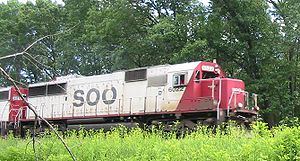 The present Soo Line Railroad Company was actually incorporated October 19, 1949 in Minnesota as the Duluth, South Shore and Atlantic Railroad, as part of the plan for reorganizing the Duluth, South Shore and Atlantic Railway
and subsidiary Mineral Range Railroad. When the CP consolidated several subsidiaries on January 1, 1961, it used this company to merge the Minneapolis, St. Paul and Sault Ste. Marie Railroad
and Wisconsin Central Railroad into, and renamed it to the present name, Soo Line Railroad. The Soo Line gained control of the Minneapolis, Northfield and Southern Railway
(MN&S), a Twin Cities-area short line, in June 1982.
Passenger service was mostly eliminated by the 1961 merger, but several trains remained for a few more years. These were a Saint Paul to Duluth daytime train known only as Trains 62 and 63 (discontinued June 1961); the overnight Chicago to Duluth Laker and its Saint Paul connection (both discontinued January 15, 1965); the Twin Cities to Winnipeg
Winnipeger
(discontinued March 25, 1967); and the Saint Paul to Portal, North Dakota
Soo-Dominion that during the summer, ran through to Vancouver
via a connection with Canadian Pacific Railway
's The Dominion at Moose Jaw. It was discontinued in December 1963, and the western Canada cars were handled on the Winnipeger for two more summers before they too were pulled. The Soo Line's last passenger train was the Copper Country Limited, a joint service with the Milwaukee Road inherited from the Duluth, South Shore and Atlantic. This Chicago-Champion-Calumet
service was discontinued May 8, 1968. In addition there were several mixed trains, with additional ones created to enable the discontinuance of the Saint Paul to Portal passenger train. Some mixed train services gained notoriety because passengers were conveyed in one direction only.
In 1984, the CP incorporated the Soo Line Corporation in Minnesota as a holding company
, exchanging stock in December to give the Soo Line Corporation total control over the railroad. Two months later, on February 19, 1985, the Soo Line purchased the property of the bankrupt Chicago, Milwaukee, St. Paul and Pacific Railroad
and assigned it to a newly-created subsidiary, The Milwaukee Road, Inc. This company and the MN&S were both merged into the Soo Line Railroad effective January 1, 1986. To cut costs, the Soo Line created the Lake States Transportation Division
(LSTD) on February 10, 1986 to operate the less-important lines, including the ex-Wisconsin Central line between Chicago and the Twin Cities. Unable to implement its proposed labor
rule changes, the Soo Line sold the approximately 2000 miles (3,218.7 km) LSTD to a new regional railroad
, Wisconsin Central Ltd., in 1987 for $133 million. In 1990, the CP gained full control of the Soo Line Corporation, of which it had previously owned about 56% of the common stock
.
s have been preserved:
In addition, a number of the railroad's 145-strong all-steel caboose
s have been preserved.
United States
The United States of America is a federal constitutional republic comprising fifty states and a federal district...
railroad subsidiary of the Canadian Pacific Railway
Canadian Pacific Railway
The Canadian Pacific Railway , formerly also known as CP Rail between 1968 and 1996, is a historic Canadian Class I railway founded in 1881 and now operated by Canadian Pacific Railway Limited, which began operations as legal owner in a corporate restructuring in 2001...
(CP), controlled through the Soo Line Corporation, and one of seven U.S. Class I railroad
Class I railroad
A Class I railroad in the United States and Mexico, or a Class I rail carrier in Canada, is a large freight railroad company, as classified based on operating revenue.Smaller railroads are classified as Class II and Class III...
s. Although it is named for the Minneapolis, St. Paul and Sault Ste. Marie Railroad
Minneapolis, St. Paul and Sault Ste. Marie Railroad
The Minneapolis, St. Paul and Sault Ste. Marie Railroad was a Class I railroad subsidiary of the Canadian Pacific Railway in the Midwest U.S. Commonly known as the Soo Line after the phonetic spelling of Sault, it was merged with several other major CP subsidiaries on January 1, 1961 to form the...
(MStP&SSM), which was commonly known as the Soo Line after the phonetic spelling of Sault, it was formed in 1961 by the consolidation of that company with two other CP subsidiaries, the Duluth, South Shore and Atlantic Railroad and Wisconsin Central Railroad. It is also the successor to other Class I railroads, including the Minneapolis, Northfield and Southern Railway
Minneapolis, Northfield and Southern Railway
The Minneapolis, Northfield and Southern Railway was an long American short line railroad connecting Minneapolis and Northfield, Minnesota. It was incorporated in 1918 to take over the trackage of the former Minneapolis, St. Paul, Rochester and Dubuque Electric Traction Company, also known as...
(acquired 1982) and Chicago, Milwaukee, St. Paul and Pacific Railroad
Chicago, Milwaukee, St. Paul and Pacific Railroad
The Milwaukee Road, officially the Chicago, Milwaukee, St. Paul and Pacific Railroad , was a Class I railroad that operated in the Midwest and Northwest of the United States from 1847 until its merger into the Soo Line Railroad on January 1, 1986. The company went through several official names...
(Milwaukee Road, acquired at bankruptcy in 1985). On the other hand, a large amount of mileage was spun off in 1987 to Wisconsin Central Ltd., now part of the Canadian National Railway
Canadian National Railway
The Canadian National Railway Company is a Canadian Class I railway headquartered in Montreal, Quebec. CN's slogan is "North America's Railroad"....
. The Soo Line and the Delaware and Hudson Railway
Delaware and Hudson Railway
The Delaware and Hudson Railway is a railroad that operates in the northeastern United States. Since 1991 it has been a subsidiary of the Canadian Pacific Railway, although CPR has assumed all operations and the D&H does not maintain any locomotives or rolling stock.It was formerly an important...
, the CP's other major subsidiary (before the 2008 DM&E
Dakota, Minnesota and Eastern Railroad
The Dakota, Minnesota and Eastern Railroad is a Class II railroad subsidiary of the Canadian Pacific Railway operating across South Dakota and southern Minnesota in the northern plains of the United States...
acquisition), presently do business as
Doing business as
The phrase "doing business as" is a legal term used in the United States, meaning that the trade name, or fictitious business name, under which the business or operation is conducted and presented to the world is not the legal name of the legal person who actually own it and are responsible for it...
the Canadian Pacific Railway, and most equipment has been repainted into the CP's scheme, but the U.S. Surface Transportation Board
Surface Transportation Board
The Surface Transportation Board of the United States is a bipartisan, decisionally-independent adjudicatory body organizationally housed within the U.S. Department of Transportation. The STB was established in 1996 to assume some of the regulatory functions that had been administered by the...
groups all the CP's U.S. subsidiaries under the Soo Line name for reporting purposes.
System description
The company's main line begins at Portal, North DakotaPortal, North Dakota
As of the census of 2000, there were 131 people, 63 households, and 43 families residing in the city. The population density was 232.8 people per square mile . There were 98 housing units at an average density of 174.1 per square mile...
on the Canadian border, and extends southeast along former MStP&SSM trackage to the Twin Cities (Minneapolis-St. Paul). Ex-Milwaukee Road trackage takes the Soo Line from the Twin Cities to Chicago via Milwaukee. Between Chicago and Detroit, where the CP-owned Detroit River Tunnel connects back into Canada, the Soo Line has trackage rights
Trackage rights
Trackage rights , running rights or running powers is an agreement whereby a railway company has the right to run its trains on tracks owned by another railway company....
over the Norfolk Southern Railway
Norfolk Southern Railway
The Norfolk Southern Railway is a Class I railroad in the United States, owned by the Norfolk Southern Corporation. With headquarters in Norfolk, Virginia, the company operates 21,500 route miles in 22 eastern states, the District of Columbia and the province of Ontario, Canada...
and haulage rights over CSX Transportation
CSX Transportation
CSX Transportation operates a Class I railroad in the United States known as the CSX Railroad. It is the main subsidiary of the CSX Corporation. The company is headquartered in Jacksonville, Florida, and owns approximately 21,000 route miles...
.
Major branches include a connection from the border at Noyes to Glenwood, Minnesota
Glenwood, Minnesota
As of the census of 2000, there were 2,594 people, 1,131 households, and 629 families residing in the city. The population density was 466.0 people per square mile . There were 1,202 housing units at an average density of 215.9 per square mile...
and, until it was sold to the Indiana Rail Road
Indiana Rail Road
The Indiana Rail Road is a United States Class II railroad, originally operating over former Illinois Central Railroad trackage from Newton, Illinois to Indianapolis, Indiana, a distance of 155 miles...
in 2006, a line from Chicago to Louisville, Kentucky
Louisville, Kentucky
Louisville is the largest city in the U.S. state of Kentucky, and the county seat of Jefferson County. Since 2003, the city's borders have been coterminous with those of the county because of a city-county merger. The city's population at the 2010 census was 741,096...
.
Through trackage rights over the BNSF Railway
BNSF Railway
The BNSF Railway is a wholly owned subsidiary of Berkshire Hathaway Inc., and is headquartered in Fort Worth, Texas. It is one of seven North American Class I railroads and the second largest freight railroad network in North America, second only to the Union Pacific Railroad, its primary...
, the Soo Line also serves Duluth from the Twin Cities.
History
Duluth, South Shore and Atlantic Railway
The Duluth, South Shore and Atlantic Railway was an American railroad serving the Upper Peninsula of Michigan and the Lake Superior shoreline of Wisconsin. It provided service from Sault Ste. Marie, Michigan, and St. Ignace, Michigan, westward through Marquette, Michigan to Superior, Wisconsin,...
and subsidiary Mineral Range Railroad. When the CP consolidated several subsidiaries on January 1, 1961, it used this company to merge the Minneapolis, St. Paul and Sault Ste. Marie Railroad
Minneapolis, St. Paul and Sault Ste. Marie Railroad
The Minneapolis, St. Paul and Sault Ste. Marie Railroad was a Class I railroad subsidiary of the Canadian Pacific Railway in the Midwest U.S. Commonly known as the Soo Line after the phonetic spelling of Sault, it was merged with several other major CP subsidiaries on January 1, 1961 to form the...
and Wisconsin Central Railroad into, and renamed it to the present name, Soo Line Railroad. The Soo Line gained control of the Minneapolis, Northfield and Southern Railway
Minneapolis, Northfield and Southern Railway
The Minneapolis, Northfield and Southern Railway was an long American short line railroad connecting Minneapolis and Northfield, Minnesota. It was incorporated in 1918 to take over the trackage of the former Minneapolis, St. Paul, Rochester and Dubuque Electric Traction Company, also known as...
(MN&S), a Twin Cities-area short line, in June 1982.
Passenger service was mostly eliminated by the 1961 merger, but several trains remained for a few more years. These were a Saint Paul to Duluth daytime train known only as Trains 62 and 63 (discontinued June 1961); the overnight Chicago to Duluth Laker and its Saint Paul connection (both discontinued January 15, 1965); the Twin Cities to Winnipeg
Winnipeg
Winnipeg is the capital and largest city of Manitoba, Canada, and is the primary municipality of the Winnipeg Capital Region, with more than half of Manitoba's population. It is located near the longitudinal centre of North America, at the confluence of the Red and Assiniboine Rivers .The name...
Winnipeger
Winnipeger (passenger train)
In October 1904 the Minneapolis, St. Paul and Sault Ste. Marie Railway and Canadian Pacific Railway began over-night passenger service between the Twin Cities and Winnipeg, Manitoba. The train consisted of a mail and baggage cars, two passenger cars, a sleeper and dining car...
(discontinued March 25, 1967); and the Saint Paul to Portal, North Dakota
Portal, North Dakota
As of the census of 2000, there were 131 people, 63 households, and 43 families residing in the city. The population density was 232.8 people per square mile . There were 98 housing units at an average density of 174.1 per square mile...
Soo-Dominion that during the summer, ran through to Vancouver
Vancouver
Vancouver is a coastal seaport city on the mainland of British Columbia, Canada. It is the hub of Greater Vancouver, which, with over 2.3 million residents, is the third most populous metropolitan area in the country,...
via a connection with Canadian Pacific Railway
Canadian Pacific Railway
The Canadian Pacific Railway , formerly also known as CP Rail between 1968 and 1996, is a historic Canadian Class I railway founded in 1881 and now operated by Canadian Pacific Railway Limited, which began operations as legal owner in a corporate restructuring in 2001...
's The Dominion at Moose Jaw. It was discontinued in December 1963, and the western Canada cars were handled on the Winnipeger for two more summers before they too were pulled. The Soo Line's last passenger train was the Copper Country Limited, a joint service with the Milwaukee Road inherited from the Duluth, South Shore and Atlantic. This Chicago-Champion-Calumet
Calumet, Michigan
Calumet is a village in Calumet Township, Houghton County, in the U.S. state of Michigan's Upper Peninsula, that was once at the center of the mining industry of the Upper Peninsula. Also known as Red Jacket, the village includes the Calumet Downtown Historic District, listed on the National...
service was discontinued May 8, 1968. In addition there were several mixed trains, with additional ones created to enable the discontinuance of the Saint Paul to Portal passenger train. Some mixed train services gained notoriety because passengers were conveyed in one direction only.
In 1984, the CP incorporated the Soo Line Corporation in Minnesota as a holding company
Holding company
A holding company is a company or firm that owns other companies' outstanding stock. It usually refers to a company which does not produce goods or services itself; rather, its purpose is to own shares of other companies. Holding companies allow the reduction of risk for the owners and can allow...
, exchanging stock in December to give the Soo Line Corporation total control over the railroad. Two months later, on February 19, 1985, the Soo Line purchased the property of the bankrupt Chicago, Milwaukee, St. Paul and Pacific Railroad
Chicago, Milwaukee, St. Paul and Pacific Railroad
The Milwaukee Road, officially the Chicago, Milwaukee, St. Paul and Pacific Railroad , was a Class I railroad that operated in the Midwest and Northwest of the United States from 1847 until its merger into the Soo Line Railroad on January 1, 1986. The company went through several official names...
and assigned it to a newly-created subsidiary, The Milwaukee Road, Inc. This company and the MN&S were both merged into the Soo Line Railroad effective January 1, 1986. To cut costs, the Soo Line created the Lake States Transportation Division
Lake States Transportation Division
Lake States Transportation Division was a wholly owned division of the Soo Line Railroad that existed from 1986-1987.The bankruptcy of the Chicago, Milwaukee, St. Paul and Pacific Railroad saw the Canadian Pacific Railway's subsidiary Soo Line Railroad acquire its routes to add trackage between...
(LSTD) on February 10, 1986 to operate the less-important lines, including the ex-Wisconsin Central line between Chicago and the Twin Cities. Unable to implement its proposed labor
Labor relations
Industrial relations is a multidisciplinary field that studies the employment relationship. Industrial relations is increasingly being called employment relations because of the importance of non-industrial employment relationships. Many outsiders also equate industrial relations to labour relations...
rule changes, the Soo Line sold the approximately 2000 miles (3,218.7 km) LSTD to a new regional railroad
Regional railroad
In the United States, a regional railroad is a railroad company that is not Class I, but still has a substantial amount of traffic or trackage . The Association of American Railroads has defined the lower bound as of track or $40 million in annual operating revenue...
, Wisconsin Central Ltd., in 1987 for $133 million. In 1990, the CP gained full control of the Soo Line Corporation, of which it had previously owned about 56% of the common stock
Common stock
Common stock is a form of corporate equity ownership, a type of security. It is called "common" to distinguish it from preferred stock. In the event of bankruptcy, common stock investors receive their funds after preferred stock holders, bondholders, creditors, etc...
.
Presidents
The Presidents of the Soo Line Railroad were:- Leonard Murray, 1961–1978. Previously President of the Duluth, South Shore and Atlantic Railroad.
- Thomas M. Beckley, 1978–1983.
- Dennis Miles Cavanaugh, 1983–1986, 1987–1989.
- Robert C. Gilmore, 1986–1987.
- Edwin V. Dodge, 1989–1996
Preserved equipment
Some of the railroad's diesel locomotiveDiesel locomotive
A diesel locomotive is a type of railroad locomotive in which the prime mover is a diesel engine, a reciprocating engine operating on the Diesel cycle as invented by Dr. Rudolf Diesel...
s have been preserved:
- Soo 700, an EMD GP30EMD GP30The EMD GP30 was a 2,250 hp four-axle B-B diesel locomotive built by General Motors Electro-Motive Division of La Grange, Illinois between July, 1961 and November, 1963...
, at the Lake Superior Railroad MuseumLake Superior Railroad MuseumThe Lake Superior Railroad Museum is a railroad museum in Duluth, Minnesota.The museum has seven steam, fourteen diesel and two electric locomotives, and over 40 other pieces of rolling stock...
, Duluth, MinnesotaDuluth, MinnesotaDuluth is a port city in the U.S. state of Minnesota and is the county seat of Saint Louis County. The fourth largest city in Minnesota, Duluth had a total population of 86,265 in the 2010 census. Duluth is also the second largest city that is located on Lake Superior after Thunder Bay, Ontario,...
. Restored for use on their North Shore Scenic Railroad. - Soo 703, an EMD GP30EMD GP30The EMD GP30 was a 2,250 hp four-axle B-B diesel locomotive built by General Motors Electro-Motive Division of La Grange, Illinois between July, 1961 and November, 1963...
, at the Colfax Railroad MuseumColfax Railroad MuseumThe Colfax Railroad Museum is a railroad museum in Colfax, Wisconsin.-Collection:The museum currently has a growing collection of railroad equipment from railroads that serviced the western Wisconsin and eastern Minnesota region...
, Colfax, WisconsinColfax, WisconsinColfax is a village in Dunn County, Wisconsin, United States. The population was 1,136 at the 2000 census. The village is located within the Town of Colfax.-Geography:Colfax is located at ....
. - Soo 715, an EMD GP30EMD GP30The EMD GP30 was a 2,250 hp four-axle B-B diesel locomotive built by General Motors Electro-Motive Division of La Grange, Illinois between July, 1961 and November, 1963...
, is preserved at the National Railroad MuseumNational Railroad MuseumThe National Railroad Museum is a railroad museum located in Ashwaubenon, Wisconsin, in suburban Green Bay.The museum is one of the oldest institutions in the United States dedicated to preserving and interpreting the nation's railroad history. It was founded in 1956 by community volunteers in...
in Green Bay, WisconsinGreen Bay, WisconsinGreen Bay is a city in and the county seat of Brown County in the U.S. state of Wisconsin, located at the head of Green Bay, a sub-basin of Lake Michigan, at the mouth of the Fox River. It has an elevation of above sea level and is located north of Milwaukee. As of the 2010 United States Census,...
. - Soo 500, an EMD FP7EMD FP7The EMD FP7 was a , B-B dual-service passenger and freight-hauling diesel locomotive produced between June 1949 and December 1953 by General Motors' Electro-Motive Division and General Motors Diesel. Final assembly was at GM-EMD's La Grange, Illinois plant, excepting locomotives destined for...
, at Ladysmith WI. - Soo 2500, an EMD FP7EMD FP7The EMD FP7 was a , B-B dual-service passenger and freight-hauling diesel locomotive produced between June 1949 and December 1953 by General Motors' Electro-Motive Division and General Motors Diesel. Final assembly was at GM-EMD's La Grange, Illinois plant, excepting locomotives destined for...
, at the Lake Superior Railroad MuseumLake Superior Railroad MuseumThe Lake Superior Railroad Museum is a railroad museum in Duluth, Minnesota.The museum has seven steam, fourteen diesel and two electric locomotives, and over 40 other pieces of rolling stock...
, Duluth, MinnesotaDuluth, MinnesotaDuluth is a port city in the U.S. state of Minnesota and is the county seat of Saint Louis County. The fourth largest city in Minnesota, Duluth had a total population of 86,265 in the 2010 census. Duluth is also the second largest city that is located on Lake Superior after Thunder Bay, Ontario,...
. Also restored for use on their North Shore Scenic Railroad.
In addition, a number of the railroad's 145-strong all-steel caboose
Caboose
A caboose is a manned North American rail transport vehicle coupled at the end of a freight train. Although cabooses were once used on nearly every freight train, their use has declined and they are seldom seen on trains, except on locals and smaller railroads.-Function:The caboose provided the...
s have been preserved.