


Six stroke engine

Encyclopedia
The six-stroke engine is a type of internal combustion engine
based on the four-stroke engine, but with additional complexity intended to make it more efficient and reduce emissions. Two types of six-stroke engine have been developed since the 1990s:
In the first approach, the engine captures the heat lost from the four-stroke Otto cycle or Diesel cycle
and uses it to power an additional power and exhaust stroke of the piston in the same cylinder. Designs use either steam or air as the working fluid for the additional power stroke. The pistons in this type of six-stroke engine go up and down three times for each injection of fuel. There are two power strokes: one with fuel, the other with steam or air. The currently notable designs in this class are the Crower six-stroke engine, invented by Bruce Crower of the U.S. ; the Bajulaz engine by the Bajulaz S.A. company of Switzerland; and the Velozeta Six-stroke engine built by the College of Engineering, at Trivandrum in India.
The second approach to the six-stroke engine uses a second opposed piston
in each cylinder that moves at half the cyclical rate of the main piston, thus giving six piston movements per cycle. Functionally, the second piston replaces the valve mechanism of a conventional engine but also increases the compression ratio
. The currently notable designs in this class include two designs developed independently: the Beare Head
engine, invented by Australian Malcolm Beare, and the German Charge pump, invented by Helmut Kottmann.
patents. His solution was to develop a 'Patent slide valve' and a single-acting six-stroke engine using it.
By 1886, Scottish steam locomotive maker Dick, Kerr & Co.
saw a future in large oil engines and licensed the Griffin patents. These were double acting, tandem engines and sold under the name "Kilmarnock". A major market for the Griffin engine was in electricity generation, where they developed a reputation for happily running light for long periods, then suddenly being able to take up a large demand for power. Their large heavy construction didn't suit them to mobile use, but they were capable of burning heavier and cheaper grades of oil.
The key principle of the "Griffin Simplex" was a heated exhaust-jacketed external vapouriser, into which the fuel was sprayed. The temperature was held around 550 °F (287.8 °C), sufficient to physically vapourise the oil but not to break it down chemically. This fractional distillation supported the use of heavy oil fuels, the unusable tars and asphalts separating out in the vapouriser.
Hot bulb ignition
was used, which Griffin termed the 'Catathermic Igniter' , a small isolated cavity connected to the combustion chamber. The spray injector had an adjustable inner nozzle for the air supply, surrounded by an annular casing for the oil, both oil and air entering at 20 lbs sq in. pressure, and being regulated by a governor.
Griffin went out of business in 1923.
Only two known examples of a Griffin six-stroke engine survive. One is in the Anson engine museum
. The other was built in 1885 and for some years was in the Birmingham Museum of Science and Technology, but in 2007 it returned to Bath and the Museum of Bath at Work
.
and an air preheating chamber above each cylinder. The combustion chamber receives a charge of heated air from the cylinder; the injection of fuel begins an isochoric
burn which increases the thermal efficiency
compared to a burn in the cylinder. The high pressure achieved is then released into the cylinder to work the power or expansion stroke. Meanwhile a second chamber which blankets the combustion chamber, has its air content heated to a high degree by heat passing through the cylinder wall. This heated and pressurized air is then used to power an additional stroke of the piston.
The claimed advantages of the engine include reduction in fuel consumption by at least 40%, two expansion strokes in six strokes, multi-fuel usage capability, and a dramatic reduction in pollution
.
The Bajulaz Six-Stroke Engine was invented in 1989 by the Bajulaz S A company, based in Geneva
, Switzerland
; it has and .
The Bajulaz six-stroke engine features:
is not much less than that of a four-stroke Gasoline engine. The engine can run on a variety of fuels, ranging from Gasoline
and diesel to LPG. An altered engine shows a 65% reduction in carbon monoxide pollution when compared with the four stroke engine from which it was developed.
The engine was developed in 2006 by a team of mechanical engineering students (Aaron Joseph George, Arun K Nair, Boby Sebastian, Krishnaraj U) of the College of Engineering, Trivandrum
.
, which expands and forces the piston down for an additional power stroke. Thus, waste heat that most engines require an air or water cooling system to discharge is captured and put to use driving the piston. Crower estimated that his design would reduce fuel consumption by 40% by generating the same power output at a lower RPM. The weight associated with a cooling system could be eliminated, but that would be balanced by a need for a water tank in addition to the normal fuel tank.
The Crower six-stroke engine was an experimental design that attracted media attention in 2006 because of an interview given by 75 year old American
inventor Pankaj Sharma of Guru Nanak Dev University, Punjab, India has applied for a patent on his design. (http://www.autoweek.com/apps/pbcs.dll/article?AID=/20060227/FREE/302270007/1023/THISWEEKSISSUE) That patent application was subsequently abandoned.
Leonard Dyer
invented the first six-stroke internal combustion water injection engine in 1915, which is very similar to Crower's design. A dozen more similar patents have been issued since.
Dyer's six-stroke engine features:
, Malcolm Beare. The technology combines a four stroke engine bottom end with an opposed piston in the cylinder head working at half the cyclical rate of the bottom piston. Functionally, the second piston replaces the valve mechanism of a conventional engine.
first use of "sixstroke" 1994
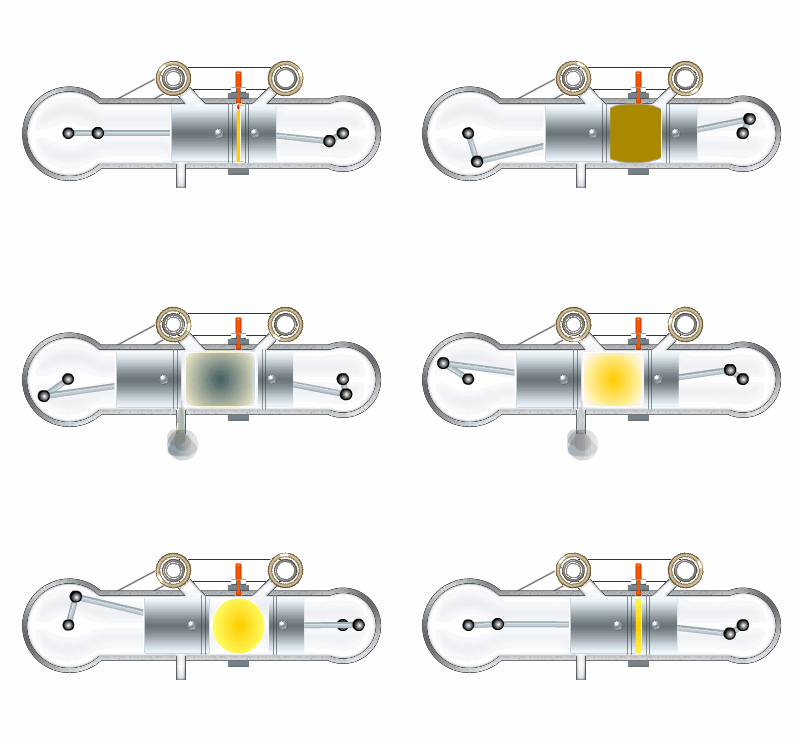 The M4+2 engines have much in common with the Beare Head
engines, combining two opposed pistons in the same cylinder. One piston working at half the cyclical rate of the other. But while the main function of the second piston in a Beare Head engine is to replace the valve mechanism of a conventional four stroke engine, the M4+2 take the principle one step further.
The working principle of the engine is explained in the Two- and four-stroke engines article.
The six strokes are: aspiration, precompression, gas transfer, compression, ignition and ejection. This is an invention
of Helmut Kottmann from Germany, working 25 years at MAHLE GmbH piston and cylinder construction.
Internal combustion engine
The internal combustion engine is an engine in which the combustion of a fuel occurs with an oxidizer in a combustion chamber. In an internal combustion engine, the expansion of the high-temperature and high -pressure gases produced by combustion apply direct force to some component of the engine...
based on the four-stroke engine, but with additional complexity intended to make it more efficient and reduce emissions. Two types of six-stroke engine have been developed since the 1990s:
In the first approach, the engine captures the heat lost from the four-stroke Otto cycle or Diesel cycle
Diesel cycle
The Diesel cycle is the thermodynamic cycle which approximates the pressure and volume of the combustion chamber of the Diesel engine, invented by Rudolph Diesel in 1897. It is assumed to have constant pressure during the first part of the "combustion" phase...
and uses it to power an additional power and exhaust stroke of the piston in the same cylinder. Designs use either steam or air as the working fluid for the additional power stroke. The pistons in this type of six-stroke engine go up and down three times for each injection of fuel. There are two power strokes: one with fuel, the other with steam or air. The currently notable designs in this class are the Crower six-stroke engine, invented by Bruce Crower of the U.S. ; the Bajulaz engine by the Bajulaz S.A. company of Switzerland; and the Velozeta Six-stroke engine built by the College of Engineering, at Trivandrum in India.
The second approach to the six-stroke engine uses a second opposed piston
Opposed piston engine
An opposed-piston engine is a reciprocating internal combustion engine in which each cylinder has a piston at both ends, and no cylinder head.-Configurations:...
in each cylinder that moves at half the cyclical rate of the main piston, thus giving six piston movements per cycle. Functionally, the second piston replaces the valve mechanism of a conventional engine but also increases the compression ratio
Compression ratio
The 'compression ratio' of an internal-combustion engine or external combustion engine is a value that represents the ratio of the volume of its combustion chamber from its largest capacity to its smallest capacity...
. The currently notable designs in this class include two designs developed independently: the Beare Head
Beare Head
The Beare Head engine internal combustion engine technology combines a four stroke engine bottom end with a ported cylinder head closely resembling that of a two stroke, thus 4+2= six stroke. The head piston is smaller and has half the speed of the opposing piston. Functionally, the cylinder head...
engine, invented by Australian Malcolm Beare, and the German Charge pump, invented by Helmut Kottmann.
Griffin six-stroke engine
In 1883, the Bath-based engineer Samuel Griffin was an established maker of steam and gas engines. He wished to produce an internal combustion engine, but without paying the licensing costs of the OttoOtto cycle
An Otto cycle is an idealized thermodynamic cycle which describes the functioning of a typical reciprocating piston engine, the thermodynamic cycle most commonly found in automobile engines....
patents. His solution was to develop a 'Patent slide valve' and a single-acting six-stroke engine using it.
By 1886, Scottish steam locomotive maker Dick, Kerr & Co.
Dick, Kerr & Co.
Dick, Kerr and Company was a locomotive and tramcar manufacturer based in Kilmarnock, Scotland and Preston, England.-Early history:Having previously been known as W.B.Dick and Company the company had built all kinds of tramway equipment and rolling stock. From 1883 the company joined with John Kerr...
saw a future in large oil engines and licensed the Griffin patents. These were double acting, tandem engines and sold under the name "Kilmarnock". A major market for the Griffin engine was in electricity generation, where they developed a reputation for happily running light for long periods, then suddenly being able to take up a large demand for power. Their large heavy construction didn't suit them to mobile use, but they were capable of burning heavier and cheaper grades of oil.
The key principle of the "Griffin Simplex" was a heated exhaust-jacketed external vapouriser, into which the fuel was sprayed. The temperature was held around 550 °F (287.8 °C), sufficient to physically vapourise the oil but not to break it down chemically. This fractional distillation supported the use of heavy oil fuels, the unusable tars and asphalts separating out in the vapouriser.
Hot bulb ignition
Hot bulb engine
The hot bulb engine, or hotbulb or heavy oil engine is a type of internal combustion engine. It is an engine in which fuel is ignited by being brought into contact with a red-hot metal surface inside a bulb....
was used, which Griffin termed the 'Catathermic Igniter' , a small isolated cavity connected to the combustion chamber. The spray injector had an adjustable inner nozzle for the air supply, surrounded by an annular casing for the oil, both oil and air entering at 20 lbs sq in. pressure, and being regulated by a governor.
Griffin went out of business in 1923.
Only two known examples of a Griffin six-stroke engine survive. One is in the Anson engine museum
Anson Engine Museum
The Anson Engine Museum is situated on the site of the old Anson colliery in Poynton, Cheshire, England. It is the result of years of work by Les Cawley and Geoff Challinor who began collecting and showing stationary engines for a hobby. When the number and size of engines they collected...
. The other was built in 1885 and for some years was in the Birmingham Museum of Science and Technology, but in 2007 it returned to Bath and the Museum of Bath at Work
Museum of Bath at Work
The Museum of Bath at Work is at Camden Works, Julian Road, in Bath, Somerset, England.This museum was established in 1978 to present the commercial development of Bath over the last 2000 years and includes displays on four floors. The main exhibit is the reconstruction of an engineering and...
.
Bajulaz six-stroke engine
The Bajulaz six-stroke engine is similar to a regular combustion engine in design. There are however modifications to the cylinder head, with two supplementary fixed capacity chambers: a combustion chamberCombustion chamber
A combustion chamber is the part of an engine in which fuel is burned.-Internal combustion engine:The hot gases produced by the combustion occupy a far greater volume than the original fuel, thus creating an increase in pressure within the limited volume of the chamber...
and an air preheating chamber above each cylinder. The combustion chamber receives a charge of heated air from the cylinder; the injection of fuel begins an isochoric
Isochoric process
An isochoric process, also called a constant-volume process, an isovolumetric process, or an isometric process, is a thermodynamic process during which the volume of the closed system undergoing such a process remains constant...
burn which increases the thermal efficiency
Thermal efficiency
In thermodynamics, the thermal efficiency is a dimensionless performance measure of a device that uses thermal energy, such as an internal combustion engine, a boiler, a furnace, or a refrigerator for example.-Overview:...
compared to a burn in the cylinder. The high pressure achieved is then released into the cylinder to work the power or expansion stroke. Meanwhile a second chamber which blankets the combustion chamber, has its air content heated to a high degree by heat passing through the cylinder wall. This heated and pressurized air is then used to power an additional stroke of the piston.
The claimed advantages of the engine include reduction in fuel consumption by at least 40%, two expansion strokes in six strokes, multi-fuel usage capability, and a dramatic reduction in pollution
Pollution
Pollution is the introduction of contaminants into a natural environment that causes instability, disorder, harm or discomfort to the ecosystem i.e. physical systems or living organisms. Pollution can take the form of chemical substances or energy, such as noise, heat or light...
.
The Bajulaz Six-Stroke Engine was invented in 1989 by the Bajulaz S A company, based in Geneva
Geneva
Geneva In the national languages of Switzerland the city is known as Genf , Ginevra and Genevra is the second-most-populous city in Switzerland and is the most populous city of Romandie, the French-speaking part of Switzerland...
, Switzerland
Switzerland
Switzerland name of one of the Swiss cantons. ; ; ; or ), in its full name the Swiss Confederation , is a federal republic consisting of 26 cantons, with Bern as the seat of the federal authorities. The country is situated in Western Europe,Or Central Europe depending on the definition....
; it has and .
The Bajulaz six-stroke engine features:
- Reduction in fuel consumption by at least 40%
- Two expansion (work) strokes in six strokes
- Multifuel, including liquefied petroleum gas
- Dramatic reduction in air pollution
- Costs comparable to those of a four-stroke engine
Velozeta six-stroke engine
In a Velozeta engine, during the exhaust stroke, fresh air is injected into the cylinder, which expands by heat and therefore forces the piston down for an additional stroke. The valve overlaps have been removed and the two additional strokes using air injection provide for better gas scavenging. The engine seems to show 40% reduction in fuel consumption and dramatic reduction in air pollution. Its specific powerSpecific power
In physics and engineering, surface power density or sometimes simply specific power is power per unit area.-Applications:* The intensity of electromagnetic radiation can be expressed in W/m2...
is not much less than that of a four-stroke Gasoline engine. The engine can run on a variety of fuels, ranging from Gasoline
Gasoline
Gasoline , or petrol , is a toxic, translucent, petroleum-derived liquid that is primarily used as a fuel in internal combustion engines. It consists mostly of organic compounds obtained by the fractional distillation of petroleum, enhanced with a variety of additives. Some gasolines also contain...
and diesel to LPG. An altered engine shows a 65% reduction in carbon monoxide pollution when compared with the four stroke engine from which it was developed.
The engine was developed in 2006 by a team of mechanical engineering students (Aaron Joseph George, Arun K Nair, Boby Sebastian, Krishnaraj U) of the College of Engineering, Trivandrum
College of Engineering, Trivandrum
The College of Engineering, Trivandrum, commonly known as CET, is situated in Thiruvananthapuram, the capital city of Kerala. Founded in 1939, it is the top ranked engineering college in Kerala, and one of the top engineering schools in India....
.
Crower six-stroke engine
In a six-stroke engine prototyped in the U.S. by Bruce Crower, water is injected into the cylinder after the exhaust stroke, and is instantly turned to steamSteam
Steam is the technical term for water vapor, the gaseous phase of water, which is formed when water boils. In common language it is often used to refer to the visible mist of water droplets formed as this water vapor condenses in the presence of cooler air...
, which expands and forces the piston down for an additional power stroke. Thus, waste heat that most engines require an air or water cooling system to discharge is captured and put to use driving the piston. Crower estimated that his design would reduce fuel consumption by 40% by generating the same power output at a lower RPM. The weight associated with a cooling system could be eliminated, but that would be balanced by a need for a water tank in addition to the normal fuel tank.
The Crower six-stroke engine was an experimental design that attracted media attention in 2006 because of an interview given by 75 year old American
United States
The United States of America is a federal constitutional republic comprising fifty states and a federal district...
inventor Pankaj Sharma of Guru Nanak Dev University, Punjab, India has applied for a patent on his design. (http://www.autoweek.com/apps/pbcs.dll/article?AID=/20060227/FREE/302270007/1023/THISWEEKSISSUE) That patent application was subsequently abandoned.
Leonard Dyer
Leonard Dyer
Leonard H. Dyer was an inventor, patent attorney, and yachtsman from Washington, DC.-Inventions:The most remarkable of his inventions was a patented six stroke engine using water injected as a 5th stroke for extra power and cooling, to be ejected on the final exhaust stroke...
invented the first six-stroke internal combustion water injection engine in 1915, which is very similar to Crower's design. A dozen more similar patents have been issued since.
Dyer's six-stroke engine features:
- No cooling system required
- Improves a typical engine’s fuel consumption
- Requires a supply of pure water to act as the medium for the second power stroke.
Beare Head
The term "Six Stroke" was coined by the inventor of the Beare HeadBeare Head
The Beare Head engine internal combustion engine technology combines a four stroke engine bottom end with a ported cylinder head closely resembling that of a two stroke, thus 4+2= six stroke. The head piston is smaller and has half the speed of the opposing piston. Functionally, the cylinder head...
, Malcolm Beare. The technology combines a four stroke engine bottom end with an opposed piston in the cylinder head working at half the cyclical rate of the bottom piston. Functionally, the second piston replaces the valve mechanism of a conventional engine.
first use of "sixstroke" 1994
M4+2
Beare Head
The Beare Head engine internal combustion engine technology combines a four stroke engine bottom end with a ported cylinder head closely resembling that of a two stroke, thus 4+2= six stroke. The head piston is smaller and has half the speed of the opposing piston. Functionally, the cylinder head...
engines, combining two opposed pistons in the same cylinder. One piston working at half the cyclical rate of the other. But while the main function of the second piston in a Beare Head engine is to replace the valve mechanism of a conventional four stroke engine, the M4+2 take the principle one step further.
The working principle of the engine is explained in the Two- and four-stroke engines article.
Piston charger engine
In this engine, similar in design to the Beare head, a "piston charger" replaces the valve system. The piston charger charges the main cylinder and simultaneously regulates the inlet and the outlet aperture leading to no loss of air and fuel in the exhaust. In the main cylinder, combustion takes place every turn as in a two-stroke engine and lubrication as in a four-stroke engine. Fuel injection can take place in the piston charger, in the gas transfer channel or in the combustion chamber. It is also possible to charge two working cylinders with one piston charger. The combination of compact design for the combustion chamber together with no loss of air and fuel is claimed to give the engine more torque, more power and better fuel consumption. The benefit of less moving parts and design is claimed to lead to lower manufacturing costs. Good for hybrid technology and stationary engines. The engine is claimed to be suited to alternative fuels since there is no corrosion or deposits left on valves.The six strokes are: aspiration, precompression, gas transfer, compression, ignition and ejection. This is an invention
of Helmut Kottmann from Germany, working 25 years at MAHLE GmbH piston and cylinder construction.