


Simula

Encyclopedia
Simula is a name for two programming language
s, Simula I and Simula 67, developed in the 1960s at the Norwegian Computing Center
in Oslo
, by Ole-Johan Dahl
and Kristen Nygaard
. Syntactically, it is a fairly faithful superset of ALGOL 60
.
Simula 67 introduced objects, classes
, subclasses, virtual methods
, coroutine
s, discrete event simulation
, and features garbage collection
.
Simula is considered the first object-oriented
programming
language. As its name implies, Simula was designed for doing simulations, and the needs of that domain
provided the framework for many of the features of object-oriented languages today.
Simula has been used in a wide range of applications such as simulating VLSI
designs, process modeling
, protocols, algorithm
s, and other applications such as typesetting
, computer graphics
, and education
. The influence of Simula is often understated, and Simula-type objects are reimplemented in C++
, Java
and C#. The creator of C++, Bjarne Stroustrup
, has acknowledged that Simula 67 was the greatest influence on him to develop C++, to bring the kind of productivity enhancements offered by Simula to the raw computational speed offered by lower level languages like BCPL
.
Kristen Nygaard
started writing computer simulation programs in 1957. Nygaard saw a need for a better way to describe the heterogeneity and the operation of a system
. To go further with his ideas on a formal computer language for describing a system, Nygaard realized that he needed someone with more programming skills than he had. Ole-Johan Dahl
joined him on his work January 1962. The decision of linking the language up to ALGOL 60
was made shortly after. By May 1962 the main concepts for a simulation
language
were set. "SIMULA I" was born, a special purpose programming language
for simulating
discrete event systems.
Kristen Nygaard was invited to UNIVAC
late May 1962 in connection with the marketing of their new UNIVAC 1107
computer. At that visit Nygaard presented the ideas of Simula to Robert Bemer
, the director of systems programming at Univac
. Bemer was a sworn ALGOL
fan and found the Simula project compelling. Bemer was also chairing a session at the second international conference on information processing hosted by IFIP
. He invited Nygaard, who presented the paper "SIMULA -- An Extension of ALGOL to the Description of Discrete-Event Networks".
Norwegian Computing Center
got a UNIVAC 1107
August 1963 at a considerable discount, on which Dahl implemented the SIMULA I under contract with UNIVAC. The implementation was based on the UNIVAC ALGOL 60
compiler. SIMULA I was fully operational on the UNIVAC 1107 by January 1965. In the following couple of years Dahl and Nygaard spent a lot of time teaching Simula. Simula spread to several countries around the world and SIMULA I was later implemented on Burroughs B5500 computers and the Russian URAL-16 computer
.
In 1966 C. A. R. Hoare
introduced the concept of record class construct, which Dahl and Nygaard extended with the concept of prefixing and other features to meet their requirements for a generalized process concept. Dahl and Nygaard presented their paper on Class
and Subclass Declarations at the IFIP
Working Conference on simulation languages in Oslo
, May 1967. This paper became the first formal definition of Simula 67. In June 1967 a conference was held to standardize the language and initiate a number of implementations. Dahl proposed to unify the type
and the class concept. This led to serious discussions, and the proposal was rejected by the board. SIMULA 67 was formally standardized on the first meeting of the SIMULA Standards Group (SSG) in February 1968.
Simula was influential in the development of Smalltalk
and later object-oriented programming language
s. It also helped inspire the Actor model
of concurrent computation although Simula only supports co-routines and not true concurrency
.
In the late sixties and the early seventies there were four main implementations of Simula:
These implementations were ported to a wide range of platforms. The TOPS-10
implemented the concept of public, protected, and private member variables and methods, that later was integrated into Simula 87. Simula 87 is the latest standard and is ported to a wide range of platforms. There are mainly three implementations:
In November 2001 Dahl and Nygaard were awarded the IEEE John von Neumann Medal
by the Institute of Electrical and Electronic Engineers "For the introduction of the concepts underlying object-oriented programming
through the design and implementation of SIMULA 67". In February 2002 they received the 2001 A. M. Turing Award
by the Association for Computing Machinery
(ACM), with the citation: "For ideas fundamental to the emergence of object oriented programming, through their design of the programming languages Simula I and Simula 67." Unfortunately neither Dahl, nor Nygaard could make it to the ACM Turing Award Lecture, scheduled to be delivered at the OOPSLA
2002 conference in Seattle, as they both died within two months of each other in June and August, respectively.
Simula Research Laboratory
is a research institute named after the Simula language, and Nygaard held a part time position there from the opening in 2001.
Simula is still used for various types of university courses, for instance, Jarek Sklenar teaches Simula to students at University of Malta.
is the minimal program
in Simula, measured by the size of the source code
.
It consists of one thing only; a dummy statement
.
However, the minimal program is more conveniently represented as an empty block:
Begin
End;
It begins executing and immediately terminates.
The language does not have any return value from the program itself.
in Simula:
Begin
OutText ("Hello World!");
Outimage;
End;
Simula is case-insensitive.
Begin
Class Glyph;
Virtual: Procedure print Is Procedure print;;
Begin
End;
Glyph Class Char (c);
Character c;
Begin
Procedure print;
OutChar(c);
End;
Glyph Class Line (elements);
Ref (Glyph) Array elements;
Begin
Procedure print;
Begin
Integer i;
For i:= 1 Step 1 Until UpperBound (elements, 1) Do
elements (i).print;
OutImage;
End;
End;
Ref (Glyph) rg;
Ref (Glyph) Array rgs (1 : 4);
! Main program;
rgs (1):- New Char ('A');
rgs (2):- New Char ('b');
rgs (3):- New Char ('b');
rgs (4):- New Char ('a');
rg:- New Line (rgs);
rg.print;
End;
The above example has one super class (Glyph) with two subclasses (Char and Line).
There is one virtual method with two implementation
s.
The execution starts by executing the main program.
Simula does not have the concept of abstract classes since classes with pure virtual methods can be instantiated. This means that in the above example all classes can be instantiated. Calling a pure virtual method will however produce a run-time error.
can easily be implemented.
However, the default transmission mode for simple parameter is call by value, contrary to ALGOL
which used call by name.
The source code for the Jensen's Device
must therefore specify call by name for the parameters when compiled by a Simula compiler.
Another much simpler example is the summation function which can be implemented as follows:
Real Procedure Sigma (k, m, n, u);
Name k, u;
Integer k, m, n; Real u;
Begin
Real s;
k:= m;
While k <= n Do Begin s:= s + u; k:= k + 1; End;
Sigma:= s;
End;
The above code uses call by name for the controlling variable (k) and the expression (u).
This allows the controlling variable to be used in the expression.
Note that the Simula standard allows for certain restrictions on the controlling variable
in a for loop
. The above code therefore uses a while loop for maximum portability.
The following:
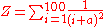
can then be implemented as follows:
Z:= Sigma (i, 1, 100, 1 / (i + a) ** 2);
package for doing discrete event simulation
s. This simulation package is based on Simula's object oriented features and its coroutine
concept.
Sam, Sally, and Andy are shopping for clothes. They have to share one fitting room. Each one of them is browsing the store for about 12 minutes and then uses the fitting room exclusively for about three minutes, each following a normal distribution. A simulation of their fitting room experience is as follows:
Simulation Begin
Class FittingRoom; Begin
Ref (Head) door;
Boolean inUse;
Procedure request; Begin
If inUse Then Begin
Wait (door);
door.First.Out;
End;
inUse:= True;
End;
Procedure leave; Begin
inUse:= False;
Activate door.First;
End;
door:- New Head;
End;
Procedure report (message); Text message; Begin
OutFix (Time, 2, 0); OutText (": " & message); OutImage;
End;
Process Class Person (pname); Text pname; Begin
While True Do Begin
Hold (Normal (12, 4, u));
report (pname & " is requesting the fitting room");
fittingroom1.request;
report (pname & " has entered the fitting room");
Hold (Normal (3, 1, u));
fittingroom1.leave;
report (pname & " has left the fitting room");
End;
End;
Integer u;
Ref (FittingRoom) fittingRoom1;
fittingRoom1:- New FittingRoom;
Activate New Person ("Sam");
Activate New Person ("Sally");
Activate New Person ("Andy");
Hold (100);
End;
The main block is prefixed with
The fitting room object uses a queue (
Person is a subclass of Process and its activity is described using hold (time for browsing the store and time spent in the fitting room) and calls methods in the fitting room object for requesting and leaving the fitting room.
The main program creates all the objects and activates all the person objects to put them into the event queue. The main program holds for 100 minutes of simulated time before the program terminates.
Programming language
A programming language is an artificial language designed to communicate instructions to a machine, particularly a computer. Programming languages can be used to create programs that control the behavior of a machine and/or to express algorithms precisely....
s, Simula I and Simula 67, developed in the 1960s at the Norwegian Computing Center
Norwegian Computing Center
Norwegian Computing Center is a private, independent, non-profit research foundation founded in 1952. NR carries out contract research and development in the areas of computing and quantitative methods for a broad range of industrial, commercial and public service organisations in the national...
in Oslo
Oslo
Oslo is a municipality, as well as the capital and most populous city in Norway. As a municipality , it was established on 1 January 1838. Founded around 1048 by King Harald III of Norway, the city was largely destroyed by fire in 1624. The city was moved under the reign of Denmark–Norway's King...
, by Ole-Johan Dahl
Ole-Johan Dahl
Ole-Johan Dahl was a Norwegian computer scientist and is considered to be one of the fathers of Simula and object-oriented programming along with Kristen Nygaard.- Career :...
and Kristen Nygaard
Kristen Nygaard
Kristen Nygaard was a Norwegian computer scientist, programming language pioneer and politician. He was born in Oslo and died of a heart attack in 2002.-Object-oriented programming:...
. Syntactically, it is a fairly faithful superset of ALGOL 60
ALGOL 60
ALGOL 60 is a member of the ALGOL family of computer programming languages. It gave rise to many other programming languages, including BCPL, B, Pascal, Simula, C, and many others. ALGOL 58 introduced code blocks and the begin and end pairs for delimiting them...
.
Simula 67 introduced objects, classes
Class (computer science)
In object-oriented programming, a class is a construct that is used as a blueprint to create instances of itself – referred to as class instances, class objects, instance objects or simply objects. A class defines constituent members which enable these class instances to have state and behavior...
, subclasses, virtual methods
Virtual function
In object-oriented programming, a virtual function or virtual method is a function or method whose behaviour can be overridden within an inheriting class by a function with the same signature...
, coroutine
Coroutine
Coroutines are computer program components that generalize subroutines to allow multiple entry points for suspending and resuming execution at certain locations...
s, discrete event simulation
Discrete Event Simulation
In discrete-event simulation, the operation of a system is represented as a chronological sequence of events. Each event occurs at an instant in time and marks a change of state in the system...
, and features garbage collection
Garbage collection (computer science)
In computer science, garbage collection is a form of automatic memory management. The garbage collector, or just collector, attempts to reclaim garbage, or memory occupied by objects that are no longer in use by the program...
.
Simula is considered the first object-oriented
Object-oriented programming
Object-oriented programming is a programming paradigm using "objects" – data structures consisting of data fields and methods together with their interactions – to design applications and computer programs. Programming techniques may include features such as data abstraction,...
programming
Programming paradigm
A programming paradigm is a fundamental style of computer programming. Paradigms differ in the concepts and abstractions used to represent the elements of a program and the steps that compose a computation A programming paradigm is a fundamental style of computer programming. (Compare with a...
language. As its name implies, Simula was designed for doing simulations, and the needs of that domain
Problem domain
A problem domain is the area of expertise or application that needs to be examined to solve a problem. A problem domain is simply looking at only the topics you are interested in, and excluding everything else. For example, if you were developing a system trying to measure good practice in...
provided the framework for many of the features of object-oriented languages today.
Simula has been used in a wide range of applications such as simulating VLSI
Very-large-scale integration
Very-large-scale integration is the process of creating integrated circuits by combining thousands of transistors into a single chip. VLSI began in the 1970s when complex semiconductor and communication technologies were being developed. The microprocessor is a VLSI device.The first semiconductor...
designs, process modeling
Process modeling
The term process model is used in various contexts. For example, in business process modeling the enterprise process model is often referred to as the business process model. Process models are core concepts in the discipline of process engineering....
, protocols, algorithm
Algorithm
In mathematics and computer science, an algorithm is an effective method expressed as a finite list of well-defined instructions for calculating a function. Algorithms are used for calculation, data processing, and automated reasoning...
s, and other applications such as typesetting
Typesetting
Typesetting is the composition of text by means of types.Typesetting requires the prior process of designing a font and storing it in some manner...
, computer graphics
Computer graphics
Computer graphics are graphics created using computers and, more generally, the representation and manipulation of image data by a computer with help from specialized software and hardware....
, and education
Education
Education in its broadest, general sense is the means through which the aims and habits of a group of people lives on from one generation to the next. Generally, it occurs through any experience that has a formative effect on the way one thinks, feels, or acts...
. The influence of Simula is often understated, and Simula-type objects are reimplemented in C++
C++
C++ is a statically typed, free-form, multi-paradigm, compiled, general-purpose programming language. It is regarded as an intermediate-level language, as it comprises a combination of both high-level and low-level language features. It was developed by Bjarne Stroustrup starting in 1979 at Bell...
, Java
Java (programming language)
Java is a programming language originally developed by James Gosling at Sun Microsystems and released in 1995 as a core component of Sun Microsystems' Java platform. The language derives much of its syntax from C and C++ but has a simpler object model and fewer low-level facilities...
and C#. The creator of C++, Bjarne Stroustrup
Bjarne Stroustrup
Bjarne Stroustrup ; born December 30, 1950 in Århus, Denmark) is a Danish computer scientist, most notable for the creation and the development of the widely used C++ programming language...
, has acknowledged that Simula 67 was the greatest influence on him to develop C++, to bring the kind of productivity enhancements offered by Simula to the raw computational speed offered by lower level languages like BCPL
BCPL
BCPL is a procedural, imperative, and structured computer programming language designed by Martin Richards of the University of Cambridge in 1966.- Design :...
.
History
The following account is based on Jan Rune Holmevik's historical essay.Kristen Nygaard
Kristen Nygaard
Kristen Nygaard was a Norwegian computer scientist, programming language pioneer and politician. He was born in Oslo and died of a heart attack in 2002.-Object-oriented programming:...
started writing computer simulation programs in 1957. Nygaard saw a need for a better way to describe the heterogeneity and the operation of a system
System
System is a set of interacting or interdependent components forming an integrated whole....
. To go further with his ideas on a formal computer language for describing a system, Nygaard realized that he needed someone with more programming skills than he had. Ole-Johan Dahl
Ole-Johan Dahl
Ole-Johan Dahl was a Norwegian computer scientist and is considered to be one of the fathers of Simula and object-oriented programming along with Kristen Nygaard.- Career :...
joined him on his work January 1962. The decision of linking the language up to ALGOL 60
ALGOL 60
ALGOL 60 is a member of the ALGOL family of computer programming languages. It gave rise to many other programming languages, including BCPL, B, Pascal, Simula, C, and many others. ALGOL 58 introduced code blocks and the begin and end pairs for delimiting them...
was made shortly after. By May 1962 the main concepts for a simulation
Simulation
Simulation is the imitation of some real thing available, state of affairs, or process. The act of simulating something generally entails representing certain key characteristics or behaviours of a selected physical or abstract system....
language
Programming language
A programming language is an artificial language designed to communicate instructions to a machine, particularly a computer. Programming languages can be used to create programs that control the behavior of a machine and/or to express algorithms precisely....
were set. "SIMULA I" was born, a special purpose programming language
Programming language
A programming language is an artificial language designed to communicate instructions to a machine, particularly a computer. Programming languages can be used to create programs that control the behavior of a machine and/or to express algorithms precisely....
for simulating
Simulation
Simulation is the imitation of some real thing available, state of affairs, or process. The act of simulating something generally entails representing certain key characteristics or behaviours of a selected physical or abstract system....
discrete event systems.
Kristen Nygaard was invited to UNIVAC
UNIVAC
UNIVAC is the name of a business unit and division of the Remington Rand company formed by the 1950 purchase of the Eckert-Mauchly Computer Corporation, founded four years earlier by ENIAC inventors J. Presper Eckert and John Mauchly, and the associated line of computers which continues to this day...
late May 1962 in connection with the marketing of their new UNIVAC 1107
UNIVAC 1107
The UNIVAC 1107 was the first member of Sperry Rand's UNIVAC 1100 series of computers, introduced in October 1962. It was also known as the Thin Film Computer because of its use of thin film memory for its register storage...
computer. At that visit Nygaard presented the ideas of Simula to Robert Bemer
Bob Bemer
Robert William Bemer was a computer scientist best known for his work at IBM during the late 1950s and early 1960s.-Biography:...
, the director of systems programming at Univac
UNIVAC
UNIVAC is the name of a business unit and division of the Remington Rand company formed by the 1950 purchase of the Eckert-Mauchly Computer Corporation, founded four years earlier by ENIAC inventors J. Presper Eckert and John Mauchly, and the associated line of computers which continues to this day...
. Bemer was a sworn ALGOL
ALGOL
ALGOL is a family of imperative computer programming languages originally developed in the mid 1950s which greatly influenced many other languages and became the de facto way algorithms were described in textbooks and academic works for almost the next 30 years...
fan and found the Simula project compelling. Bemer was also chairing a session at the second international conference on information processing hosted by IFIP
International Federation for Information Processing
The International Federation for Information Processing is an umbrella organization for national societies working in the field of information technology. It is a non-governmental, non-profit organization with offices in Laxenburg, Austria...
. He invited Nygaard, who presented the paper "SIMULA -- An Extension of ALGOL to the Description of Discrete-Event Networks".
Norwegian Computing Center
Norwegian Computing Center
Norwegian Computing Center is a private, independent, non-profit research foundation founded in 1952. NR carries out contract research and development in the areas of computing and quantitative methods for a broad range of industrial, commercial and public service organisations in the national...
got a UNIVAC 1107
UNIVAC 1107
The UNIVAC 1107 was the first member of Sperry Rand's UNIVAC 1100 series of computers, introduced in October 1962. It was also known as the Thin Film Computer because of its use of thin film memory for its register storage...
August 1963 at a considerable discount, on which Dahl implemented the SIMULA I under contract with UNIVAC. The implementation was based on the UNIVAC ALGOL 60
ALGOL 60
ALGOL 60 is a member of the ALGOL family of computer programming languages. It gave rise to many other programming languages, including BCPL, B, Pascal, Simula, C, and many others. ALGOL 58 introduced code blocks and the begin and end pairs for delimiting them...
compiler. SIMULA I was fully operational on the UNIVAC 1107 by January 1965. In the following couple of years Dahl and Nygaard spent a lot of time teaching Simula. Simula spread to several countries around the world and SIMULA I was later implemented on Burroughs B5500 computers and the Russian URAL-16 computer
Ural (computer)
Ural is a computer series built in Soviet Union.- History :The Ural was developed at the Electronic Computer Producing Manufacturer of Penza in the Soviet Union and was produced between 1959 and 1964. In total 139 were made...
.
In 1966 C. A. R. Hoare
C. A. R. Hoare
Sir Charles Antony Richard Hoare , commonly known as Tony Hoare or C. A. R. Hoare, is a British computer scientist best known for the development of Quicksort, one of the world's most widely used sorting algorithms...
introduced the concept of record class construct, which Dahl and Nygaard extended with the concept of prefixing and other features to meet their requirements for a generalized process concept. Dahl and Nygaard presented their paper on Class
Class (computer science)
In object-oriented programming, a class is a construct that is used as a blueprint to create instances of itself – referred to as class instances, class objects, instance objects or simply objects. A class defines constituent members which enable these class instances to have state and behavior...
and Subclass Declarations at the IFIP
International Federation for Information Processing
The International Federation for Information Processing is an umbrella organization for national societies working in the field of information technology. It is a non-governmental, non-profit organization with offices in Laxenburg, Austria...
Working Conference on simulation languages in Oslo
Oslo
Oslo is a municipality, as well as the capital and most populous city in Norway. As a municipality , it was established on 1 January 1838. Founded around 1048 by King Harald III of Norway, the city was largely destroyed by fire in 1624. The city was moved under the reign of Denmark–Norway's King...
, May 1967. This paper became the first formal definition of Simula 67. In June 1967 a conference was held to standardize the language and initiate a number of implementations. Dahl proposed to unify the type
Data type
In computer programming, a data type is a classification identifying one of various types of data, such as floating-point, integer, or Boolean, that determines the possible values for that type; the operations that can be done on values of that type; the meaning of the data; and the way values of...
and the class concept. This led to serious discussions, and the proposal was rejected by the board. SIMULA 67 was formally standardized on the first meeting of the SIMULA Standards Group (SSG) in February 1968.
Simula was influential in the development of Smalltalk
Smalltalk
Smalltalk is an object-oriented, dynamically typed, reflective programming language. Smalltalk was created as the language to underpin the "new world" of computing exemplified by "human–computer symbiosis." It was designed and created in part for educational use, more so for constructionist...
and later object-oriented programming language
Object-oriented programming language
This is a list of object-oriented programming programming languages.-Languages with object-oriented features:*ABAP*Ada 95*AmigaE*BETA*Blue*Boo*C++*C#*COBOL*Cobra*ColdFusion*Common Lisp*COOL*CorbaScript*Clarion*CLU*Curl*D*Dylan*E*Eiffel...
s. It also helped inspire the Actor model
Actor model
In computer science, the Actor model is a mathematical model of concurrent computation that treats "actors" as the universal primitives of concurrent digital computation: in response to a message that it receives, an actor can make local decisions, create more actors, send more messages, and...
of concurrent computation although Simula only supports co-routines and not true concurrency
Concurrency (computer science)
In computer science, concurrency is a property of systems in which several computations are executing simultaneously, and potentially interacting with each other...
.
In the late sixties and the early seventies there were four main implementations of Simula:
- UNIVAC 1100UNIVACUNIVAC is the name of a business unit and division of the Remington Rand company formed by the 1950 purchase of the Eckert-Mauchly Computer Corporation, founded four years earlier by ENIAC inventors J. Presper Eckert and John Mauchly, and the associated line of computers which continues to this day...
by NCCNorwegian Computing CenterNorwegian Computing Center is a private, independent, non-profit research foundation founded in 1952. NR carries out contract research and development in the areas of computing and quantitative methods for a broad range of industrial, commercial and public service organisations in the national... - System/360System/360The IBM System/360 was a mainframe computer system family first announced by IBM on April 7, 1964, and sold between 1964 and 1978. It was the first family of computers designed to cover the complete range of applications, from small to large, both commercial and scientific...
and System/370System/370The IBM System/370 was a model range of IBM mainframes announced on June 30, 1970 as the successors to the System/360 family. The series maintained backward compatibility with the S/360, allowing an easy migration path for customers; this, plus improved performance, were the dominant themes of the...
by Swedish Research Institute for National Defence (FOA) - CDC 3000CDC 3000The CDC 3000 series computers from Control Data Corporation were mid-1960s follow-ons to the CDC 1604 and CDC 924 systems. Over time, a range of machines were produced - divided into the 'upper 3000 series' and the 'lower 3000 series'. CDC phased out production of the 3000 series in the early 1970s...
by University of OsloUniversity of OsloThe University of Oslo , formerly The Royal Frederick University , is the oldest and largest university in Norway, situated in the Norwegian capital of Oslo. The university was founded in 1811 and was modelled after the recently established University of Berlin...
's Joint Computer Installation at Kjeller - TOPS-10TOPS-10The TOPS-10 System was a computer operating system from Digital Equipment Corporation for the PDP-10 mainframe computer launched in 1967...
by ENEA ABENEA ABENEA is global information technology company with its headquarters in Kista, Sweden that provides real-time operating systems and consulting services...
These implementations were ported to a wide range of platforms. The TOPS-10
TOPS-10
The TOPS-10 System was a computer operating system from Digital Equipment Corporation for the PDP-10 mainframe computer launched in 1967...
implemented the concept of public, protected, and private member variables and methods, that later was integrated into Simula 87. Simula 87 is the latest standard and is ported to a wide range of platforms. There are mainly three implementations:
- Simula AS
- Lund Simula
- GNU Cim - [ftp://ftp.ifi.uio.no/pub/cim/ Download from the University of Oslo ftp site]
In November 2001 Dahl and Nygaard were awarded the IEEE John von Neumann Medal
IEEE John von Neumann Medal
The IEEE John von Neumann Medal was established by the IEEE Board of Directors in 1990 and may be presented annually "for outstanding achievements in computer-related science and technology." The achievements may be theoretical, technological, or entrepreneurial, and need not have been made...
by the Institute of Electrical and Electronic Engineers "For the introduction of the concepts underlying object-oriented programming
Object-oriented programming
Object-oriented programming is a programming paradigm using "objects" – data structures consisting of data fields and methods together with their interactions – to design applications and computer programs. Programming techniques may include features such as data abstraction,...
through the design and implementation of SIMULA 67". In February 2002 they received the 2001 A. M. Turing Award
Turing Award
The Turing Award, in full The ACM A.M. Turing Award, is an annual award given by the Association for Computing Machinery to "an individual selected for contributions of a technical nature made to the computing community. The contributions should be of lasting and major technical importance to the...
by the Association for Computing Machinery
Association for Computing Machinery
The Association for Computing Machinery is a learned society for computing. It was founded in 1947 as the world's first scientific and educational computing society. Its membership is more than 92,000 as of 2009...
(ACM), with the citation: "For ideas fundamental to the emergence of object oriented programming, through their design of the programming languages Simula I and Simula 67." Unfortunately neither Dahl, nor Nygaard could make it to the ACM Turing Award Lecture, scheduled to be delivered at the OOPSLA
OOPSLA
OOPSLA is an annual ACM research conference. OOPSLA mainly takes place in the United States, while the sister conference of OOPSLA, ECOOP, is typically held in Europe...
2002 conference in Seattle, as they both died within two months of each other in June and August, respectively.
Simula Research Laboratory
Simula Research Laboratory
is a Norwegian research organisation located just outside Oslo, the capital of Norway. The laboratory conducts basic research in the fields of networks and distributed systems, scientific computing, and software engineering. It employs around 120 people, mainly scientific researchers, and has an...
is a research institute named after the Simula language, and Nygaard held a part time position there from the opening in 2001.
Simula is still used for various types of university courses, for instance, Jarek Sklenar teaches Simula to students at University of Malta.
Minimal program
The empty computer fileComputer file
A computer file is a block of arbitrary information, or resource for storing information, which is available to a computer program and is usually based on some kind of durable storage. A file is durable in the sense that it remains available for programs to use after the current program has finished...
is the minimal program
Computer program
A computer program is a sequence of instructions written to perform a specified task with a computer. A computer requires programs to function, typically executing the program's instructions in a central processor. The program has an executable form that the computer can use directly to execute...
in Simula, measured by the size of the source code
Source code
In computer science, source code is text written using the format and syntax of the programming language that it is being written in. Such a language is specially designed to facilitate the work of computer programmers, who specify the actions to be performed by a computer mostly by writing source...
.
It consists of one thing only; a dummy statement
Statement (programming)
In computer programming a statement can be thought of as the smallest standalone element of an imperative programming language. A program written in such a language is formed by a sequence of one or more statements. A statement will have internal components .Many languages In computer programming...
.
However, the minimal program is more conveniently represented as an empty block:
Begin
End;
It begins executing and immediately terminates.
The language does not have any return value from the program itself.
Classic Hello world
An example of a Hello world programHello world program
A "Hello world" program is a computer program that outputs "Hello world" on a display device. Because it is typically one of the simplest programs possible in most programming languages, it is by tradition often used to illustrate to beginners the most basic syntax of a programming language, or to...
in Simula:
Begin
OutText ("Hello World!");
Outimage;
End;
Simula is case-insensitive.
Classes, subclasses and virtual methods
A more realistic example with use of classes, subclasses and virtual methods:Begin
Class Glyph;
Virtual: Procedure print Is Procedure print;;
Begin
End;
Glyph Class Char (c);
Character c;
Begin
Procedure print;
OutChar(c);
End;
Glyph Class Line (elements);
Ref (Glyph) Array elements;
Begin
Procedure print;
Begin
Integer i;
For i:= 1 Step 1 Until UpperBound (elements, 1) Do
elements (i).print;
OutImage;
End;
End;
Ref (Glyph) rg;
Ref (Glyph) Array rgs (1 : 4);
! Main program;
rgs (1):- New Char ('A');
rgs (2):- New Char ('b');
rgs (3):- New Char ('b');
rgs (4):- New Char ('a');
rg:- New Line (rgs);
rg.print;
End;
The above example has one super class (Glyph) with two subclasses (Char and Line).
There is one virtual method with two implementation
Implementation
Implementation is the realization of an application, or execution of a plan, idea, model, design, specification, standard, algorithm, or policy.-Computer Science:...
s.
The execution starts by executing the main program.
Simula does not have the concept of abstract classes since classes with pure virtual methods can be instantiated. This means that in the above example all classes can be instantiated. Calling a pure virtual method will however produce a run-time error.
Call by name
Simula supports call by name so the Jensen's DeviceJensen's Device
Jensen's Device is a computer programming technique devised by Danish computer scientist Jørn Jensen, who worked with Peter Naur at Regnecentralen, particularly on the GIER Algol compiler, one of the earliest correct implementations of ALGOL 60....
can easily be implemented.
However, the default transmission mode for simple parameter is call by value, contrary to ALGOL
ALGOL
ALGOL is a family of imperative computer programming languages originally developed in the mid 1950s which greatly influenced many other languages and became the de facto way algorithms were described in textbooks and academic works for almost the next 30 years...
which used call by name.
The source code for the Jensen's Device
Jensen's Device
Jensen's Device is a computer programming technique devised by Danish computer scientist Jørn Jensen, who worked with Peter Naur at Regnecentralen, particularly on the GIER Algol compiler, one of the earliest correct implementations of ALGOL 60....
must therefore specify call by name for the parameters when compiled by a Simula compiler.
Another much simpler example is the summation function
which can be implemented as follows:Real Procedure Sigma (k, m, n, u);
Name k, u;
Integer k, m, n; Real u;
Begin
Real s;
k:= m;
While k <= n Do Begin s:= s + u; k:= k + 1; End;
Sigma:= s;
End;
The above code uses call by name for the controlling variable (k) and the expression (u).
This allows the controlling variable to be used in the expression.
Note that the Simula standard allows for certain restrictions on the controlling variable
in a for loop
For loop
In computer science a for loop is a programming language statement which allows code to be repeatedly executed. A for loop is classified as an iteration statement....
. The above code therefore uses a while loop for maximum portability.
The following:
can then be implemented as follows:
Z:= Sigma (i, 1, 100, 1 / (i + a) ** 2);
Simulation
Simula includes a simulationSimulation
Simulation is the imitation of some real thing available, state of affairs, or process. The act of simulating something generally entails representing certain key characteristics or behaviours of a selected physical or abstract system....
package for doing discrete event simulation
Discrete Event Simulation
In discrete-event simulation, the operation of a system is represented as a chronological sequence of events. Each event occurs at an instant in time and marks a change of state in the system...
s. This simulation package is based on Simula's object oriented features and its coroutine
Coroutine
Coroutines are computer program components that generalize subroutines to allow multiple entry points for suspending and resuming execution at certain locations...
concept.
Sam, Sally, and Andy are shopping for clothes. They have to share one fitting room. Each one of them is browsing the store for about 12 minutes and then uses the fitting room exclusively for about three minutes, each following a normal distribution. A simulation of their fitting room experience is as follows:
Simulation Begin
Class FittingRoom; Begin
Ref (Head) door;
Boolean inUse;
Procedure request; Begin
If inUse Then Begin
Wait (door);
door.First.Out;
End;
inUse:= True;
End;
Procedure leave; Begin
inUse:= False;
Activate door.First;
End;
door:- New Head;
End;
Procedure report (message); Text message; Begin
OutFix (Time, 2, 0); OutText (": " & message); OutImage;
End;
Process Class Person (pname); Text pname; Begin
While True Do Begin
Hold (Normal (12, 4, u));
report (pname & " is requesting the fitting room");
fittingroom1.request;
report (pname & " has entered the fitting room");
Hold (Normal (3, 1, u));
fittingroom1.leave;
report (pname & " has left the fitting room");
End;
End;
Integer u;
Ref (FittingRoom) fittingRoom1;
fittingRoom1:- New FittingRoom;
Activate New Person ("Sam");
Activate New Person ("Sally");
Activate New Person ("Andy");
Hold (100);
End;
The main block is prefixed with
Simulation for enabling simulation. The simulation package can be used on any block and simulations can even be nested when simulating someone doing simulations.The fitting room object uses a queue (
door) for getting access to the fitting room. When someone requests the fitting room and it's in use they must wait in this queue (Wait (door)). When someone leaves the fitting room the first one (if any) is released from the queue (Activate door.first) and accordingly removed from the door queue (door.First.Out).Person is a subclass of Process and its activity is described using hold (time for browsing the store and time spent in the fitting room) and calls methods in the fitting room object for requesting and leaving the fitting room.
The main program creates all the objects and activates all the person objects to put them into the event queue. The main program holds for 100 minutes of simulated time before the program terminates.
See also
- ALGOL 60ALGOL 60ALGOL 60 is a member of the ALGOL family of computer programming languages. It gave rise to many other programming languages, including BCPL, B, Pascal, Simula, C, and many others. ALGOL 58 introduced code blocks and the begin and end pairs for delimiting them...
- BETABETABETA is a pure object-oriented language originating within the "Scandinavian School" in object-orientation where the first object-oriented language Simula was developed....
, a modern successor to Simula - Object-oriented programmingObject-oriented programmingObject-oriented programming is a programming paradigm using "objects" – data structures consisting of data fields and methods together with their interactions – to design applications and computer programs. Programming techniques may include features such as data abstraction,...
- Simulation languageSimulation languageA computer simulation language describes the operation of a simulation on a computer. There are two major types of simulation: continuous and discrete event though more modern languages can handle combinations. Most languages also have a graphical interface and at least simple statistical gathering...
- Subtyping, the modern theoretical notion of subtyping originates in Simula
Source
- IBM System 360/370 Compiler and Historical Documentation The Simula Standard and other historical documentation by Peter Sylvester