


Shuya

Encyclopedia
Shuya is the third largest town in Ivanovo Oblast
, Russia
; located on the Teza River
. Population:
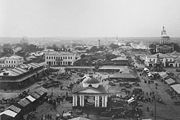
 The first record of Shuya is dated by 1393. Since 1403, the area was held by a branch of the House of Suzdal
, which got their name "Shuysky" after the town. In 1539, the town was sacked by Safagäräy of Kazan
. In 1566, it was taken by Ivan the Terrible as his personal property into Oprichnina
. In 1722, the town was visited by Peter the Great, who launched textile manufacturing there. Town status was granted to it in 1778. By the 19th century, Shuya was developed into a major flax
-processing center, although it has been since superseded in importance by the neighboring town of Ivanovo
.
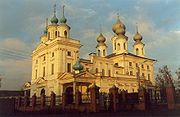
Nikolo-Shartomsky Abbey, situated 12 kilometres (7.5 mi) from Shuya, has one of the largest monastic communities in Russia. The cloister
was first mentioned in 1425. It has a cathedral
from 1652 and a refectory
from 1678. The belltower of the Resurrection Cathedral, is the tallest freestanding bell tower in the world.
Notable people from Shuya include peasant Feodor Vassilyev
, whose first wife still holds the world record for most children ever born (sixty-nine). Mikhail Frunze
led textile workers in the town in a strike action during the Russian Revolution of 1905
.
Ivanovo Oblast
Ivanovo Oblast is a federal subject of Russia .Its three largest cities are Ivanovo , Kineshma, and Shuya.The principal center of tourism is Plyos. The Volga River flows through the northern part of the oblast....
, Russia
Russia
Russia or , officially known as both Russia and the Russian Federation , is a country in northern Eurasia. It is a federal semi-presidential republic, comprising 83 federal subjects...
; located on the Teza River
Teza River
The Teza River is a river in Ivanovo Oblast, Russia. It is a left tributary of the Klyazma River, which is in turn a tributary of the Volga River. It has a length of 192 kilometers and a drainage basin with an area of 3,450 square kilometers. Annual flooding occurs between April and the middle of...
. Population:
History
Suzdal
Suzdal is a town in Vladimir Oblast, Russia, situated northeast of Moscow, from the city of Vladimir, on the Kamenka River. Population: -History:...
, which got their name "Shuysky" after the town. In 1539, the town was sacked by Safagäräy of Kazan
Kazan
Kazan is the capital and largest city of the Republic of Tatarstan, Russia. With a population of 1,143,546 , it is the eighth most populous city in Russia. Kazan lies at the confluence of the Volga and Kazanka Rivers in European Russia. In April 2009, the Russian Patent Office granted Kazan the...
. In 1566, it was taken by Ivan the Terrible as his personal property into Oprichnina
Oprichnina
The oprichnina is the period of Russian history between Tsar Ivan the Terrible's 1565 initiation and his 1572 disbanding of a domestic policy of secret police, mass repressions, public executions, and confiscation of land from Russian aristocrats...
. In 1722, the town was visited by Peter the Great, who launched textile manufacturing there. Town status was granted to it in 1778. By the 19th century, Shuya was developed into a major flax
Flax
Flax is a member of the genus Linum in the family Linaceae. It is native to the region extending from the eastern Mediterranean to India and was probably first domesticated in the Fertile Crescent...
-processing center, although it has been since superseded in importance by the neighboring town of Ivanovo
Ivanovo
Ivanovo is a city and the administrative center of Ivanovo Oblast, Russia. Population: Ivanovo has traditionally been called the textile capital of Russia. Since most textile workers are women, it has also been known as the "City of Brides"...
.
Nikolo-Shartomsky Abbey, situated 12 kilometres (7.5 mi) from Shuya, has one of the largest monastic communities in Russia. The cloister
Cloister
A cloister is a rectangular open space surrounded by covered walks or open galleries, with open arcades on the inner side, running along the walls of buildings and forming a quadrangle or garth...
was first mentioned in 1425. It has a cathedral
Cathedral
A cathedral is a Christian church that contains the seat of a bishop...
from 1652 and a refectory
Refectory
A refectory is a dining room, especially in monasteries, boarding schools and academic institutions. One of the places the term is most often used today is in graduate seminaries...
from 1678. The belltower of the Resurrection Cathedral, is the tallest freestanding bell tower in the world.
Notable people from Shuya include peasant Feodor Vassilyev
Feodor Vassilyev
Feodor Vassilyev was a peasant from Shuya, Russia. His first wife, Mrs. Vassilyev sets the record for most children birthed by a single woman. She gave birth to a total of 69 children; however, few other details are known of her life, such as her date of birth or death...
, whose first wife still holds the world record for most children ever born (sixty-nine). Mikhail Frunze
Mikhail Frunze
Mikhail Vasilyevich Frunze was a Bolshevik leader during and just prior to the Russian Revolution of 1917.-Life and Political Activity:Frunze was born in Bishkek, then a small Imperial Russian garrison town in the Kyrgyz part of Turkestan, to a Moldovan medical practitioner and his Russian wife...
led textile workers in the town in a strike action during the Russian Revolution of 1905
Russian Revolution of 1905
The 1905 Russian Revolution was a wave of mass political and social unrest that spread through vast areas of the Russian Empire. Some of it was directed against the government, while some was undirected. It included worker strikes, peasant unrest, and military mutinies...
.