


Shabaka Stone

Encyclopedia
Nubia
Nubia is a region along the Nile river, which is located in northern Sudan and southern Egypt.There were a number of small Nubian kingdoms throughout the Middle Ages, the last of which collapsed in 1504, when Nubia became divided between Egypt and the Sennar sultanate resulting in the Arabization...
n Twenty-fifth Dynasty of Egypt
Twenty-fifth dynasty of Egypt
The twenty-fifth dynasty of Egypt, known as the Nubian Dynasty or the Kushite Empire, was the last dynasty of the Third Intermediate Period of Ancient Egypt....
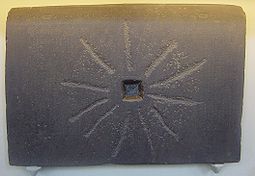
. It is a stone slab measuring 66 cm in height and 137 cm in width and was incised with the surviving hieroglyphs
Egyptian hieroglyphs
Egyptian hieroglyphs were a formal writing system used by the ancient Egyptians that combined logographic and alphabetic elements. Egyptians used cursive hieroglyphs for religious literature on papyrus and wood...
of a worm-ridden, decaying papyrus
Papyrus
Papyrus is a thick paper-like material produced from the pith of the papyrus plant, Cyperus papyrus, a wetland sedge that was once abundant in the Nile Delta of Egypt....
. This papyrus was found as pharaoh Shabaka
Shabaka
Shabaka or Shabaka Neferkare, 'Beautiful is the Soul of Re', was a Kushite pharaoh of the Twenty-fifth dynasty of Egypt, between according to Peter Clayton .-Family:...
was inspecting the temple of Ptah
Ptah
In Ancient Egyptian Religion, Ptah was the deification of the primordial mound in the Ennead cosmogony, which was more literally referred to as Ta-tenen , meaning risen land, or as Tanen, meaning submerged land, though Tatenen was a god in his...
in Memphis, Egypt
Memphis, Egypt
Memphis was the ancient capital of Aneb-Hetch, the first nome of Lower Egypt. Its ruins are located near the town of Helwan, south of Cairo.According to legend related by Manetho, the city was founded by the pharaoh Menes around 3000 BC. Capital of Egypt during the Old Kingdom, it remained an...
.
The Pharaoh Shabaka, concerned about the loss of the information on the papyrus, had the rest of the text written into this stone. However, in later years, the stone was used as a millstone
Millstone
Millstones or mill stones are used in windmills and watermills, including tide mills, for grinding wheat or other grains.The type of stone most suitable for making millstones is a siliceous rock called burrstone , an open-textured, porous but tough, fine-grained sandstone, or a silicified,...
and so some of the hieroglyphics were damaged. Nevertheless, it has been a fruitful source of insight into the culture and religious doctrines of the ancient Egyptians.
The Shabaka Stone is also noteworthy in that it places Ptah as the center of existence and as the creator god. It is the principal surviving source of the Memphite theology in Ancient Egyptian culture.